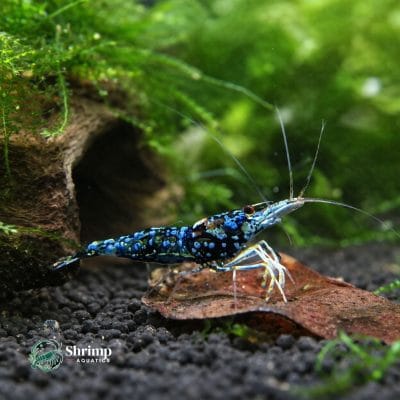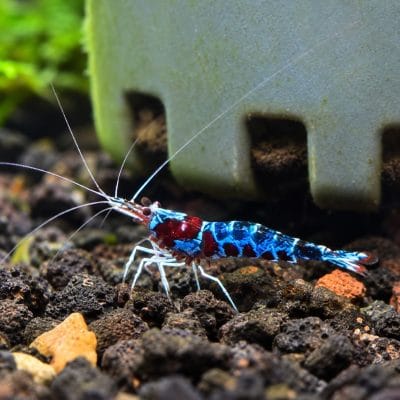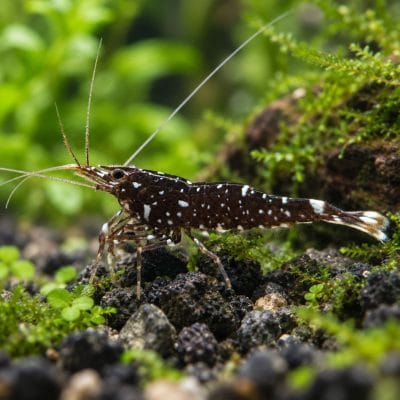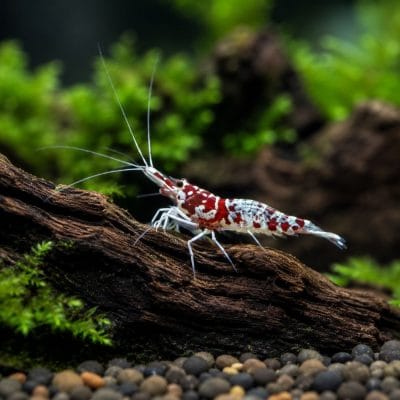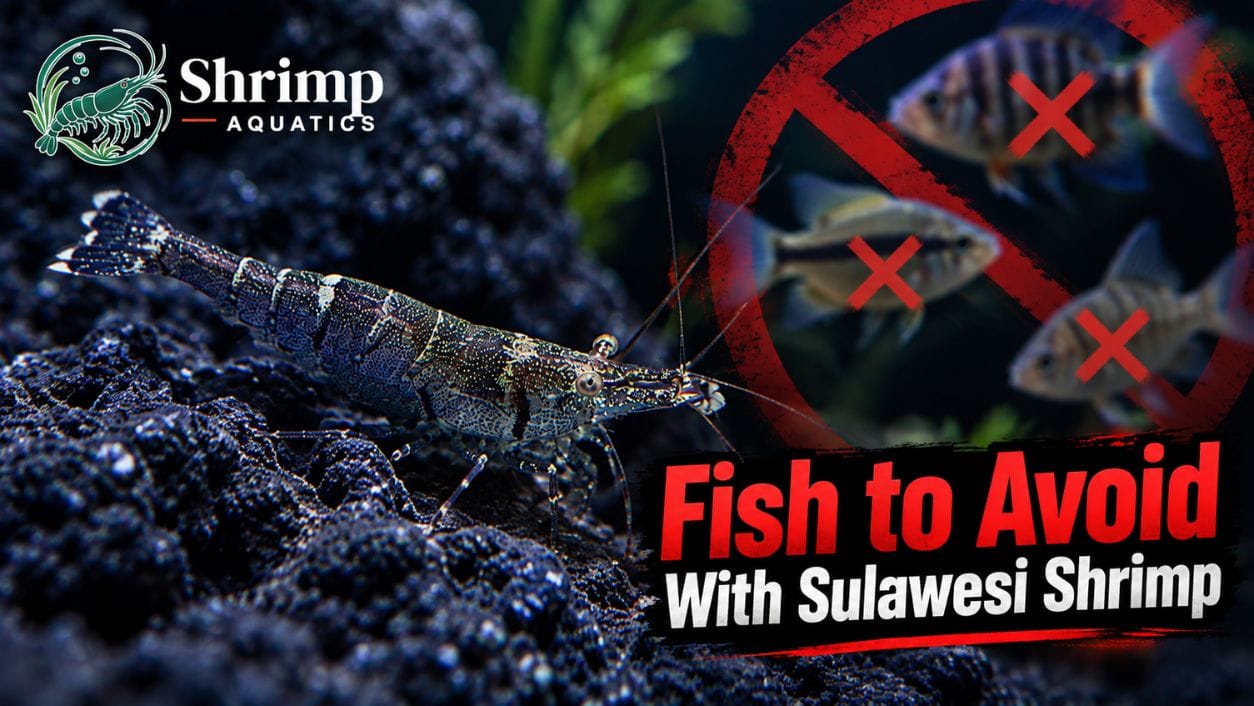
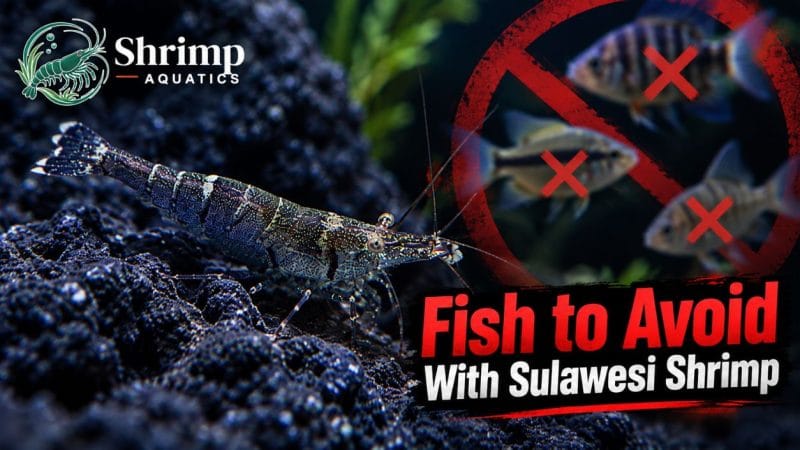
The honest answer is that no fish belongs in a Sulawesi shrimp tank. Some will eat your adults, the peaceful ones eat the shrimplets, and the rest quietly take the biofilm and the open grazing time the colony needs. If you want fish, give them their own tank and keep the Sulawesi shrimp on their own.
Why fish waste hits harder in warm, alkaline Sulawesi water
Fish waste does more harm in a Sulawesi tank because warm, alkaline water pushes more of the ammonia it produces into the form that’s toxic.
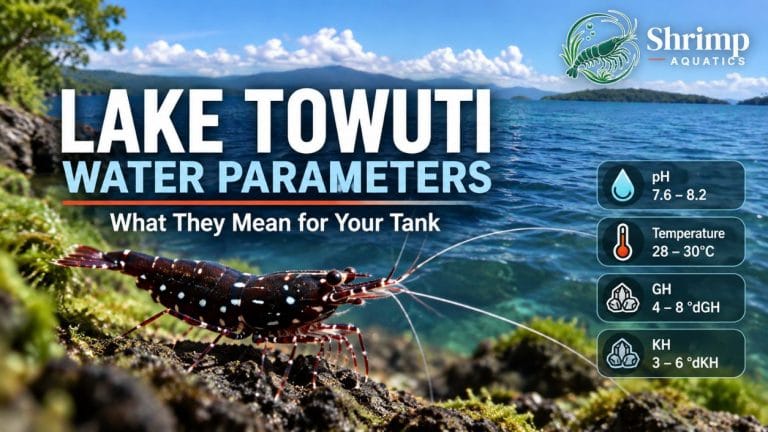
| Temperature | 79-86°F (26-30°C) |
|---|---|
| pH | 7.5-8.5 |
| GH | 4-8 dGH |
| KH | 3-6 dKH |
| TDS | 150-250 ppm |
| Nitrate | Kept under 10 ppm as a working target |
| Difficulty | Advanced to expert |
Total ammonia in any tank sits in a balance between ammonium, which is relatively benign, and un-ionized ammonia, which is the form that drives toxicity in aquatic animals. That balance is not fixed. In fresh water the ratio of un-ionized ammonia to ammonium rises roughly ten-fold for each single pH unit, and about two-fold for each 10 degrees Celsius of warming across the 0-30 degrees Celsius range.1 Read that twice and the consequence is obvious: a tank held at pH 8 and 84°F carries far more of the dangerous form, at the same test-kit reading, than the soft acidic tank most community fish advice was written for.
So the practical point isn’t that fish are dirty. It’s that your margin is thinner. A bioload that a planted tetra tank absorbs without anyone noticing is a bioload you cannot afford here, and the test kit that says 0.25 ppm total ammonia is telling you something different in this tank than it would in that one.
Warmth costs you on the other side too. Cold water holds more dissolved oxygen than warm water,2 so a Sulawesi tank is already running near the bottom of the oxygen range the hobby usually deals with. Adding a school of active fish adds oxygen demand to a system that has less to give.
Before you add anything
If ammonia or nitrite ever reads above zero in a stocked Sulawesi tank, stocking is not the question to be asking. Fix the cycle first, and slowly, because a fast correction is its own shock.
The fish that will eat adult Sulawesi shrimp
Bettas, gouramis, larger cichlids and anything with a mouth wider than a shrimp carry a real predation risk to adult Sulawesi shrimp. Nothing in that group is marketable as shrimp safe, and we don’t treat any of it as a maybe.
| Group | What actually happens |
|---|---|
| Bettas and gouramis | Slow, deliberate hunters that work rockwork and crevices, which is exactly where these shrimp sit. A shrimp that has just molted has no defense at all. |
| Cichlids, large or small | Material predation risk on adults. The dwarf species that people propose as a compromise also want water nothing like this. |
| Puffers, pea puffers included | We wouldn’t put one in a tank with shrimp or rabbit snails, at any size. Their whole feeding style is aimed at small hard-shelled animals. |
| Anything over a few inches | If the shrimp fits in the mouth, assume it will eventually go in the mouth. Gape is the rule, not temperament. |
You will read that a particular betta ignored the shrimp for six months. We believe those accounts. The problem is that the exception is only visible after the fact, and the price of being wrong is a colony you spent a year building.
Peaceful nano fish don’t eat adults, they end the next generation
Small rasboras, ember tetras, chili rasboras, guppies and endlers won’t hurt an adult Sulawesi shrimp, but they’ll eat the shrimplets that should become your next generation. They’re visual micro-predators, and a newly released shrimplet is exactly the size of the food they hunt.
Keepers often get away with that in a cherry shrimp tank. You won’t here. In wild Caridina dennerli, ovigerous females were recorded carrying 8-14 eggs per brood, with eggs measuring 1.0-1.2 x 0.5-0.7 mm; across the lake species in the same revision, per-species clutches ran from single figures to a few dozen, and higher in a handful of deep-water species.3 Those are small wild samples, not a species constant, but the scale is the point. A clutch that size cannot absorb a fish eating the young.
What you see is not a massacre. It’s a tank that looks fine. The adults are there, they graze, they molt, and then a year later there are fewer of them and no juveniles anywhere. The adults lived as long as Sulawesi shrimp live while the fish ate every recruit. That is why we say the peaceful species do the most damage: nothing about the tank looks wrong while it is happening.
The phrase to distrust
Generally shrimp safe means lower risk to adults. It has never meant safe for shrimplets, and no fish sold under that label is safe for a Sulawesi colony that has to breed to survive.
Fish that never touch your shrimp still take their food and their nerve
Even a fish that won’t eat your shrimp still takes their food and unsettles them. Otocinclus is the usual candidate, sometimes pygmy corydoras or a kuhli loach. Predation risk is low, and that is a fair reading. It’s also not the whole bill.
Sulawesi shrimp graze aufwuchs, algae and biofilm off rock and glass, and in a mature tank that growth is most of their food. An otocinclus eats the same film, all day, and it is much better at it. Corydoras add competition and can still take shrimplets. Everything in this group works the substrate, which is where your shrimp live.
Then there’s the part keepers underrate. These shrimp are shy. A tank with fish moving through it is a tank where shrimp spend their day in the dark gaps between rocks instead of out on the lit surfaces where the biofilm actually is. Nothing eats them. They just stop feeding properly, and grazing time is the whole point of the setup you built.
Are the lakes’ own fish a safe exception?
No. Sailfin silversides, ricefish and the Matano gobies share the shrimp’s water chemistry, so the biotope logic sounds airtight. We still wouldn’t put them in a Sulawesi shrimp tank.
What the literature describes is what these fish eat in a lake, not whether they can share a tank. One published stomach-content study of Telmatherina prognatha in Lake Matano recorded insects, debris and plankton as the main food items across a year of sampling.4 That tells you about a lake with enormous volume, deep water and endless rock for a shrimp to disappear into. Your tank has none of that. Compress an active, hungry fish and a slow shy shrimp into a few feet of glass with no escape route, and the wild relationship stops being a useful guide.
We could not find a published compatibility trial for any fish kept with lake Caridina in an aquarium. When the hobby doesn’t know, we’d rather say so than borrow a lake study and call it a tankmate recommendation.
What happens the day you have to medicate the fish
Fish kept with Sulawesi shrimp get sick sooner or later, and the moment you reach for a treatment, the shrimp become the problem. That’s no knock on anyone’s husbandry; it’s what happens over a few years of keeping fish.
Copper is the clearest case. Elevated copper is toxic in aquatic environments and may adversely affect fish, invertebrates, plants and amphibians; acute effects include mortality, and chronic exposure can reduce survival, reproduction and growth.5 Its bioavailability, and so its toxicity, shifts with pH, alkalinity, dissolved organic carbon and hardness, which means the number printed on a bottle does not transfer cleanly between two tanks with different water. Plenty of ordinary fish medications carry copper or other actives that invertebrates tolerate poorly, and reading the actual ingredient list matters more than the shrimp-safe badge on the front.
We won’t give you a dose, because dosing an invertebrate tank is not something to work out from an article. The realistic version is this: in a fish-and-shrimp tank, treating the fish properly usually means moving them, and by then you are running the separate tank you could have set up at the start.
What can share a Sulawesi tank, and what to do if fish are already in there
A shrimp-only Sulawesi tank keeps the colony breeding. A Sulawesi community tank with fish can keep the adults alive for a year or two, but not the colony.
A shrimp-only Sulawesi tank
Low bioload, stable chemistry, biofilm that belongs to the shrimp, and juveniles that actually reach adulthood. It’s the setup our own Sulawesi shrimp lines are bred in, and it’s the one we’d tell a friend to build.
A Sulawesi community tank
More waste in water that punishes waste, a food supply split with something faster, and a colony that stops recruiting. You may keep the adults alive for a year or two. You will not keep the colony going.
For tankmates, the short list really is short. Rabbit snails from the same lakes, Tylomelania spp., want warm alkaline water like the shrimp do, so nothing has to be compromised to keep both. They clear decaying matter and they don’t hunt. Nerites can work on chemistry, though check the species rather than assuming, and skip assassin snails, which prey on other snails. Rabbit snails and nerites are the realistic picks once fish are off the table, which lines up with the best tank mates for Sulawesi shrimp.
If what you actually want is movement in the tank, there’s one option we’ve used ourselves.
In some of our Sulawesi systems at Shrimp Aquatics we keep about five Neocaridina, and we have observed the Sulawesi shrimp remain more visible, or retreat less, when people approach the tank. This still needs temperature overlap, enough grazing surface and stocking room for both groups, so it isn’t a free addition, and we wouldn’t put a breeding Neocaridina colony in a specialist Sulawesi tank.
Bee and Crystal Caridina are a different question with the same answer: their soft, acidic, cooler water is incompatible with this tank, and sharing the genus Caridina changes nothing about that.
Already have fish in with your shrimp? Don’t tear the tank apart today. Work through it in order:
- Move the fish to their own tank, matched on temperature and chemistry, rather than rehoming the shrimp into an immature system.
- Cut feeding back toward what the shrimp actually use, since the fish portion was inflating the waste load.
- Test ammonia and nitrite, then temperature, pH, GH, KH and TDS, and correct anything out of line slowly over days.
- Give the rockwork a few weeks with the lights on a normal cycle so the grazing surfaces recover before you judge the colony.
- Don’t add a second fish species to balance the first, and don’t treat the tank for anything you have not identified.
Then leave it alone and watch. Juveniles on the rock are the signal you’re looking for, and they arrive on the tank’s schedule, not yours.
References
5 Sources
- Aquatic Life Ambient Water Quality Criteria for Ammonia, Freshwater, U.S. Environmental Protection Agency, Office of Water, April 2013.
- Dissolved Oxygen and Water, U.S. Geological Survey, Water Science School, updated August 24, 2026.
- Radiation of endemic species flocks in ancient lakes: systematic revision of the freshwater shrimp Caridina from the ancient lakes of Sulawesi, Indonesia, with the description of eight new species, Raffles Bulletin of Zoology 57(2): 343-452, 2009.
- Food habits of endemic opudi fish (Telmatherina prognatha, Kottelat 1991) in Matano Lake, South Sulawesi, Indonesia, Biodiversitas Journal of Biological Diversity 21(4): 1373-1378, 2020.
- Supplementary Training Materials for Aquatic Life Criteria, Copper, Background, U.S. Environmental Protection Agency, Office of Water, updated May 6, 2026.