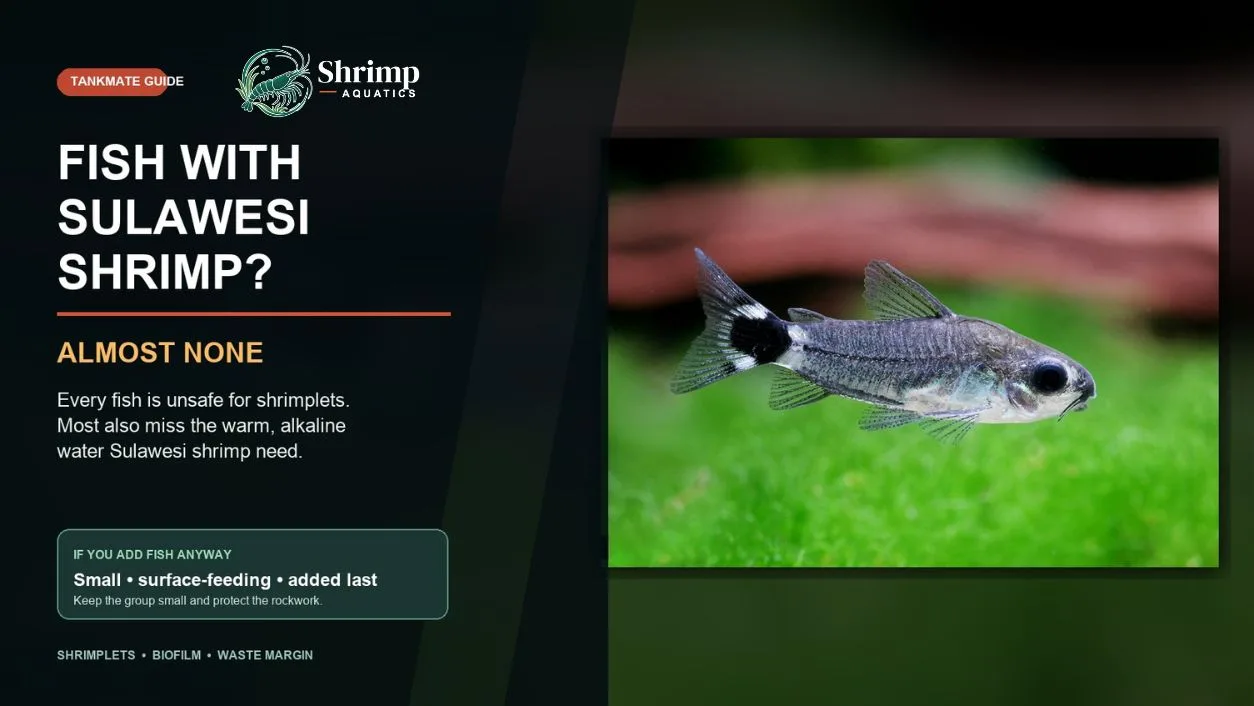
Which fish can actually live with Sulawesi shrimp? Almost none: the only kind that comes close is a very small, surface feeding nano fish, added last to an established tank by a keeper who accepts that shrimplets are part of the price. Every other fish the hobby recommends for these tanks fails somewhere, which makes it one of the fish to avoid with Sulawesi shrimp. It lives outside the water these shrimp need, grows big enough to hunt them, or feeds off the same rock they graze.
What a fish has to clear before it belongs in a Sulawesi tank
A fish has to clear three filters: the water, its adult size against a shrimplet, and where it feeds. Those three remove almost every suggestion you’ll read. Apply them in that order, because the first one is the one nobody checks.
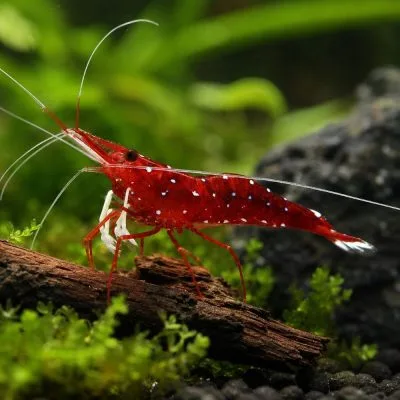
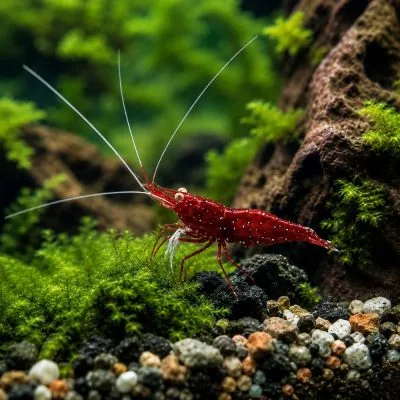
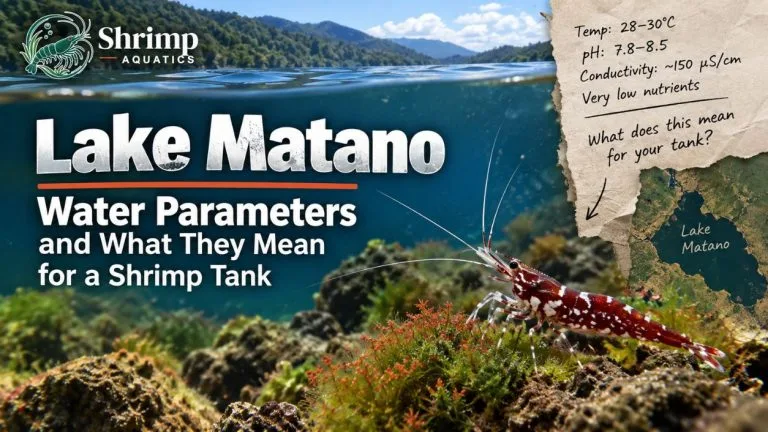
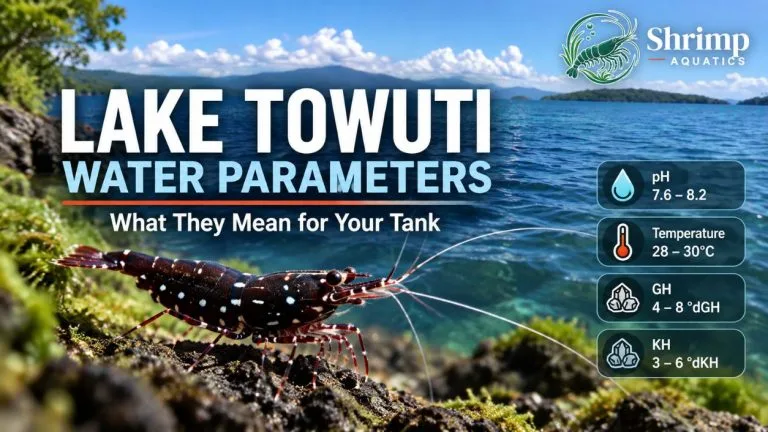
The first filter is the water. Sulawesi lake Caridina, including the cardinal or Sulawesi White Sock shrimp (Caridina dennerli), are kept warm, mildly alkaline and low in dissolved minerals. These are the typical ranges used across the Sulawesi group.
| Difficulty | Advanced to expert |
|---|---|
| Temperature | 79-86°F (26-30°C) |
| pH | 7.5-8.5 |
| GH | 4-8 dGH |
| KH | 3-6 dKH |
| TDS | 150-250 ppm |
| Nitrate | Under 10 ppm |
A candidate fish has to live in that water for good, not just survive a spell in it. Warm and alkaline together is an awkward combination in the aquarium trade, because most nano fish sold as peaceful come from soft, acidic, cooler water. A fish held for years outside its own range isn’t a compatibility success. It’s a slow welfare problem.
The second filter is adult size, measured against a shrimplet, not against an adult shrimp. Sulawesi adults are small and their young are far smaller. So the useful question isn’t whether a fish can swallow a grown shrimp. Can its adult mouth take a newly released one? It almost always can. When a fish is called generally shrimp safe, that’s a statement about adult shrimp only, and the risk to the young stays on the table whatever the label says.
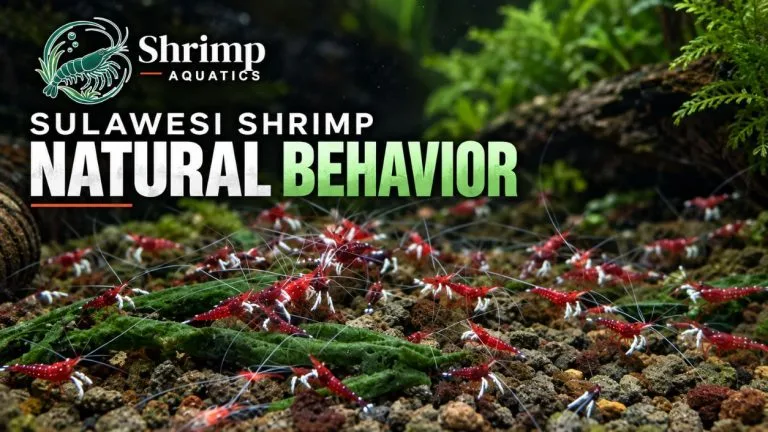
The third filter is where the fish spends its day. The natural behavior of Sulawesi shrimp is to graze slowly across open rock, which is exactly where a bottom working or rock working fish operates. A fish that holds station at the surface at least leaves the grazing zone alone for most of the day. A fish that patrols the hardscape never does.
How the commonly suggested Sulawesi tankmates hold up against the record
Badly, on at least one count each. These are the species that come up in Sulawesi tankmate threads and retailer lists, and the record column is what the FishBase species summary publishes for each fish. Those entries are compilations, not lake measurements. Read them as the best available description of where the animal comes from, not as a tested tolerance.
| Fish | Adult size on record | Documented water and origin | Where it feeds | Verdict for a Sulawesi tank |
|---|---|---|---|---|
| Daisy’s blue ricefish (Oryzias woworae) | 2.8 cm SL | Freshwater, with a pH range of 6.0-7.0; the single known collection is from a spring on Muna Island, Sulawesi Tenggara1 | Pelagic | The least bad option, on a record that sits below the Sulawesi pH floor |
| Blue neon blue eye (Pseudomugil cyanodorsalis) | 3.5 cm TL | Marine and brackish; mangrove swamps and highly saline creeks in northern Australia, tolerating 28-40 ppt2 | Pelagic and neritic | Not a freshwater fish on the record, so long term freshwater keeping is untested |
| Matano ricefish (Oryzias matanensis) | 5.5 cm TL | Freshwater from Indonesia, with a pH range of 7.5-8.5 and a listed thermal range that stops below the Sulawesi band3 | Benthopelagic | Right chemistry, wrong temperature, and large enough to take young shrimp |
| Endler’s livebearer (Poecilia wingei) | 2.0 cm SL, female | Freshwater lagoons in Venezuela; no pH, hardness or thermal range is published on the record4 | Benthopelagic | Feeds at every level, including the rock the shrimp graze |
| Neon goby (Stiphodon semoni) | 4.6 cm SL | Freshwater and amphidromous; small, swift, clear streams with rocky bottoms, usually within 30 km of the sea5 | Demersal | Lives on the same stone the shrimp graze and can’t complete its life cycle in a closed tank |
| Otocinclus (Otocinclus vittatus) | 3.3 cm TL | South American river basins, with a pH range of 6.0-7.5 and hardness of 2-18 dH6 | Demersal | Soft, acidic, cooler origin, and it grazes the shrimp’s food |
| Celebes rainbowfish (Marosatherina ladigesi) | 8.0 cm SL | Freshwater from the Bantimurung area of south Sulawesi, with a pH range of 7.0-8.0 and hardness of 9-19 dH7 | Benthopelagic | Too large, and its hardness record sits above the Sulawesi ceiling |
| Sailfin silverside (Telmatherina sarasinorum) | 6.6 cm SL | Freshwater and pelagic, from Lake Matano8 | Pelagic | Shares the lake and eats what lives in it |
Why the two most recommended fish are weaker picks than they look
Daisy’s blue ricefish is the fish named most often as the safe choice, and on size and feeding position it’s the strongest candidate on the list. The problem is the water. The pH range published for it is 6.0-7.0, and the type material comes from a spring on Muna Island, not from the ancient lakes. So a Sulawesi tank asks the fish to live a full pH unit above anything on its own record. Hobby care sheets usually quote a pH of about 7.0-8.2 with a temperature band that happens to overlap the Sulawesi one, but those figures aren’t attached to any source we were able to open.
The blue neon blue eye has the opposite problem: its record isn’t a freshwater record at all. It’s listed as marine and brackish, living in mangrove swamps and highly saline creeks and tolerating salinities of 28-40 ppt. The freshwater, high pH accounts that made it popular for Sulawesi tanks trace back to a single commercial breeder’s blog. That may well describe a real result. It’s still one unverified account, and we wouldn’t plan a colony around it.
The Sulawesi fish that hunt the shrimp themselves
Two Sulawesi natives get suggested because they share the island, and both sit at the wrong end of the food chain. In Lake Matano, stomach contents sorted the sharpfin sailfin silverside radiation into feeding groups, and the fish feeders, shrimp feeders and egg feeders were the most distinct in body shape.9 A lineage with shrimp eating specialists that evolved alongside these shrimp isn’t a tankmate. It’s the lake’s own answer to the question of who eats the shrimp. The Celebes rainbowfish is a different animal with the same verdict. At 8.0 cm SL it’s simply too big for the job, and its hardness record sits outside the Sulawesi range as well.
What a peaceful fish still costs a Sulawesi colony
Even a peaceful fish costs a Sulawesi colony visibility, young and food. The clearest picture of what a predator does to these shrimp comes from the lake. In Lake Matano, Caridina dennerli are no longer found where they used to be abundant, and the surviving shrimp hide at least 30 cm deep under stones. The invasive flowerhorn cichlids there are described as waiting for any movement and eating a shrimp or a small crab immediately.10 A pygmy rainbowfish isn’t a flowerhorn cichlid. But hiding is the response this species already carries, and a shrimp that stays under the rock grazes less, breeds less predictably and is seen far less by the person who bought it.
The second cost is arithmetic. Wild berried cardinal shrimp examined in the 2009 revision of the group carried 8-14 eggs each, across seven females.11 A colony rebuilding from broods that size gains ground slowly, so a steady trickle of shrimplet losses doesn’t look like predation. It looks like a colony that never quite grows, which is why keepers usually blame the water.
The third cost is food. Sulawesi shrimp depend on the biofilm, aufwuchs and algae that build up on mature hardscape. A fish that works the same surfaces, an Otocinclus or a Stiphodon goby above all, is eating off the same plate. The obvious fix is to feed the tank more heavily to make up for it, and that’s the worst move available here, for the reason in the next section.
Before you add anything
Treat every fish on this page as unsafe for shrimplets. Shrimp safe, applied to a fish, is a claim about adult shrimp, and in a Sulawesi tank the young are the whole future of the colony.
Why fish waste is more dangerous in warm alkaline Sulawesi water
Because warm, alkaline water turns more of the same ammonia into its toxic form. Ammonia in water sits in two forms, the ammonium ion and un-ionized ammonia, and it’s the un-ionized form that carries the toxicity. High outside concentrations reduce or reverse the gradients an animal relies on to excrete it, so ammonia builds up in its tissues and blood. The split between the two is set by pH and temperature. In fresh water the ratio of un-ionized ammonia to ammonium rises about tenfold for each single pH unit, and roughly twofold for each rise of 18°F (10°C).12 A Sulawesi tank sits high on both scales at once, so the same slip in feeding or maintenance does more harm here than it would in a cooler, neutral tank.
Oxygen runs the other way. Cold water can hold more dissolved oxygen than warm water.13 So the same tank that turns waste into its most toxic form also has less oxygen in reserve. That reserve has to cover the extra animals, the extra food and the bigger biological filter they need.
None of this makes fish impossible. It does mean that stocking fish into a Sulawesi tank isn’t the same decision as stocking them into a room temperature community tank. The margin for a missed water change is thinner than fish keeping habits assume.
If you add fish to a Sulawesi tank anyway, what actually lowers the risk
A tiny, surface feeding fish, added late, kept in a small group and fed carefully, lowers the risk the most. We know some of you have read every trade off above and still want a fish in the display. These are the choices that change the outcome.
- Add the fish last, to a tank whose grazing surfaces and chemistry have held steady for months, never to a system that’s still settling.
- Take the smallest adult size and the highest feeding position you can get, and buy grown fish so you’re judging a finished size.
- Keep the group small. Three or four small fish in a mature tank is a different proposition from a full school, both for grazing pressure and for waste.
- Feed the fish, not the tank. Anything the fish can’t finish quickly settles on the rock the shrimp graze and turns into the waste this water handles worst.
- Build the hardscape with narrow, interlocking gaps no fish can get into, so the shrimplets have space that’s truly theirs.
- Watch grazing behavior for two weeks after the fish goes in. Shrimp that stop coming out in the light have told you the answer, and the fish can still be moved.
- Don’t add fish to fix a shy colony, a feeding problem or an algae problem. None of those is a fish problem, and the fish will eat shrimplets while it fails to solve them.
If a particular line matters to you, keep it somewhere with no fish in it. A second small tank costs less than losing a generation of a species you waited months to breed.
Company for Sulawesi shrimp that costs the colony less than a fish
Rabbit snails and a very small number of Neocaridina take less out of the colony than any fish. If what you’re after is movement and interest, not fish as such, start with those two.
Rabbit snails are the obvious one, because they’re the only common aquarium animal that comes from the same water. Tylomelania forms an endemic assemblage in the two central lake systems on Sulawesi, Lake Poso and the Malili lakes such as Danau Matano, Mahalona and Towuti.14 They’re large, slow, easy to watch and no threat to shrimplets. They’re also a real bioload and a real grazer, so the stocking arithmetic above still applies to them. That’s exactly why rabbit snails top the list of best tank mates for Sulawesi shrimp.
The second option is a very small number of Neocaridina. Keeping Sulawesi shrimp with Neocaridina is a compatibility decision with its own trade offs around temperature fit and competition for grazing surface.
Whichever way you go, the arithmetic is the same: everything you add spends part of a margin that’s already narrow. The default we’d defend is a tank that holds one thing well. Pick the Sulawesi shrimp line you want to build around, give it the whole system, and let the colony be the display.
References
14 Sources
- Oryzias woworae species summary, FishBase, viewed September 2026.
- Pseudomugil cyanodorsalis species summary, FishBase, viewed September 2026.
- Oryzias matanensis species summary, FishBase, viewed September 2026.
- Poecilia wingei species summary, FishBase, viewed September 2026.
- Stiphodon semoni species summary, FishBase, viewed September 2026.
- Otocinclus vittatus species summary, FishBase, viewed September 2026.
- Marosatherina ladigesi species summary, FishBase, viewed September 2026.
- Telmatherina sarasinorum species summary, FishBase, viewed September 2026.
- Phenotypic traits meet patterns of resource use in the radiation of sharpfin sailfin silverside fish in Lake Matano, abstract, Evolutionary Ecology 24, 957 to 974, 2009.
- Caridina dennerli is not yet extinct in 2024, Sulawesi Keepers, September 5, 2024.
- Radiation of endemic species flocks in ancient lakes: systematic revision of the freshwater shrimp Caridina from the ancient lakes of Sulawesi, Indonesia, with the description of eight new species, The Raffles Bulletin of Zoology 57(2), 343 to 452, 2009.
- Aquatic Life Ambient Water Quality Criteria for Ammonia, Freshwater 2013, U.S. Environmental Protection Agency, Office of Water, April 2013.
- Dissolved Oxygen, U.S. Geological Survey Water Science School.
- The species flocks of lacustrine gastropods: Tylomelania on Sulawesi as models in speciation and adaptive radiation, abstract, Hydrobiologia 615, 181 to 199, 2008.
Ready to get started?
Shop our Sulawesi Shrimp collection
27 products available · Live Arrival Guarantee
Featured Sulawesi Shrimp
Sulawesi Orange Eyes White Sock
Caridina dennerli
Advanced · 79-86°F · pH 7.5-8.5
From $19.99View Product