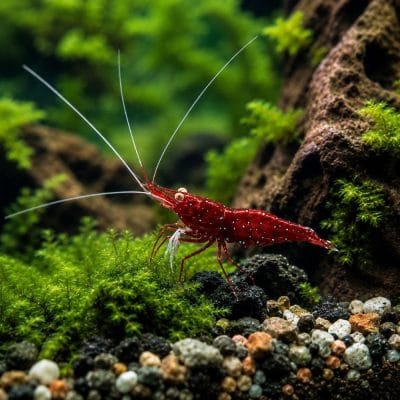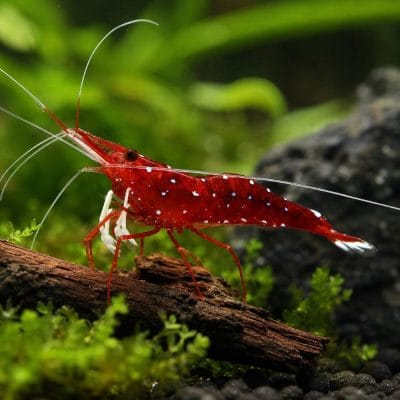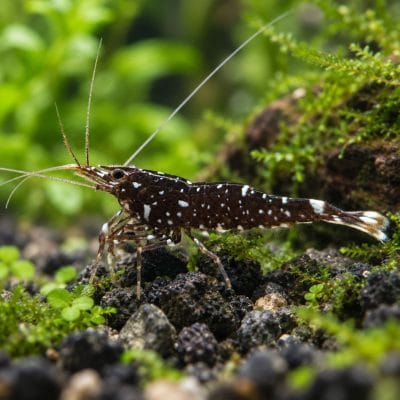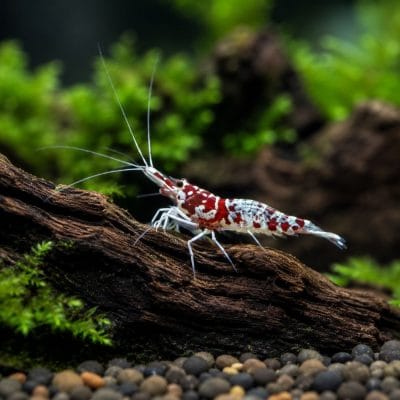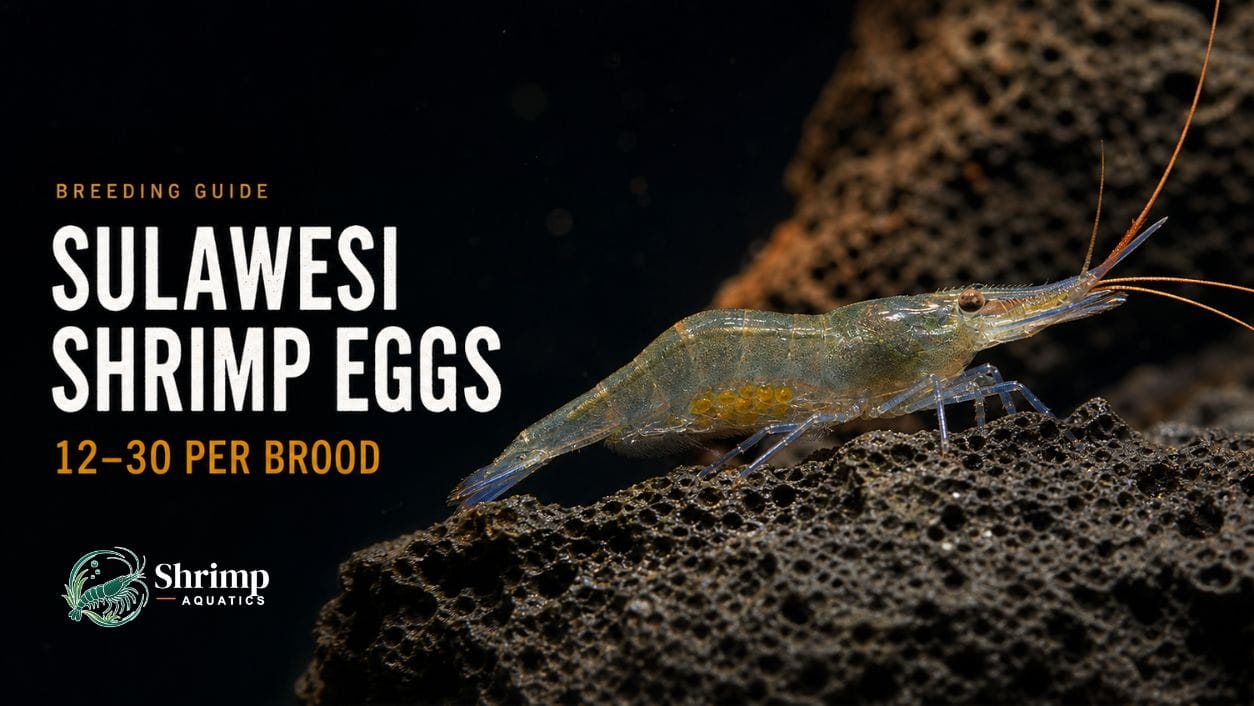
A female Sulawesi shrimp carries a very small brood. Published counts for the lake Caridina of Sulawesi mostly fall between about 12 and 30 eggs at a time12, and the highest figure recorded for any of them is 26 to 47 eggs in females from Lake Lindu3. There’s no single number for the whole group. Sulawesi shrimp is a group name covering many lake species, the published counts come from small numbers of wild females, and the species in your tank matters more than any average. In our own Caridina dennerli lines at Shrimp Aquatics, a female usually carries 10 to 20.
Published brood counts for each Sulawesi Caridina species
Only a few Sulawesi species have ever had their eggs counted, and the counts come from the original scientific descriptions rather than from aquarium records. The table below shows every figure we could verify in the primary literature, with the number of females behind each range.
| Species | Where the females were collected | Eggs per brood | Egg size (mm) | Females behind the figure |
|---|---|---|---|---|
| Caridina spongicola | Lake Towuti, living on a freshwater sponge | 12 to 181 | 0.8-0.9 x 0.4-0.6 | 4 females |
| Caridina ensifera | Wild females used in a parentage study | 5 to 30, average 15.652 | Not measured | 20 broods |
| Caridina linduensis | Lake Lindu, Central Sulawesi | 26 to 473 | 1.0-1.1 x 0.7 | 3 females |
| Caridina woltereckae | Lake Towuti and Lake Mahalona, open rock | Not given in the species description | 0.90 x 0.50-0.554 | Not stated |
Read the sample sizes
Two of these ranges rest on three or four females. The one figure with a real sample is the Caridina ensifera study, where 20 wild broods averaged 15.65 offspring and ran from 5 to 302. That average is the most useful single number for the group, and it’s close to what most keepers report seeing.
One species is missing from the table on purpose. We couldn’t find a published clutch count for Caridina dennerli, the Cardinal shrimp behind several of the lines we sell, including the Oiran, Galaxy and White Sock. Figures for it circulate widely in care sheets without a source behind them, so we’ve kept it out of the table rather than repeat a number we can’t trace.
Why a Sulawesi female carries so few eggs
The limit is space. A mature Caridina spongicola female has a carapace of roughly 2.4 to 2.8 mm and carries eggs up to 0.9 mm long1. Set a few dozen eggs of that size against the underside of an animal barely over a centimeter, and the ceiling is obvious. These aren’t the hundreds of tiny eggs a marine or migratory shrimp produces. They’re a handful of large, yolk-heavy eggs.
That trade is deliberate. Zitzler and Cai measured eggs of 0.8-0.9 x 0.4-0.6 mm in Caridina spongicola and linked that medium egg size, combined with a clutch of only 12 to 18, to abbreviated larval development, which they describe as typical of lake species.1 In practice the female carries the brood on her pleopods through to hatching, and the parentage study on Caridina ensifera recorded broods at both the fertilized egg and the hatchling stage still attached to her.2 What leaves the egg is a small shrimp that walks and grazes, not a drifting larva. You don’t need brackish water, a larval tank or a special first food.
The same study found something worth knowing before you build a colony. All 20 broods had more than one father, and a single brood of 30 offspring was traced to as many as 11 different males2. A small brood doesn’t have to be a genetically narrow one, but that only holds when there are enough adults in the tank for it to happen.
Telling a berried Sulawesi female from one carrying a saddle
Before counting anything, make sure you’re looking at a brood. Eggs that are still developing sit inside the body as an ovarian saddle, a yellow or dark patch in the cephalothorax just behind the head. Those aren’t a brood and can’t be counted. A berried female has already moved the eggs to her pleopods on the underside of the abdomen, where they sit as a visible clutch2. On the dark, densely pigmented Sulawesi lines both are harder to see than on a Neocaridina, and a light held to the side of the tank helps more than a brighter tank overall.
A shrimp with no visible saddle isn’t proven to be male. Pigment, age and where the animal is in its molt cycle all change what you can see, so treat a saddle as evidence of a female and never treat its absence as evidence of a male. If you want the full set of cues we use before setting up a breeding group, they’re in our guide on how to breed Sulawesi shrimp.
What to do when a berried Sulawesi female drops her eggs
A clutch you counted on Monday can be gone by Wednesday. When the whole brood is only 10 to 20 eggs, losing one isn’t a small setback, and it’s a common reason keepers decide their Sulawesi shrimp are not breeding when they are.
The useful response is to change less, not more. While a female is carrying, keep water changes small and on their normal schedule, leave the hardscape where it is, and hold temperature and mineral levels steady. Don’t correct a reading in one session. A fast correction is usually harder on the shrimp than the value you were trying to fix. If a clutch does go, or you find Sulawesi shrimp eggs not hatching, leave the group alone and let the next cycle come.
Stocking a Sulawesi tank when every brood is small
Work backward from the numbers. If a female produces something in the region of 15 young at a time, a pair isn’t a colony plan. It takes a group of adults, breeding repeatedly over months, before the population moves at all. This is the practical reason Sulawesi shrimp sit at the advanced to expert end of the hobby. The animals are demanding, and a colony that adds young this slowly has almost no capacity to absorb a bad month.
When we can sex the shrimp with reasonable confidence, we usually build a Sulawesi breeding group with either 2 males to 8 females or 3 males to 7 females. We use a female-heavy group to reduce mating pressure on newly molted females, which are still soft and vulnerable. We confirm sex from multiple visible cues before setting the ratio.
Two habits follow from that. Buy enough animals at once that the group can pair up without you managing it, then leave the tank alone. Stability over months is what turns a series of 15-egg broods into a colony, and it’s worth checking the species before you buy, since a Lake Lindu shrimp and a Lake Towuti sponge dweller don’t reproduce at the same rate. If you’re choosing between lines, our Sulawesi shrimp listings show the species behind each name.
References
4 Sources
- Caridina spongicola, new species, a freshwater shrimp (Crustacea: Decapoda: Atyidae) from the ancient Malili lake system of Sulawesi, Indonesia, hosted full text PDF, Zitzler, K. and Cai, Y., Raffles Bulletin of Zoology 54(2): 271-276, 2006.
- Molecular evidence for high frequency of multiple paternity in a freshwater shrimp species Caridina ensifera, Yue, G. H. and Chang, A., PLoS ONE 5(9): e12721, 2010.
- Caridina linduensis Roux 1904, taxonomic treatment, from Wowor, D., The atyid shrimps from Lake Lindu, Central Sulawesi, Indonesia, Zootaxa 3957(5): 501-519, Plazi TreatmentBank, 2015.
- Caridina woltereckae Cai, Wowor and Choy 2009, taxonomic treatment, from Partial revision of freshwater shrimps from Central Sulawesi, Indonesia, Zootaxa 2045: 15-32, Plazi TreatmentBank, 2009.
Ready to get started?
Shop our Sulawesi Shrimp collection
27 products available · Live Arrival Guarantee
Featured Sulawesi Shrimp
Sulawesi Orange Eyes White Sock
Caridina dennerli
Advanced · 79–86°F · pH 7.5–8.5
From $19.99View Product