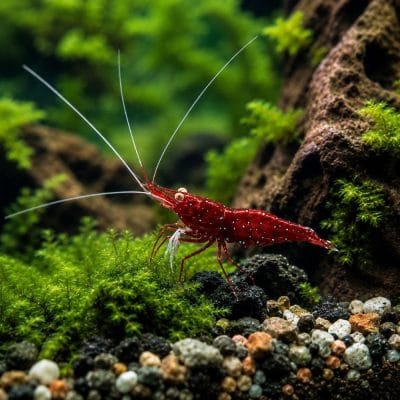
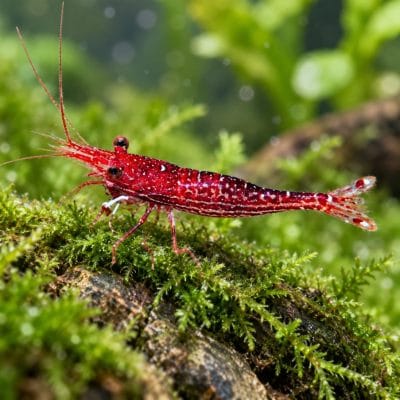
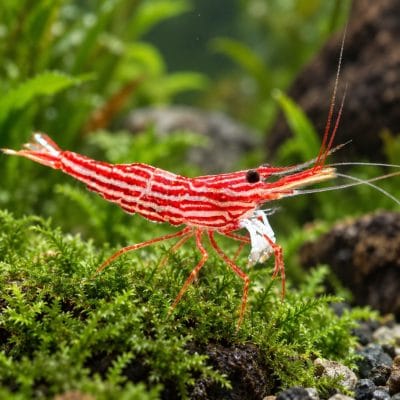
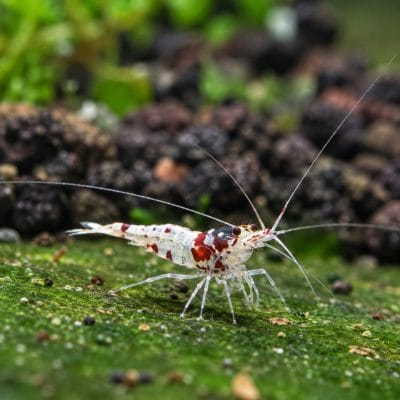
If you’re looking at a pale line where the carapace meets the first abdominal segment on a Sulawesi shrimp, the answer depends on two things. How wide is that line, and what is the shrimp doing? A faint, narrow line there belongs to a normal molt. A broad white gap, with the front and back of the shell visibly held apart and the shrimp unable to pull free, is a molt that has stalled. That’s a far more serious picture.
Sulawesi shrimp are lake-system Caridina spp., and like all crustaceans they grow only by casting the whole exoskeleton and replacing it.1 Every shrimp in the tank therefore goes through the same brief, exposed event over and over, and the joint behind the head is supposed to open when it does. The question is never whether that joint opens. It’s whether it opened the way it should.
Tell a normal pre-molt line apart from a split shell on a Sulawesi shrimp
In the run up to a molt the epidermis underneath pulls away from the old cuticle and leaves a clear space between the two layers. Immediately after the molt the new exoskeleton is soft, parchment-like and uncalcified until it hardens.2 That separation underneath is what makes a faint, narrow line show at the joint on a perfectly healthy shrimp a day or two before it sheds. Under the tank light it can look alarming on a dark Sulawesi shrimp, because the pale strip contrasts with the body color, and that alone doesn’t mean anything has gone wrong.
The presentation keepers worry about sits in the same place and differs only in scale. Instead of a hairline, the joint stands open as a broad, opaque white band, the two sections of the shell sit visibly apart, and the shrimp doesn’t complete the shed. Width, and whether the animal gets out, are the two things worth judging. Color alone isn’t, because both look white.
| What you are checking | Normal pre-molt line | Stalled molt |
|---|---|---|
| The mark itself | Narrow and faint, following the joint | Broad and opaque, with the front and rear sections of the shell held apart |
| How the shrimp moves | Grazing, climbing and righting itself as usual | Struggling in place, lying on its side, or still with the gap open |
| The next few hours | An empty cast shell turns up and the shrimp is back on the rock | No cast shell appears and the gap doesn’t close |
| What you should do | Nothing, and no water change on account of it | Leave the shrimp undisturbed and start checking the tank |
Give it a few hours before deciding. A shrimp that’s simply close to molting will usually have shed by the next time you look, and the cast shell is the confirmation. If you find no shell and the gap is still open, you’re looking at the second column.
How likely is a Sulawesi shrimp to survive a molt it can’t finish?
At Shrimp Aquatics we haven’t found a published measurement of how often a Sulawesi Caridina recovers from a stalled molt. The survival percentages and time windows that circulate in aquarium articles don’t trace back to one. Treat any firm percentage or countdown you see for this group as an estimate.
What’s documented is the direction. In an experimental study of the mud crab Scylla paramamosain, the shedding step was blocked in animals that had completed the internal preparation for a molt, including the water uptake that drives it. They died instead of shedding the old exoskeleton.3 That’s a cross-species mechanism and doesn’t predict what a Sulawesi shrimp will do, but it explains why a shed that doesn’t complete is a structural failure rather than a cosmetic mark. The animal can’t stay in the old shell and can’t grow a functioning new one inside it.
So the claim you were asking about is closer to right than wrong for the severe presentation, and wrong for the mild one. A shrimp visibly held open at the joint and unable to free itself is in serious trouble, and the practical planning assumption is that you’ll lose that individual. A shrimp with a hairline at the same joint that’s still grazing is doing what shrimp do. Reading the second as the first is the mistake that leads keepers into emergency water changes that then put the rest of the colony at risk.
Leave a stuck Sulawesi shrimp alone instead of pulling the shell free
Don’t try to free it by hand: no published procedure exists for freeing a Sulawesi shrimp from a failed molt, and the animal you’d be handling is soft underneath the shell it’s caught in. Forceps, a net or a finger applied to a body in that state does damage you can’t undo. A shrimp small enough to sit on a fingernail gives you no margin for a careful grip.
Don’t intervene physically or chemically
Don’t pry, pull or net the shrimp. Don’t dose the tank with a medication or a mineral product in response to what you’re seeing, and don’t run a large or unmatched water change to try to help. Each of those adds a second stressor to a colony that’s already telling you something about its conditions.
Leave the shrimp in the tank as well, including if it stops moving. Removing it or throwing it out takes away the only chance it has if it does work itself free, and it tells you nothing you couldn’t learn by watching.
The one thing worth doing on the day is testing, because it gives you information without changing anything. Ammonia and nitrite should read zero, and temperature, pH, GH and TDS should sit where they normally sit. Write the readings down. If stalled molts keep happening in the same tank over weeks, that’s a pattern for a specialist keeper or an aquatic veterinarian to look at with you. The test log is what makes that conversation useful. Repeated stalls belong with the other molting signs in common health problems in Sulawesi shrimp.
Water conditions that make a failed molt more likely in a warm alkaline Sulawesi tank
One shrimp that couldn’t finish a molt is worth treating as a question about the whole system. Everything in the tank went through the same water. These are the group ranges for Sulawesi lake Caridina, and they’re what to compare your own readings against.
| Temperature | 79-86°F (26-30°C) |
|---|---|
| pH | 7.5-8.5 |
| GH | 4-8 dGH |
| KH | 3-6 dKH |
| TDS | 150-250 ppm |
| Nitrate | Aim for under 10 ppm; that is a target rather than a tolerance limit |
Hardness is the first thing to look at. The calcium a crustacean uses to harden a new exoskeleton comes mainly from the water it lives in, with stored reserves and food contributing much less.4 A tank sitting below the GH range, or one that has drifted a long way in either direction between water changes, sets the shrimp a hard task. It’s asking them to build a shell out of a supply that keeps moving. Steadiness matters as much as the number.
The second thing is waste, and it carries more weight in this group than in a soft acidic tank. Total ammonia in water splits between the relatively harmless ammonium ion and the un-ionized form that drives toxicity. The ratio of un-ionized ammonia to ammonium rises roughly tenfold for each single pH unit and roughly doubles for each rise of 10 degrees Celsius.5 A Sulawesi tank is run warm and alkaline by design. That places it at the end of that relationship where more of whatever ammonia is present sits in the harmful form. A trace reading that would matter less in a cool acidic tank matters here, so a true zero on the test is the standard worth holding.
Oxygen belongs in the same thought, because cold water holds more dissolved oxygen than warm water.6 A tank kept in the upper part of the temperature range has less headroom than a cooler one. Gentle surface movement and a filter that’s genuinely keeping up are worth more than they look on a warm shelf.
Finally, watch what evaporation does over weeks. Evaporation concentrates dissolved solids in the water left behind.7 In a warm open tank that means GH and TDS climb quietly if you top off with anything other than pure RO water. The shrimp meet a slowly moving target. Top off with RO, and match replacement water for temperature, GH and TDS before it goes in.
- Ammonia and nitrite read zero on a fresh test.
- Temperature, pH, GH, KH and TDS sit inside the ranges above and haven’t moved sharply.
- Top offs use pure RO water only.
- Replacement water is matched and added slowly.
- Don’t add a mineral product, buffer or medication to correct a reading you haven’t taken.
- Don’t chase a number with a large water change, which is itself a swing.
References
7 Sources
- Farming freshwater prawns. A manual for the culture of the giant river prawn (Macrobrachium rosenbergii), biology chapter, FAO Fisheries Technical Paper 428, Food and Agriculture Organization of the United Nations.
- Characterization of the Molt Stages in Penaeus vannamei: Setogenesis and Hemolymph Levels of Total Protein, Ecdysteroids, and Glucose, Chan, Rankin and Keeley, Biological Bulletin 175, pages 185 to 192, 1988, hosted copy at the Internet Archive.
- Ecdysis Triggering Hormone, Eclosion Hormone, and Crustacean Cardioactive Peptide Play Essential but Different Roles in the Molting Process of Mud Crab, Scylla paramamosain, Zhao and others, Frontiers in Marine Science, 2022.
- Biomineralizations: insights and prospects from crustaceans, Gilles Luquet, ZooKeys 176, 2012, open access copy at PubMed Central.
- Aquatic Life Ambient Water Quality Criteria for Ammonia, Freshwater, U.S. Environmental Protection Agency, Office of Water, April 2013.
- Dissolved Oxygen, U.S. Geological Survey Water Science School.
- Chloride, Salinity, and Dissolved Solids, U.S. Geological Survey, March 1, 2019.
Ready to get started?
Shop our Sulawesi Shrimp collection
27 products available · Live Arrival Guarantee
Featured Sulawesi Shrimp
Sulawesi Orange Eyes White Sock
Caridina dennerli
Advanced · 79–86°F · pH 7.5–8.5
From $19.99View ProductSulawesi Red Line Blue Dot
Caridina sp. "Red Line Blue Dot"
Advanced · 79–86°F · pH 7.5–8.5
From $15.99View Product