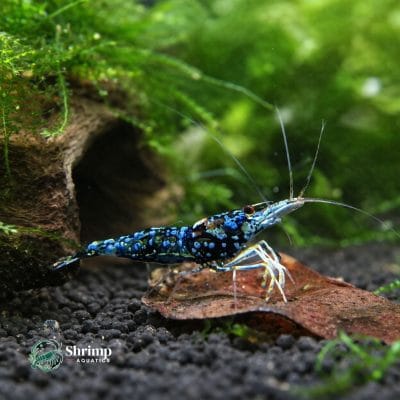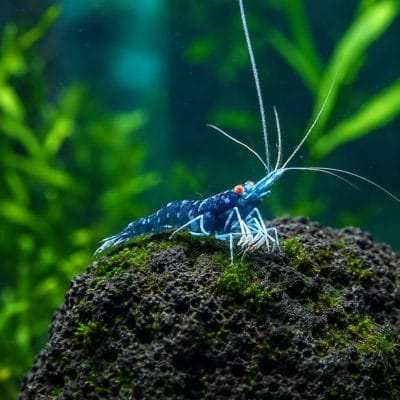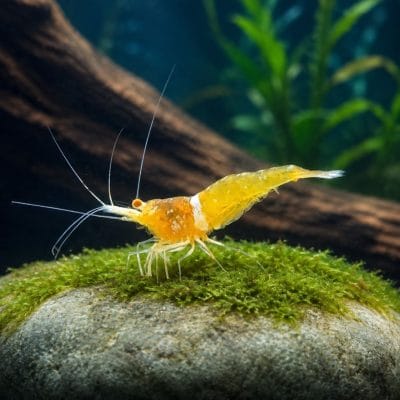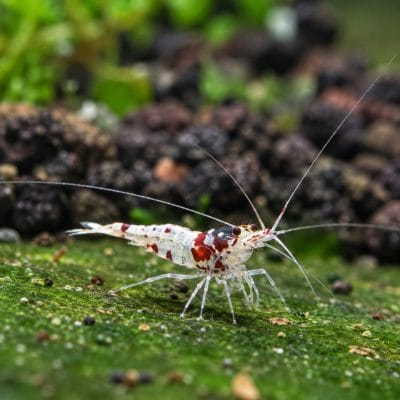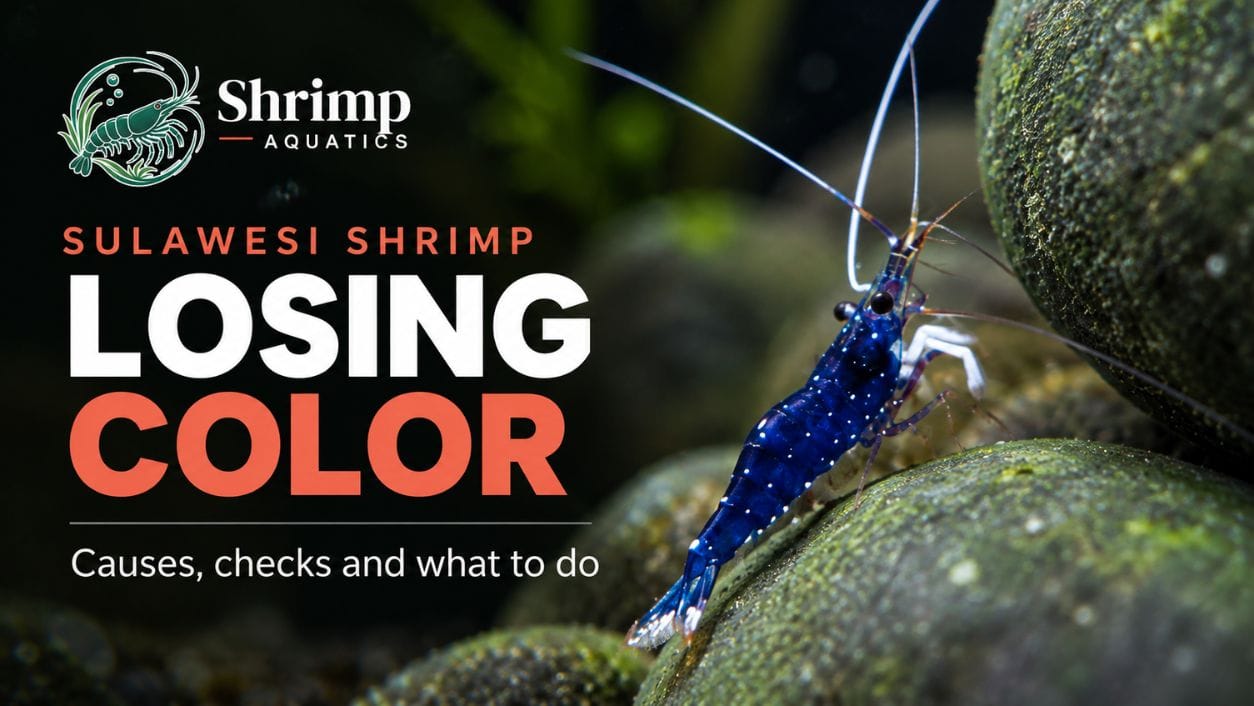
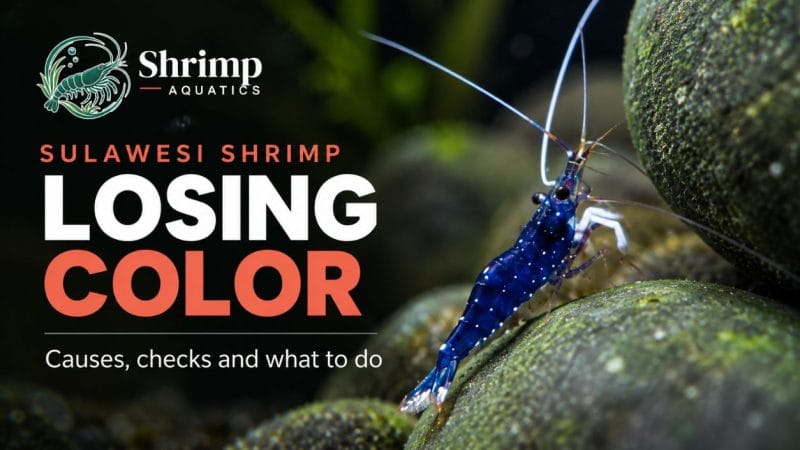
If your Sulawesi shrimp have gone pale, the cause is almost always something in the tank rather than something in the shrimp. Light, background, a recent molt and above all the water move color around in these animals, and the color comes back when the cause is removed. There is one exception, and it is the first thing to rule out: color that has been replaced by a dense milky white inside the tail is not fading at all.
Is your Sulawesi shrimp faded, or is the muscle inside its tail going white?
These are two different problems and they need opposite reactions, so settle this before you touch the tank. Get a torch, look at the animal from the side, and ask what you can see through the abdomen. Sulawesi shrimp (the lake Caridina species, including the cardinal shrimp, Caridina dennerli) have a body you can partly see into, and that transparency is the diagnostic.
Pale shell, clear body
The red or the banding has washed out, the white socks have gone dull, but the tail is still translucent and you can make out the gut line running through it. The shrimp grazes, flicks away when you move, and behaves like the others. This is pigment, not tissue. It reverses.
Opaque white tail
A patch of the abdomen has turned dense, chalky and milky white, usually starting near the tail fan, and you cannot see through it any more. The shrimp may be slow, stiff or off its food. This is not fading, and nothing in this article’s water advice will reverse it.
If you’re looking at the first card, work through the rest of this page in order. If you’re looking at the second, skip to the next section now.
What to do when a Sulawesi shrimp’s tail muscle turns milky
Move that shrimp to a separate container filled with water from its own tank, and leave the colony alone while you work out what changed. Opaque abdominal muscle is a recognized sign in cultured decapods and it is not a single condition: in the giant freshwater prawn, for example, opaqueness of the abdominal muscle is one of the described clinical signs of white tail disease, which is viral and can kill nearly every affected animal within days.1 Acute stress, oxygen loss and infection can all end in a similar looking tail, and no keeper can tell them apart by eye.
Nothing has been published on this presentation in Sulawesi Caridina specifically. That is worth saying plainly, because it means anyone who tells you exactly what your shrimp has, from a photograph, is guessing.
Do not medicate the display tank
Shrimp are sensitive to copper and to a long list of fish treatments, and a broad antibacterial dose will also take out the biological filter that is keeping ammonia at zero. Losing the filter in a warm alkaline tank is a bigger event than the illness you were aiming at. If you want a treatment decision, take it to an aquatic vet or a specialist who can look at the animal, not to a dosing chart.
What you can do without risk is remove the affected animal, check the water as described below, restore oxygen with more surface movement, and stop feeding for a day or two so nothing decays. Then watch. If one shrimp goes opaque after a heatwave or a big water change, you probably found your cause. If several go opaque over a few days with the water unchanged, stop guessing and get help. Pair that pause with a full set of readings before you name a cause, as common health problems in Sulawesi shrimp does.
The fading that fixes itself in a Sulawesi tank
Some pale shrimp need nothing from you at all. Before you start adjusting water, rule out the four ordinary explanations, because each one has a tell.
The lights just came on, or the shrimp just molted
Shrimp shift pigment around inside the day. A colony inspected in the first minutes after the lights come on often looks washed out, and looks normal again a little later, which is why the same tank can seem to have a problem in the morning and none at lunchtime. Check again at a different hour before you believe what you saw.
A shrimp that has just molted is also duller than it will be in a few days, because the new shell has not finished hardening. If you can find a cast shell nearby, you have your answer.
New arrivals fade before they settle
Shipped shrimp arrive pale. They have been in a bag in the dark, they have burned through their reserves, and the color usually deepens over the following week or two once they are grazing again. Give a new group of tank-bred Sulawesi shrimp a fortnight of quiet water, low light and no interventions before you judge their color, and resist the urge to start adjusting parameters to fix something that is still settling. Judging a colony on arrival day tells you about the courier, not about your tank.
A pale substrate really does wash the color out
This one surprises people. Shrimp adjust their pigment to the surface they are sitting on, and the effect is measurable: in an eight week trial on red cherry shrimp, pigmentation increased significantly as the background got darker, with black gravel producing more color than red and red more than white.2 That study is on Neocaridina rather than a lake Caridina, so read it as the direction of the effect and not as a number for your tank. If your Sulawesi shrimp sit on white sand under a bright light, some of the color you’re missing is being suppressed rather than lost.
At Shrimp Aquatics we commonly use Sula Sand Volcanic Rock in our Sulawesi systems because it is inert and has worked well in tanks where we need pH to remain steady. In our Blue Ghost, Yellow Ghost, White Ghost and Oiran systems, we have also seen color remain more consistent as the shrimp mature.
The word that matters there is inert. If you swap a pale substrate for a darker one, do not reach for an active soil substrate sold for bee shrimp: those strip carbonate out of the water and pull pH down, which is the fastest way to turn a color problem into a dead colony.
The water checks worth running on a faded Sulawesi colony, in order
If none of the ordinary explanations fits, test before you adjust. Run them in this order, because the early ones are the ones that hurt fastest.
- Ammonia and nitrite. Both should read zero. Anything else is your answer and the rest of the list can wait.
- Temperature, measured with a thermometer you trust, not the heater dial.
- pH and KH together. KH is what stops pH from moving in the alkaline water Sulawesi shrimp need, so a falling KH is an early warning even while pH still looks fine.
- TDS, then GH.
- Nitrate, and while you’re there, look at how much uneaten food and detritus is sitting in the rockwork.
Here is the range we keep to for Sulawesi lake species. Use it to spot the reading that has drifted, not as a target to chase all at once.
| Temperature | 79-86°F (26-30°C) |
|---|---|
| pH | 7.5-8.5 |
| GH | 4-8 dGH |
| KH | 3-6 dKH |
| TDS | 150-250 ppm |
| Nitrate | Aim for under 10 ppm |
| Ammonia and nitrite | Zero, from an established filter |
| Difficulty | Advanced to expert |
Ammonia is more dangerous in warm alkaline water
This is the part that catches keepers who moved across from cherry shrimp. Total ammonia in water splits between ammonium and un-ionized ammonia, and the split is not fixed. The ratio of un-ionized ammonia to ammonium ion in fresh water rises roughly tenfold for each single pH unit, and about twofold for each 10 degrees Celsius, and at high external concentrations un-ionized ammonia reduces or reverses the diffusive gradients an animal relies on.3 A Sulawesi tank runs warm and alkaline by design, so the same test reading that would be a minor note in a soft acidic tank is a serious one here.
Warm water compounds it a second way, because cold water can hold more dissolved oxygen than warm water.4 A tank sitting near the top of the temperature range has less oxygen in reserve, and organic waste breaking down in the rockwork competes for what’s left. That is the honest argument for surface movement in a Sulawesi tank: not because the shrimp enjoy current, but because the water has less room for error than a cool tank does.
TDS that creeps up while you top off
Evaporation takes water out and leaves the dissolved solids behind, concentrating what remains.5 Top a tank off with remineralized water and you’re adding minerals to a tank that never lost any, so TDS and hardness climb week after week while every individual top-off looks harmless. Colonies that fade slowly over a couple of months, with no other symptom, are very often on this curve.
The fix is a habit, not a product: top off evaporation with pure RO water, and use remineralized water only for actual water changes. If your TDS reading has already drifted well above the range above, bring it down over weeks, not over a weekend.
Hardness, and what the new shell has to pull from the water
Color sits in the shell, so anything that goes wrong with shell building shows up as a dull or patchy animal. The major source of calcium used for crustacean exoskeleton calcification is exogenous, meaning the water the animal lives in.6 Diet and stored reserves contribute less. That’s why GH is on the checklist and why a colony sitting under the range often looks chalky and molts badly at the same time, and it is also why the answer to soft water is to correct the water, not to add a mineral supplement to the food.
Correcting Sulawesi water without causing a second shock
More Sulawesi colonies are lost to the repair than to the fault. A shrimp that has been sitting in drifted water for six weeks has adjusted to it, and yanking the tank back to the middle of the range in one afternoon is a bigger event than the drift ever was. Say the honest thing out loud: if the water is wrong but the shrimp are alive and eating, you have time.
So move slowly. Prepare replacement water in a separate container, mineralize it there, and test its pH, GH and TDS before it goes anywhere near the tank. Match the temperature by eye and by thermometer. Then add it back through airline tubing at a drip, one to two drops a second, over a couple of hours. Set a water change schedule of small, regular changes instead of large, occasional ones, and change one variable at a time so that if the colony reacts, you know what it reacted to.
Give it time to show. Pigment sits in the shell, so recovery arrives with molts rather than with hours, and molts are not daily events. The usual rule is to give a correction far longer than feels natural before you judge it. If you go looking for a result the next morning you’ll convince yourself the fix failed and start changing things again, which is the actual trap.
Color food, medications and a warmer heater will not fix a faded Sulawesi shrimp
Every one of these gets recommended, and none of them addresses what is happening. Here is why, shortest first.
- Color enhancing food, fed heavily. Astaxanthin genuinely is the pigment involved: it is the most prevalent carotenoid in commercially important crustaceans, it sits in the exoskeleton bound into carotenoproteins such as crustacyanin, and animals absorb and deposit carotenoids through the diet.7 But a Sulawesi tank feeds mostly from the biofilm on its rock, prepared food is taken slowly, and what isn’t eaten breaks down in warm water and pushes the tank back toward the ammonia problem you were trying to solve. A little food more often beats a lot of food now.
- Medications, dosed hopefully. If the body is clear and only the shell is pale, there is nothing there for a medication to treat, and shrimp tolerate treatments poorly. Copper in particular is dangerous to invertebrates, and plenty of fish products contain it.
- Turning the heater up. Warmer water holds less oxygen and speeds up everything decaying in the tank, and the shrimp are already near the warm end of what they want. If your tank is genuinely cool for the group, correct it slowly; do not push past the range hoping for color.
- Changing three things at once. New substrate, new salt, new food and a big water change in the same week gives you no idea which one helped, and four simultaneous shocks to a colony that was only pale.
What actually works is dull: find the drifted number, correct it slowly, darken the background, keep the grazing surfaces mature, and leave the colony alone long enough to molt a couple of times. If the color comes back, it comes back that way.
References
7 Sources
- White Tail Disease of Freshwater Prawn, Macrobrachium rosenbergii (abstract), Sahul Hameed and Bonami, Indian Journal of Virology 23(2), 2012.
- Effect of Dietary Astaxanthin and Background Color on Pigmentation and Growth of Red Cherry Shrimp, Neocaridina heteropoda, Laohavisuti and Ruangdej, Journal of Fisheries and Environment 38(1), 2014.
- Aquatic Life Ambient Water Quality Criteria for Ammonia, Freshwater, U.S. Environmental Protection Agency, Office of Water, April 2013.
- Dissolved Oxygen and Water, U.S. Geological Survey Water Science School, updated August 24, 2026.
- Chloride, Salinity, and Dissolved Solids, U.S. Geological Survey, March 1, 2019.
- Biomineralizations: insights and prospects from crustaceans, Gilles Luquet, ZooKeys 176, 2012.
- Astaxanthin from Crustaceans and Their Byproducts: A Bioactive Metabolite Candidate for Therapeutic Application, Simat and others, Marine Drugs 20(3), 2022.
Ready to get started?
Shop our Sulawesi Shrimp collection
27 products available · Live Arrival Guarantee
Featured Sulawesi Shrimp
Sulawesi Orange Eyes Yellow Ghost
Caridina dennerli
Advanced · 79–86°F · pH 7.5–8.5
$120.00View Product