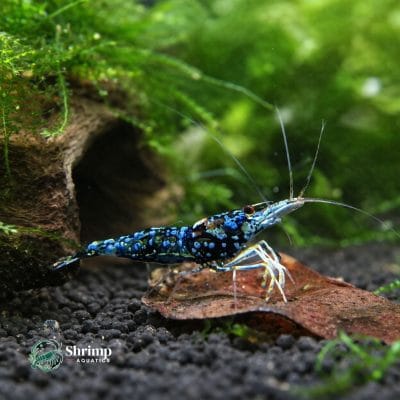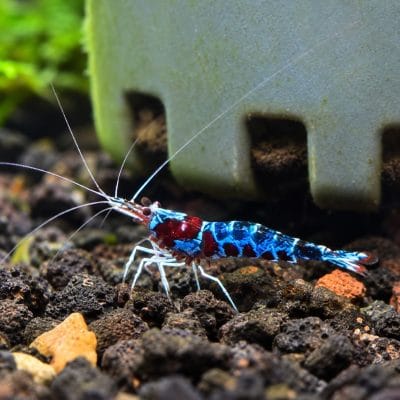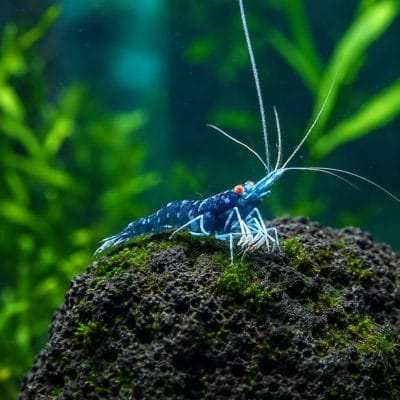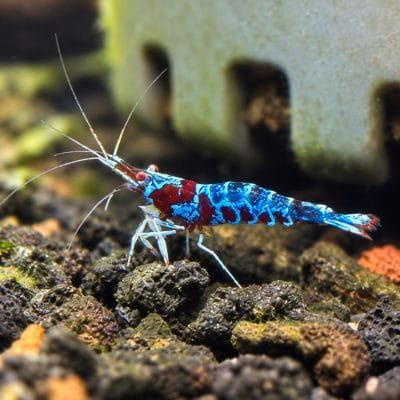
Keeping Sulawesi shrimp healthy is mostly a stability problem, not a medicine problem. These are lake shrimp from warm, alkaline, biologically mature water. In a home tank they need the same thing held still: 79-86°F (26-30°C), pH 7.5-8.5, GH 4-8 dGH, KH 3-6 dKH and TDS 150-250 ppm. They also need enough grazing surface that the colony feeds itself between your feedings. Almost every loss a keeper reports traces back to a tank that was too young, water that moved too fast, or waste the system couldn’t process at that temperature and pH.
What has to be true before Sulawesi shrimp arrive
Sulawesi shrimp are an advanced to expert group, and the honest version of that label is this. The tank has to be finished before the animals go in, and it has to stay finished. There’s no beginner route where a hardy line forgives a fortnight of drift. If you’re still deciding whether to commit, the question isn’t whether you can hit these numbers once. Can you hold them without thinking about it for a year?
| Difficulty | Advanced to expert |
|---|---|
| Temperature | 79-86°F (26-30°C) |
| pH | 7.5-8.5 |
| General hardness | 4-8 dGH |
| Carbonate hardness | 3-6 dKH |
| TDS | 150-250 ppm |
| Nitrate | Aim for under 10 ppm |
| Substrate | Inert substrate and hardscape; not an active pH lowering soil |
| Tank | Mature and stable, with established grazing surfaces and biofilm |
| Behavior | Peaceful and often shy; how visible they are varies with the setup |
Those are typical ranges for the group, useful for catching an obvious mistake and for setting a mineral salt. They aren’t survival limits, and a particular species or line may sit in a narrower part of the band, so check the listing you’re actually buying. Verify each item’s identity. Don’t assume that anything sold as a Sulawesi shrimp shares one set of water values. The ranges to hold steady are the ones in Sulawesi shrimp care parameters.
Order only once the tank has been running long enough to feed them. Check that the tank-bred Sulawesi shrimp you’re looking at are lines your water and your heater can actually hold. If you aren’t sure your setup qualifies, email contact@shrimpaquatics.com with your pH, GH, KH, TDS, temperature, tank size, cycle status and current livestock. You’ll get a straight answer about fit before anything ships.
Mixing the water Sulawesi shrimp need from RO
Start from RO or RO/DI water and build the numbers yourself. That isn’t purism. It’s the only way to know what GH, KH and TDS you’re giving the shrimp, and to mix the same water again next month. Tap water varies by supply and by season, and it carries whatever your utility adds, so you can’t assume it lands anywhere near this band without testing it first.
- Mix in a dedicated container outside the aquarium, never in the tank with shrimp in it.
- Add the mineral salt to RO water and let it dissolve completely before you measure anything.
- Test the finished pH, GH and TDS in that container and adjust there, not in the display tank.
- Bring the mixed water to tank temperature before it goes anywhere near the shrimp.
Choosing between Sulawesi Mineral 7.5 and 8.5
The two common Sulawesi salts aren’t interchangeable in handling. Sulawesi Mineral 7.5 dissolves almost completely within seconds in RO water, buffers the pH at around 7.5 and raises carbonate and total hardness at a ratio of KH/dH = 0.42/1.0.1 Sulawesi Mineral 8.5 raises them at a ratio of KH/dH = 0.78/1.0, but it will only dissolve almost totally if CO2 is added for a few days. That means roughly 3-4 days at about one bubble per second. The manufacturer then instructs you to aerate the water afterwards for at least three hours with an air stone to expel the CO2 before use.2 Skipping that aeration step means putting carbonated water into a tank, which isn’t a small mistake.
If that preparation routine sounds like something you won’t keep doing every water change, choose the salt you’ll actually prepare correctly. The manufacturer notes that less finicky Sulawesi shrimp such as the freshwater cardinal shrimp (Caridina dennerli) have been kept and bred with positive outcomes. That applies to both Sulawesi Mineral 7.5 and Sulawesi Mineral 8.5.2
Carbonate hardness is the number that keeps the rest of the tank from moving. Alkalinity is the buffering capacity of a water body, a measure of its ability to neutralize acids. It comes from bicarbonates, carbonates and hydroxides.3 Practically, that means KH is what stands between a small acid load and a pH slide. It’s worth testing on the same schedule as TDS, not just once at setup.
When a new Sulawesi tank is actually ready for shrimp
A cycled tank and a mature tank are different things. Nitrifying bacteria can be established well before rock and glass carry anything a grazing shrimp can eat, and shrimplets in particular don’t travel far to find food. Stocking into a tank that processes ammonia but grows nothing is the most common way a first Sulawesi order disappears over two weeks with no obvious cause.
At Shrimp Aquatics we don’t rush a new Sulawesi tank. With a powdered bacterial starter, our normal minimum is 3-4 weeks. With a liquid or live culture, the process may reach the same checkpoint in 2-3 weeks. The calendar doesn’t decide when shrimp go in. We wait for 0 ammonia and nitrite, stable temperature and chemistry, an established biological filter and visible grazing surfaces before stocking.
Use the same checkpoints on your own tank, and treat any one of them failing as a reason to wait rather than to average the rest.
- Ammonia and nitrite both read zero on a test you trust, not on a strip that’s nearly out of date.
- pH, GH, KH, TDS and temperature have held the same readings across several days without you correcting them.
- The biological filter has been running continuously and hasn’t been cleaned out in the past week.
- Rock and glass carry visible growth, a film you can see and scrape.
- A calendar date has passed but the surfaces are still clean and the readings still move; that tank isn’t ready.
Holding temperature steady inside the Sulawesi band
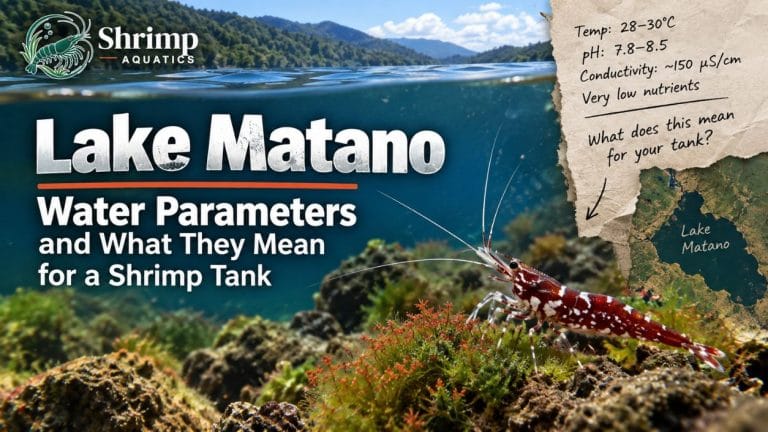
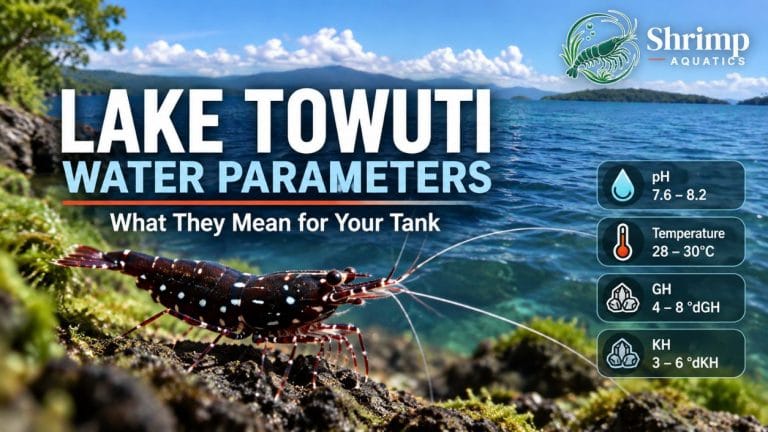
The reason this group wants warm water, and wants it without variation, is where they come from. Water temperatures of Lake Towuti are approximately 28 degrees Celsius throughout the year, with an annual average air temperature of 26 degrees Celsius and little variation in monthly temperatures.4 Lake Matano is studied specifically because minimal seasonal temperature variability shapes its biogeochemical cycling.5 A tank at about 82°F (28°C) that never moves is closer to that than a tank that averages the same number across a daily swing.
In practice that means a heater sized for the tank, a thermostat you’ve verified against a separate thermometer, and attention to the room as well as the aquarium. A heater that cycles on and off against a cold room is holding an average, not a temperature. Check the reading at the same time each day for the first few weeks. A heater failing open or shut is one of the few problems in this hobby that can empty a tank overnight.
Resist the temptation to push toward the top of the band to speed anything up. Previous laboratory and field experiments suggest that temperature affects both intermolt period and growth per molt in many crustaceans. Blue crabs reared under elevated temperatures showed decreased intermolt period and decreased growth per molt, resulting in smaller sizes at each instar.6 That’s a crustacean level pattern from a different animal, and nobody has measured it in Sulawesi shrimp. It’s still enough reason not to treat heat as an accelerator. You’d be buying more frequent molts, which is the most fragile moment in the animal’s life, and getting less from each one.
Why a warm alkaline Sulawesi tank is unforgiving of waste
The same trace of ammonia isn’t equally dangerous in every tank, and Sulawesi water sits at the wrong end of that relationship. Total ammonia in water splits between the ammonium ion and un-ionized ammonia, and it’s the un-ionized form that drives toxicity. The ratio of un-ionized ammonia to ammonium in fresh water increases about tenfold for each rise of a single pH unit. It roughly doubles for each rise of ten degrees Celsius across the range these tanks sit in. High external un-ionized ammonia reduces or reverses diffusive gradients and causes ammonia to build up in internal tissues and blood.7 A reading of the same total ammonia that a cool, acidic Bee tank would shrug off is a different exposure here.
Zero is the only acceptable reading
Ammonia and nitrite should read zero in an established Sulawesi tank, and nitrate is worth holding under 10 ppm as a working target. If a test shows anything above zero, stop feeding and find the cause before you change anything else. A large corrective water change on top of an ammonia problem gives the colony two shocks instead of one.
Oxygen works against you in the same direction. Cold water can hold more dissolved oxygen than warm water.8 So a tank at the top of this band starts with less headroom than a room temperature shrimp tank. Warm water is also where uneaten food breaks down fastest. The practical response isn’t a stronger pump but a steadier one. Keep the surface genuinely moving, keep stocking modest for the volume, and keep organic waste out rather than trying to filter your way through it.
Feeding Sulawesi shrimp without fouling the tank
Mature algae, aufwuchs and biofilm are the important grazing resources for this group, and a tank that grows them well needs very little from you. What doesn’t follow is the common claim that Sulawesi shrimp can eat only biofilm or can never accept prepared food. Acceptance and nutritional value vary by species, by system and by the food itself, and the evidence doesn’t support that universal version. What’s clear is that supplemental food can’t compensate for an immature system. Get that grazing base right and most of what Sulawesi shrimp eat is already taken care of.
The one controlled feeding trial published on a Sulawesi species points the same way. Juvenile Caridina dennerli starting at an average total length of 1.445 cm were reared under four combinations of feed and shelter. The group given commercial pellets with Hydrilla shelter gained 0.119 cm in absolute total length and had the highest survival of the four treatments. The group given a bacterial starter with stone shelter gained 0.013 cm.9 That’s a small trial in a controlled setup, not a feeding schedule for your tank. It’s still a reason to treat prepared food as a real tool used sparingly.
At Shrimp Aquatics, in our Sulawesi shrimp tanks, mature algae and biofilm do most of the feeding. We normally offer prepared food only about once a week and remove leftovers. Many of the shrimp in these systems show limited interest in it. Food that sits in warm water adds organic waste and can raise ammonia, nitrite and nitrate as it breaks down.
Use that as a starting point and let the tank tell you the rest. If food is still sitting on the substrate hours later, the colony didn’t need it. If the rocks are grazed clean and the shrimp are working the glass constantly, the grazing base is thin. The answer is more surface and more light on it, not a bigger portion.
Changing water in a Sulawesi tank without a TDS swing
Water changes in this tank are a stability exercise, not a cleaning exercise. The goal is to leave the shrimp in water they can’t tell has changed. That means mixing the replacement water in advance, letting it dissolve and equilibrate fully, and matching temperature and TDS to the tank before any of it goes in. Small volumes, added slowly, cost you nothing. A large fast change is the single most avoidable stressor in a specialist shrimp tank, because it lands hardest on any animal that happens to be mid molt. Match temperature and TDS this closely every time, the standard for Sulawesi shrimp water changes.
Test the mixed water and the tank water side by side before you start, and add slowly enough that the tank reading barely moves. If the two don’t match, fix the container, not the aquarium.
Why evaporation top-offs must be pure RO
Evaporation removes water and leaves the dissolved solids behind, which concentrates them in what remains.10 In a warm, open topped tank that happens continuously. Topping off with remineralized water adds minerals to a volume that has already been concentrated, so GH and TDS climb week after week while every individual top-off looks harmless. Use pure RO for evaporation and save the remineralized water for actual water changes, and the drift stops.
Which tankmates a Sulawesi tank can carry
The default answer is a species tank, and that default isn’t caution for its own sake. Every additional animal competes for the same grazing surfaces, adds to the bioload in water that’s already unforgiving of waste, and has to fit the same warm, alkaline water. A mixed setup is only reasonable when every species overlaps in temperature, water chemistry, behavior, space and feeding opportunity.
| Candidate | Fit with Sulawesi water | Main risk to weigh |
|---|---|---|
| Sulawesi snails (Tylomelania spp.) | The closest match, since they’re kept warm and alkaline as well; verify the species rather than the trade name | Adds bioload and grazes the same surfaces, so it competes for the food base in a small tank |
| Neocaridina shrimp | Their usual range sits below the Sulawesi band, so any overlap has to be checked against both groups’ ranges before it’s a plan | Competition for grazing surfaces and stocking capacity; a breeding colony in a specialist Sulawesi tank isn’t a default recommendation |
| Bee and Taiwan Bee Caridina | Incompatible on water, since they’re kept cool and acidic | No setup satisfies both groups at once, whatever the shared genus suggests |
| Small peaceful fish | Some species tolerate the temperature, but few need it and none need this chemistry | Even fish described as generally lower risk with adult shrimp will take shrimplets, and constant movement keeps a shy colony out of sight |
If you want the colony visible rather than hidden in the rockwork, the lever is structure and calm, not company. That means open grazing surfaces, hides they can choose to leave, a steady light schedule and few hands in the tank.
What to check first when Sulawesi shrimp start dying
Losses in these tanks are usually environmental rather than infectious, and the useful first move is measurement, before any treatment. Work in this order, and write the numbers down so you can see movement. If something still goes wrong, common health problems in Sulawesi shrimp sorts the causes by urgency.
- Test ammonia and nitrite. Anything above zero explains the tank before you look for anything else.
- Check temperature against a second thermometer and confirm the heater is actually cycling.
- Test TDS, pH, GH and KH, and compare them with what you recorded last time as well as with the target range.
- List what changed in the past week: a water change, a top-off, a new food, a cleaned filter, a new decoration, a treatment in a nearby tank.
- Look at behavior across the whole tank, not just at the animals that died. Shrimp gathered at the surface, motionless in the open, or all hiding at once are telling you about the water.
Molting deserves particular attention, because it’s when the animal is least able to absorb anything else going wrong. All freshwater prawns, like other crustaceans, have to regularly cast their exoskeleton in order to grow. Successful mating can only take place between ripe females that have just completed their pre-mating molt and are therefore soft-shelled, and hard-shelled males.11 So the molt is both the growth event and the reproductive event, and a colony that’s molting is a colony you shouldn’t be disturbing. The mineral side matters too. The major source of calcium used for crustacean exoskeleton calcification is exogenous, meaning the water the animal lives in, with food and stored reserves contributing much less.12 That’s a crustacean level mechanism, not a Sulawesi measurement. It’s still why letting GH drift is a molting problem and why a calcium rich food isn’t a substitute for correct water.
Don’t treat what you haven’t identified
Shrimp are sensitive to copper and to several common fish medications, and product formulations differ, so check the actual active ingredients before anything goes into the water. A short description of a symptom isn’t a diagnosis, and no article can give you a safe dose for an unidentified problem. If losses continue after the water checks come back clean, get a qualified aquatic veterinarian or an experienced local specialist to look at the animals.
Keeping a Sulawesi colony going year after year
A healthy Sulawesi tank grows slowly and quietly, and that’s the correct expectation. One measured example makes the point. Ovigerous Caridina dennerli females carried 8-14 eggs each in the 2009 systematic revision of the Sulawesi Caridina, from a sample of seven wild females.13 Counts differ from species to species, and a colony built on broods that size doesn’t double in a season, whatever a stocking calculator suggests.
What sustains a colony over years is the absence of events. Rearranging hardscape, deep cleaning filters, chasing parameters toward a number you read somewhere, and adding new animals repeatedly are all disturbances that arrive at some individual’s worst moment. Set the tank up so that the routine is testing, small matched water changes, RO top-offs and light feeding, and then do very little else.
Sourcing matters for the same reason. Stock that has already lived and bred in warm alkaline water is starting from your conditions rather than adapting to them. Our livestock is bred by Shrimp Aquatics, not collected from the wild. When you add to an established colony, it’s worth matching the water the new animals are coming from as closely as you match everything else.
References
13 Sources
- Sulawesi Mineral 7,5, minerals and trace elements, SaltyShrimp, product technical page.
- Sulawesi Mineral 8,5, minerals and trace elements, SaltyShrimp, product technical page.
- Alkalinity and Water, U.S. Geological Survey Water Science School, updated August 24, 2026.
- Geomicrobiological Features of Ferruginous Sediments from Lake Towuti, Indonesia, Frontiers in Microbiology 7, article 1007, 2016.
- The biogeochemistry of tropical lakes: A case study from Lake Matano, Indonesia, repository record and abstract, Limnology and Oceanography 53(1): 319-331, 2008.
- Elevated temperature induces a decrease in intermolt period and growth per molt in the lesser blue crab Callinectes similis, abstract, Journal of Crustacean Biology 39(1): 22-27, 2019.
- Aquatic Life Ambient Water Quality Criteria for Ammonia, Freshwater, U.S. Environmental Protection Agency, Office of Water, April 2013.
- Dissolved Oxygen and Water, U.S. Geological Survey Water Science School, updated August 24, 2026.
- Effect of Using Different Shelter and Feed Types on Growth and Survival Rate of Sulawesi Endemic Ornamental Shrimps (Caridina dennerli), journal PDF, Jurnal Ilmiah PLATAX 13(1): 191-204, 2025.
- Chloride, Salinity, and Dissolved Solids, U.S. Geological Survey Water Resources Mission Area, March 1, 2019.
- Farming freshwater prawns, a manual for the culture of the giant river prawn, biology chapter, Food and Agriculture Organization of the United Nations, Fisheries Technical Paper T428.
- Biomineralizations: insights and prospects from crustaceans, ZooKeys 176: 103-121, 2012.
- Radiation of endemic species flocks in ancient lakes: systematic revision of the freshwater shrimp Caridina from the ancient lakes of Sulawesi, Indonesia, The Raffles Bulletin of Zoology 57(2): 343-452, 2009.
Ready to get started?
Shop our Sulawesi Shrimp collection
27 products available · Live Arrival Guarantee