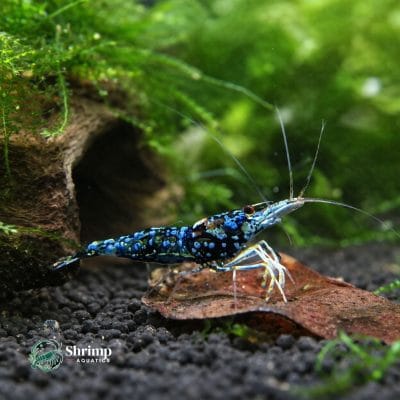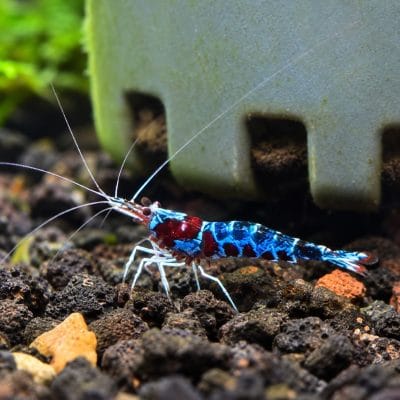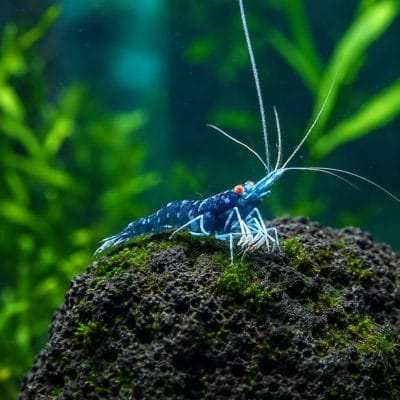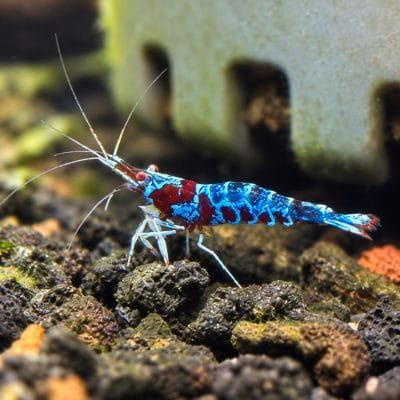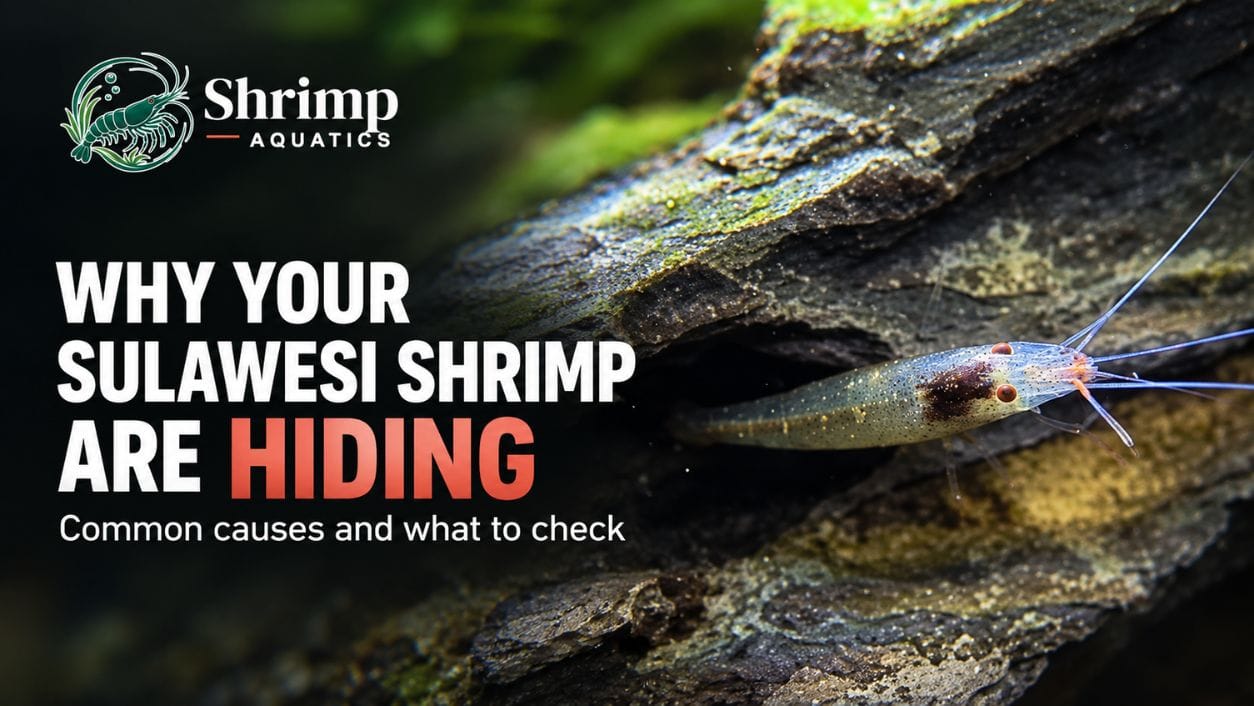
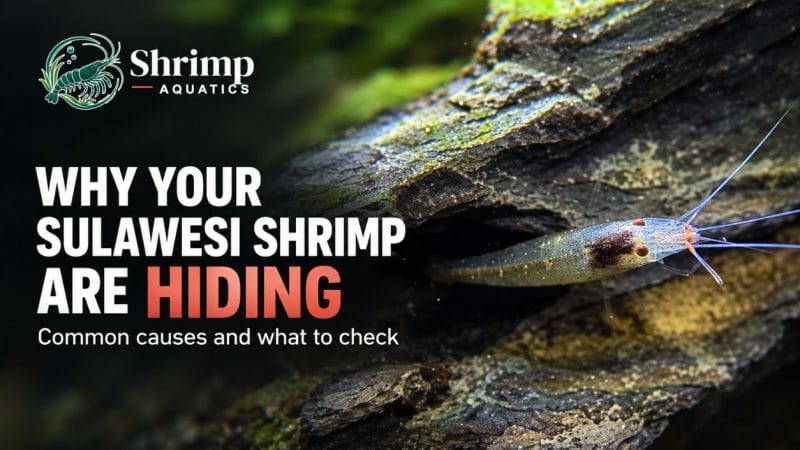
Sulawesi shrimp are rock grazers that stay close to cover, so some hiding is simply how the group behaves. The question worth answering isn’t whether they hide, but whether they still come out. Shrimp that graze in the open at feeding time and duck into a crevice when you walk past are behaving normally. A colony that used to graze and now never appears is telling you something about the tank, and water chemistry is where to look first.
Is your Sulawesi shrimp hiding normal, or has the colony stopped grazing?
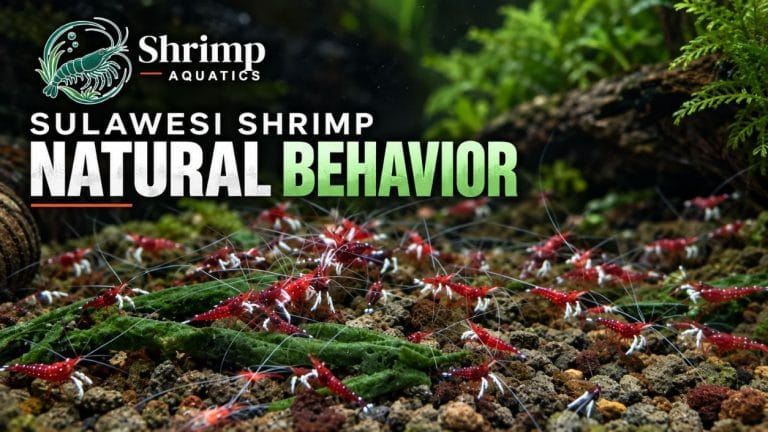
Judge the colony, not the individual, and judge it by grazing rather than by how many shrimp you happen to see. Sulawesi shrimp (lake Caridina spp.) work rock surfaces for biofilm and algae. A shrimp that’s feeding will be moving over stone with its antennae active and its front limbs picking at the surface. That’s the behavior you’re looking for. Whether it happens in the open or half inside a fissure matters much less.
Normal for the group
Shrimp retreat when you approach or when the light changes, then reappear within minutes. Some graze at the mouth of a crevice. You see more of them at feeding time and after lights out. New arrivals stay out of sight for their first days in a tank.
Worth acting on
Shrimp that used to graze in the open no longer appear at all, including at night. Food sits untouched. Antennae are still and the animals are wedged motionless in the darkest part of the hardscape for days. You’re also finding fewer shrimp than you stocked.
Give yourself three viewing windows before you conclude anything. One is at feeding. One is about thirty minutes after the light goes off with only dim room light on. The last is first thing in the morning before the tank light comes on. Count the shrimp you can actually see in each window and write the number down. Two counts a few days apart tell you far more than an impression formed while standing in front of the glass. Standing there is itself one of the reasons the shrimp aren’t out.
Test the water first, because a warm alkaline tank turns less waste into more ammonia
A cycled tank reads 0 ammonia and 0 nitrite. If either shows a number, that’s your answer and nothing else on this page matters until it’s fixed. The reason this group punishes a small reading harder than a cool, soft water tank is chemistry. Total ammonia in water sits in two forms. EPA reports that the ratio of un-ionized ammonia to ammonium ion in fresh water increases about tenfold for each rise of a single pH unit. It roughly doubles for each 10 degree Celsius rise in temperature between 0 and 30 degrees Celsius.1 The un-ionized form is the one that drives toxicity, because high external concentrations reduce or reverse diffusive gradients and cause ammonia to build up in internal tissues and blood.1 Those criteria were derived for the freshwater assemblage EPA studied and set no aquarium threshold. The direction is what matters here. The same total ammonia number means a larger toxic share in a tank held at pH 8.0 and 84°F (29°C) than in a cooler, more acidic shrimp tank.
Warmth costs you on the oxygen side as well, since cold water can hold more dissolved oxygen than warm water.2 A tank held near the top of the Sulawesi range has less margin than the same tank three degrees cooler. Gentle surface movement is worth more here than it is in a Neocaridina tank.
| Temperature | 79-86°F (26-30°C) |
|---|---|
| pH | 7.5-8.5 |
| GH | 4-8 dGH |
| KH | 3-6 dKH |
| TDS | 150-250 ppm |
| Nitrate | Aim for under 10 ppm; that’s a target, not a tolerance limit |
| Ammonia and nitrite | 0 in a cycled, established tank |
Test before you treat
Don’t add a medication, a bacterial dose or a mineral product to a tank you haven’t tested. Hiding is a behavior, not a diagnosis, and a treatment aimed at the wrong cause becomes the second problem the colony has to survive.
Check what drifted since the last time you saw them out
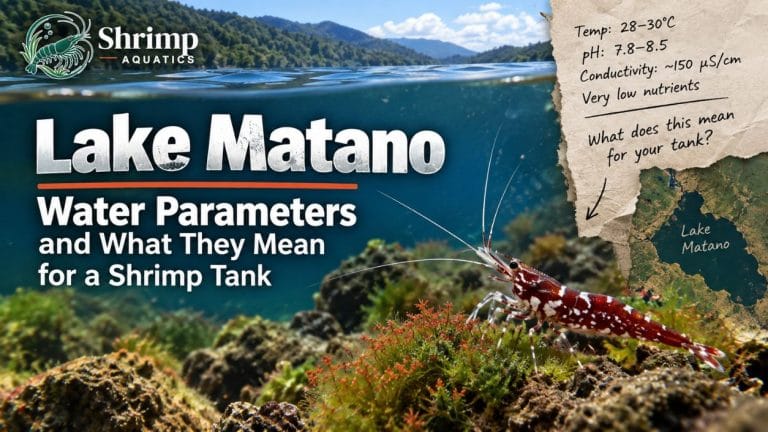
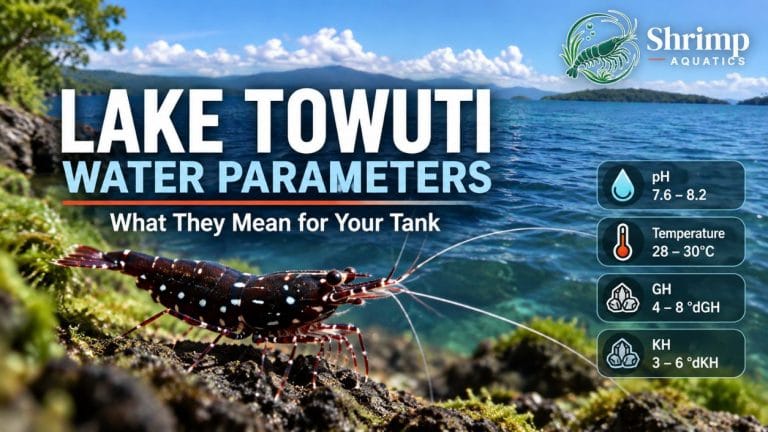
These shrimp evolved in water that barely moves. Surface temperatures in Lake Towuti are commonly 28-29 degrees Celsius, with water temperatures reported at approximately 28 degrees Celsius throughout the year.3 Lake Matano water parameters have been studied specifically because of the minimal seasonal temperature variability of the lake.4 Nothing in an aquarium is that steady. So what’s the useful question after a behavior change? Not what’s wrong with the shrimp, but what moved in the tank.
Two values drift on their own. Carbonate hardness is your buffer. Alkalinity is the water’s capacity to neutralize acids and hold a fairly stable pH. It comes from bicarbonates, carbonates and hydroxides, and water with more of it changes less when acid enters.5 A tank sitting at the bottom of the 3-6 dKH range will swing further on the same amount of organic acid than one in the middle. TDS drifts the other way, because evaporation concentrates the dissolved solids left behind in the remaining water.6 USGS describes that for shallow groundwater, but the physics are the same in an open tank running at 79-86°F (26-30°C). That’s why, in routine Sulawesi tank maintenance, top-offs use pure RO water and replacement water gets matched and added slowly.
Raising the temperature isn’t a way to make shy shrimp more active. Temperature affects both the intermolt period and growth per molt in many crustaceans. Blue crabs reared at elevated temperatures molted more often but grew less each time, ending up smaller at each instar.7 That’s a crab study and not a Sulawesi measurement, but it’s the direction the mechanism runs, and it removes heat from the list of harmless things to try.
- Topped off with tap water or with mineralized water instead of pure RO
- A water change larger, faster or less closely matched than usual
- New or rinsed filter media, or a filter left off for a while
- A heater, controller or room temperature that has moved the tank a degree or two
- New rock, substrate, plants or decor added in the last two weeks
- A new food, a heavier feeding, or food left in the tank overnight
- Any medication, algae treatment or plant fertilizer used in or near the tank
A Sulawesi shrimp that disappears for a few days is usually molting
Crustaceans have to cast the exoskeleton regularly in order to grow,8 so every shrimp in the tank spends part of its life freshly soft. In most shrimps mating takes place at the female’s premating molt. The brief window of attractiveness that follows it is understood as a way of limiting harassment of the female, which can otherwise result in her injury or even death.9 A female that has just molted therefore has two good reasons to stay inside the rock. Several males working the same crevice is a normal sight.
Mineral supply is the part of this that shows up in your test kit. The major source of calcium for crustacean shell calcification is exogenous, meaning the water the animal lives in, with food and stored reserves contributing much less.10 So a tank whose GH and TDS have drifted low will produce its first visible symptom at a molt, not on the day the numbers moved.
While a shrimp is out of sight, the useful actions are all small ones. Leave the shed shell in the tank rather than fishing it out. Don’t move rock to look for the animal. Don’t run a large water change to help, since a sudden mineral change is exactly what a soft shrimp can’t absorb. If you’re finding shed shells with the shrimp still trapped in them, or shrimp dying at the molt, that’s a molting problem rather than a hiding problem. It needs the parameter history above before any treatment.
Give them rock they can graze on and sightlines you can watch
Shelter and food aren’t separate decisions for this group. The one controlled trial available on a Sulawesi species reared Caridina dennerli from an average total length of 1.445 cm in four combinations of feed and shelter. The group given commercial pellets with Hydrilla shelter grew most, 0.119 cm over 30 days, and survived best at 72.7%. Survival was 40.9% for pellets with stone shelter, and 31.8% and 22.7% for the two bacterial starter groups over 37 days.11 The trial varied feed and shelter together, so it doesn’t show that stone shelter alone is worse than plants. Its survival figures describe that setup, not your tank. What it does show is that a shelter choice and a feeding choice land on the same animal at the same time.
In practice that means building the hardscape so shelter and grazing surface are the same rock. Porous stone arranged in open terraces and arches gives far more biofilm area than a solid pile. Fissures that face the front of the tank let a shrimp feel covered while you can still see it. Keep the floor fine and sealed, so juveniles can’t drop into spaces they won’t climb out of. Leave the stack loose enough that waste doesn’t collect in dead pockets under it. Which stone you choose is its own decision, since some rock will move your KH and GH as it sits in the water. That belongs with your hardscape selection.
Dim the light and cut the traffic past the glass before you change the tank
Dim the tank light for a few days and compare your counts. Nobody has published a measurement of how Sulawesi shrimp respond to light intensity. Every care sheet that calls them light sensitive is passing on hobby consensus, and this guide isn’t going to add a number to it. What can be said is that dimming is cheap, reversible and easy to judge from your own counts, which puts it ahead of any change to water chemistry.
Run the light lower than a planted tank would need, and add a gradual ramp at both ends of the photoperiod. Light the central rock while leaving the edges shaded. Then leave the tank alone for a week. Move the feeding to the end of the photoperiod if that’s when you want to see them. Keep the tank out of a walkway, and stop tapping the glass to check. If your counts rise over that week, you have your answer without having touched the water.
Would a few Neocaridina bring your Sulawesi shrimp into the open?
At Shrimp Aquatics, in some of our Sulawesi systems we keep about five Neocaridina. We’ve observed the Sulawesi shrimp remain more visible, or retreat less, when people approach the tank. That’s worth trying if your tank can carry it, and it comes with real conditions. Five shrimp is a handful, not a breeding colony, and a Neocaridina population left to multiply competes for the same biofilm the Sulawesi shrimp graze. The typical Neocaridina range of 65-78°F (18-26°C) also overlaps the Sulawesi range of 79-86°F (26-30°C) only at the very edge. So the Sulawesi tank stays at Sulawesi temperature, and the Neocaridina are the ones being kept warm. Your grazing surface and your filtration have to carry both groups.
Group size is the other lever keepers reach for, and it’s worth being straight about the evidence. The figures you’ll see on care sheets, ten or more, or fifteen to twenty five, come from hobby convention. A larger group is still a reasonable bet, because more animals grazing at once simply gives you more chances to see one. Add the extra shrimp in small batches over several weeks, whichever Sulawesi shrimp lines you’re stocking. That way the mature grazing surface and the biological filter keep pace with the bioload.
When constant hiding is the last symptom before you start losing shrimp
Some of what looks like hiding is a colony already in trouble. Treat these as same day signals: shrimp climbing to the surface or sitting on the glass at the waterline, and shrimp lying on their side in the open. Add animals unresponsive when you move a hand past them, several deaths inside a week, or no grazing at all in the dark. In those cases the sequence is test first, then correct slowly. Read ammonia, nitrite, temperature, pH, KH, GH and TDS before altering anything. Stop extra feeding and remove uneaten food, and add gentle surface movement. Then bring any value that’s out of range back toward the table above over several days. Test before you treat, the same order common health problems in Sulawesi shrimp follows.
Keep treatments out of it unless something has actually been identified. Copper and a number of fish medications are harmful to shrimp and snails. Dosing a tank on a guess costs you the ability to tell what the original problem was. If losses continue, if you suspect disease, or if the water tests clean and the colony keeps declining, get outside help. A qualified aquatic veterinarian or an experienced local specialist is the right next step rather than another product. You’re also welcome to email contact@shrimpaquatics.com with your pH, GH, KH, TDS, temperature, tank size, cycle status and current livestock. We’ll tell you what we’d check next.
References
11 Sources
- Aquatic Life Ambient Water Quality Criteria for Ammonia, Freshwater, U.S. Environmental Protection Agency, Office of Water, April 2013.
- Dissolved Oxygen and Water, U.S. Geological Survey, Water Science School, updated August 24, 2026.
- Geomicrobiological Features of Ferruginous Sediments from Lake Towuti, Indonesia, Frontiers in Microbiology 7: 1007, 2016.
- The biogeochemistry of tropical lakes: A case study from Lake Matano, Indonesia, Limnology and Oceanography 53(1): 319-331, 2008, repository record and abstract.
- Alkalinity and Water, U.S. Geological Survey, Water Science School, updated August 24, 2026.
- Chloride, Salinity, and Dissolved Solids, U.S. Geological Survey, Water Resources Mission Area, March 1, 2019.
- Elevated temperature induces a decrease in intermolt period and growth per molt in the lesser blue crab Callinectes similis Williams, 1966, Journal of Crustacean Biology 39(1), 2019, abstract.
- Farming freshwater prawns, biology chapter, FAO Fisheries Technical Paper T428, Food and Agriculture Organization of the United Nations.
- Mating Behavior and Strategies, Raymond T. Bauer, University of Louisiana at Lafayette, research page.
- Biomineralizations: insights and prospects from crustaceans, ZooKeys 176, 2012.
- Effect of Using Different Shelter and Feed Types on Growth and Survival Rate of Sulawesi Endemic Ornamental Shrimps (Caridina dennerli), Jurnal Ilmiah PLATAX 13(1): 191-204, 2025, journal PDF.
Ready to get started?
Shop our Sulawesi Shrimp collection
27 products available · Live Arrival Guarantee