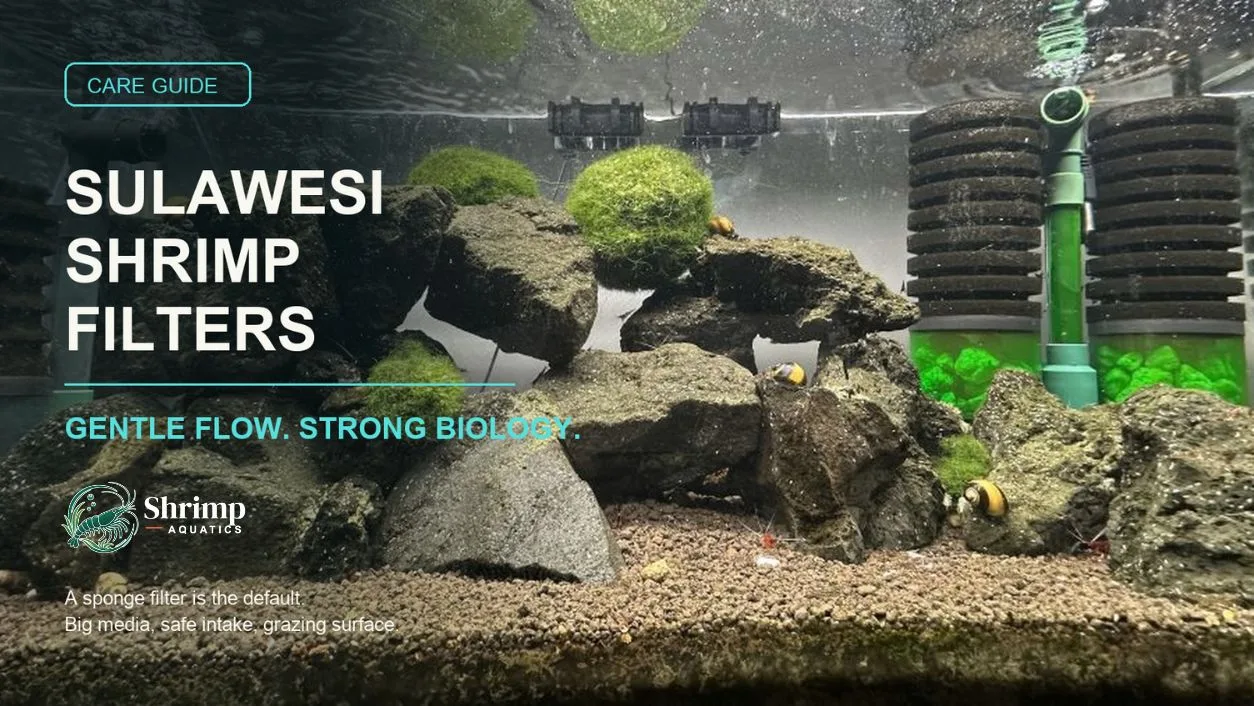
Which filter should go on a Sulawesi shrimp tank? An air-driven sponge filter, or in a larger tank a matten filter, which is a foam wall with an airlift behind it and the same idea scaled up. Both put biological media, gentle water movement and a grazing surface into one piece of equipment, and neither has a concentrated intake that can pull in a shrimplet or a freshly molted shrimp. A canister, hang-on-back or powered internal filter isn’t ruled out. It just has to earn its place with a guarded intake and a return aimed at the surface, away from the rock where the shrimp graze.
What a Sulawesi Filter Has to Do That a Neocaridina Filter Does Not
It has four jobs here, and the first is processing waste with room to spare. Total ammonia in water sits in two forms, the ammonium ion and un-ionized ammonia, and it’s the un-ionized share that drives ammonia toxicity in aquatic animals. In fresh water the ratio of un-ionized ammonia to ammonium ion rises about ten-fold for each single pH unit.1 It rises roughly two-fold for each 10 degree Celsius rise in temperature across the range the EPA assessed.1 The typical Sulawesi range is pH 7.5-8.5 at 79-86°F (26-30°C). So the same ammonia reading sits further toward the harmful form there than it would in a cool, acidic shrimp tank.
That’s the single biggest reason the filter decision is different here: you’re buying biological capacity first and clear water second. The rest of the numbers you’re aiming at live on the Sulawesi shrimp care parameters page. For this decision, only the warm temperature and the alkaline pH matter.
The second job is movement without a current. These shrimp spend their day working over surfaces, and a filter that pushes them off those surfaces has taken away the natural behavior you keep Sulawesi shrimp for. How much the outlet moves the water surface is a separate question from how well the filter handles waste. Whether your filter does that alone, or you need an air stone alongside your Sulawesi shrimp filter, depends on the outlet you end up with. Check it in your own tank at your own temperature.
The third job is one that general filter guides never mention. In this tank the filter is also a feeding surface. Mature biofilm, aufwuchs and algae are important grazing resources for Sulawesi shrimp, so a filter that puts a large soft surface into the lit part of the tank adds food capacity. A sealed canister keeps all of its media in a dark box the shrimp can never reach. Think of it as a pantry with the door locked. That matters more here than in most shrimp tanks, because what Sulawesi shrimp eat is mostly what grows on surfaces, not what you drop in.
The fourth job is being serviceable without resetting the tank. A shrimp tank is ready only when ammonia and nitrite read 0 with an established biological filter behind them, and a calendar alone never proves that. Every filter you pick will need cleaning one day. So how much colonized surface a cleaning takes with it belongs in the buying decision.
Which Filter Types Actually Suit a Sulawesi Shrimp Colony
Air-driven sponge and matten filters suit it best, with powered filters as a guarded second option. Judged against those four jobs, the types separate cleanly. The table compares them on what decides a Sulawesi tank. Rated turnover isn’t on it, because it tells you very little about how a filter behaves at rock level.
| Filter type | How it moves water | Risk to shrimplets and molting shrimp | Grazing surface it adds | Where it fits |
|---|---|---|---|---|
| Air-driven sponge | Air rising in a lift tube draws water slowly through foam | Low, because the intake is the whole foam face rather than a narrow port | Large, lit and grazed continuously | The default for most Sulawesi tanks, single or paired |
| Matten, a full width foam wall | The same airlift principle behind a foam sheet spanning the tank or a corner | Low, for the same reason, across an even bigger face | The largest of any option here | Larger or busier tanks, when you accept losing some tank space |
| Hang-on-back | An impeller lifts water up a narrow intake tube into a rear chamber | Concentrated at the intake tube, so a sponge guard is required | Little, since the media sits outside the tank | When you want more media volume than a sponge holds and can guard the intake |
| External canister | A sealed pressurized loop through stacked media trays | The strongest concentrated intake of the group, so a guard is required | None inside the tank | Larger or heavily stocked tanks, with the return aimed at the surface |
| Powered internal or moving-bed | A pump circulates tank water through media held inside the tank | Depends entirely on the pump inlet, which needs guarding | Some, on the housing and on any exposed media | When you want active media in the tank and can throttle the outlet |
| Undergravel plate | Water is pulled down through the substrate bed and returned by an airlift or powerhead | Low at the plate itself | The substrate surface stays available | Hard to service without disturbing the grazing layer, so not a first choice here |
Why an Air-Driven Sponge or Matten Filter Is the Default Choice
Intake guards and sponge filtration are the two measures that reduce shrimplet loss in a shrimp tank, and a sponge filter is both at once. There’s no narrow port to guard, because the foam face is the intake. It’s also the only filter type that covers all four jobs in one purchase. The same foam holds the bacteria, breaks the surface as the bubbles arrive, and grows the biofilm the colony grazes. A matten filter is the same machine with far more foam, which is why it suits a bigger or busier tank. What you give up is the tank space the wall takes and a look that not everyone wants.
Does one sponge cover any tank? No. It still comes back to the flow and bioload your own tank needs, so treat a sponge filter as a starting point. A single small unit on a well stocked tank is undersized whatever the box says. The fix is usually a second sponge or more foam, not a faster pump.
When a Canister or Hang-on-Back Earns Its Place
Reach for a powered filter when the tank has outgrown what foam alone can hold. That means a larger volume, a colony that has been breeding for a while, or a feeding routine that puts more waste into the water than a single sponge can process. The gain is media volume, kept outside the display where you can service it without reaching into the rockwork. The cost is that every safety feature the sponge gave you for free now has to be built back in, which is the next section. If your tank isn’t asking for the extra capacity, a canister buys you nothing here that a second sponge wouldn’t.
Make a Canister or Hang-on-Back Safe Before You Put It on a Sulawesi Tank
Guard the intake and calm the outlet before the filter ever runs, because the danger is all about timing. Crustaceans have to cast the exoskeleton regularly to grow, and a shrimp that has just finished a molt stays soft-shelled until the new shell hardens.2 Shrimplets are in that state often, and an adult passes through it every time it grows. Your filter setup has to allow for those hours, because they aren’t rare events in a breeding colony.
- Fit a sponge pre-filter over the intake before the filter is switched on for the first time, not after you notice something missing.
- Aim the return along the water surface, so the energy goes into the surface film instead of across the grazing area.
- Use a spray bar, a flow tap or a wider outlet to bring velocity down at shrimp level. Judge the setting by watching the shrimp, not by the pump rating.
- Clean the pre-filter sponge on the same schedule as the rest of the maintenance, since a clogging guard quietly strangles the turnover you bought the filter for.
- Don’t treat the slotted plastic strainer that ships with the filter as a shrimplet guard. It’s a leaf guard.
At Shrimp Aquatics, our Sulawesi systems use biological filtration together with a Kaldnes moving-bed filter. The combination gives us strong aeration and active biological media, but we tune the outlet so the shrimp aren’t pushed around while grazing. The goal is high oxygen with gentle movement at shrimp level.
That tuning step is the real test for any powered filter you fit. Watch the colony at rock level for a few minutes after the filter goes on. Shrimp that stay put and keep picking are in a flow they can work in. Shrimp that brace, get lifted or abandon a surface they were grazing a moment ago are telling you the outlet is still too strong.
Should a Sulawesi Tank Run Two Filters Instead of One?
If you can fit two, run two, and the reason has little to do with turnover. A single filter is a single point of failure. When the pump stops or the airline slips off the barb overnight, the tank loses its water movement and its biological processing at the same moment, in water that’s already less forgiving of ammonia than most shrimp tanks. A second, independent unit keeps both going until you notice.
The second reason is maintenance. Cleaning a sponge takes a large share of the colonized surface with it. So the safe pattern is to clean one filter, leave the other completely alone, and swap the order next time. Rinse the foam in water you’ve just siphoned out of the tank, never under the faucet. Why not tap water? Many public water systems dose chloramine precisely because it keeps disinfecting as the water travels through the pipes to the tap.3 Squeeze the foam instead of scrubbing it, replace a sponge only when it’s falling apart, and never replace both at once.
When one does have to go, the usual rule is to run the new sponge beside the old one for a while first, so the new foam isn’t carrying the tank’s biological load from day one. Test ammonia and nitrite in the days after any filter cleaning, because that’s when a thin biological margin shows itself.
Setting a tank up now? The setup that covers all four jobs with the fewest compromises is two air-driven sponge filters at opposite ends of the tank, on separate air pumps where you have them. Use a matten wall instead if the tank is large enough to justify it. Add a canister or hang-on-back later, guarded and surface-aimed, only when your stock of Sulawesi shrimp actually asks for the extra media.
References
3 Sources
- Aquatic Life Ambient Water Quality Criteria for Ammonia, Freshwater, U.S. Environmental Protection Agency, Office of Water, April 2013.
- Farming freshwater prawns, biology chapter, Food and Agriculture Organization of the United Nations, FAO Fisheries Technical Paper 428.
- Chloramines in Drinking Water, U.S. Environmental Protection Agency, page updated March 12, 2026.
Ready to get started?
Shop our Sulawesi Shrimp collection
27 products available · Live Arrival Guarantee