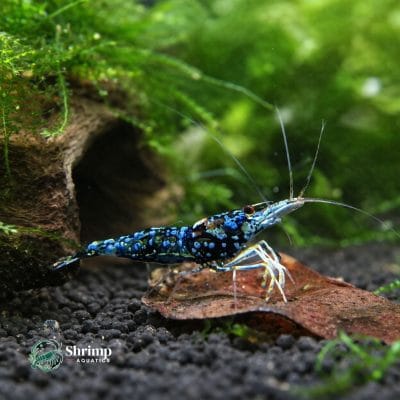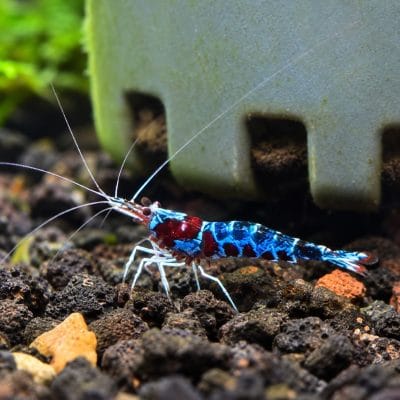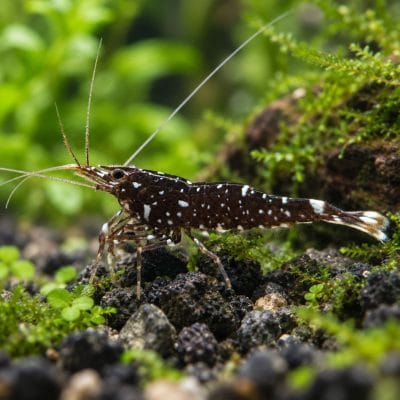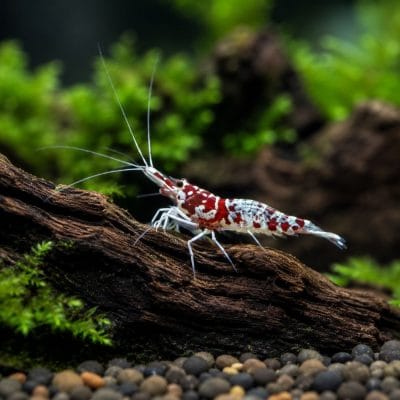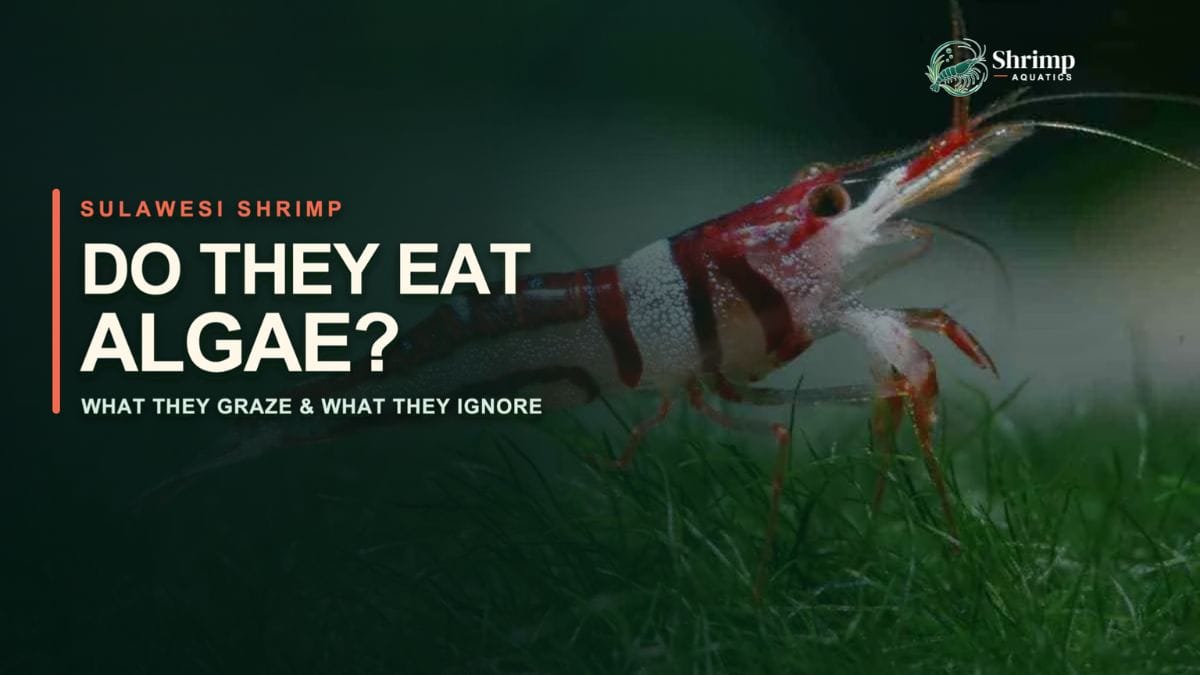
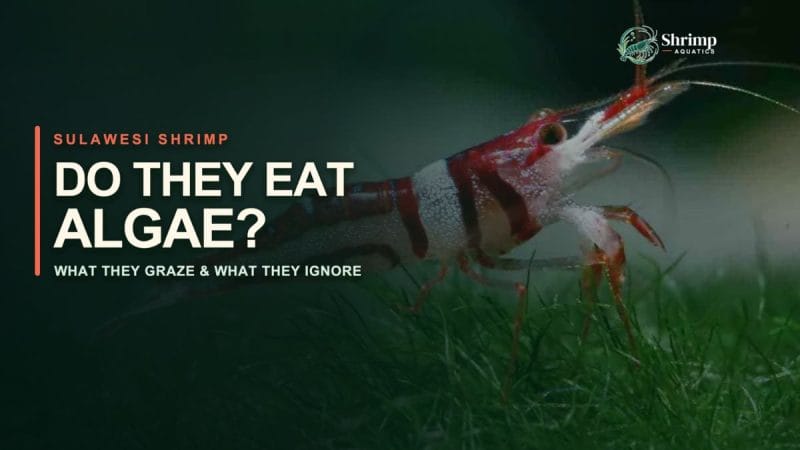
Yes, but only one kind of algae. Sulawesi shrimp graze the thin living film that grows on rock, glass and hardscape, which is mostly diatoms, single-celled algae, bacteria and fine detritus bound together. They don’t touch the algae most keepers actually want gone. Hair algae, thread algae and black beard algae stay exactly where they are, so a colony bought as a cleanup crew disappoints in both directions at once: the tank still looks green and the shrimp still need a food supply you have to grow for them. If hair algae is the problem, Amano shrimp are what people buy for that job, and choosing between Sulawesi shrimp and Amano shrimp really comes down to whether you want a second tank.
Which algae Sulawesi shrimp graze and which they leave behind
The useful distinction is microscopic against visible, and color doesn’t come into it. What these shrimp work over all day is the patina on hard surfaces: the brown diatom haze on glass, the soft coating on stone, and the bacterial and detritus layer holding it together. Anything with structure you can see and grip is a different category of food, and it’s the category they aren’t built to handle.
| Diatoms, the brown haze on glass and stone | Grazed continuously. This is the fraction documented in the gut of a lake species. |
|---|---|
| Biofilm and single-celled green algae on hardscape | Grazed as one surface layer with the diatoms. In practice this is the colony’s staple. |
| Hair and thread algae | No published evidence of removal. Expect it to stay and to keep spreading. |
| Black beard or brush algae | No published evidence of removal. Expect it to stay. |
The clearest look at what a Sulawesi lake shrimp actually swallows comes from Caridina spongicola, a small species from the Malili lakes that lives in the cavities of a freshwater sponge. When six specimens were dissected, their guts held a variety of diatoms and none of the sponge’s own spicules, so the shrimp were feeding on material accumulating on the host rather than on the host itself.1 That fits what’s known about the group more broadly: the Malili shrimp are treated as an adaptive radiation in which most species are habitat specialists and feeding morphology diversified alongside habitat.2 They’re also small animals. Museum material of the cardinal shrimp, Caridina dennerli from Lake Matano, measured 1.5-3.4 mm carapace length across 53 specimens.3 A fine-particle grazer of that size is the animal the evidence describes, and none of it describes anything that strips macroalgae off a tank.
Will Sulawesi shrimp clear the algae already in your tank?
No, and it’s worth being blunt about why, because the mistake is expensive. The material they graze is microscopic, they’re tiny, and the water they need sits at the warm alkaline end of the hobby, in the region of 79-86°F (26-30°C) and pH 7.5-8.5. That’s a system you build around the shrimp, not one you drop them into to fix a maintenance problem. Whatever livestock is in the tank, the visible growth is still answered by the photoperiod, the feeding and the water change routine, and that work stays yours. If you’re shopping for tank-bred Sulawesi shrimp, let it be because you want to keep the shrimp.
Check the inputs before you add animals
If a tank is producing more visible growth than you want, the place to start is the light hours, the amount of food going in and the water change routine. Adding animals to eat the symptom leaves you managing the algae and a demanding specialist at the same time, and this group is demanding.
What has to be growing on the rock before Sulawesi shrimp arrive
Because the diet is a living surface layer, the food has to exist before the animals do. A freshly filled tank with clean stone offers a grazing specialist almost nothing, and an immature system creates a high risk of early losses no matter how carefully the shrimp were shipped. The mature, stable setup these shrimp need is also their pantry.
At Shrimp Aquatics, during the early cycle we normally run the light for 8-10 hours a day so algae and biofilm can establish on the rock and glass. In our systems that natural growth is the main grazing base and prepared food stays supplemental. The light in a Sulawesi tank is doing a job even when there are no plants in it, which is why cutting the photoperiod to fight algae in this particular tank works against you.
Before shrimp go in, look for all three of these together:
- The rock and glass carry a visible film.
- Ammonia and nitrite read zero, so that film is sitting on a working biological filter.
- Temperature and chemistry have held steady for weeks.
How often to feed a Sulawesi colony that already has grazing surfaces
Less than you’d think, and less than the packet suggests. In a system with real grazing surfaces the rock is feeding the colony continuously, so anything you add is only topping up.
At Shrimp Aquatics, in our Sulawesi systems mature algae and biofilm do most of the feeding. We normally offer prepared food only about once a week and remove leftovers, both because many of the shrimp in these systems show limited interest in it and because food sitting in warm water adds organic waste as it breaks down.
That cadence isn’t the same as saying these shrimp reject prepared food, and the only controlled trial on the group points the other way. In a 2025 rearing study, cardinal shrimp starting at an average total length of 1.445 cm were kept under four combinations of feed and shelter. The groups fed commercial pellets did better on both measures than the groups given only a bacterial starter: pellets with a Hydrilla shelter produced an average gain of 0.119 cm and 72.727 percent survival over 30 days, while the bacterial starter with a stone shelter produced 0.013 cm and 31.818 percent over 37 days.4 Those are figures from one controlled setup, not an expectation for a home colony, but they’re a fair warning against treating bare rock as a complete diet, and a reason to keep offering a small amount of a suitable food even when the shrimp seem uninterested.
Why leftover food is riskier in a warm alkaline Sulawesi tank
Taking the leftovers out matters more here than in a cool soft-water shrimp tank, and the reason is chemistry. Total ammonia in water sits in two forms, the ammonium ion and un-ionized ammonia, and the un-ionized form is the one that drives ammonia toxicity. Its share rises about ten-fold for each rise of a single pH unit, and roughly two-fold for each 10 degrees Celsius of warming.5 A Sulawesi tank is warm and alkaline by design, so the same total ammonia reading means something harsher in it than it would in a Bee shrimp tank. Warm water also holds less dissolved oxygen than cold water,6 while the bacteria breaking down that uneaten pellet are drawing on the same supply.
So read the film on your rock as the feeding schedule. When the stone and glass start to look grazed thin, the answer is more grazing surface, a longer photoperiod or a larger tank for the number of shrimp you keep, rather than a heavier hand with the food. That’s the whole trade with this group: they do eat algae, but you’re the one growing it.
References
6 Sources
- Caridina spongicola, new species, a freshwater shrimp (Crustacea: Decapoda: Atyidae) from the ancient Malili lake system of Sulawesi, Indonesia, The Raffles Bulletin of Zoology 54(2): 271-276, 2006.
- Adaptive radiation and ecological diversification of Sulawesi’s ancient lake shrimps (abstract), Evolution 64(11): 3287-3299, 2010.
- Radiation of endemic species flocks in ancient lakes: systematic revision of the freshwater shrimp Caridina from the ancient lakes of Sulawesi, Indonesia, with the description of eight new species, The Raffles Bulletin of Zoology 57(2): 343-452, 2009.
- Effect of using different shelter and feed types on growth and survival rate of Sulawesi endemic ornamental shrimps (Caridina dennerli) (journal PDF), Jurnal Ilmiah PLATAX 13(1): 191-204, 2025.
- Aquatic life ambient water quality criteria for ammonia, freshwater, U.S. Environmental Protection Agency, Office of Water, April 2013.
- Dissolved oxygen and water, U.S. Geological Survey, Water Science School, updated August 24, 2026.
Ready to get started?
Shop our Sulawesi Shrimp collection
27 products available · Live Arrival Guarantee