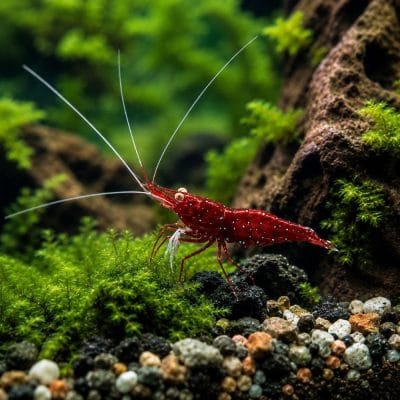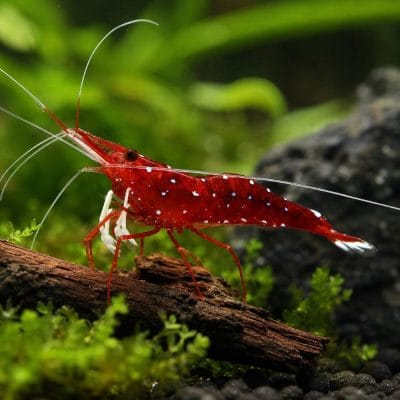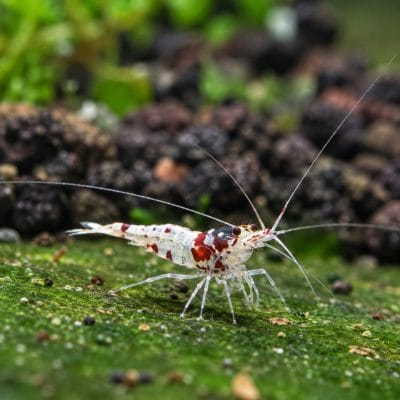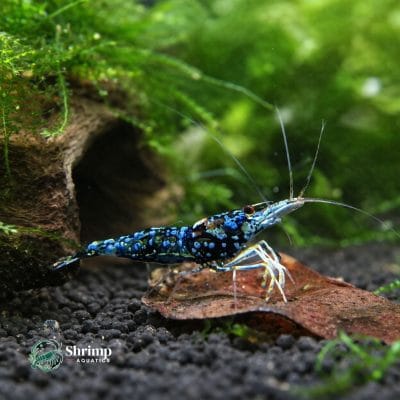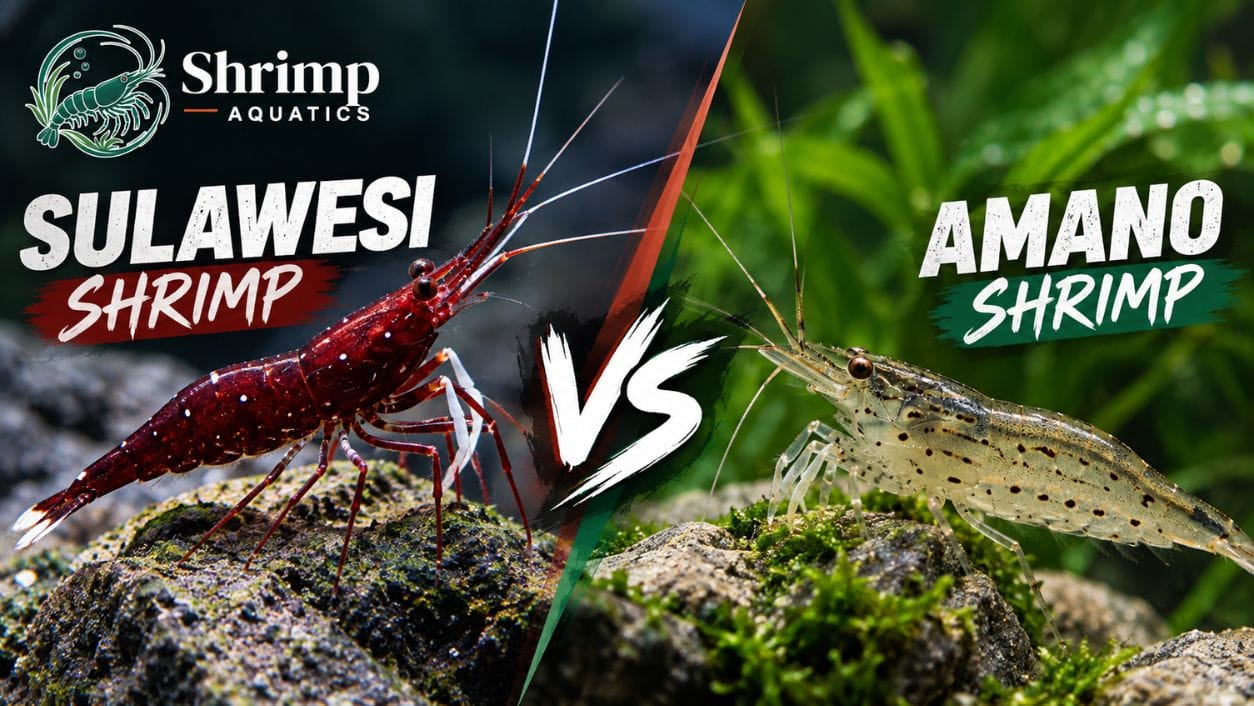
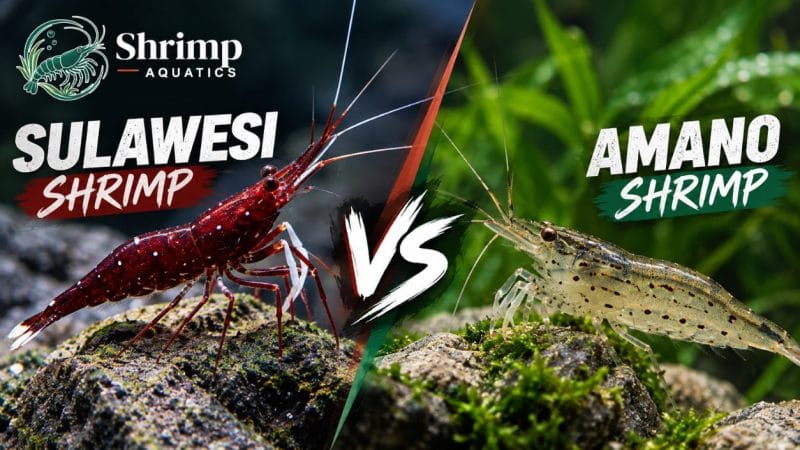
Both of these shrimp are Caridina, and that’s where the similarity ends. The Amano shrimp (Caridina multidentata) is a large, adaptable river shrimp people buy to graze algae in a planted community tank. Sulawesi shrimp such as the White Sock (Caridina dennerli) are small lake shrimp. They need warm, alkaline, very steady water of their own, and they won’t do that job for you. So if you want algae grazed in the tank you already run, buy Amano. If you want Sulawesi shrimp, what you’re really buying is a second tank.
Can Amano and Sulawesi shrimp share one tank?
No. Temperature settles it before anything else gets a vote.
Sulawesi shrimp are kept at 79-86°F (26-30°C). That band isn’t something you can shade downward to suit a tankmate, and Amano reproduction was measured against exactly that heat. Females of Caridina multidentata were cultured at 20, 23 and 26 degrees Celsius. They laid eggs at all three temperatures. But hatching rates were low at 26 degrees Celsius, and the newly hatched larvae from a single female fell by 67 percent between 20 and 23 degrees Celsius and by 88 percent between 20 and 26 degrees Celsius.1 Read that against the table below. The bottom of the Sulawesi band is the top of that trial, and it’s where the Amano side had already mostly failed.
You might reasonably say you never wanted Amano to breed anyway, since they can’t in fresh water. Fair. But a temperature that shuts reproduction down isn’t a temperature the animal is thriving at. Two more things follow the thermostat upward.
Warm alkaline water is less forgiving of waste. Total ammonia sits in the water in two forms, and the un-ionized one is what does the damage. Its share against the ammonium ion rises about tenfold for every rise of a single pH unit, and roughly twofold for every 10 degrees Celsius of warming between 0 and 30 degrees Celsius.2 So think about one dead shrimp behind the rock. In a warm pH 7.5-8.5 tank that’s a different event from the same shrimp in a cool, mildly acidic planted tank. The warmer water also starts with less oxygen in it, because cold water can hold more dissolved oxygen than warm water.3 You’re asking more of a tank that has less to give.
Don’t split the difference
A setting in the middle fails both animals. It’s too cold to hold a Sulawesi colony steady and too warm for an Amano to sit in for years. We know one tank is the cheaper answer. It’s still the wrong one. Run two.
Amano shrimp are sold as algae eaters, Sulawesi shrimp never were
Amano are bought for algae. That reputation comes from keepers rather than from a published trial, which is worth knowing before you pay for it. The firmest documented thing about how they live is that the species inhabits large rivers with a boulder substrate in Japan and Taiwan. Those are exactly the surfaces that grow film and thread algae. The US Fish and Wildlife Service screening summary goes further, and records that no information on the shrimp’s size, weight, age range or biology could be found at all. The same summary notes the animal is heavily present in the pet trade, with documented shipments of around 40,000 of them arriving monthly in one European country.4 So take the algae reputation as hobby experience. It isn’t a measured grazing rate.
The other half of this comparison is the half that costs people money. Sulawesi shrimp have never carried that reputation, and there’s a reason. They work the microscopic living film on rock and hardscape, not thread. If you’re hoping a colony will deal with a green problem, the way Sulawesi shrimp eat algae will disappoint you, because hair algae stays exactly where it is.
An animal with an algae job and an animal with a biofilm job aren’t substitutes. You add an Amano to the tank you have because you want work done. You build a tank around Sulawesi shrimp because you want the shrimp.
Sulawesi water is built from RO, Amano water usually is not
Here’s the side by side. One asymmetry in it is deliberate: the Sulawesi column is the range we keep to, while the Amano column holds only what has actually been published about the species. That’s far less than any care sheet implies.
| Decision | Sulawesi shrimp | Amano shrimp |
|---|---|---|
| Water you start from | RO or DI, remineralized outside the tank before it goes in | The tank water you already run, tested and dechlorinated |
| Temperature | 79-86°F (26-30°C) | No aquarium range published; measured reproduction fell sharply as culture temperature rose from 20 to 26 degrees Celsius |
| pH | 7.5-8.5 | No published range |
| Hardness | GH 4-8 dGH, KH 3-6 dKH | No published range |
| TDS and nitrate | TDS 150-250 ppm, nitrate under 10 ppm | No published figures |
| Substrate | Inert sand and rock only | No published requirement; the documented wild habitat is large rivers over boulders |
| Difficulty | Advanced to expert | No published ranking |
| Tank | Dedicated and mature, with grazing surfaces already grown in | The community tank you already keep |
Everything in the middle column comes out of one decision. You remineralize RO water yourself. That matters more than it sounds, because a crustacean takes most of the calcium it builds its shell from out of the water it lives in rather than out of its food.5 Put simply, what goes into your mixing bucket is what your shrimp molt with.
Which Sulawesi mineral you pick decides your mixing day
There are two salts and they don’t behave alike. Sulawesi Mineral 7.5 almost totally dissolves within seconds and the water is ready for use immediately. It buffers the pH at around 7.5, and raises carbonate and total hardness at a ratio of KH to dH of 0.42 to 1.0.6 Sulawesi Mineral 8.5 is a different afternoon. Its maker says the salt will almost totally dissolve only if CO2 is added for a few days, and that at a regular CO2 quantity of one bubble per second it dissolved totally in about 3-4 days. The water must then be aerated with an air stone for at least three hours to expel the CO2, at a KH to dH ratio of 0.78 to 1.0.7 So if you don’t own a CO2 cylinder, that decides the 7.5 for you. After that, holding the Sulawesi water parameters steady is most of the work in the tank.
Amano larvae need salt water, Sulawesi females carry very few eggs
This is the difference that decides whether you ever see a second generation.
Amano hatch as swimming larvae that have to reach the sea. In a rearing study of three amphidromous Caridina, larvae were raised across five temperatures and five salinities from 4.25 to 34 ppt. C. multidentata larvae proved able to survive to the juvenile stage across salinities of 17 to 34 ppt.8 Fresh water isn’t on that list. You can keep Amano well for years and never get one juvenile. That’s the species behaving normally, not a fault in your husbandry.
Sulawesi shrimp take the opposite deal, and it’s a modest one. Wild ovigerous Caridina dennerli females from the ancient lakes of Sulawesi carried only 8 to 14 eggs each. Those eggs are large for the animal, at 1.0 to 1.2 mm by 0.5 to 0.7 mm.9 Few large eggs instead of many small ones is the opposite shape of reproduction from the Amano side of this page. So don’t judge a Sulawesi tank on its first month. A dozen eggs per brood is a slow colony even when everything else is right.
What kills Amano shrimp, and what kills Sulawesi shrimp
They fail in completely different ways. That’s another reason one set of habits won’t cover both.
With Amano, the usual rule is a lid. Keepers lose them over the rim more often than to anything in the water. The other risk worth naming is chemical. Copper and some fish medications can harm shrimp and snails, and plants arriving from an unknown system can carry treatments or pesticides with them. A rinse and a quarantine period are a safe default for anything new going into a shrimp tank.
With Sulawesi shrimp, the killer is a tank that reads zero ammonia and zero nitrite but has nothing growing on the rock yet. A cycled tank and a mature tank aren’t the same tank, and the shrimp only care about the second one. Work through how to mature a Sulawesi shrimp tank before you order, and let the readiness checks answer, not the calendar. After that, most losses trace back to the water moving: a change that wasn’t matched, or a slow drift you didn’t measure.
What neither species will forgive
Both spend their whole lives in your water, and neither one tolerates a fast change to it. Nobody has published a safe rate of change for either species. So the honest advice is the cautious one: smaller changes, matched water, and slower than feels necessary.
What to check on the listing before you order either one
Ask each seller a different question. The two animals reach you by different routes.
Ordering Amano shrimp
- Ask whether they were bred or collected. Nobody we can point you to has published where trade Amano actually come from.
- Check the size being sold, since published size data for this species does not exist to check it against.
- Confirm the tank they are going into has a lid before the box arrives.
Ordering Sulawesi shrimp
- Ask for the species or line name, not just a color word, so you know what you are matching water to.
- Confirm the shrimp are tank-bred. Our Sulawesi shrimp lines are bred by Shrimp Aquatics rather than collected from the wild.
- Have your own readings in hand before you order: temperature, pH, GH, KH, TDS, nitrate and how long the rock has been growing film.
If that second list reads like a lot of homework, that’s the comparison answering itself. Amano are a purchase. Sulawesi shrimp are a project, and the project comes first. Build the tank, mature it, hold it steady for a few weeks, and only then buy the animals.
References
9 Sources
- Effects of temperature on reproduction of the atyid shrimp species Caridina multidentata and Caridina typus (Decapoda: Caridea: Atyidae) under laboratory conditions, Ohara, Nakamoto, Dan and Hamasaki, Aquatic Animals, 2024.
- Aquatic Life Ambient Water Quality Criteria for Ammonia, Freshwater, U.S. Environmental Protection Agency, Office of Water, April 2013.
- Dissolved Oxygen and Water, U.S. Geological Survey, Water Science School, page updated August 24, 2026.
- Ecological Risk Screening Summary: Clean Shrimp (Caridina multidentata), U.S. Fish and Wildlife Service, September 5, 2017.
- Biomineralizations: insights and prospects from crustaceans, Luquet, ZooKeys 176, 2012.
- Sulawesi Mineral 7,5, Minerals and trace elements, SaltyShrimp, manufacturer product information page, no revision date shown.
- Sulawesi Mineral 8,5, Minerals and trace elements, SaltyShrimp, manufacturer product information page, no revision date shown.
- Larval performance of three amphidromous shrimp species in the genus Caridina (Decapoda: Caridea: Atyidae) under different temperature and salinity conditions, Kondo, Hamasaki and Dan, Crustacean Research 50, 2021.
- Radiation of endemic species flocks in ancient lakes: systematic revision of the freshwater shrimp Caridina from the ancient lakes of Sulawesi, Indonesia, with the description of eight new species, von Rintelen and Cai, Raffles Bulletin of Zoology 57(2), 2009.
Ready to get started?
Shop our Sulawesi Shrimp collection
27 products available · Live Arrival Guarantee
Featured Sulawesi Shrimp
Sulawesi Orange Eyes White Sock
Caridina dennerli
Advanced · 79–86°F · pH 7.5–8.5
From $19.99View Product