Most of the work in acclimating Sulawesi shrimp happens before the box reaches your door. If the tank is already warm, alkaline, cycled and grazed over, arrival day is short: bring the sealed bag to the same temperature as the tank, move the shrimp across without their transport water, and leave them alone. If the tank isn’t ready, no acclimation method will rescue the transfer.
Is your Sulawesi tank ready to receive shrimp today?
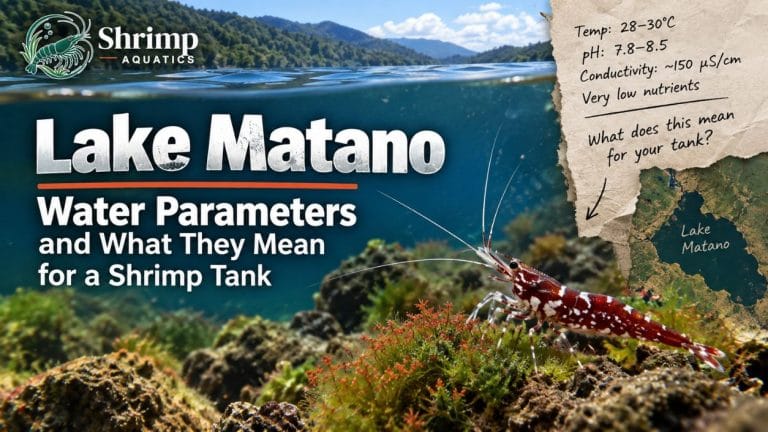
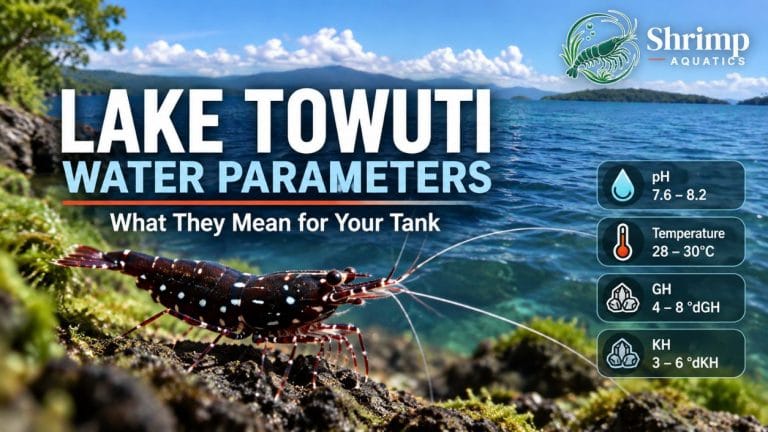
Sulawesi shrimp are lake animals from a warm, alkaline, mineral-stable system, and they’re an advanced to expert group to keep. The question to settle before anything else isn’t how slowly you’ll drip them, but whether the aquarium can hold the following band without you touching it.
| Difficulty | Advanced to expert |
|---|---|
| Temperature | 79-86°F (26-30°C) |
| pH | 7.5-8.5 |
| GH | 4-8 dGH |
| KH | 3-6 dKH |
| TDS | 150-250 ppm |
| Ammonia and nitrite | Zero, tested on the day the shrimp arrive |
| Nitrate | Aim for under 10 ppm |
| Substrate | Inert substrate and hardscape, not an active pH-lowering soil |
Those are typical ranges for the group, and a specific line or listing may come with a narrower range of its own. Treat them as the shape of the tank. Don’t chase them daily. What matters more than any single number is that the tank sits inside the band on its own, day after day, before the shrimp exist as a problem.
A calendar doesn’t prove a tank is cycled. Ammonia and nitrite at zero with an established biological filter does, and a mature Sulawesi tank also needs visible grazing surfaces, because algae and biofilm on the rock are what the shrimp will actually eat in their first week. Supplemental food doesn’t compensate for a system that isn’t there yet. If your tank can’t hold that band steadily with nothing in it, the honest move is to fix the tank before you order tank-bred Sulawesi shrimp.
- Ammonia and nitrite both read zero on a test done the day of arrival, not last week.
- Temperature has been steady inside 79-86°F (26-30°C), with a heater sized for the room’s coldest night.
- pH, GH, KH and TDS have been stable across at least two consecutive tests days apart.
- Rock and glass carry visible algae and biofilm, not a clean new surface.
- A tank set up last weekend, a tank still clearing, or a tank you’re still adjusting isn’t ready, whatever the test kit says today.
Prepare the Sulawesi water and the arrival kit before the box lands
You want two things standing by before you open anything: a small volume of prepared water that matches the tank, and a way to keep the shrimp warm while you work. Prepared water matters because a transfer sometimes needs a top up, and mixing minerals into an aquarium holding new arrivals is the opposite of the stability you’re trying to give them.
Match carbonate hardness deliberately rather than treating TDS as the only number. Alkalinity is the water’s capacity to neutralize acids and hold a fairly stable pH, and it comes chiefly from dissolved bicarbonates, carbonates and hydroxides, so water with higher alkalinity resists a pH change that would move lower-alkalinity water further.1 In practice that’s why the KH figure in the table above isn’t decoration: it’s the part of your water that keeps the pH from moving while the shrimp are settling.
Sulawesi remineralizers are made to be mixed outside the aquarium. SaltyShrimp Sulawesi Mineral 7.5, for example, states that it almost totally dissolves within seconds when added to water outside the tank and is ready for use immediately, that it buffers the pH at around 7.5, and that it raises carbonate and total hardness at a ratio of KH/dH = 0.42/1.0.2 Those are that product’s own instructions, not a Shrimp Aquatics recommendation, and its buffering point sits at the bottom of the 7.5-8.5 band, so test the finished water to see where the dose landed. Follow the current instructions for whichever mineral you actually use.
- A few liters of prepared, tested water at tank temperature and chemistry.
- A clean, chemical-free container and a soft fine mesh net kept only for livestock.
- Test kits or meters for temperature, pH, GH, KH and TDS, already checked against the tank.
- A thermometer you can read in both the bag and the tank, so the comparison means something.
- A spare heater or a warm water bath if the room is cold and the transfer may take a while.
Open a Sulawesi shipment in a dim room and read the bag before you cut it
Unpack somewhere out of a draft, with the aquarium light off and the room lights low. Sulawesi shrimp are often shy, and a bright unpacking is an avoidable stress on top of the transit they have just had.
Before you touch anything, look at the bag itself and answer three questions, because they decide what happens next. Is the bag intact and still sealed, or has it leaked? Is it a sealed transport bag or a breather bag, which exchanges gas through its wall and isn’t handled the same way? And what do the shrimp look like in there: still and clustered, or moving? Shrimp that have been in transit are often motionless for a while, so don’t judge a shipment in the first minute, and don’t discard anything on arrival day.
Don’t open a claim by opening the bag
If a shipment looks wrong, photograph the sealed bag and the box before you cut anything, and contact us at contact@shrimpaquatics.com. Evidence collected after the transfer is much harder to read.
Match the temperature first, then move the Sulawesi shrimp without their transport water
Temperature is the one difference you can close with the bag still shut, so close it first. Float the sealed bag in the aquarium until the bag and the tank read the same on the same thermometer. Only then decide how the shrimp cross.
At Shrimp Aquatics, for eligible long-distance orders that arrive in a sealed transport bag, our current shipment protocol is to equalize temperature and then transfer the shrimp across directly, commonly described as float and net, while keeping the shipping water out of the aquarium. Follow the instructions supplied with your specific order, because packing method, transit duration and species can change that decision.
- Float the sealed bag in the tank and leave it alone until both read the same temperature.
- Dim the room and switch the aquarium light off if it isn’t already off.
- Open the bag and lift the shrimp out with a soft net, or pour the bag through the net into a container so the transport water is caught and never reaches the tank.
- Keep the net submerged as you release, lowering it beside rock or hardscape so the shrimp can walk off into shelter instead of drifting in open water.
- Discard the transport water and anything it touched, then leave the tank undisturbed.
The rule that doesn’t bend is the last one. Transport water carries the waste of a closed journey, and it never belongs in the aquarium, whichever method you use to move the animals. Handle the shrimp briefly and gently, and give the same care to the second bag as the first, when an order arrives in several.
This protocol is written for eligible sealed-bag shipments. An open or leaking bag, a breather bag, fresh holding water from a local pickup, or a shipment you know nothing about is a different situation, and it should be assessed on its own.
When drip acclimation fits a Sulawesi transfer, and when it doesn’t
Drip acclimation is a real tool, not a ritual, and the honest answer is that it fits some transfers better than others. A short local move, in fresh holding water, from a tank whose parameters you can actually read, is the case it was designed for: the chemistry gap is knowable, the water in the bag isn’t old, and a slow blend costs the shrimp nothing.
A multi-day sealed shipment is a different problem, and a longer time to acclimate Sulawesi shrimp isn’t automatically the safer choice. Warm water also works against a long, open container sitting in a cool room, because cold water can hold more dissolved oxygen than warm water,3 so a small warm volume standing for hours isn’t a restful place to keep shrimp. If you do drip, keep the container thermally coupled to the tank, off the floor, and keep it short enough that the shrimp aren’t sitting in cooling, standing water at the end of it.
For any transfer that isn’t one of our shipments, work out the answer before you start. What species is it, how long was it in transit, what kind of bag is it and what condition is it in, what temperature did it arrive at, and what’s the gap between the source water and yours? If you can’t answer those, ask the seller. If it’s our order, the instructions in the box are the current answer.
Leave the new Sulawesi shrimp alone while they find the grazing surfaces
Newly moved shrimp usually go straight into the rock and stay out of sight, and the useful response is to do nothing about it. Keep the light off or low for the first days and bring it back gradually. Skip maintenance inside the tank. Watch through the glass rather than opening the lid.
Don’t start feeding on day one. In a tank that was genuinely ready, the algae and biofilm on the rock are the food, and that’s exactly why the readiness check earlier matters. Food added into a warm tank that nobody is eating from is waste the system now has to process, at the moment you least want the numbers to move. Wait until the shrimp are grazing in the open before you return to a normal feeding routine, and take leftovers out.
- Adding food because the shrimp are hiding, which loads a warm tank at its most fragile moment.
- Chasing a small parameter reading with a correction, when stability is the thing you’re trying to give them.
- Counting shrimp with a flashlight every hour, which keeps the colony hidden longer.
- Topping up evaporation with remineralized water instead of plain RO water, which walks TDS upward over weeks.
The first molt after transfer is the real test of your Sulawesi water
An acclimation that looked fine in the first hour can still be judged later, because a shrimp builds its next shell out of the water it’s living in. The major source of calcium used for crustacean exoskeleton calcification is exogenous, meaning the water the animal lives in, with stored reserves and diet contributing less.4 That’s a crustacean-level mechanism that nobody has measured in Sulawesi shrimp, but it explains why GH and KH in the table above matter more in the second week than on arrival day.
So the check that counts isn’t how the shrimp looked going in. It’s whether they’re grazing normally, whether shed exoskeletons start appearing, and whether the tank is still sitting inside its band without you steering it. Leave shed shells where they are. If a molting problem shows up across several shrimp rather than one, test GH and KH first and compare them against the table before you reach for a product.
If Sulawesi shrimp are struggling after arrival, check these before you change anything
Sulawesi shrimp dying after introduction is usually a water or maturity problem rather than a disease problem, and the fastest way to make a bad week worse is to dose something. Start with observation and the test kit: ammonia and nitrite, temperature and whether it has been drifting overnight, pH, GH, KH and TDS, how recently anything in the tank changed, and whether the behavior is the same across the whole colony or limited to one or two animals.
Copper and some fish medications can harm shrimp and snails, so nothing goes into the tank because a symptom looked familiar. We can’t diagnose a shrimp from a description, and neither can an article. If the picture is serious or you’re unsure, a qualified aquatic veterinarian or a local specialist is the right call.
You’re also welcome to write to us at contact@shrimpaquatics.com with your pH, GH, KH, TDS, temperature, tank size, how long the tank has been running and what else lives in it. Those numbers are what make the answer specific, and they’re worth sending before you make a change.
References
4 Sources
- Alkalinity and Water, U.S. Geological Survey Water Science School, updated August 24, 2026.
- Sulawesi Mineral 7,5, Minerals and trace elements, SaltyShrimp (Garnelenhaus), manufacturer product information.
- Dissolved Oxygen and Water, U.S. Geological Survey Water Science School, updated August 24, 2026.
- Biomineralizations: insights and prospects from crustaceans, Gilles Luquet, ZooKeys 176, 103-121, 2012.
Ready to get started?
Shop our Sulawesi Shrimp collection
27 products available · Live Arrival Guarantee
Featured Sulawesi Shrimp
Sulawesi Red Line Blue Dot
Caridina sp. "Red Line Blue Dot"
Advanced · 79–86°F · pH 7.5–8.5
From $15.99View Product