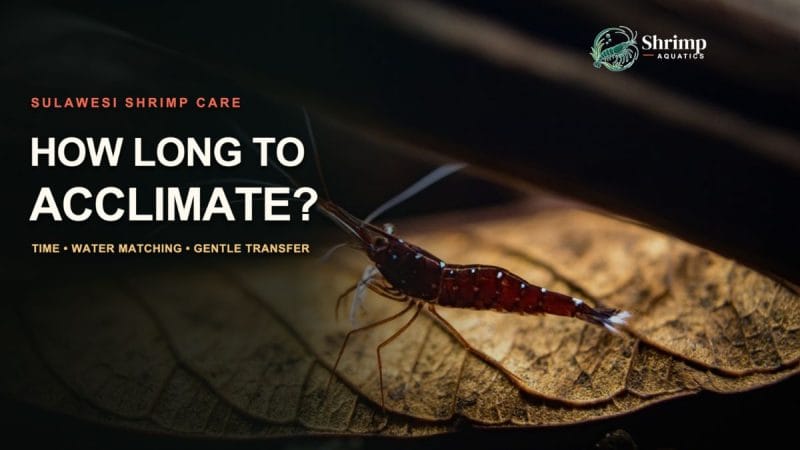
Care guides for Sulawesi shrimp mostly say two to three hours, but the real answer depends on how far apart the two waters are. No published study gives a measured acclimation time for this group. So the honest answer is that the clock governs only one part of the process: bringing the sealed bag to tank temperature. Everything after that is decided by how far apart the two waters are, and by how long the shrimp have already been sealed in that bag. For a shipped order, it’s decided by the instructions that came with it.
Why published Sulawesi acclimation times disagree with each other
Open five care guides and you’ll find five answers. The current crop publishes anything from 45 minutes for a close parameter match up to four hours for a slow drip. The figures for Sulawesi specifically sit around two to three hours. None of those pages cites a measurement. Several of them apply a single number to every dwarf shrimp in the hobby, which is how a Neocaridina drip time ends up on a page about lake Caridina.
Does that matter? More than it sounds. A number with no measurement behind it can’t tell you whether it’s the right number for your arrival. It was never tied to a transit length, a bag type, a starting water or a destination water in the first place. What it can tell you is roughly what other keepers do, which is useful context and nothing more. Treat the hour figures as a habit the hobby has settled into. Then decide your own length from the two things that actually vary: the temperature difference, and the state of the water the shrimp have been sitting in.
Match the bag temperature before you open a Sulawesi shipment
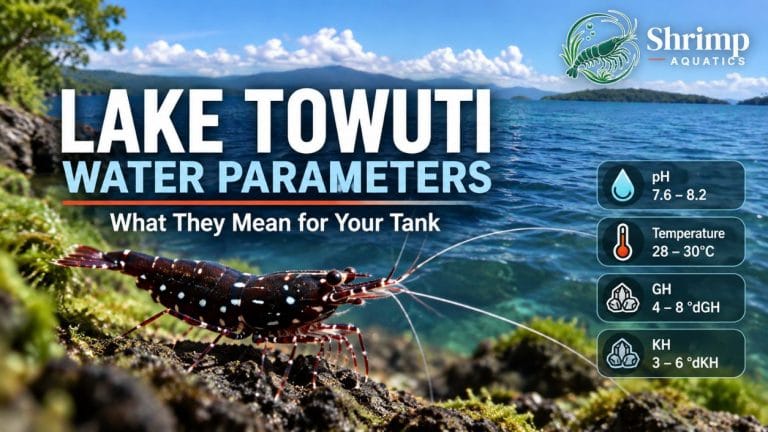
These shrimp come from lakes that don’t change. At the surface, Lake Towuti water sits at approximately 28°C, about 82°F, throughout the year, with only weak thermal layering.1 A shrimp from that lineage has no seasonal experience to draw on. That’s why the temperature step is the one part of an arrival worth being slow and deliberate about.
Float the sealed bag in the receiving tank and leave it until the water inside reads the same as the water outside. Finish this stage with a thermometer, not a stopwatch. A small bag in a warm room closes the gap quickly. A large one that arrived cold from a winter courier takes considerably longer. A bag that reaches the tank already at temperature needs almost nothing. If the shrimp are motionless and cold on arrival, let them come back to room temperature in the sealed bag before you add any heat.
A breathing bag changes how you warm the shipment
Not every order arrives in the same kind of packaging. A breathing bag is built to pass carbon dioxide and oxygen through its walls instead of sealing a gas space inside. The manufacturer of the original design states that carbon dioxide leaves the bag at four times the rate oxygen enters it.2 A bag that’s working through its walls isn’t the same object as a sealed bag holding a fixed headspace. So the way you bring it to temperature is a different question.
Identify which bag you have before anything touches water, and follow the handling note packed with that specific order for that bag type. If the packing didn’t say, ask before you float anything. This is worth a message and a short wait, because it isn’t a decision you can correct once it has gone wrong.
What multi-day transit does to the water in a shrimp bag
A sealed bag on a long international route isn’t stable water. The shrimp keep excreting nitrogen into a small closed volume, and their respiration builds carbon dioxide. Once carbon dioxide dissolves in water it reacts with water molecules to form carbonic acid, and the lower the pH value the higher the acidity of the liquid.3 That statement is written about seawater chemistry. But the reaction is the reason a closed bag drifts away from the alkaline water it was filled with over the days it travels.
The chemistry of what happens when you open it is well established for fresh water in general. Total ammonia in water sits in a balance between the ammonium ion and un-ionized ammonia, and it’s the un-ionized form that drives ammonia toxicity in aquatic animals. That balance isn’t fixed. The ratio of un-ionized ammonia to ammonium ion in fresh water rises roughly ten-fold for each single pH unit, and roughly two-fold for each 10 degree Celsius rise in temperature across the 0 to 30 degrees Celsius span.4 Those figures are drawn from criteria written for freshwater aquatic life as a whole, not for shrimp, and they set no safe or tolerated concentration for any species. What they do describe is direction, and the direction is unambiguous. Dripping warm alkaline tank water into cooled, acidified transport water moves that balance toward the more toxic form, hour after hour, in a container the shrimp can’t leave.
Warmth compounds it from a second angle. Cold water can hold more dissolved oxygen than warm water.5 So an acclimation vessel held in the Sulawesi range is working with less oxygen in reserve than a cool Neocaridina container would be, while the animals in it are respiring faster.
Longer isn’t automatically safer
The common instinct is that a slower, longer acclimation is always the gentler one. For water that has been sealed for several days that instinct runs backwards. The extra hours are spent in exactly the water you’re trying to get the shrimp out of. Drip acclimation still has a place, mainly for shrimp coming from a nearby tank in clean fresh water where the only real task is closing a mineral gap. It’s a poor fit for a parcel that has been in transit since last week.
What Shrimp Aquatics does when a Sulawesi order arrives
At Shrimp Aquatics, our current shipment protocol for eligible long-distance orders arriving in a sealed transport bag is to equalize temperature and then move the shrimp across by net. No shipping water goes into the aquarium. We don’t treat that as the only correct method for all livestock. It’s the method we use for our own packing, our own transit times and our own stock.
Two conditions sit under it. The first is that packing method, transit duration and species can all change the decision. That’s why the instructions supplied with your specific order come before anything written on a general care page, including this one. The second is that it assumes an intact, sealed bag. An open or leaking bag, a local transfer between two tanks, a breather bag or a shipment whose history you don’t know is a different situation. The safe move there is to ask about species, transit time, bag condition, temperature and both waters before choosing a method.
- Inspect before opening. Look at the sealed bag: water clarity, how many shrimp are upright and moving, whether anything has died in transit. Do this while the bag is still closed.
- Equalize temperature. Float a sealed bag, or rest a breather bag beside the tank, until the two temperatures read the same.
- Judge the water gap. If the destination water is close to what the shrimp left and the transit was short, there’s little left to close. If it’s far off, a short controlled exchange in a clean container is worth the extra minutes.
- Net them across. Lift the shrimp out with a fine net and let the transport water go down the drain. Nothing from the bag enters the aquarium.
- Leave them alone. Lights off, no feeding yet, no maintenance scheduled into the settling period.
Check the tank your Sulawesi shrimp are moving into
The length of an acclimation is mostly a function of a gap, so the gap is the thing worth knowing before the courier arrives. Test the receiving tank the day before, not the day of. Ammonia and nitrite both need to read zero on an established biological filter. The mineral and temperature values need to be sitting where they will still be sitting a week later.
| Temperature | 79-86°F (26-30°C) |
|---|---|
| pH | 7.5-8.5 |
| GH | 4-8 dGH |
| KH | 3-6 dKH |
| TDS | 150-250 ppm |
These are typical group ranges for lake Caridina, used here as the baseline you’re comparing the bag against rather than as a setup specification. A tank sitting near the top of the TDS range is a longer trip for a shrimp that has been living near the bottom of it. Knowing which end you’re on tells you more about the length you need than any published hour figure will.
At Shrimp Aquatics, most of our Sulawesi systems currently run at TDS 150 ppm, GH 6-7 dGH and pH 7.5. If your own tank sits well above that, you’re closing a real mineral gap rather than a nominal one. The exchange stage deserves more of your attention than the float did.
The arrival plan doesn’t change from one line to the next, because every tank-bred Sulawesi shrimp line we ship leaves the same water and travels the same way. Match your tank to the range above and the same routine works whichever one you ordered.
The first days after a Sulawesi transfer decide whether it worked
Acclimating Sulawesi shrimp doesn’t end when the net comes out. Keep the lights off and leave the tank alone while the shrimp spread out and find the rock. Hold food back until you can see them grazing. A mature surface is what they’ll eat first anyway, and uneaten food in warm water is the last thing a freshly stocked system needs. Don’t schedule a water change into the settling period. A colony that has just closed a mineral gap doesn’t need you opening another one.
Watch behavior rather than a countdown. Shrimp working across the hardscape, antennae active, spread through the tank instead of piled at the surface or motionless in a corner, is what a completed transfer looks like. Losses can still appear over the following days. A failed molt in Sulawesi shrimp at the next shed after a hard transfer is a plausible outcome, though you can’t diagnose it from the shell alone. If deaths continue past the first few days, treat it as a tank problem to investigate. Check parameters and the biological filter before you change anything else.
References
5 Sources
- Geomicrobiological Features of Ferruginous Sediments from Lake Towuti, Indonesia, Frontiers in Microbiology 7:1007, 2016.
- Breathing Bags, The Original Oxygen Transfer Fish Transport Bag, Kordon, product technical page.
- Understanding the Science of Ocean and Coastal Acidification, U.S. Environmental Protection Agency, updated August 24, 2026.
- Aquatic Life Ambient Water Quality Criteria for Ammonia, Freshwater, U.S. Environmental Protection Agency, Office of Water, April 2013.
- Dissolved Oxygen and Water, U.S. Geological Survey, Water Science School, updated August 24, 2026.
Ready to get started?
Shop our Sulawesi Shrimp collection
27 products available · Live Arrival Guarantee
Featured Sulawesi Shrimp
Sulawesi Red Line Blue Dot
Caridina sp. "Red Line Blue Dot"
Advanced · 79–86°F · pH 7.5–8.5
From $15.99View Product