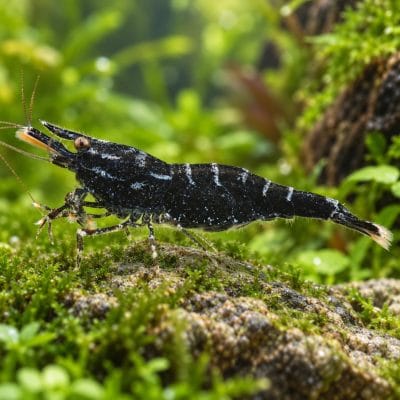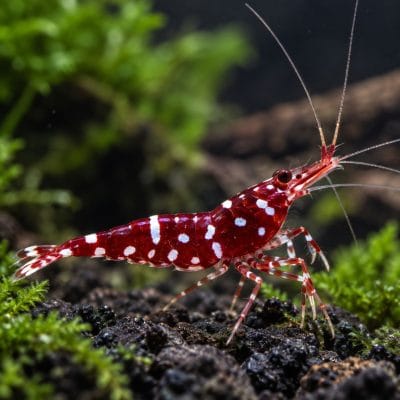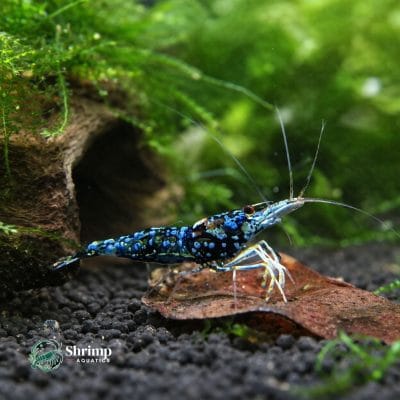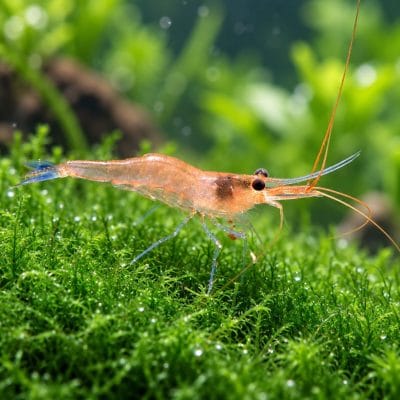
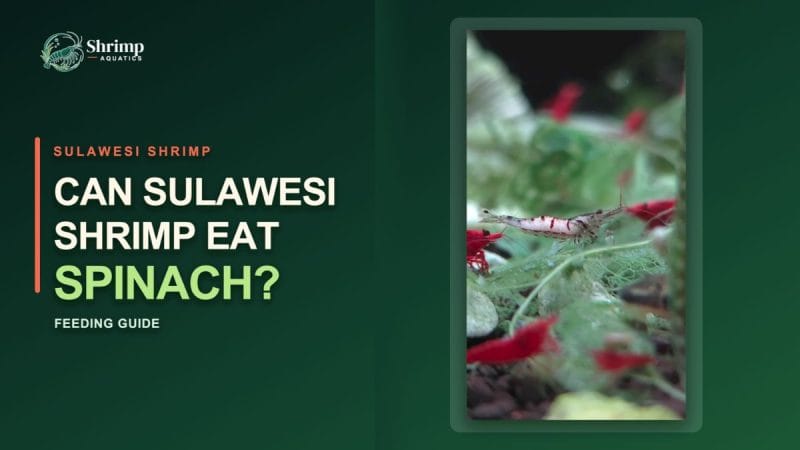
Yes. Sulawesi shrimp (Caridina spp.) will settle on a piece of blanched spinach and work it over, and nothing in the published evidence says the leaf itself poisons them. The catch isn’t the spinach. It’s that these shrimp are fine particle feeders kept in warm, alkaline water, which is the least forgiving place in the hobby to leave a soft leaf sitting. Spinach belongs in a Sulawesi tank as a rare, small, short visit, never as a food you build a diet on.
What Sulawesi shrimp actually take off a spinach leaf
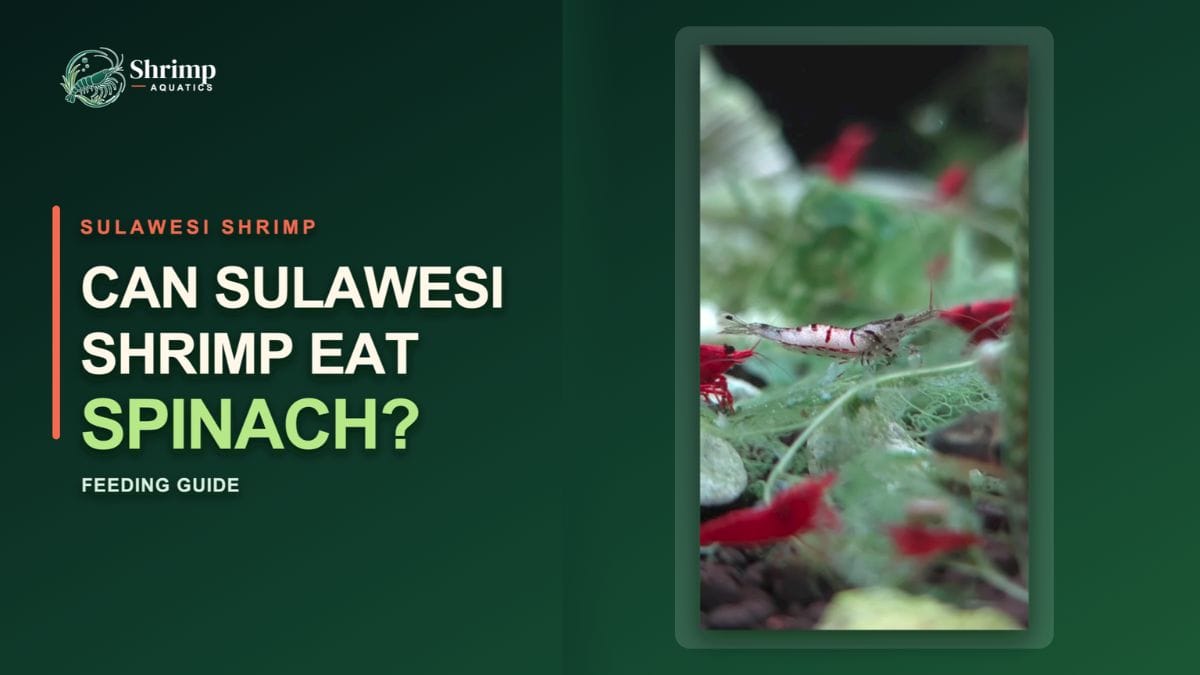
Watch a colony gather on a spinach leaf and it looks like feeding, and some of it is. The feeding mechanism of the genus was described in detail long before these lake species reached the hobby: Caridina collect fine particles of food with the chelipeds, which for this purpose are armed with greatly modified spines and setae, and transfer them rapidly to the mouthparts.1 That’s an apparatus for lifting small particles off a surface. It isn’t an apparatus for cutting and shredding a leaf.
So a piece of spinach in a Sulawesi tank is doing two jobs at once. It’s a soft food the shrimp can rasp at, and it’s a brand new surface. Within a day it carries its own film of bacteria and single celled algae, and that film sits at exactly the particle size those chelipeds are built for. If you want to know which one your colony is actually feeding on, look at the piece when you lift it out and see whether the soft leaf blade has genuinely been reduced, or whether it has come back out much the same shape it went in.
This matters for one practical reason. A keeper who reads a busy leaf as proof that Sulawesi shrimp need to eat vegetables will keep offering them, and the tank pays for that in the next section.
Why a rotting leaf costs more in warm alkaline Sulawesi water
The two facts that decide this are about the water, not about spinach. The first is ammonia. Bacterial decomposition of organic matter is where ammonia in a tank comes from, and an increase in pH favors formation of the more toxic un-ionized form, which readily diffuses across gill membranes; the ionized form doesn’t pass as easily and is appreciably less toxic.2 EPA puts a number on how steep that shift is: the ratio of un-ionized ammonia to ammonium ion in fresh water increases by 10-fold for each rise of a single pH unit, and by approximately two-fold for each 10 degrees Celsius rise in temperature from 0 to 30 degrees Celsius.3
A Sulawesi tank is run at pH 7.5-8.5 and 79-86°F (26-30°C) as a matter of course. Those two settings sit on the wrong side of both relationships at the same time. The same decaying scrap that a cool, acidic, soft water tank absorbs quietly is converted here into a much larger share of the form that actually crosses a gill.
The second fact is oxygen. During the decomposition of organic material, dissolved oxygen in the water is consumed,4 and cold water can hold more dissolved oxygen than warm water.5 A Sulawesi tank is already at the warm end of that curve, so the oxygen reserve a bacterial bloom draws down is smaller before the leaf ever goes in.
Neither relationship says a leaf will kill your shrimp. What they say together is that this tank has less margin for a mistake with soft organic matter than almost any other freshwater shrimp tank you could run, and that the margin narrows in the same direction as the parameters you’re deliberately holding.
Watch the leaf, not the clock
Once a blanched leaf has softened past the point where you can lift it out in one piece, you have no way to remove it, and every fragment left behind is decomposing in warm, alkaline water. Offer spinach only on a day when you’ll be at the tank to take it out again.
Does spinach oxalate put Sulawesi shrimp at risk during molts?
The oxalate worry is real chemistry. Spinach is a potent accumulator of anti-nutritional oxalate, and oxalate chelates divalent cations such as calcium, magnesium, zinc, manganese and iron to form insoluble complexes; in human diets, high spinach consumption reduces calcium and magnesium absorption for exactly that reason.6 From there it’s a short step to worrying about a shrimp that has to build a new shell every few weeks.
Put it in proportion before you act on it. In crustaceans, the major source of calcium used for exoskeleton calcification is exogenous, meaning the water in which the animal lives, and food makes only a minor contribution to cuticle calcification.7 A shrimp that can’t harden a new shell is far more likely to be short of minerals in the water than short of them in its last meal. If molts are going wrong in your tank, the honest first check is your mineral routine and your hardness, not whether a leaf bound some calcium in a gut a week ago.
The gap worth stating plainly is that nobody has measured what dietary oxalate does to a Caridina, at any dose, in any tank. That absence is a good reason to keep spinach occasional. It isn’t a reason to treat one blanched leaf as a poisoning, and it isn’t a reason for a competing care sheet to tell you that spinach causes failed molts.
Buy spinach for a shrimp tank as if pesticide residue is the real risk
This is the part of the question where the evidence is strongest and most hobby pages are vaguest. Insecticides used on leafy crops are designed to kill arthropods, and your shrimp are arthropods. Imidacloprid, to take the one that has been tracked most closely in fresh water, is highly toxic to freshwater invertebrates, and it reaches rivers and streams when it moves off treated fields or developed areas as runoff.8
That isn’t a reason to panic about the produce aisle. USDA tested 9,872 samples from 19 commodities of fresh and processed fruits and vegetables, nuts and fish for its 2024 Pesticide Data Program summary, and more than 99 percent of the samples tested had pesticide residues below benchmark levels established by EPA.9 Those benchmarks describe what’s acceptable for a person eating the food. They were never written for a small closed volume of water holding animals in the same broad group as the target pest, and no equivalent benchmark exists for an aquarium.
So handle the sourcing, not the statistics. Use organic spinach, or grow a few leaves yourself in soil and water you control. Rinse under running water before anything else. If you can’t say where a leaf came from or what was sprayed on it, that on its own is a good enough reason to skip it, because you gain very little from feeding it and you can’t test for what you’re worried about.
How to offer spinach to a Sulawesi colony without fouling the tank
If you still want to try it, the preparation is the whole job. Every step below exists either to reduce what the leaf brings in or to make sure you can get it back out.
- Start with an organic leaf, or one you grew yourself, and rinse it under running water to clear surface dirt.
- Blanch it briefly in plain boiling water. Cooking such as boiling is a recognized way to reduce soluble oxalate,10 and it also softens the blade and drives out trapped air so the piece sinks instead of drifting.
- Cool the leaf, then cut away the thick central stem and the main veins. Those stay tough, they’re the part your shrimp won’t reduce, and they’re what you find still lying there the next day.
- Use one small piece of the soft blade only. Set it on a flat stone or a shallow inert dish in open view, so you can see what’s happening and lift the whole thing out later.
- Remove it while it’s still intact enough to pick up in one piece. If a leftover is normal for you, the piece you’re offering is too big, not the shrimp too slow.
Two numbers you’ll see quoted elsewhere are worth ignoring. Care pages currently tell readers to pull vegetables after one to two hours, and other pages tell them six to twelve hours, and neither figure is attached to a measurement or to a species. Use the state of the leaf as your signal instead, since that’s the thing the water actually responds to.
At Shrimp Aquatics, mature algae and biofilm do most of the feeding in our Sulawesi systems. We normally offer prepared food only about once a week and remove leftovers, both because many of the shrimp in these systems show limited interest in it and because food that sits in warm water adds organic waste and can raise ammonia, nitrite and nitrate as it breaks down. Spinach isn’t something to add on top of a schedule like that. On the weeks you offer it, it takes the place of the feed rather than joining it.
What to graze a Sulawesi colony on instead of spinach
The reason spinach never becomes important in this group is that the tank itself is supposed to be the food. Mature biofilm, aufwuchs and algae on rock, wood and glass are the grazing resource these shrimp are built to work, and that resource is available all day, every day, rather than for two hours on a Sunday afternoon. A colony with good grazing surfaces is a colony you feed rarely and worry about rarely. Biofilm and algae remain the real food here, which is the core of what Sulawesi shrimp eat.
Three things reliably do more for a Sulawesi colony than any vegetable does.
- Grazing surface. Rock, wood and glass left alone long enough to grow a real film.
- Light run long enough and consistently enough for algae to establish on that hardscape in the first place.
- Mineral content held steady, since the calcium for the next shell comes out of the water rather than off the menu.
- A second food added because the first one was ignored. An ignored food is a leftover, and a leftover is waste in water that punishes waste.
A colony that grazes all day is also far easier to feed as it grows, which is worth settling before you add more tank-bred Sulawesi shrimp to the tank. So yes, Sulawesi shrimp can eat spinach. It’s just that a Sulawesi tank is something spinach has to survive. It doesn’t improve the tank.
References
10 Sources
- The Feeding Mechanism of Some Atyid Prawns of the Genus Caridina (synopsis), G. Fryer, Transactions of the Royal Society of Edinburgh 64(10): 217-244, 1960.
- Ammonia, U.S. Environmental Protection Agency, CADDIS, updated January 22, 2026.
- Aquatic Life Ambient Water Quality Criteria for Ammonia, Freshwater, U.S. Environmental Protection Agency, Office of Water, April 2013.
- Indicators: Dissolved Oxygen, U.S. Environmental Protection Agency, updated February 24, 2026.
- Dissolved Oxygen and Water, U.S. Geological Survey, Water Science School, updated August 24, 2026.
- Regulation of Oxalate Metabolism in Spinach Revealed by RNA-Seq-Based Transcriptomic Analysis, V. Joshi, A. Penalosa, M. Joshi and S. Rodriguez, International Journal of Molecular Sciences 22: 5294, 2021.
- Biomineralizations: insights and prospects from crustaceans, G. Luquet, ZooKeys 176: 103-121, 2012.
- A Decade of Data Reveals Imidacloprid, a common insecticide, is Increasing in American Rivers, U.S. Geological Survey, July 9, 2026.
- USDA Publishes 2024 Pesticide Data Program Annual Summary, U.S. Department of Agriculture, Agricultural Marketing Service, January 6, 2026.
- Management Strategies for the Anti-nutrient Oxalic Acid in Foods: A Comprehensive Overview of Its Dietary Sources, Roles, Metabolism, and Processing (abstract), A. Zayed, G. M. Adly and M. A. Farag, Food and Bioprocess Technology 18(5): 4280-4300, 2025.
Ready to get started?
Shop our Sulawesi Shrimp collection
27 products available · Live Arrival Guarantee