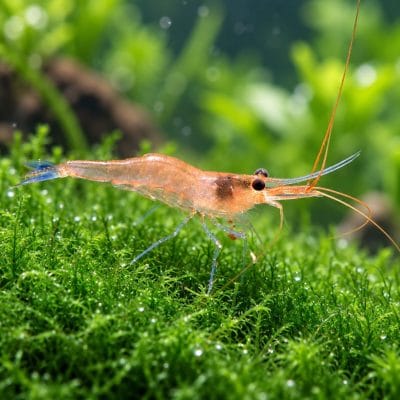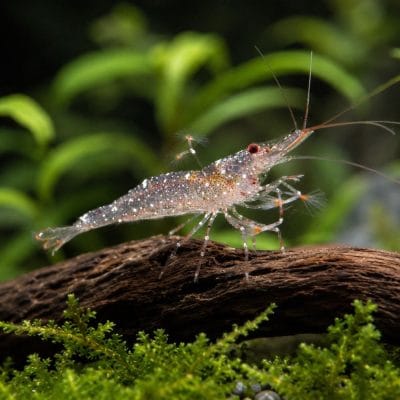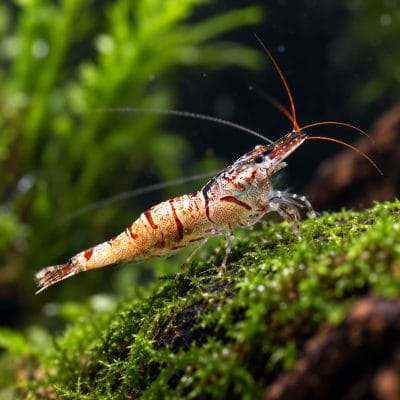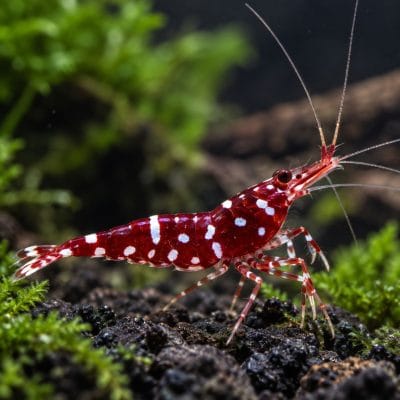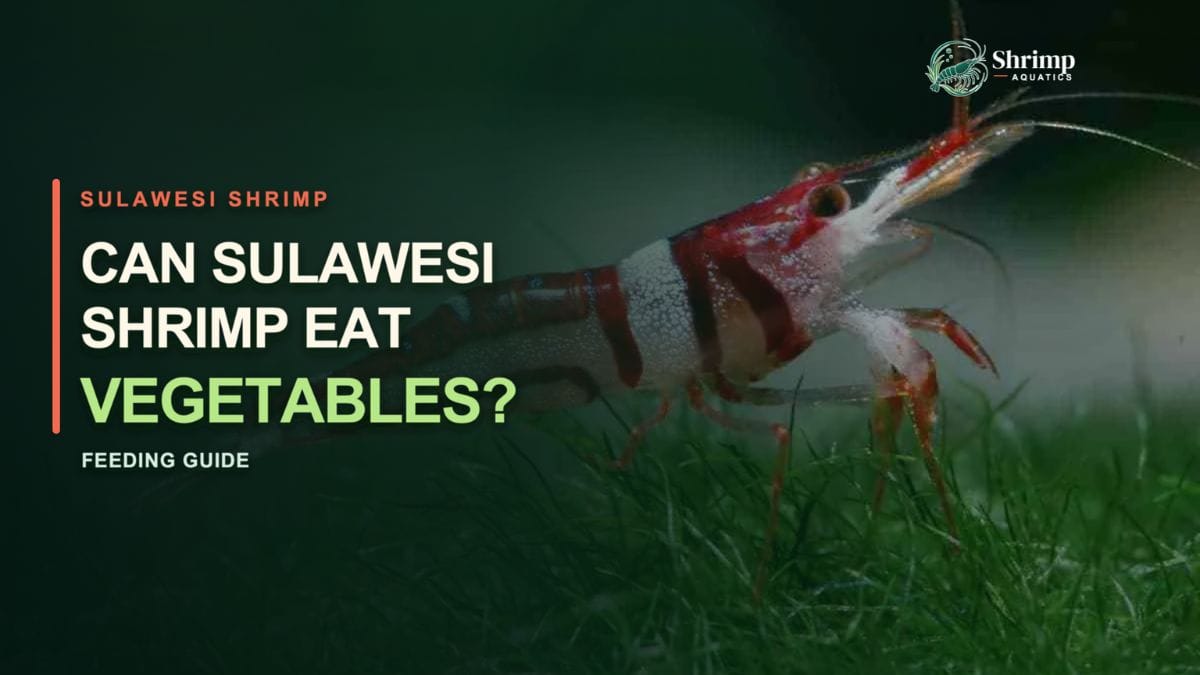
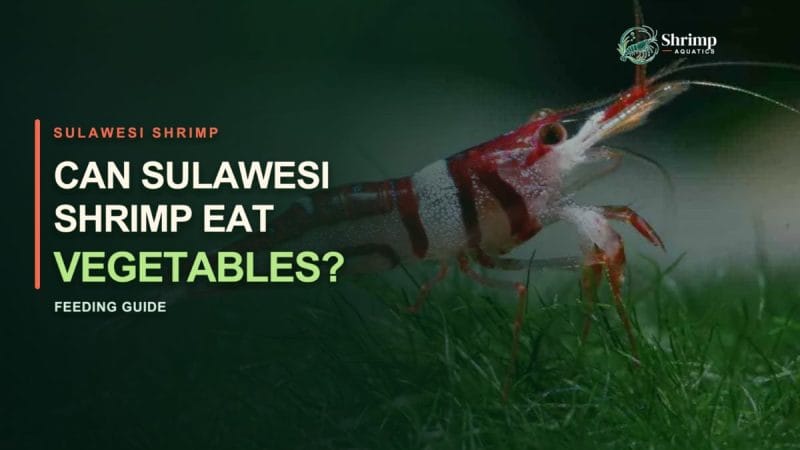
Yes, Sulawesi shrimp will climb onto a piece of blanched vegetable and work at it, and there is nothing wrong with offering one. What they take off it is mostly the soft surface material, not the plant fiber underneath. That makes a vegetable a grazing surface rather than a meal. So the deciding question isn’t what to feed. It’s how long the piece can sit in warm alkaline water before it starts costing you water quality. In a tank held at 79-86°F (26-30°C) and pH 7.5-8.5, the honest answer is about two hours.
What Sulawesi shrimp are actually eating off a blanched leaf
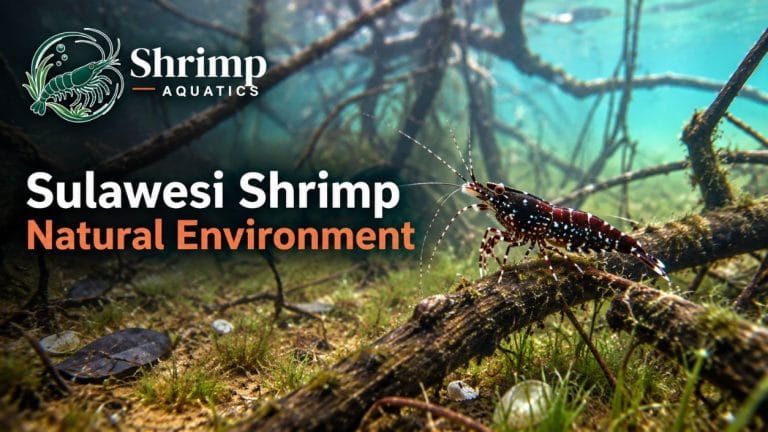
The lake Caridina of Sulawesi are hard-surface animals. In the 2009 revision of the group, specimens were collected on gravel, on boulders in deeper water, on rocks, on wood and on sponges. None came out of soft sediment.1 A 2025 survey of deep-water Caridina in Lake Poso reports the same pattern for named species. Caridina longidigita prefers hard substrates such as wood, boulders and gravel and has never been observed in sandy areas. Caridina caerulea is abundant on rocky bottoms.2 These are shrimp that spend the day going over solid surfaces with their front legs.
That’s what happens when you drop a blanched leaf in. A soft, boiled surface sitting in a warm mature tank becomes one more thing to work over, and the shrimp go at it the way they go at rock. What comes away is the soft material on and just under that surface. The tough structural fiber isn’t what they’re after, and it usually leaves the tank as a limp skeleton. So the vegetable is doing the same job a piece of rock does, only it rots. That’s worth being clear-eyed about, because it changes what a good result looks like. A piece of zucchini covered in shrimp doesn’t mean the colony was hungry. A piece nobody touches doesn’t mean the shrimp are fussy. It’s the reason a Sulawesi tank is judged on its rockwork and its maturity before its feeding schedule. It’s also why every one of our Sulawesi shrimp lines goes into a system with established grazing surfaces before food is a question at all.
Warm alkaline water shortens how long that leaf can stay in
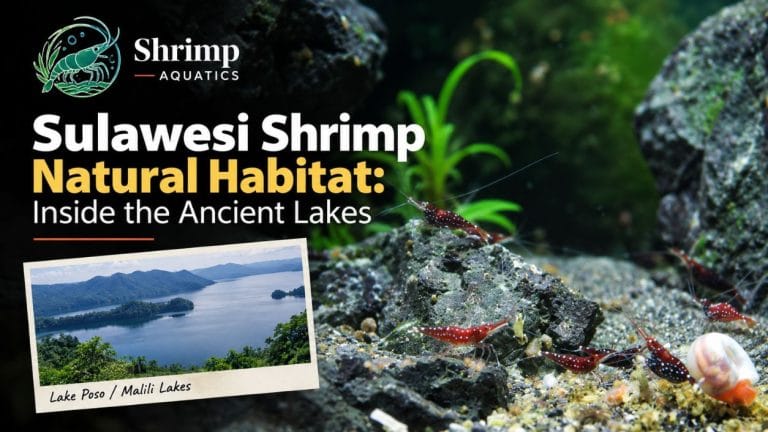
Sulawesi isn’t a temperature preference you can trade away. Lake Towuti, one of the Malili lakes these shrimp come from, holds water temperatures of approximately 82°F (28°C) throughout the year. It shows only weak thermal stratification through the column.3 The tank follows: 79-86°F (26-30°C), pH 7.5-8.5. Both halves of that range change what leftover food does.
The alkaline half is the one keepers underestimate. Total ammonia in water sits in equilibrium between the ammonium ion and un-ionized ammonia, and it’s the un-ionized form that drives toxicity. EPA’s freshwater ammonia criteria document states that the ratio of un-ionized ammonia to ammonium ion in fresh water increases by 10-fold for each rise of a single pH unit. It rises by approximately two-fold for each 10 degree Celsius rise in temperature across the range 0 to 30 degrees Celsius.4 The same document states that high external un-ionized ammonia concentrations reduce or reverse diffusive gradients and cause a build-up of ammonia in internal tissues.4 So what does that mean for your test kit? A total ammonia reading isn’t a fixed amount of danger. The same number on the same vial means something harder in alkaline water than in a soft-water tank a full pH unit lower. It means something harder again at 84°F (29°C) than in a cooler tank. A Sulawesi setup sits at the demanding end of both scales at once. That’s why a forgotten piece of spinach is a different event here than in a room-temperature cherry shrimp tank.
The warm half works against you from the other side. Cold water can hold more dissolved oxygen than warm water, so a Sulawesi tank starts with a smaller oxygen reserve than a room-temperature one.5 Decomposition is one of the things that spends that reserve. So the same piece of food is being broken down against a smaller buffer than it would be in a room-temperature tank. None of this makes vegetables dangerous by themselves. It makes the clock shorter, and it means the margin you may have gotten away with in a cherry shrimp tank doesn’t transfer.
Vegetables won’t solve a molting problem in a Sulawesi tank
The usual reason people start feeding vegetables to shrimp is minerals, and specifically the idea that leafy greens feed the shell. That’s worth taking apart, because it sends keepers to the fridge when they should be looking at a TDS meter. In crustaceans generally, the major source of calcium used for exoskeleton calcification is exogenous, meaning the water the animal lives in. Stored premolt reserves and food, including consumed exuviae, make a minor contribution to cuticle calcification.6
That’s a crustacean-level mechanism, not a measurement on any Sulawesi species, so treat it as the direction things work. But the direction is enough to act on. If shrimp in your tank are having trouble at the molt, check GH, KH, TDS and how much those have moved recently. Don’t ask whether the colony has had kale this week. A vegetable is a reasonable enrichment. It isn’t a Sulawesi shrimp mineral supplement, and treating it as one usually means the actual problem goes unexamined for another fortnight.
Picking produce that won’t move a Sulawesi tank’s KH or pH
Anything you put in the tank is judged on two things: how fast it collapses into the water, and whether it drags the chemistry anywhere. The list below is short on purpose. There’s no nutritional reason to work through a greengrocer.
| Item | Why keepers offer it | How it behaves in a warm tank | Practical call |
|---|---|---|---|
| Zucchini, peeled and deseeded | Holds shape long enough to be grazed, easy to portion | Dense flesh stays intact for a couple of hours; seeds and skin foul faster than the flesh | The default choice. One thin quarter slice, out within two hours |
| Spinach, blanched | Soft fast, shrimp settle on it quickly | Goes slimy quickly at 79-86°F (26-30°C) and sheds material into the water | Workable, but the shortest clock of the group. Watch it, don’t walk away |
| Stinging nettle, dried or blanched | Fibrous leaf that holds a film without collapsing | Resists breaking up longer than spinach | A good occasional option in small fragments |
| Mulberry leaf, boiled soft | Slow to break down, gives a stable grazing surface | Structure holds well past the point where a vegetable would have gone | The one item that can reasonably stay in longer, in a mature tank you’re watching |
| Cucumber | Cheap and easy, shrimp will sit on it | Collapses into loose pulp fast and disperses through the water column | Little to gain. Skip it in favor of zucchini |
Leaves and botanicals that work against an alkaline tank
Indian almond leaf is the standard botanical in soft-water Caridina keeping and it doesn’t belong in this one. Alkalinity is the buffering capacity of a water body, a measure of its ability to neutralize acids and so maintain a fairly stable pH. It comes from dissolved bicarbonates, carbonates and hydroxides.7 A Sulawesi tank is built on that buffer. Anything that steadily releases acids into the water is spending it, and the whole point of the setup is that it doesn’t move. We aren’t aware of a published measurement of what catappa does to KH in a Sulawesi system specifically. So the honest position isn’t that a leaf will crash your tank. It’s that the tank’s entire design is a buffer you deliberately built, and there’s no reason to hand it a job. Boiled mulberry or guava leaf gives you the same slow grazing surface without that argument.
What to keep out of a Sulawesi tank entirely
Garlic, onion and other alliums are common in shrimp folklore and have no place here. Acidic fruit belongs in the same bin, for the reason above. Starchy tubers such as potato go anaerobic in the substrate rather than being grazed. And the produce itself is worth a thought before it’s worth a knife. Insecticides are designed to be lethal to insects, so they pose a particular risk to aquatic insects, but they also affect other aquatic organisms.8 Shrimp are in that second group. Buy organic where you can, and rinse hard in RO or distilled water either way. If you wouldn’t eat it unwashed, don’t offer it to a colony you can’t rinse.
How to prepare and portion one piece for a Sulawesi colony
- Rinse the piece thoroughly in RO or distilled water rather than tap water, and cut away skin and seeds where they’re present.
- Blanch it in boiling RO or distilled water for two to three minutes, until it’s soft enough to give under light pressure. This drives out the air that would otherwise keep it floating and breaks down the surface enough for the shrimp to work it.
- Chill it briefly in cold purified water so it goes in at something close to tank temperature.
- Cut the portion small. For a colony of fifteen to twenty adults, a fragment about the size of a fingernail is the whole feeding. A piece that still looks generous after ten minutes is too big.
- Put it on a glass dish or a smooth flat stone on open substrate, never wedged into rockwork. You want to be able to lift the entire thing out in one movement, including whatever has crumbled off it.
- Note the time. This is the part people skip and it’s the part that matters.
How long a blanched vegetable stays in a Sulawesi tank
Take it out within about two hours, and take it out whether or not it has been eaten. If nothing has come near it in thirty to forty-five minutes, the colony is telling you it’s grazing elsewhere. The piece is now just organic material sitting in warm alkaline water. Nothing organic stays in a Sulawesi tank overnight.
Set an alarm, not an intention
The two-hour figure is a practical ceiling, not a measured safety threshold, and the risk it manages is water quality. Most fouling incidents in warm alkaline tanks aren’t the result of a keeper deciding to leave food in. They’re the result of a keeper getting distracted.
At Shrimp Aquatics, mature algae and biofilm do most of the feeding in our Sulawesi systems. We normally offer prepared food only about once a week and remove leftovers. Many of the shrimp in these systems show limited interest in it. Food that sits in warm water adds organic waste and can raise ammonia, nitrite and nitrate as it breaks down. The same holds for spirulina. Sulawesi shrimp will eat spirulina too, and the part they don’t eat is what the warm, alkaline water has to absorb. Algae and biofilm do the real feeding day to day, and a vegetable only tops that up, as what Sulawesi shrimp eat sets out.
Read that as a cadence, not a rule for every tank. If you already feed once a week with a prepared food, a vegetable isn’t a separate meal to add on top of it. It replaces that feeding, or it waits until the following week. A blanched spinach leaf follows the same rule: Sulawesi shrimp can eat spinach, but only as a rare, small, short visit, never as a food the diet is built on.
When to skip vegetables in a Sulawesi tank altogether
There are three situations where the right amount of vegetable is none. The first is a tank that isn’t finished. If the rock and glass aren’t yet carrying visible growth, the colony doesn’t have a grazing base. Adding food won’t build one any faster than light and time will. The second is a tank with a colony that has just arrived. New shrimp are usually not eating in a way you can read. A piece of produce during that window tells you nothing, and it adds waste at the moment the system is least settled. The third is any tank where the parameters have moved recently. Feeding into an unstable system adds a variable you’ll have to rule out later.
The habit worth building is the opposite of a feeding schedule. Watch the grazing surfaces. Picture a colony working steadily over rock and glass, with shrimp spread through the tank rather than clustered at one spot. That colony doesn’t need a vegetable this week. Offer one when you want to watch them, take it out on time, and keep the real work where it belongs, which is holding the water still.
References
8 Sources
- Radiation of endemic species flocks in ancient lakes: systematic revision of the freshwater shrimp Caridina from the ancient lakes of Sulawesi, Indonesia, with the description of eight new species, Raffles Bulletin of Zoology 57(2): 343-452, Lee Kong Chian Natural History Museum, 2009.
- First report on deep-water Caridina spp from Lake Poso, Sulawesi, BIO Web of Conferences 185, 02002, 2025.
- Geomicrobiological Features of Ferruginous Sediments from Lake Towuti, Indonesia, Frontiers in Microbiology 7, article 1007, 2016.
- Aquatic Life Ambient Water Quality Criteria for Ammonia, Freshwater, U.S. Environmental Protection Agency, Office of Water, April 2013.
- Dissolved Oxygen and Water, U.S. Geological Survey, Water Science School, updated August 24, 2026.
- Biomineralizations: insights and prospects from crustaceans, ZooKeys 176: 103-121, 2012.
- Alkalinity and Water, U.S. Geological Survey, Water Science School, updated August 24, 2026.
- Insecticides, U.S. Environmental Protection Agency, CADDIS, updated January 22, 2026.
Ready to get started?
Shop our Sulawesi Shrimp collection
27 products available · Live Arrival Guarantee