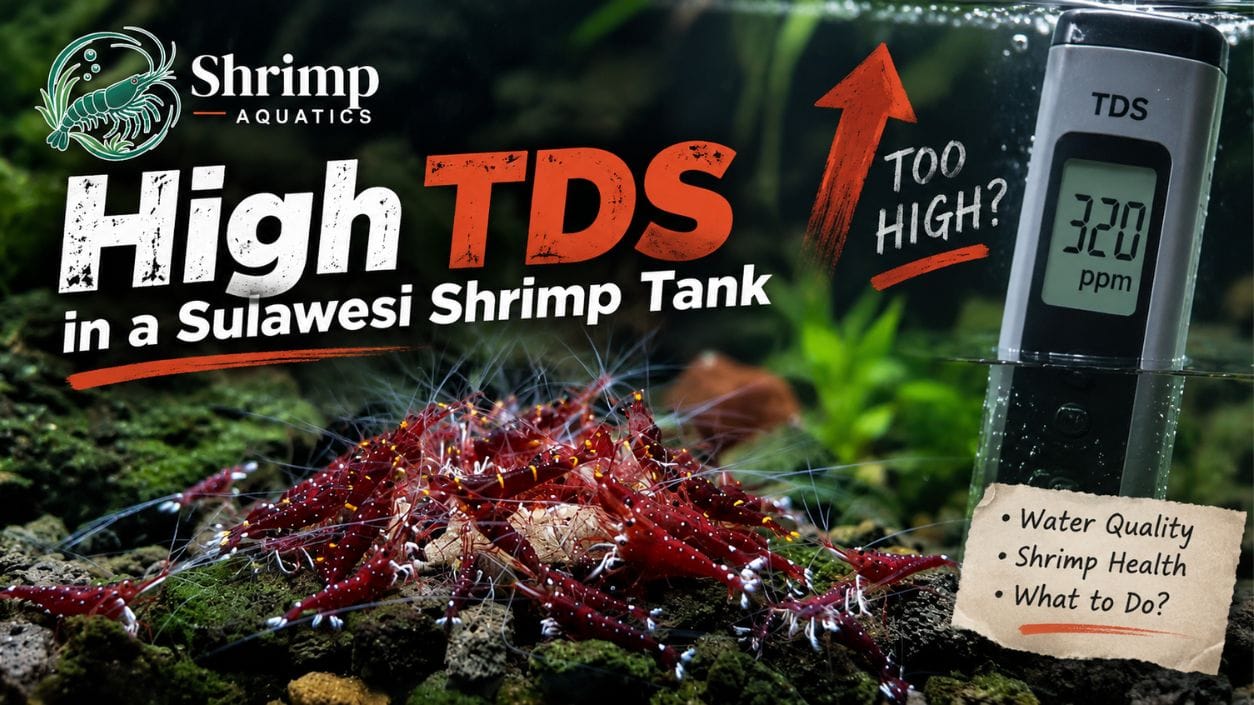
A TDS reading above the 150-250 ppm band Sulawesi shrimp are kept in tells you that something dissolved in your water has been added or concentrated. It doesn’t tell you what. No published study we can find puts a number on the TDS at which Sulawesi lake Caridina start to suffer, so the reading on its own isn’t a diagnosis. Read GH, KH and nitrate next, work out whether minerals or waste moved, stop whatever is feeding it, then bring the number back down slower than it climbed.
Confirm a high Sulawesi TDS reading before you change anything
Before you touch the tank, find out whether the number is real. A pen that hasn’t been calibrated in a year is a poor witness. A flat battery usually reads high rather than reading nothing at all. Check the pen against its calibration solution first. Then take three readings a minute apart from mid water, not one skimmed off the surface.
Now test the water you’ve been putting in. If your RO or DI water isn’t reading close to zero, the membrane or the resin is finished, and every top off has been adding minerals you didn’t intend to add. That’s worth knowing before you start correcting the display tank.
- Calibrate the pen, or borrow a second one and compare.
- Take the reading from mid water, not off the top.
- Test your RO or DI water straight from the unit.
- Test your mixed replacement water, not just the tank.
- Write the number down, so tomorrow’s reading means something.
What a TDS meter counts in your Sulawesi tank, and why the number climbs on its own
A TDS meter doesn’t weigh anything. It measures specific conductance, the water’s ability to carry a current, which rises with the amount of dissolved ions. That stands in for the sum of every substance dissolved in the water, organic and inorganic, and in natural water calcium, magnesium, sodium, potassium, bicarbonate, sulfate, chloride, nitrate and silica make up most of it.1
Read that list again and you’ll see the problem. Calcium is in the number. So is nitrate. The pen gives them the same weight and hands you one figure. A tank whose minerals are fine but whose waste is climbing reads just like a tank whose minerals are climbing and whose waste is fine.
The number also rises without anyone adding a thing. Pure water leaves as vapor and the dissolved solids stay behind, so evaporation concentrates what’s left.1 Your tank runs at 79-86°F (26-30°C). That’s warm enough to lose water steadily, which is why this is the drift most keepers meet first.
Use GH, KH and nitrate to tell Sulawesi mineral creep from a waste problem
Three tests sort it out, and you probably own all three already. Take GH, KH and nitrate at the same time as the TDS reading. Then compare them against the band the group is kept in.
| What you check | Minerals have crept up | Waste is building |
|---|---|---|
| GH and KH | One or both sit above GH 4-8 dGH or KH 3-6 dKH | Both still sit where they always have |
| Nitrate | Still low, under 10 ppm | Climbing, and ammonia or nitrite may show too |
| Recent history | Topping off with mixed water, a fresh salt batch, new rock or sand | Heavier feeding, a lost shrimp or snail, a filter left alone for months |
| Where to start | Stop the input, then dilute slowly | Find and remove the organic load first |
Both can be true at once, and often are, because a tank that gets topped off carelessly usually gets fed carelessly too. If nitrate is up, treat that side first. Waste is the half of the reading that can hurt the colony this week.
Where the extra minerals in a Sulawesi tank usually come from
If GH and KH moved, something is putting minerals in. There are only a few honest candidates, and they’re all on the maintenance side of the glass rather than inside the tank.
Topping off evaporation with remineralized water instead of plain RO
This is the big one. Evaporation takes the water and leaves the minerals. Replace that water with your mineral mix and you’ve added a second dose on top of a load that never left. Do it weekly for a few months and the reading walks up on its own. Top offs get plain RO or DI water. The mineral mix is for water changes, where minerals actually went out with the old water. Getting that split right is most of what it takes to stabilize the water for Sulawesi shrimp.
A carbonate Sulawesi mineral that never fully dissolved
Not every Sulawesi salt stirs in. The maker of Sulawesi Mineral 8.5 says that on a regular CO2 quantity of about one bubble per second the salt dissolves totally in approximately 3-4 days, and that you should then aerate the water for at least three hours with an air stone to expel the CO2 before use.2 That’s days of preparation, not minutes.
So if you stirred a carbonate salt into a bucket and poured it in while it still looked cloudy, the batch wasn’t finished. The fix sits on the mixing side, in how you prepare and test a batch of remineralized RO water, not in anything you can do to the tank today.
Rock or substrate that keeps dissolving into the water
If GH and KH keep climbing and you genuinely haven’t added anything, look at what’s sitting on the floor. Crushed coral, aragonite and some unidentified stones don’t sit still in water, and a bed of them is an input you can’t switch off. The best substrate for Sulawesi shrimp is an inert one, and that’s what lets your numbers hold where you put them.
Why a waste driven TDS rise costs more in warm alkaline water
If nitrate is what moved, the reading is the least of it. Organic waste breaks down into ammonia first, and the risk of ammonia poisoning in Sulawesi shrimp depends on the water that ammonia lands in. EPA’s freshwater assessment states that the ratio of un-ionized ammonia to ammonium ion in fresh water increases by 10-fold for each rise of a single pH unit, and by roughly two-fold for each 10 degree Celsius rise across the 0 to 30 degree range. It’s the un-ionized form that drives toxicity, and high external concentrations reduce or reverse diffusive gradients so that ammonia builds up in internal tissues and blood.3
That’s a finding for the freshwater assemblage EPA studied. It isn’t a shrimp threshold and it sets no safe number for your tank. But the direction is the point. Your tank sits at pH 7.5-8.5 and 79-86°F (26-30°C), which is the warm alkaline end of that relationship. The same forgotten pellet is doing more here than it would in a cool, near neutral cherry shrimp tank. Test ammonia and nitrite, find what’s decaying, lift it out, and feed less until the tank catches up.
What has actually been measured about TDS and Sulawesi shrimp
Here’s the honest part. Nobody has published a TDS at which Sulawesi lake Caridina stop coping, or how fast the number can be moved without harm. Care sheets that print a hard ceiling aren’t citing anything. We’d rather tell you that than invent a line for you to panic about.
Two things are measured at a wider scope, and they pull in opposite directions. Shrimp in this family work to stay saltier than the water around them. In the atyid Halocaridina rubra, hemolymph osmolality sat about 868 mOsm per kg above the surrounding medium in fresh water, and every gill carried mitochondria-rich cells with constantly high ion transport capability.4 That’s a different animal in different water. It tells you the family spends effort holding that gradient. It doesn’t tell you what your pen reading costs your shrimp.
Pulling the other way, the calcium that goes into a new shell mostly comes from outside the animal. The major source of calcium used for crustacean exoskeleton calcification is exogenous, the water the animal lives in, with stored premolt reserves and diet contributing less.5 So the mineral half of a high reading isn’t purely a stress question. It’s also the supply the next molt draws on, which is a good reason not to strip it out in an afternoon. If you’re already looking at a failed molt in a Sulawesi shrimp, leave the animal alone and test the water instead.
Bring a high Sulawesi TDS down slower than it rose
Stop the input first. Until top offs are plain RO, the salt batch is properly dissolved and the leaching rock is out, anything you dilute today comes back next week. Once the input is off, a tank that drifted up over three months should come back over weeks, not over a weekend.
Mix replacement water a little under your current tank reading rather than at zero. Bring it to tank temperature. Then let it in slowly. A gravity drip at one to two drops a second into the filter outflow is the usual way, and a change of five to ten percent is plenty per session. Feed lightly while you’re doing it, because less food in means less of the waste half of the number.
Where should you land? At Shrimp Aquatics, most of our Sulawesi shrimp systems currently run at TDS 150 ppm, GH 6-7 dGH and pH 7.5. That’s the lower half of the band, and it’s where we’d aim a tank that has drifted high, because it leaves room to drift again before anything needs correcting.
One practical note on timing. If your Sulawesi mineral needs days of CO2 because it is the carbonate type, you can’t mix corrective water on the morning you need it. The maker of Sulawesi Mineral 7.5 says that salt almost totally dissolves within seconds, that the water is ready for use immediately, and that it buffers the pH at around 7.5.6 Whichever you use, plan the batch before the reading forces your hand.
Don’t fix this with one big water change
Swapping half the tank for fresh RO moves the water further and faster than the drift ever did. It’s the most common way a high reading turns into dead shrimp. The only sensible answer is smaller and slower than feels satisfying.
A tank sitting above 250 ppm and holding steady while you walk it down is in less trouble than a tank reading a tidy 200 ppm because you dumped in RO water yesterday. Steady beats correct. Fix the reason the number moved, then let the number follow.
References
6 Sources
- Chloride, Salinity, and Dissolved Solids, U.S. Geological Survey, Water Resources Mission Area, March 1, 2019.
- Sulawesi Mineral 8,5, Minerals and trace elements, SaltyShrimp (Garnelenhaus), product technical page.
- Aquatic Life Ambient Water Quality Criteria for Ammonia, Freshwater (2013), U.S. Environmental Protection Agency, Office of Water, April 2013.
- Osmoregulation in the Hawaiian anchialine shrimp Halocaridina rubra (Crustacea: Atyidae), Journal of Experimental Biology 217(13): 2309-2320, 2014.
- Biomineralizations: insights and prospects from crustaceans, ZooKeys 176: 103-121, 2012.
- Sulawesi Mineral 7,5, Minerals and trace elements, SaltyShrimp (Garnelenhaus), product technical page.
Ready to get started?
Shop our Sulawesi Shrimp collection
27 products available · Live Arrival Guarantee
Featured Sulawesi Shrimp
Sulawesi Red Line Blue Dot
Caridina sp. "Red Line Blue Dot"
Advanced · 79–86°F · pH 7.5–8.5
From $15.99View Product