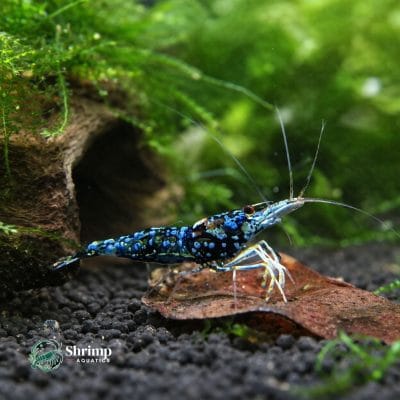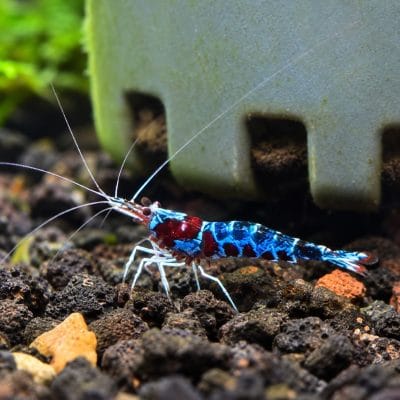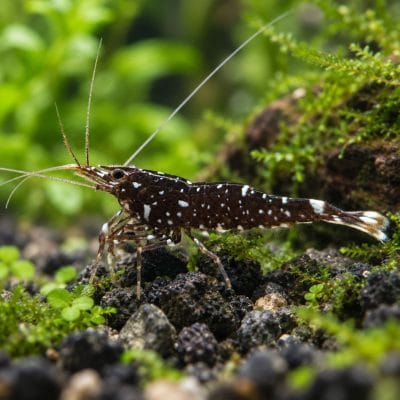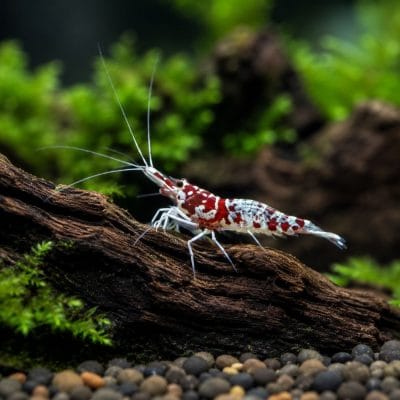
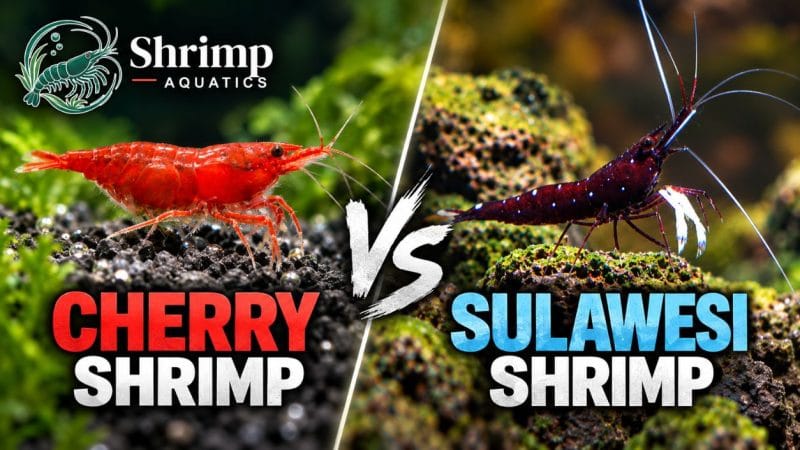
If you’re choosing between the two, keep cherry shrimp. Sulawesi shrimp aren’t a harder version of the same animal. They’re a different tank: warm, alkaline, built from RO water, and left to grow a grazing surface for weeks before anything goes in it. That tank is a project. A cherry tank is a Tuesday. Below is what each one asks of you, so you can tell which one your setup can already hold steady.
The only water number Sulawesi shrimp and cherry shrimp cannot share
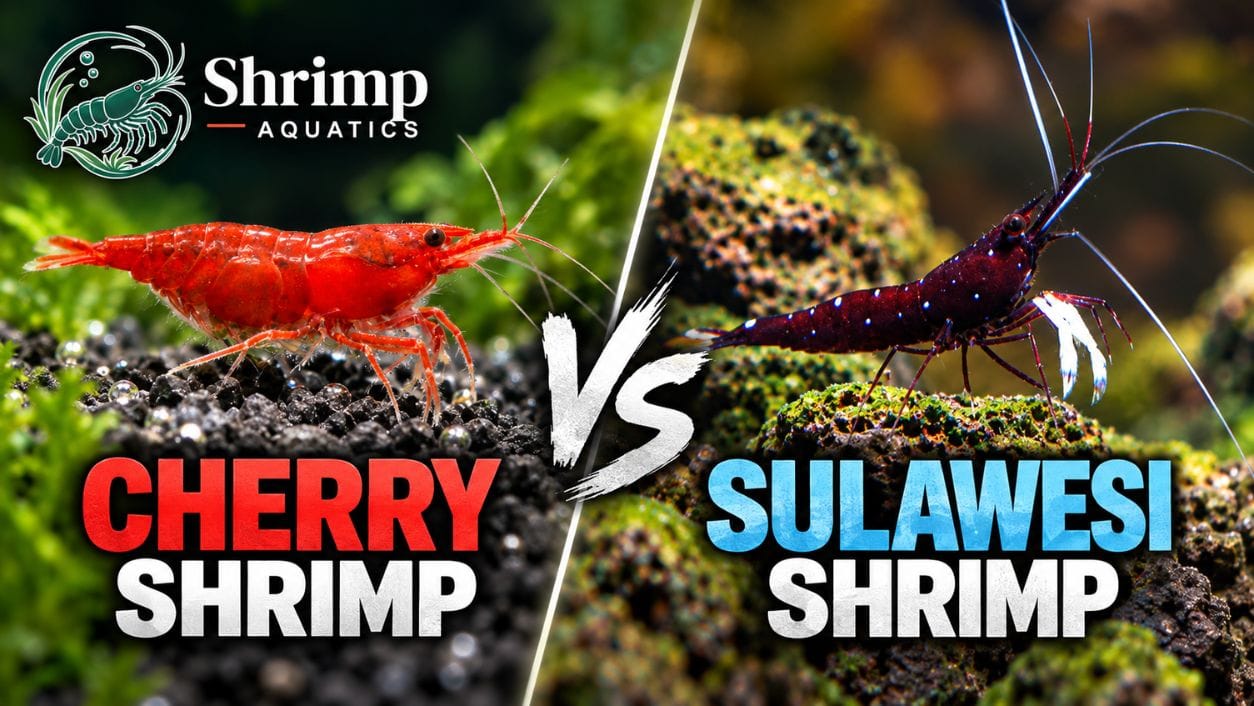
Put the two side by side and the surprise is how much they agree on. pH, hardness and dissolved solids all overlap somewhere. It’s temperature that splits them, and it splits them completely.
| What you set | Sulawesi shrimp | Cherry shrimp |
|---|---|---|
| Difficulty | Advanced to expert | Often beginner friendly in a stable, suitable tank |
| Temperature | 79-86°F (26-30°C) | 65-78°F (18-26°C) |
| pH | 7.5-8.5 | 6.5-8.0 |
| GH | 4-8 dGH | 6-12 dGH |
| KH | 3-6 dKH | 2-8 dKH |
| TDS | 150-250 ppm | 150-300 ppm |
| What they mostly eat | Mature biofilm, aufwuchs and algae grazed off rock | Biofilm and algae plus prepared foods |
| Temperament | Peaceful and often shy | Peaceful |
Read the pH row again. A cherry tank at pH 7.8 and a Sulawesi tank at pH 7.8 show the same reading. One of them is an ordinary community tank. The other is a specialist system. That’s the thing most comparisons get wrong. The numbers aren’t what makes Sulawesi shrimp hard. Holding them steady is.
Temperature is the line you can’t split
No single setting suits both groups. Run the tank cool enough for cherry shrimp and you’re under everything a Sulawesi shrimp is kept at. Run it warm enough for Sulawesi shrimp and your cherry shrimp live above their range every day of the year. If you want both animals, you want two tanks.
What a Sulawesi tank costs you that a cherry tank does not
People budget for the shrimp and forget the water. With cherry shrimp the water is close to free. With Sulawesi shrimp it’s the whole job, and it starts before you order anything alive.
Why a Sulawesi tank starts with RO water and a mineral salt
Cherry shrimp settle into dechlorinated tap water in most places, as long as it’s copper free and the hardness lands somewhere sensible. A Sulawesi tank doesn’t work that way. Sulawesi shrimp need RO water with nothing in it, rebuilt with a mineral made for these lakes. You need low dissolved solids and an alkaline pH at the same time, and tap water almost never gives you both.
Which mineral you pick changes your week. One of the two common SaltyShrimp formulations dissolves almost completely within seconds and buffers the water at around pH 7.5, so a batch is ready when you are.1 The other is a carbonate salt. It only goes into solution with carbon dioxide added at roughly one bubble a second for about 3-4 days, after which the maker says to aerate the water with an air stone for at least three hours to drive the gas back out.2 If mixing water is going to be a four day errand, you want to know that before the shrimp are in a bag. Weigh up Sulawesi Mineral 7.5 or 8.5 before you buy either one.
Why warm alkaline water punishes a feeding mistake
Here’s the part that catches people who have kept cherry shrimp for years. Ammonia in water sits in two forms, and only the free, un-ionized one really hurts. The share sitting in that form rises about tenfold for every single pH unit you go up. It roughly doubles again for every 10 degree Celsius rise between freezing and 30 degrees.3 A Sulawesi tank runs high on both of those dials at once. The same pinch of uneaten food that a cool, near neutral cherry tank shrugs off is doing more damage here, and your test kit still reads the same total.
Warmth costs you on the other side too, because cold water holds more dissolved oxygen than warm water does.4 So a filter for Sulawesi shrimp has to give you strong aeration and gentle flow at once. That’s fussier equipment shopping than a sponge filter in a cherry tank. None of this is exotic. It just means your margin for a lazy week is smaller.
How long each tank has to sit before shrimp go in
A cherry tank needs to be cycled. A Sulawesi tank needs to be cycled and then grown, because these shrimp graze film off rock. There has to be film on the rock when they arrive. Zero ammonia and zero nitrite is the start of that wait, not the end of it. If you’re pricing the project in weeks rather than dollars, maturing a Sulawesi tank is where most of those weeks go.
How fast a cherry colony grows, and why a Sulawesi one does not
This is the difference nobody puts in a comparison table, and it changes what you get for your money. A laboratory study of cherry shrimp, published under the older name Neocaridina heteropoda heteropoda, recorded an average of 24.2 juveniles per female. Incubation ran 21 days in the coolest tank and 12 days in the hottest. Females were already carrying eggs by day 50 of the growth period. Temperature had limits, though. Females held at 82°F (28°C) still produced a second generation, while every female that matured at the study’s hottest setting, warmer than any Sulawesi tank should run, dropped her eggs.5 The rest is the compounding most keepers have seen for themselves. A dozen shrimp in spring, a crowd by autumn.
Sulawesi shrimp don’t do that. When the cardinal shrimp Caridina dennerli was formally described, the egg carrying females examined from the wild held 8-14 eggs each, from a sample of seven females.6 Growth is slow to match. In the only feeding and shelter trial published on this species, shrimp starting at about 1.4 cm gained between 0.013 cm and 0.119 cm of total length over 30 to 37 days, depending on the treatment. Survival across the four treatments ran from 22.7% to 72.7%.7 Small broods, slow growth, and a survival spread that wide in a controlled setup. That should tell you what an unstable home tank does.
We’d put it plainly. If you want a colony you can watch fill a tank, that’s a cherry shrimp outcome. Our Neocaridina shrimp lines do that, and they’ll do it in water you probably already have. Sulawesi shrimp are worth keeping for how they look and how they graze, not for how quickly they multiply. No honest published figure will tell you how long your own colony takes.
Can you keep Sulawesi shrimp and cherry shrimp in one tank?
Not as two colonies, no. The tank can only run at one temperature, and that has to be the Sulawesi one. That parks the cherry shrimp above their range permanently. The study above is the reason this isn’t a flat no: cherry females still bred at the warm end of that band. So a small handful of cherry shrimp can live in there. A breeding cherry colony sharing the same grazing surface is a different proposition, and keeping Sulawesi shrimp with Neocaridina is worth reading first.
Three checks that settle the choice between Sulawesi and cherry shrimp
Forget which shrimp you’d rather own for a minute. Test the tank you actually have. Three answers decide it.
- Can you hold one Sulawesi tank temperature inside 79-86°F (26-30°C) all year, through summer heat and winter heating, without the room fighting you? If not, keep cherry shrimp.
- Are you set up to make RO water and rebuild it every time you top off or change water? A Sulawesi tank needs that every week, not once at setup.
- Are you hoping to add these to an existing planted community tank? That’s your answer arriving early. Neither the temperature nor the grazing surface will work out.
Start with cherry shrimp if your tap water is usable, your room temperature drifts, you want breeding within months, or this is your first shrimp tank. They forgive the mistakes everyone makes in the first year.
Go to Sulawesi shrimp if you already run RO water and can hold one warm setting year round. You’ll also want to spend weeks growing biofilm on rock before you order. Previous shrimp keeping helps, but steady water is what actually decides it.
When you do get there, buy stock raised in the water you’re going to keep it in. Every Sulawesi shrimp line we sell is bred by Shrimp Aquatics rather than collected from the wild. The honest ask before you order either group is your own numbers: temperature, pH, GH, KH, TDS, tank size and how long the tank has been running. If those don’t line up with the table above, tell us and we’ll say so.
References
7 Sources
- Sulawesi Mineral 7,5, Minerals and trace elements, SaltyShrimp (Garnelenhaus), product information page.
- Sulawesi Mineral 8,5, Minerals and trace elements, SaltyShrimp (Garnelenhaus), product information page.
- Aquatic Life Ambient Water Quality Criteria for Ammonia, Freshwater, U.S. Environmental Protection Agency, Office of Water, April 2013.
- Dissolved Oxygen and Water, U.S. Geological Survey, Water Science School, updated August 24, 2026.
- Effect of Temperature on Biochemical Composition, Growth and Reproduction of the Ornamental Red Cherry Shrimp Neocaridina heteropoda heteropoda (Decapoda, Caridea), Tropea, Stumpf and Lopez Greco, PLOS ONE, 2015.
- Radiation of endemic species flocks in ancient lakes: systematic revision of the freshwater shrimp Caridina from the ancient lakes of Sulawesi, Indonesia, with the description of eight new species, von Rintelen and Cai, Raffles Bulletin of Zoology 57(2): 343-452, 2009.
- Effect of Using Different Shelter and Feed Types on Growth and Survival Rate of Sulawesi Endemic Ornamental Shrimps (Caridina dennerli), Abdullah, Hasim and Mulis, Jurnal Ilmiah PLATAX 13(1): 191-204, 2025, journal PDF.
Ready to get started?
Shop our Sulawesi Shrimp collection
27 products available · Live Arrival Guarantee