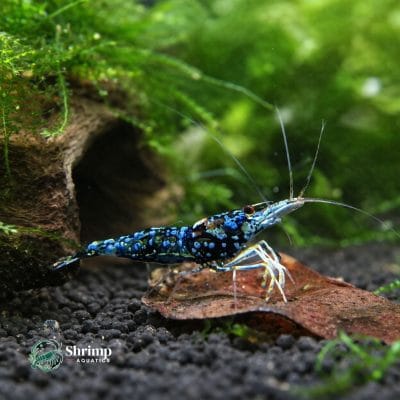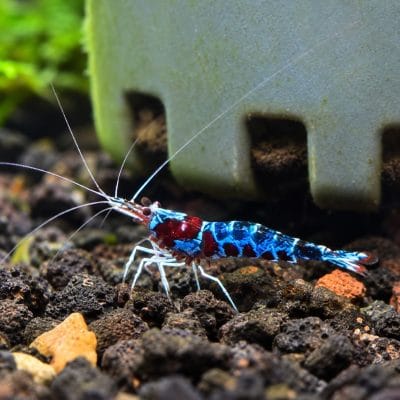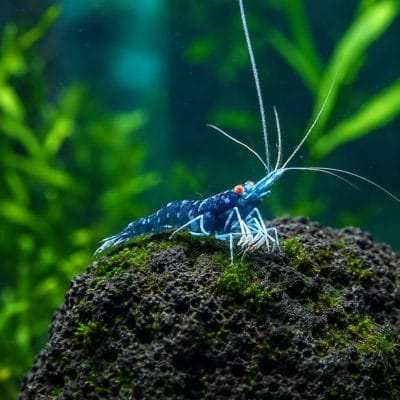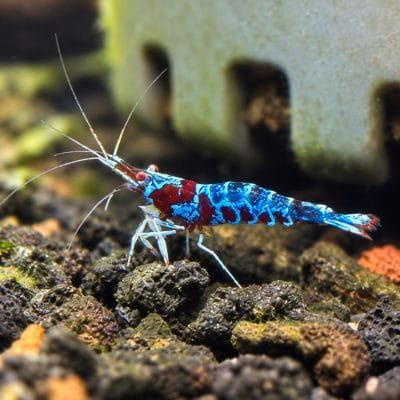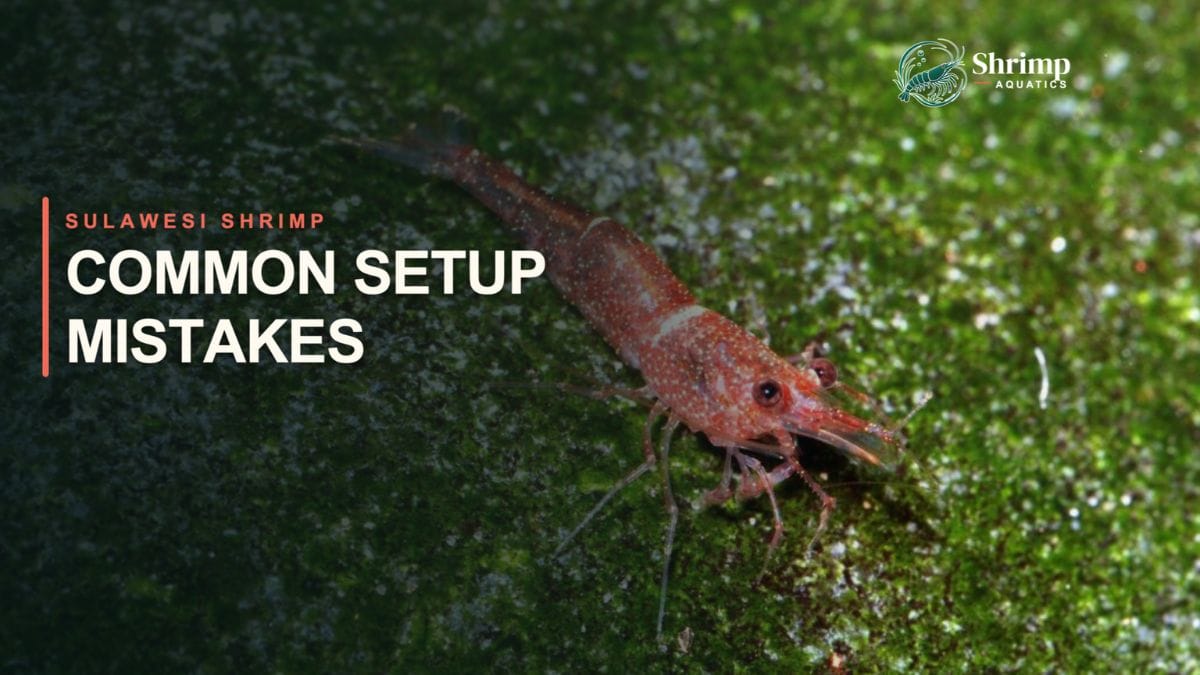
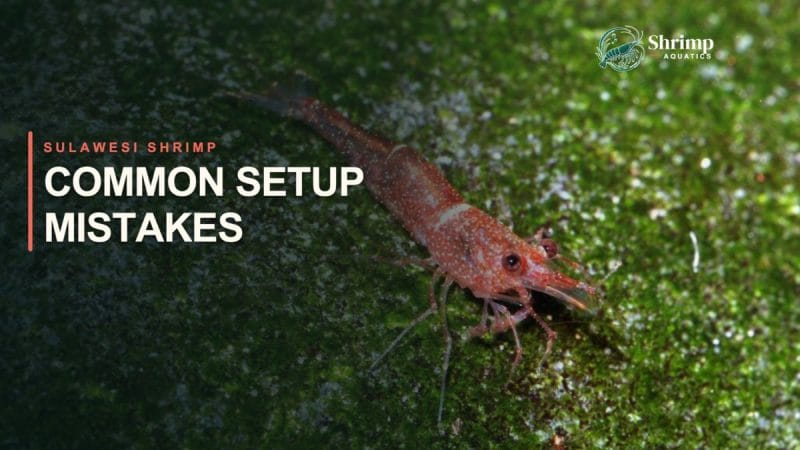
Sulawesi shrimp are demanding, but the ways a colony goes wrong aren’t mysterious. They trace back to a short list of decisions taken before the shrimp ever arrived: an active soil working against the pH, mineral that never fully dissolved, a tank that finished its nitrogen cycle but has nothing growing on the rock yet, and a maintenance routine carried over from a Neocaridina tank. Every one of those is visible and fixable. This guide works through the mistakes roughly in the order they happen, so you can find the one your own tank is making.
Why a Bee shrimp routine kills Sulawesi shrimp
A common way to start badly is to arrive with a Caridina routine that already works elsewhere. Crystal Red and Taiwan Bee lines are kept cool, soft and acidic. Sulawesi lake Caridina need the reverse, and the two kinds of water can’t be blended or averaged.
The shrimp in this group come from the ancient lakes of Sulawesi, and individual species are often restricted to a single lake. The cardinal shrimp, Caridina dennerli, is endemic to Lake Matano and widely distributed within it, and Caridina glaubrechti is endemic to Lake Towuti.1 Those lakes are unusually steady places. Lake Matano has been studied in part because of its minimal seasonal temperature variability,2 and water temperatures in Lake Towuti are around 82°F (28°C) throughout the year.3 Those are the conditions these shrimp live in, and a tank that swings a few degrees between afternoon and dawn isn’t reproducing them.
Set the three groups side by side and the problem with a transferred routine becomes obvious.
| Parameter | Neocaridina | Bee or Crystal Caridina | Sulawesi lake Caridina |
|---|---|---|---|
| Difficulty | Often beginner friendly in a stable, suitable tank | Intermediate to advanced | Advanced to expert |
| Temperature | 65-78°F (18-26°C) | 60-72°F (15.5-22°C) | 79-86°F (26-30°C) |
| pH | 6.5-8.0 | 5.8-6.8 | 7.5-8.5 |
| GH | 6-12 dGH | 4-6 dGH | 4-8 dGH |
| KH | 2-8 dKH | 0-2 dKH | 3-6 dKH |
| TDS | 150-300 ppm | 100-150 ppm | 150-250 ppm |
Read down the last column and the practical requirements fall out of it. You need a heater that genuinely holds a setpoint, a carbonate reserve that nothing in the tank is quietly eating, and a system that doesn’t lurch when you touch it. Everything below is a way of protecting one of those three things.
Active soil and botanicals pull a Sulawesi tank out of range
Almost every popular shrimp substrate is engineered to do the opposite of what this group needs. Active and buffering soils exist to pull a Bee tank down to a low pH and hold it there. A Sulawesi tank is asking the water to do the reverse job. Alkalinity is the buffering capacity of the water, a measure of its ability to neutralize acids and maintain a fairly stable pH, and it depends on dissolved bicarbonates, carbonates and hydroxides.4 A substrate whose whole purpose is to win an argument with that buffer isn’t a neutral choice underneath shrimp that need the buffer intact.
The standard setup for this group is inert substrate and inert hardscape, and an active pH-lowering substrate shouldn’t be the default under a Sulawesi tank. Sand, inert gravel and unreactive rock give you what you actually want from the bottom of the tank, which is surface area with no chemistry attached.
The same reasoning applies to the botanical habits people bring across from soft water tanks. Driftwood, catappa leaves and alder cones are added to those tanks deliberately, for what they put into the water. In a Bee tank that’s the point of them. In a tank whose stability depends on holding an alkaline pH, anything added for its effect on water chemistry needs a reason to be there, and in this setup those items don’t have one.
Check the bag before you buy
Substrate sold as shrimp soil, active soil or buffering soil is designed to lower and hold pH. If the packaging doesn’t say inert, treat it as active until you can confirm otherwise.
Dissolve Sulawesi mineral fully before it reaches the tank
A Sulawesi remineralizer isn’t a scoop and stir product, and the manufacturer is explicit about that. SaltyShrimp states that Sulawesi Mineral 8.5 requires additional measures to dissolve fully, that with CO2 added at a regular quantity of about one bubble per second the salt dissolves almost totally in approximately 3-4 days, and that the water must then be aerated with an air stone for at least three hours to expel the CO2 before use. The same page gives the salt’s effect on hardness as a KH to dH ratio of 0.78 to 1.0, and notes that less finicky Sulawesi species such as Caridina dennerli have been kept and bred with both Sulawesi Mineral 7.5 and Sulawesi Mineral 8.5.5
Two things follow from that for your own routine.
- Mix and finish the water in a separate container, never in the tank. Cloudy water means part of the mineral hasn’t dissolved yet, so the mix is unfinished by the manufacturer’s own description of it.
- Take the reading that counts after the water has cleared and been aerated. A number measured while the mix is still hazy isn’t the number the shrimp will end up living in.
Those instructions describe the 8.5 formulation. Follow the current instructions for the product you actually bought, and verify the finished pH, GH and TDS yourself.
Zero ammonia doesn’t mean a Sulawesi tank is ready for shrimp
A fully cycled aquarium is the baseline for any shrimp, and for this group it’s only the baseline. Ammonia and nitrite at zero with an established biological filter tells you the tank can process waste. It tells you nothing about whether there’s anything on the rock worth eating. A tank that finished cycling a fortnight ago is chemically safe and nutritionally bare, and supplemental food can’t make up for a system that hasn’t matured.
What you’re waiting for is a mature, stable system with established grazing surfaces. That’s something you look at, not something you count off a calendar.
At Shrimp Aquatics we don’t rush a new Sulawesi tank. With a powdered bacterial starter, our normal minimum is 3-4 weeks. With a liquid or live culture, the process may reach the same checkpoint in 2-3 weeks. The calendar doesn’t decide when shrimp go in. We wait for 0 ammonia and nitrite, stable temperature and chemistry, an established biological filter and visible grazing surfaces before stocking.
- Ammonia and nitrite both read zero on a fresh test, not on a test from last week
- Temperature and chemistry have held across several days rather than one good reading
- The biological filter has been running long enough to be established, not merely installed
- Rock and glass carry visible biofilm and algae instead of looking clean
- A date on the calendar isn’t one of these checks and can’t stand in for them
When the shrimp do arrive, follow the instructions on how long to acclimate Sulawesi shrimp supplied with that specific order rather than a generic routine copied from another species, and don’t add transport water to the aquarium. Packing method, transit time and species all change what the right approach is on the day.
Why the cardinal shrimp’s conservation status should decide where you buy
Caridina dennerli, the animal most people mean when they say cardinal shrimp, was assessed for the IUCN Red List on 20 August 2018 as Critically Endangered and tagged Possibly Extinct in the Wild under criterion A2e, with a decreasing population trend and a native range confined to Sulawesi.6 That’s the condition of the wild population, and it’s why sourcing isn’t a matter of preference for this group in particular.
Shrimp Aquatics breeds its own stock, and the care level shown against each of our tank-bred Sulawesi shrimp tells you whether a line suits the tank you’ve actually built rather than the one you’re hoping to build. Ask any seller the same two questions before you order: where the animals were bred, and what water they’re being kept in right now.
What adding fish costs a Sulawesi shrimp colony
The mistake here’s thinking of a Sulawesi tank as a display tank that happens to contain shrimp. A mixed setup only makes sense when every species in it overlaps in temperature, water chemistry, behavior, space and feeding opportunity, and the Sulawesi water of 79-86°F (26-30°C) with pH 7.5-8.5 rules out most common nano fish before behavior is even considered. Bee and Crystal Caridina are excluded by the same table you read earlier, for the same reason.
Even a fish described as generally shrimp safe will take shrimplets and sometimes adults. The honest version of that label is lower risk with adult shrimp, not safe for shrimplets, and the shrimplets are the generation that replaces the adults you already have. Anything else in the tank is also grazing the surfaces you spent weeks growing, so a tankmate that eats nothing is still competing for the food supply.
Sulawesi shrimp are peaceful and often shy, and what you see of them varies a great deal with the environment you give them. If you want company in the tank, weigh each candidate against the same five criteria.
Why the same trace ammonia is more dangerous at pH 8.5 than at pH 6.5
Total ammonia in water sits in equilibrium between the ammonium ion and un-ionized ammonia, and it’s the un-ionized form that drives toxicity, because high external un-ionized ammonia concentrations reduce or reverse diffusive gradients and cause ammonia to build up in internal tissues and blood. The split between the two forms is set by pH and temperature: the ratio of un-ionized ammonia to ammonium ion in fresh water increases roughly tenfold for each rise of a single pH unit, and by approximately two-fold for each rise of 10 degrees Celsius across the range from freezing to 30 degrees.7
Apply that relationship and the consequence for this group is plain. Two pH units of difference works out at about a hundredfold difference in how much of one identical total ammonia reading is present as the free form, before the warmer water is even counted. A trace reading that a Neocaridina keeper would shrug at is worth acting on in a Sulawesi tank, and it’s why nitrate here’s held to a target of under 10 ppm, tighter than the numbers used elsewhere in the hobby.
In practice, the waste load you control most directly is food, and food that goes uneaten in a warm alkaline tank is exactly the input this section is about.
Prepared food is neither automatically refused nor automatically harmful. In a 2025 rearing trial on Caridina dennerli, the group given commercial pellets with a Hydrilla shelter gained the most length, an average of 0.119 cm over 30 days, and recorded the highest survival of the four treatments at 72.727 percent, well ahead of the bacterial starter groups.8 Those figures describe that trial and not your tank, but they do settle the argument about whether prepared food belongs in a Sulawesi system. The failure mode is uneaten food breaking down in warm alkaline water, not the food itself.
How to keep oxygen up without pushing Sulawesi shrimp around
Warm water is the entire premise of this tank, and it works against you in one specific way, because cold water can hold more dissolved oxygen than warm water.9 A Sulawesi system runs near the top of the freshwater temperature range, so it begins with less oxygen in solution than the Bee tank beside it.
The mistake is solving two different problems with one knob. Keepers see shy shrimp being blown off the rock, throttle the flow back, and remove the surface movement that was putting oxygen back into the water. Those are separate requirements and they deserve separate answers: gentle movement down at shrimp level, strong gas exchange at the surface. Air driven sponge filtration is one common way to separate them, and a powered return can be aimed to ripple the surface rather than the rock. Suitability still depends on tank size, bioload and the flow the system actually needs.
Judge the result in your own tank, and treat any change to flow as a change to two things at once.
Why TDS climbs in a Sulawesi tank between water changes
Water leaves a warm open tank quickly, and the dissolved solids don’t leave with it. Evaporation concentrates dissolved solids in the water that remains.10 Refill that lost volume with remineralized water rather than pure RO and you add a second dose of mineral to water that’s already more concentrated than when you mixed it. Repeat for a few months and the tank walks out of the TDS band of 150-250 ppm without a single event you could point to.
The correction is unglamorous. Replace evaporation with unmineralized RO water, and replace only water you deliberately removed with fully prepared, temperature matched and parameter matched water. Take a reading before you add anything, because a measurement you never took is precisely how drift goes unnoticed for a season.
Minerals aren’t cosmetic in this tank. The major source of calcium a crustacean uses to calcify a new exoskeleton is exogenous, meaning the water it lives in, while diet and stored reserves contribute less.11 Hardness that drifts is therefore changing the conditions under which every shrimp in the tank has to rebuild its shell, which isn’t a process you get to observe until it goes wrong.
Running a Sulawesi tank hotter doesn’t speed anything up
Once a tank is finally stable, the next mistake tends to be a deliberate one. Growth looks slow, breeding hasn’t started, and the temperature dial is the easiest thing in the room to turn. The crustacean literature gives no encouragement here. In a controlled study of the lesser blue crab, animals reared under elevated temperatures showed a decreased intermolt period and decreased growth per molt, producing smaller sizes at each instar, and the authors add that if the pattern continued through the pubertal molt, elevated temperatures would result in smaller size at maturity.12 More molts, less growth at each one.
That’s a crab, not a Sulawesi shrimp, so read it as a direction only. The working conclusion still holds. Within 79-86°F (26-30°C), choose a value your equipment can actually hold and then leave it alone. Steadiness is the condition this group rewards, and moving the setpoint to chase a result trades away the one thing that was going right.
What to check first when Sulawesi shrimp start dying
Losses in progress aren’t the moment for a redesign. Work down this order, change one thing at a time, and write down what you find so the next reading means something.
- Water temperature, measured with a thermometer, not read off the heater dial. A heater that has stuck on or failed off moves the tank out of the band in either direction.
- Ammonia and nitrite. Anything above zero carries more weight here than the same reading would in a cooler, softer tank.
- pH and KH together, never pH alone. A pH that has slipped below the band is a buffering question, and KH is the reading that describes the buffer.
- TDS and GH, compared against your own previous readings as well as the range, so you can see the direction of travel.
- Everything that changed in the past week: new hardscape, a new food, a filter clean, an unusually large water change, or anything sprayed or dosed in the room.
- Uneaten food and the state of the rock. Remove what’s sitting there, then look at the grazing surfaces, because food supply and water quality are separate questions and the rock is what answers the first one.
If the readings are inside the band and steady and the losses continue, stop adding things. This guide doesn’t diagnose disease, and exact medication or chemical doses aren’t something to work out from a care page. Speak to a qualified aquatic veterinarian or an experienced local specialist, and bear in mind that copper and some fish medications can harm shrimp and snails, so the actual formulation of anything you’re considering matters more than the label on the front.
References
12 Sources
- Radiation of endemic species flocks in ancient lakes: systematic revision of the freshwater shrimp Caridina from the ancient lakes of Sulawesi, Indonesia, with the description of eight new species, Raffles Bulletin of Zoology 57(2), Lee Kong Chian Natural History Museum, 2009.
- The biogeochemistry of tropical lakes: a case study from Lake Matano, Indonesia (repository record and abstract), Limnology and Oceanography 53(1), 2008.
- Geomicrobiological features of ferruginous sediments from Lake Towuti, Indonesia, Frontiers in Microbiology 7, article 1007, 2016.
- Alkalinity and Water, U.S. Geological Survey Water Science School, updated August 24, 2026.
- Sulawesi Mineral 8,5, minerals and trace elements, SaltyShrimp product information page, accessed September 5, 2026.
- Caridina dennerli, IUCN Red List assessment, IUCN Red List of Threatened Species, assessed 20 August 2018.
- Aquatic Life Ambient Water Quality Criteria for Ammonia, Freshwater, U.S. Environmental Protection Agency, Office of Water, April 2013.
- Effect of using different shelter and feed types on growth and survival rate of Sulawesi endemic ornamental shrimps (Caridina dennerli), journal PDF, Jurnal Ilmiah PLATAX 13(1), 2025.
- Dissolved Oxygen and Water, U.S. Geological Survey Water Science School, updated August 24, 2026.
- Chloride, Salinity, and Dissolved Solids, U.S. Geological Survey Water Resources Mission Area, March 1, 2019.
- Biomineralizations: insights and prospects from crustaceans, ZooKeys 176, 2012.
- Elevated temperature induces a decrease in intermolt period and growth per molt in the lesser blue crab Callinectes similis (abstract), Journal of Crustacean Biology 39(1), 2019.
Ready to get started?
Shop our Sulawesi Shrimp collection
27 products available · Live Arrival Guarantee