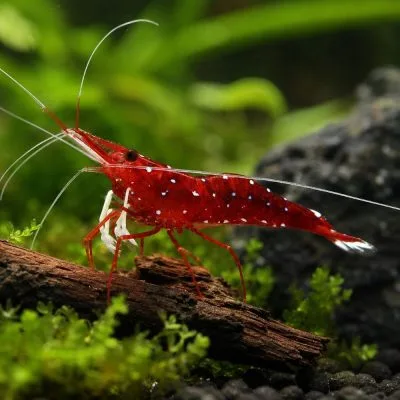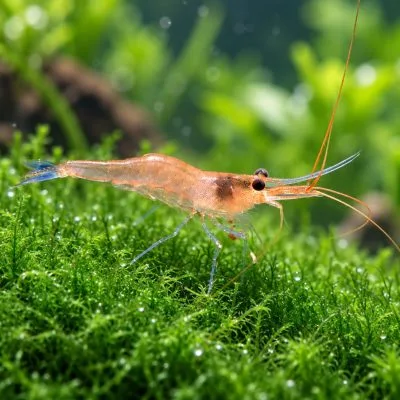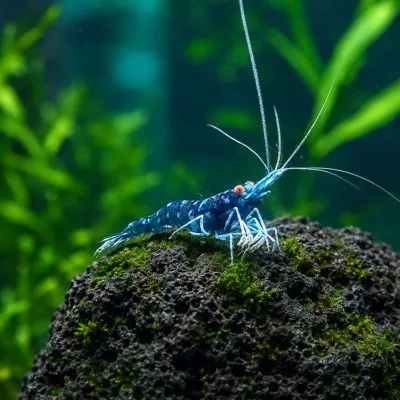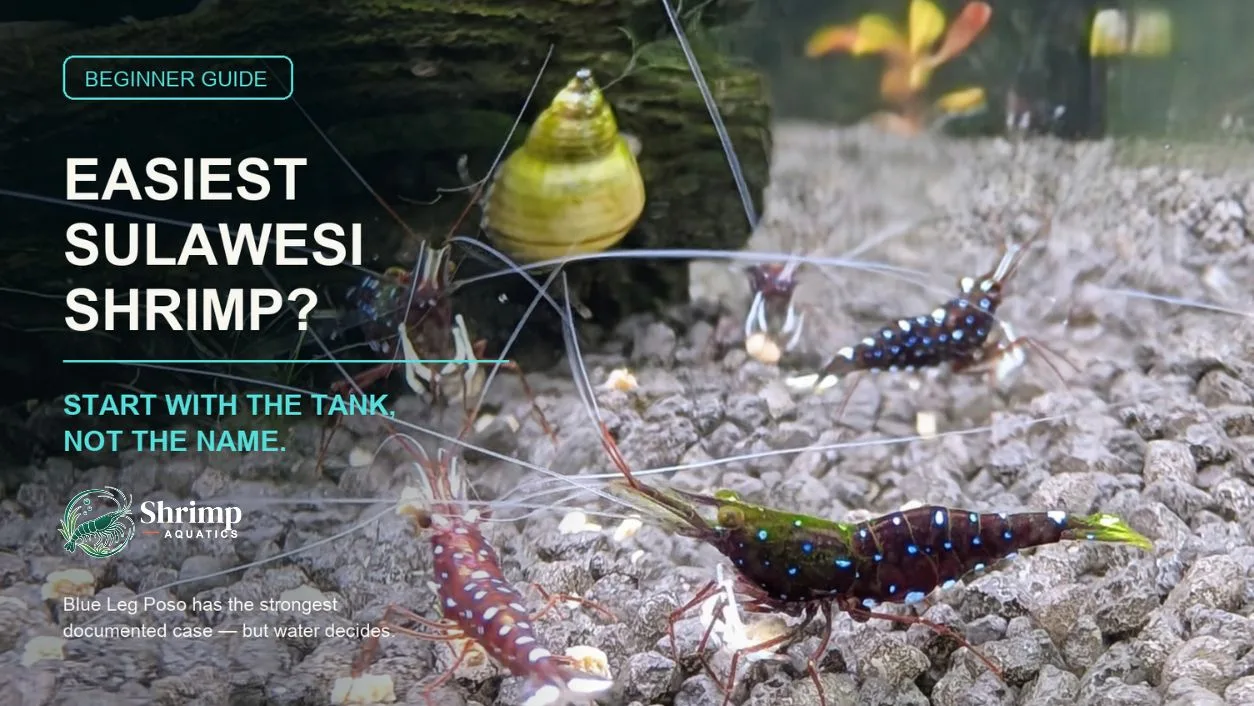
Which Sulawesi shrimp gives a first colony the best chance of forgiving a mistake? Blue Leg Poso has the best documented case, and of the lines that are easy to buy, a mineral manufacturer singles out the Cardinal group as less demanding. Blue Leg Poso is a Lake Poso endemic, and its Red List assessment describes it as a generalist found on rocks, wood, sand and macrophytes.1 No published trial ranks Sulawesi shrimp species by how hard they are to keep. None of the care pages that rank them cites one, which is why their rankings contradict each other. The honest answer is that the species you pick changes far less than the water you build. Every ancient lake Caridina in the hobby wants the same warm, alkaline, mineral-stable tank, and that tank is where new Sulawesi keepers lose shrimp.
Why Published Easiest Sulawesi Shrimp Rankings Disagree With Each Other
They disagree because there’s no data for them to agree on. Read three Sulawesi guides and you’ll get three answers. One ranks Blue Leg Poso as the only moderate species in the group and puts Cardinal and White Orchid a tier below it. Another names Blue Leg the best first Sulawesi shrimp but recommends Cardinal right alongside it. A magazine feature by a keeper who had three of these species concluded that Cardinal was the easiest of them, and the most available. None of those pages cites anything for its ranking, and none says where the ranking came from.
That’s less sloppiness than an absence of data. These are recently described animals, and no controlled comparison of two Sulawesi species under identical conditions has been published. What every ranking actually reports is the writer’s own tank, or the tanks of the people they talk to. That’s worth something. It just isn’t the same as a fact, and it’s why the rankings shuffle around from page to page.
So what’s the useful question? Not which species is easiest, but what’s actually written down about these species, and by whom. The answer is short.
What a Red List Entry and a Mineral Maker’s Own Page Say About These Species
Only two kinds of source say anything comparative at all. The first is the conservation assessment, which is where the Blue Leg Poso description above comes from. That’s a statement about the wild animal, not a measured aquarium tolerance, and habitat breadth is only a stand-in for the flexibility keepers are asking about. Still, it’s the closest thing to a documented flexibility statement that any species in this group has, which is why it carries the answer here.
The second is the company that makes the mineral salts formulated for Sulawesi tanks. Its technical page for the higher pH product names the freshwater harlequin shrimp (Caridina woltereckae) and the red-banded shrimp (Caridina striata) among the more susceptible species the product is intended for. It also states that less finicky Sulawesi species such as Caridina dennerli have been kept and bred with both of its Sulawesi salts.2 Its page for the lower pH product adds that cardinal shrimp breeders have been using that version very successfully.3 A manufacturer describing its own market isn’t a neutral referee. But it’s a dated, attributable statement, which is more than a care sheet offers.
| Species or line | What a source actually says | What is not established |
|---|---|---|
| Blue Leg Poso, Caridina caerulea | Endemic to Lake Poso, and described in its Red List assessment as a generalist found on rocks, wood, sand and macrophytes | No aquarium tolerance range, no survival figure, no comparison against another Sulawesi species |
| Cardinal group, Caridina dennerli, sold as White Sock, Blue Ghost, Galaxy and Oiran | Named by the mineral manufacturer among less finicky Sulawesi species kept and bred with either of its two Sulawesi salts | No measured tolerance, and the statement describes the manufacturer’s customers rather than a trial |
| Harlequin and Red Line, Caridina woltereckae and Caridina striata | Named by the same manufacturer among the more susceptible species its higher pH product is intended for | No quantified difference in sensitivity, and no equivalent statement covering the other Lake Towuti species |
| Every other line, including White Orchid, Yellow Nose, Yellow Cheek and Pink Boxer | Nothing comparative from an official or a manufacturer source | Any difficulty tier published for these lines is one keeper’s experience, however confidently it’s written |
A More Forgiving Species Still Needs the Full Sulawesi Water Setup
Whichever species you pick, the tank is the same tank. That’s the part the rankings bury. There’s no Sulawesi shrimp that accepts untested tap water, none that tolerates an active pH-lowering substrate, and none that forgives a swinging pH. The gap between the most and the least forgiving species in this group is a margin inside one demanding setup, not a different setup.
| Difficulty | Advanced to expert |
|---|---|
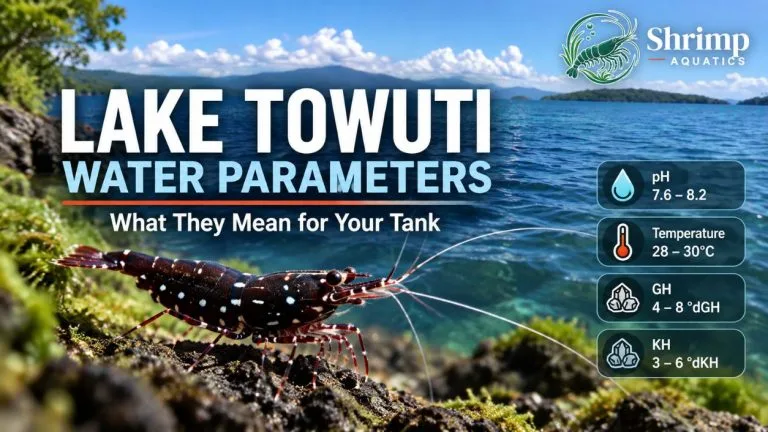
| Temperature | 79-86°F (26-30°C) |
| pH | 7.5-8.5 |
| GH | 4-8 dGH |
| KH | 3-6 dKH |
| TDS | 150-250 ppm |
| Nitrate | Aim for under 10 ppm |
| Ammonia and nitrite | Zero, from an established biological filter |
Those are group ranges, not a per species requirement, and a verified line can be narrower. What matters for this decision is that warm and alkaline together are chemically unforgiving in a way a cool, acidic Bee tank isn’t. In fresh water, the share of ammonia held in its toxic, un-ionized form climbs steeply as pH and temperature rise.4 The research section further down has the numbers and their limits.
The same feeding mistake costs more here
An uneaten pellet in a 72°F (22°C) Bee Caridina tank and an uneaten pellet in an 84°F (29°C) Sulawesi tank aren’t the same event. Warm alkaline water pushes more of whatever ammonia appears into the toxic form, and it appears faster. That’s why a Sulawesi tank needs a mature grazing surface before it needs a feeding schedule, and why small, parameter-matched water changes matter more here than large ones. It’s also why the Sulawesi shrimp care parameters are worth locking down before you order any livestock.
The One Measured Sulawesi Trial Points at Setup Rather Than Species
There’s exactly one published dataset that measures anything about keeping a Sulawesi shrimp, and it isn’t about species choice. A 2025 rearing trial on Caridina dennerli started shrimp at an average total length of 1.445 cm and ran four combinations of feed and shelter. The shrimp got commercial pellets or a bacterial starter, with either Hydrilla or stone as cover. Over 30 to 37 days, survival came out at 72.727% for pellets with Hydrilla and 40.909% for pellets with stone. The starter gave 31.818% with stone and 22.727% with Hydrilla. Growth followed the same order, the best treatment gaining 0.119 cm and the worst 0.013 cm.5
Those are trial conditions over short trial durations, and they aren’t a survival rate to expect at home or from shipped stock. But look at the spread. Holding the species constant and changing only what the shrimp ate and where they could hide moved survival by more than a factor of three. No claim about Blue Leg being easier than Cardinal comes anywhere near that size. If you’ve got a fixed amount of effort to spend, tank maturity, grazing surface and cover buy you more than picking the right species does. Mature biofilm and algae on the rock are the grazing that matters most in these tanks, and prepared food is only a supplement. So getting what Sulawesi shrimp eat right before stocking is worth more than the name on the invoice.
Should You Start With One Sulawesi Line or a Mixed Group?
Start with one line, because a mixed group makes your own tank much harder to read. Plenty of first Sulawesi orders are mixed, on the theory that a variety pack spreads the risk. It does close to the opposite. When half the colony thins out over a month, you can’t tell why. Did one species disagree with your water? Did that part of the shipment travel badly? Or was the tank simply not mature yet? One line gives you one clean signal.
Mixing also carries a genetic cost inside the closely related color lines, which is a separate question from whether two species can live together.
At Shrimp Aquatics, in our Sulawesi systems we haven’t seen routine crossing among unrelated Sulawesi species, but we treat White Sock, Blue Ghost, Yellow Ghost and Oiran as lines that may cross when kept together. The offspring we’ve observed haven’t shown the same obvious color fading that we’ve seen after uncontrolled mixing in some Neocaridina or Bee Caridina lines.
The practical reading is that mixing named lines is a choice about what you want the colony to look like in two years, not a safety decision. If you’d like to keep the option of trading or selling true offspring later, a starter group of Sulawesi White Sock or Sulawesi Blue Ghost kept on its own keeps that door open. It also means that if shrimplets do turn up, you’ll know they came from the animals you bought.
What the research says about how forgiving Sulawesi shrimp are
The ammonia chemistry behind this guide comes from U.S. water quality criteria written for freshwater life in general, not from work on Sulawesi shrimp. Total ammonia in water splits between the ammonium ion and the un-ionized form, and it’s the un-ionized form that drives toxicity. The ratio of un-ionized ammonia to ammonium in fresh water rises roughly ten-fold for each single pH unit and roughly two-fold for each 10 degrees Celsius. At high external concentrations the un-ionized form reduces or reverses the diffusive gradient, so ammonia builds up in tissue and blood.4
Those ratios were derived for the freshwater community the regulator assessed, not for shrimp. Read them as the direction of the effect, not as a threshold for your tank. What they do explain is why a species that sounds hardier buys you so little here: in warm, alkaline water the same slip leaves more of the toxic form behind than it would in a cool, acidic Bee tank.
Check How a Sulawesi Shrimp Was Bred Before You Order It
Ask how it was bred, because this group carries a sourcing question that most aquarium livestock doesn’t. The Cardinal shrimp is endemic to Lake Matano, one lake in the Malili system. Its Red List assessment lists it as Critically Endangered and possibly extinct in the wild, with no record of the species since 2013 at the time it was assessed. Harvesting of aquatic resources sits on its threat list alongside dams, invasive species and effluent pollution, and the population trend is recorded as decreasing.6
That doesn’t make keeping one wrong, and buying a tank-bred shrimp doesn’t save a species either. It does make origin a real question to ask before you order, and one of the few things about a shrimp a seller can answer plainly. Everything in our tank-bred Sulawesi shrimp range is bred here rather than collected from the wild. If you buy elsewhere the same question is worth asking.
Choose Your First Sulawesi Shrimp From What Your Tank Can Already Hold
Put the species question last, because it’s the smallest variable in front of you. First, can you hold this water steady? Second, is the tank mature enough to feed a grazing colony? Only then does it matter which line goes in it. Build the water and let the tank mature first, the same order the beginner guide to keeping Sulawesi shrimp follows.
Order now if you already run RO water remineralized with a Sulawesi mineral salt and the hardscape carries visible biofilm and algae. Ammonia and nitrite read zero, and a heater plus a thermometer hold the tank inside 79-86°F (26-30°C) without you watching it. Buy one line, buy enough of it to form a colony, and then leave the tank alone.
Wait if you’re still choosing between Sulawesi Mineral 7.5 or 8.5, the tank went up within the last month, or the rock is still bare. Wait too if you’d be adding Sulawesi shrimp to an existing planted or Bee Caridina setup. None of that’s fixed by picking a hardier species, and all of it’s fixed by a few more weeks.
If you can source it, Blue Leg Poso is the species with the best documented case for a first colony. If you can’t, the Cardinal lines are the realistic starting point, and they’ve got a manufacturer statement behind them as well as hobby consensus. Either way, be honest about whether your setup is ready before you order. Everything that makes Sulawesi shrimp hard to keep applies just as fully to the easiest line in the group.
Once the setup is settled, the types of Sulawesi shrimp on offer come down to color and price.
References
6 Sources
- Caridina caerulea, IUCN Red List assessment, De Grave, S., Wowor, D. and Klotz, W., The IUCN Red List of Threatened Species 2013: e.T197973A2507226, assessed 16 November 2011.
- Sulawesi Mineral 8,5, minerals and trace elements, SaltyShrimp (Garnelenhaus), manufacturer product information page.
- Sulawesi Mineral 7,5, minerals and trace elements, SaltyShrimp (Garnelenhaus), manufacturer product information page.
- Aquatic Life Ambient Water Quality Criteria for Ammonia, Freshwater (2013), U.S. Environmental Protection Agency, Office of Water, April 2013.
- Effect of Using Different Shelter and Feed Types on Growth and Survival Rate of Sulawesi Endemic Ornamental Shrimps (Caridina dennerli), journal PDF, Jurnal Ilmiah PLATAX 13(1): 191-204, Universitas Sam Ratulangi, 2025.
- Caridina dennerli, IUCN Red List assessment, von Rintelen, K., The IUCN Red List of Threatened Species 2018: e.T198055A109683594, assessed 20 August 2018.