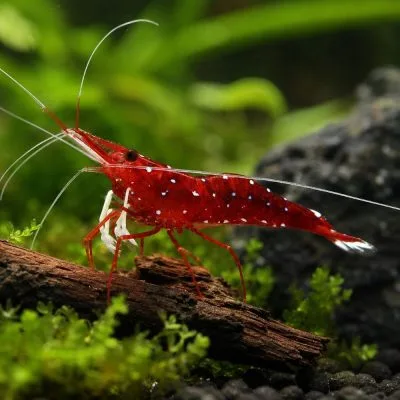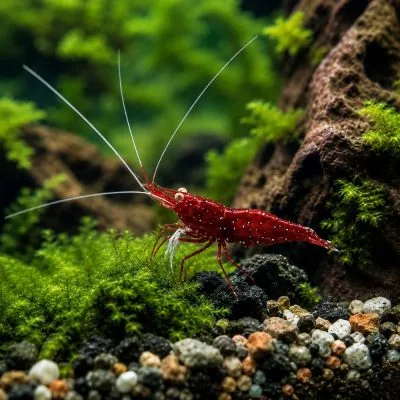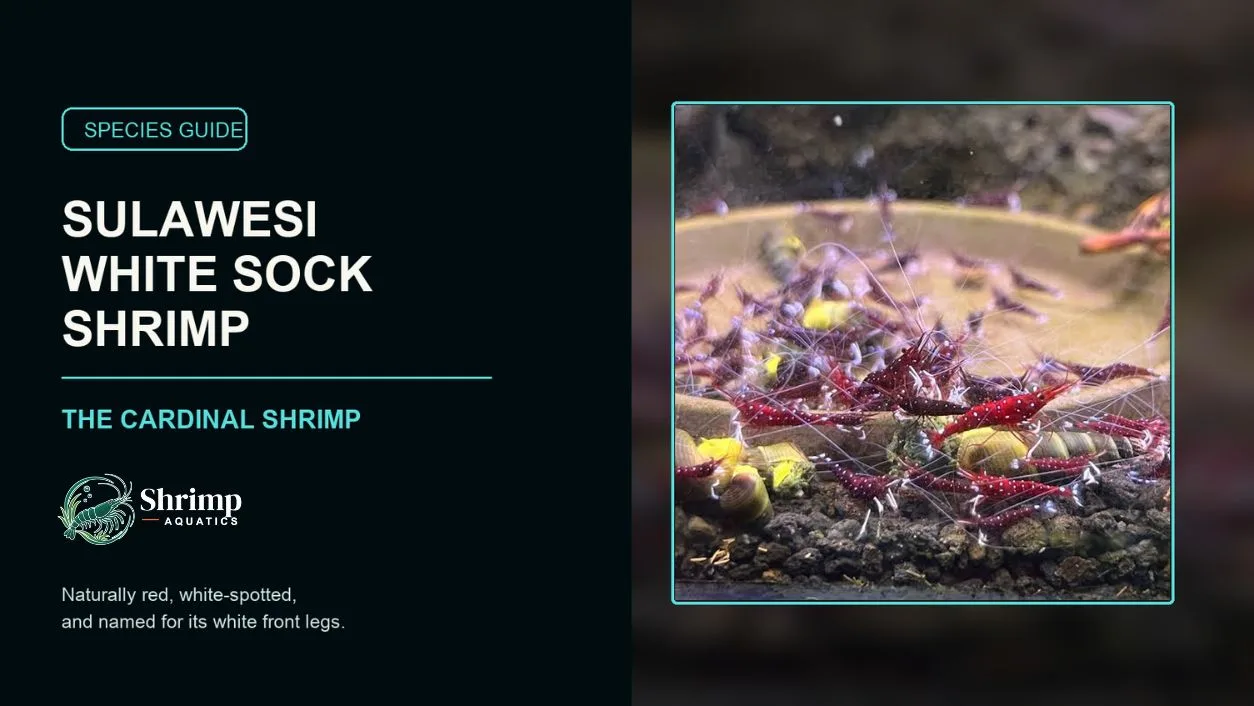
Why is everyone after Sulawesi White Sock shrimp? Three reasons: their red and white look is pure wild color, they graze in the open once they’ve settled, and they’re known as the most forgiving Sulawesi lake species. White Socks are also sold as the Cardinal shrimp (Caridina dennerli). The original description of this Lake Matano endemic backs up the first two reasons, down to the deep red body and bright white front legs.1 Nobody had to breed the color in, and a settled group turns a rock pile into something worth watching. The third reason is only true next to its neighbors, and that’s where new keepers usually come unstuck.
White Sock color is wild type, so there’s no grade to pay for
You’re not paying for a color grade, because the White Sock pattern is simply what the species is. In Neocaridina color lines, the color you pay for is the result of generations of selection, which is also why mixing those lines can throw wild type offspring. Sulawesi White Socks work the other way around.
The 2009 revision that described the species records the living animal as dark red to purple over the body and most appendages. It’s covered with conspicuous white spots, with one distinct white dot on the upper rear of the abdomen.1 The chela and carpus of the first and second pereiopods are bright white against that red, and so are the antenna, antennule and scaphocerite.1 Those bright front limbs are the socks in the name.
So what are you paying for? Age, condition and how settled the animal is. This species has no grade ladder like the one behind high grade Neocaridina pricing. Treat a grade premium as something to ask about, not something to assume. And a shrimp that looks washed out on arrival after a long flight isn’t automatically a poorer animal. Give it a week.
What brings a shy White Sock colony out onto the rock
Mature rock and nothing to run from. The Sulawesi group is peaceful but often shy, and how much you see of them depends heavily on the tank they’re in. The display people buy this species for doesn’t happen on its own. It shows up when the shrimp have a reason to be out on the open rock. That means mature biofilm and algae on hardscape they can work over, and no reason to bolt back into a crevice.
At Shrimp Aquatics, in some of our Sulawesi systems we keep about five Neocaridina, and we’ve observed the Sulawesi shrimp remain more visible, or retreat less, when people approach the tank. That setup still requires suitable temperature overlap, enough grazing surface and stocking capacity for both groups.
Take that as one option, not a requirement. A few Neocaridina won’t fix a young tank with nothing growing on the rock. A breeding Neocaridina colony isn’t what a specialist Sulawesi tank needs either, because both groups then compete for the same grazing surface. If your tank is new, the honest answer is that the shrimp will spend their first months mostly out of sight. That’s normal, and it isn’t a sign you bought the wrong animal.
How fast a White Sock colony actually grows
Slowly, and this is the expectation popularity distorts most. The seven egg carrying females examined for the 2009 revision carried 8-14 eggs each. The eggs measured 1.0-1.2 by 0.5-0.7 mm.1 Those are wild females counted at the moment of collection, so read them as the measured picture, not a captive average. The egg size is the reason the count is low.
Growth is slower still. A 2025 rearing trial started with shrimp at an average total length of 1.445 cm. Over 30 to 37 days they gained between 0.013 cm and 0.119 cm on average.2 The result depended on which feed and shelter they got, and commercial pellets alongside Hydrilla did best of the four combinations tested. Survival in the same trial ranged from 22.727% to 72.727% across those combinations.2 That describes the treatments the researchers compared, not anything a home colony should expect.
We haven’t found a published age at first breeding for this species, so treat any month count you see quoted as a guess. In practice a starter group stays a starter group for a long time. The way through is a stable, mature tank. Heavier feeding can’t make up for a system that isn’t ready, and in warm water it makes things worse.
Being the easiest Sulawesi shrimp doesn’t make it a beginner shrimp
No, the easiest Sulawesi shrimp still isn’t a beginner shrimp, because “easiest” is measured against the other lake species. The reputation does have a real basis. SaltyShrimp makes the point on its own technical page for its Sulawesi remineralizers. It says less finicky Sulawesi shrimp such as Caridina dennerli can be kept and bred with positive outcomes on either its Sulawesi Mineral 7.5 or its Sulawesi Mineral 8.5 preparation.3 The more susceptible species are the reason the 8.5 version exists.3 Notice what that’s a comparison against. Other ancient lake species. Not Cherry shrimp.
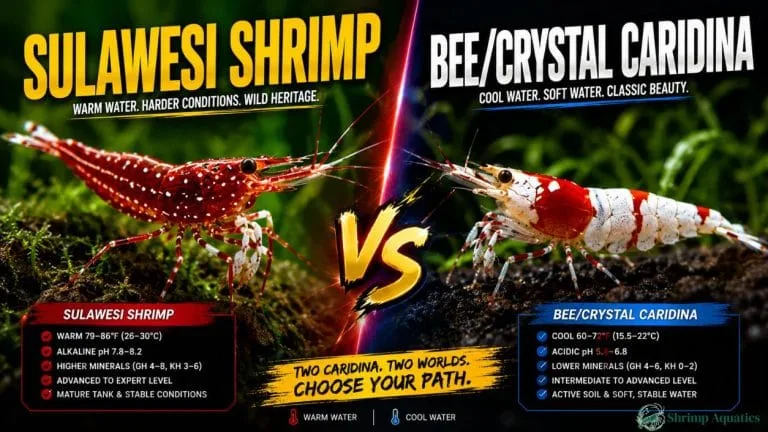
| Difficulty | Advanced to expert |
|---|---|
| Temperature | 79-86°F (26-30°C) |
| pH | 7.5-8.5 |
| GH | 4-8 dGH |
| KH | 3-6 dKH |
| TDS | 150-250 ppm |
| Nitrate | Aim for under 10 ppm |
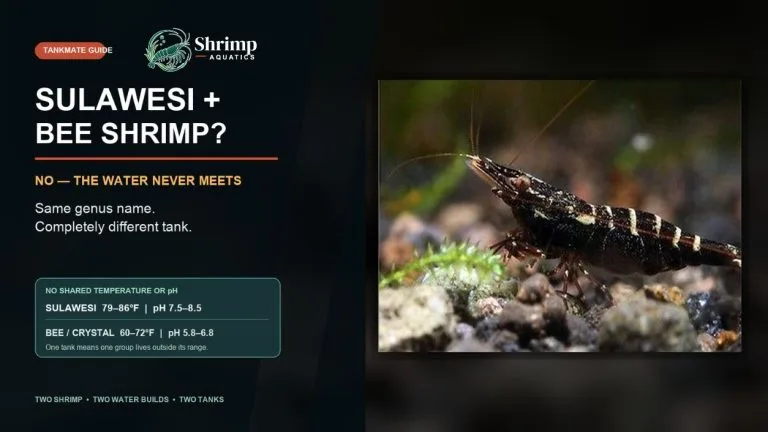
Every line of that table points the opposite way from the soft, acidic water Bee and Crystal Caridina live in. A working Crystal Red setup isn’t a head start here. It’s a habit you’ll have to unlearn.
Warm alkaline water also leaves less room for error on waste. More of the total ammonia in your tank sits in the toxic un-ionized form as pH and temperature rise. By EPA’s figures, it’s roughly tenfold more for each single pH unit.4 So the same ammonia reading is more dangerous in a warm alkaline Sulawesi tank than in a cool, acidic one. That’s why the entry price for this species is a fully cycled, stable system with grazing surfaces established before the shrimp arrive. Not a bigger budget. Patience.
Test your own water before you order
Measure pH, GH, KH and TDS on the water you’d actually use, whether that’s tap or remineralized RO. Then decide whether you can hold those values steady week after week. If you aren’t sure, email contact@shrimpaquatics.com with your pH, GH, KH, TDS, temperature, tank size, cycle status and current livestock and ask before you buy.
What the research says about keeping White Sock shrimp
The ammonia figures above don’t come from shrimp. They come from EPA’s freshwater ammonia criteria, which cover aquatic animals in general. Total ammonia in water splits between the ammonium ion and un-ionized ammonia. It’s the un-ionized form that drives ammonia toxicity in aquatic animals.4 EPA puts that split at roughly tenfold more un-ionized ammonia for each rise of a single pH unit, with a further increase as temperature rises.4 This is general water chemistry, not a measurement taken in a White Sock tank, but it holds whatever animal is in the water, and it’s the reason warm alkaline Sulawesi water punishes leftover food harder than a cool, acidic Crystal tank does.
What to ask about sourcing before you buy a White Sock
Ask whether the stock was bred in captivity, because the wild side of this story isn’t comfortable. The IUCN Red List assessed Caridina dennerli on 20 August 2018. The assessment lists the species as Critically Endangered and possibly extinct in the wild in Sulawesi under criterion A2e.5 It records the species as endemic to Lake Matano in the Malili Lakes system of Sulawesi, with a decreasing population.5 The threats listed include nickel mining and hydroelectric installations on the lake outlet.5 The same assessment records that the species is present in the aquarium trade.5
That status describes the lake, not the shrimp in a shop tank, but it does change what you should ask before ordering. Two questions: was the stock bred in captivity rather than imported from the wild, and what water is it living in right now? Matching the water it already lives in is the part of arrival day you actually control. Starting a colony with tank-bred Sulawesi shrimp means the animals are already living in warm alkaline water. They aren’t adjusting to it after a long flight.
References
5 Sources
- Radiation of endemic species flocks in ancient lakes: systematic revision of the freshwater shrimp Caridina from the ancient lakes of Sulawesi, Indonesia, with the description of eight new species, Raffles Bulletin of Zoology 57(2), Lee Kong Chian Natural History Museum, National University of Singapore, 2009.
- Effect of Using Different Shelter and Feed Types on Growth and Survival Rate of Sulawesi Endemic Ornamental Shrimps (Caridina dennerli), journal PDF, Jurnal Ilmiah PLATAX 13(1), Universitas Sam Ratulangi, 2025.
- Sulawesi Mineral 8,5, minerals and trace elements, SaltyShrimp technical page, no revision date shown.
- Aquatic Life Ambient Water Quality Criteria for Ammonia, Freshwater, U.S. Environmental Protection Agency, Office of Water, April 2013.
- Caridina dennerli, IUCN Red List assessment, IUCN Red List of Threatened Species, assessed 20 August 2018.
Ready to get started?
Shop our Sulawesi Shrimp collection
27 products available · Live Arrival Guarantee
Featured Sulawesi Shrimp
Sulawesi Orange Eyes White Sock
Caridina dennerli
Advanced · 79-86°F · pH 7.5-8.5
From $19.99View Product