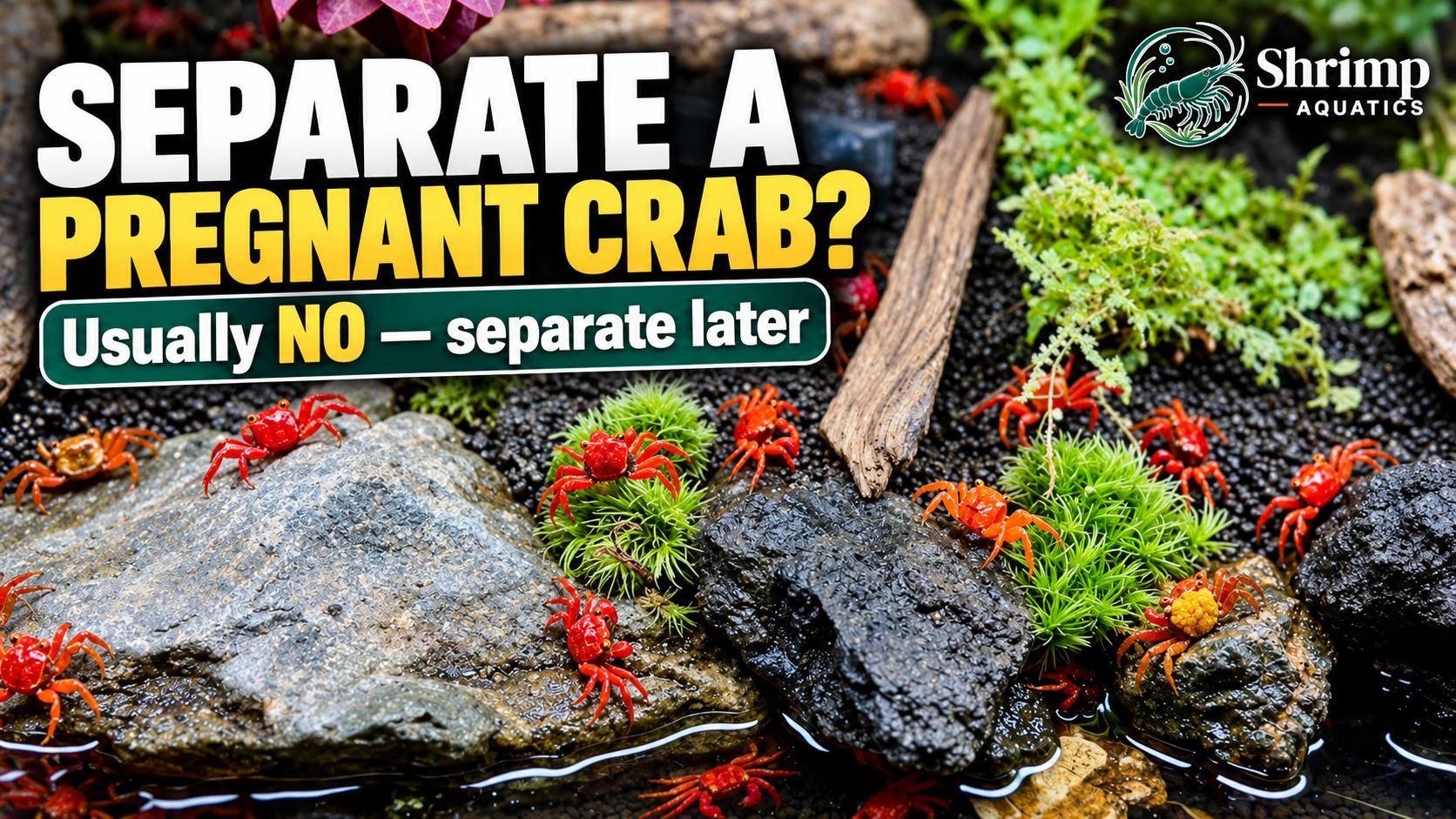

Usually you don’t need to separate a pregnant (berried) vampire crab while she’s carrying eggs. She goes into hiding on her own, and the step that decides how many young you raise comes later: separating the crablets, or the adults, once the crablets appear, because adult vampire crabs eat the crablets they catch.
There are two reasons we’d move her early: a male in the group keeps going after the females, or the tank is small or sparsely planted and you want her young to hatch away from the adults. Even then, only move her when she’s out in the open and you can lift her out without digging. Otherwise, leave her where she is, let the weeks pass and have a spare container ready.
Why a hidden pregnant vampire crab is usually best left in the group tank
Leave her in the group tank, because a berried female already keeps herself out of sight. She spends most of the brooding time hidden, often dug in or down a burrow, and you’ll rarely see her until the crablets appear. Expect that to take about three to seven weeks, depending partly on whether you count from the day you first notice eggs or the day she disappears. Give her damp soil a pregnant vampire crab can burrow into, and she’ll do the hiding herself.
So what would pulling her out actually get you? To catch a female that has gone to ground, you’d usually have to dig through the land section and pull apart the hides she picked. We wouldn’t do that. Leaving her in place costs you nothing, because the separating that matters comes once the crablets appear.
Not sure which female is carrying? That’s normal. A female who drops out of sight for weeks is often the first clue, and the other signs are part of vampire crab breeding at home.
When moving a berried vampire crab into her own container makes sense
The first reason is a male that keeps chasing the females. In a group, a dominant male that harasses the others can cost them legs and claws, and we’d rather a berried female wasn’t on the receiving end of that. Only move her when she’s in the open and you can scoop her up without disturbing the tank.
Space is the other reason. In a small or sparsely planted tank you’ll want every crablet you can get, and if she’s already in her own container, the young come out somewhere the adults can’t reach them.
What her container needs
Set it up as a small copy of the main tank: moist land with a hide she can dig into, a tight lid, the same warmth and humidity, and a water section she can climb right into and fully enter. That’s the basics of vampire crab care in miniature. The young come out as tiny crabs, not larvae, so the container’s water section needs only plain fresh water, with no salt. Put it somewhere quiet and leave her alone apart from feeding.
When to take the mother back out
Move her back to the group once the crablets have left her. Newly hatched crablets stay on or under their mother for a short time before they go off on their own, so wait until you see them moving about by themselves. From then on, treat her like the other adults and keep her away from the young.
What to do once vampire crablets appear in the group tank
Move the crablets out, or move the adults, as soon as you spot the young. That keeps the young out of the adults’ reach. If the crablets are scattered through moss and leaf litter, we’d move the adults instead, because it’s far easier to catch a few big crabs than dozens of tiny ones. Have a spare tank ready if you plan to move adult vampire crabs after the babies appear.
Plan for numbers. One clutch gives up to about 40 crablets, so whichever tank they grow up in needs room and plenty of cover for that many.
Do you have to separate at all? Not if you’re happy with fewer. In a large, densely planted paludarium, some crablets grow up alongside the adults. You’ll just raise fewer of them than you would by moving them.
Planning more broods? Our tank-bred vampire crab lines are sold as males or females, so you choose the sex on each product page. Everything in our catalog is bred or propagated in our own tanks rather than collected from the wild. We can’t promise that a female will breed, or how many young she’ll have.
Ready to get started?
Shop our Vampire Crab collection
8 products available · Live Arrival Guarantee