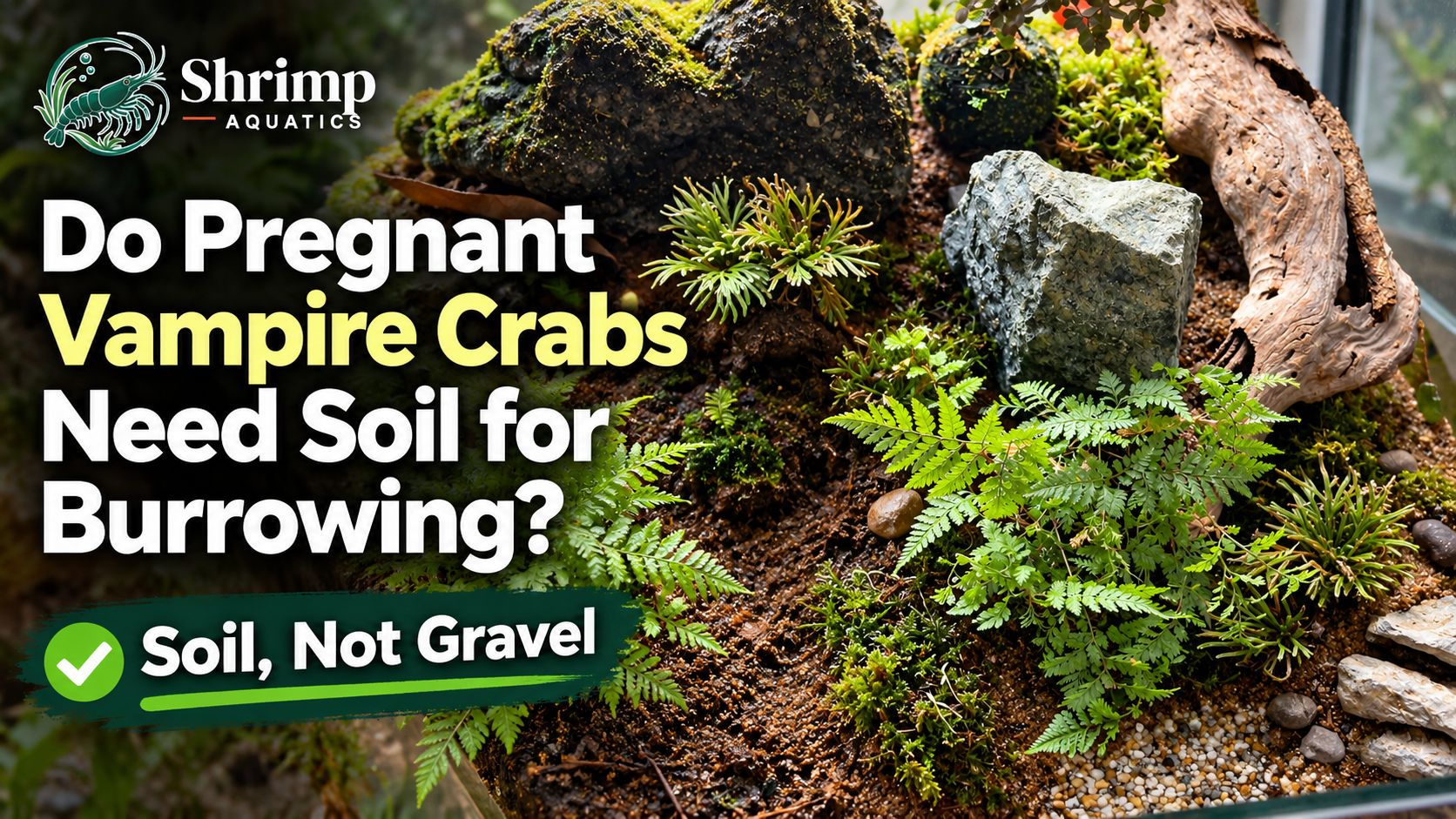
Yes, give a berried vampire crab (Geosesarma) soil she can dig into. She spends most of her brooding weeks out of sight, often dug into the ground or tucked in a burrow, and damp soil lets her dig a hiding place that holds its shape. Loose gravel won’t hold a hole like that. She isn’t looking for a spot to lay eggs, though: she’s already carrying them, so what the soil gives her is cover.
Does a pregnant vampire crab lay her eggs in the soil?
No, she keeps them on her body. In true crabs, the female’s abdominal flap is broad because it covers the egg mass, and the eggs stay fixed to small limbs underneath it while she broods them.1 That’s why keepers call an egg-carrying female berried, and why the soil question is really about where she can hide, not where she can nest.
What digging gives a berried vampire crab that gravel can’t
A place to disappear. Damp soil lets her push out a pocket that keeps its shape and stays moist around her, while loose gravel on its own leaves her the caves and plants on top and very little to dig into.
She’ll still use cork bark, caves and dense moss, so give her those as well. Wild crabs dig too: the two vampire crabs described from central Java, Geosesarma dennerle and G. hagen, dig burrows close to the water’s edge in the wild.2 Plan the land section as burrowing space for vampire crabs, not just a floor for hides.
How to build a diggable land section for a berried vampire crab
Set it up before she’s berried, ideally when you build the tank, because you won’t want to dig around her once she’s hidden. A simple setup is plain soil with no added fertilizer on the land section, with any gravel kept to the drainage layer underneath or the water section. If you plan on vampire crab breeding, build the soil in from the start.
- Plain soil, nothing added, deep enough that a crab can bury herself completely with soil still beneath her.
- Damp all the way through, never sitting wet.
- Hides on top of the soil: cork bark, a cave, moss she can push under.
- A barrier or edge that keeps the soil from washing into the water.
- A water section she can still climb into and fully enter.
Don’t drop that last point to make more room for soil. In our paludariums, vampire crabs go into the water to molt, so the water section has to be one a crab can climb into and fully enter. That’s part of everyday vampire crab care, berried or not.
There’s no tested depth figure for vampire crab soil, so judge it by the crab: if she can vanish into it, it’s deep enough. Damp, not soggy, is the line to hold. Soil that sits wet in still air is where mold usually starts in a closed paludarium, especially in the first weeks of a new setup. The lid and misting you already use for humidity keep the soil damp, and dry air is the usual way these tanks fail.
Planning a breeding group from scratch? Our tank-bred vampire crabs are sold as males or females, and you choose the sex on each product page. Everything in our catalog is bred or propagated in our own tanks rather than collected from the wild. We don’t promise breeding or the number of young from any order.
Keeping the soil right while a berried vampire crab stays hidden
A berried female carries her eggs for about three to seven weeks, so keep the soil damp and leave her burrow alone. Lifting the cork to check on her, or digging her out to separate a pregnant vampire crab, tears up the hiding place the soil gave her.
Pick the substrate color with the crablets in mind. Newly hatched crablets start out clear, brown or dark and blend into the ground, so they’re easy to miss. One keeper who used black gravel could only spot the crablets when they moved, and advises against a dark substrate.
References
2 Sources
- Systema Brachyurorum: Part I. An annotated checklist of extant brachyuran crabs of the world, Ng, Guinot and Davie, Raffles Bulletin of Zoology Supplement 17, 2008.
- New species of “vampire crabs” (Geosesarma De Man, 1892) from central Java, Indonesia, and the identity of Sesarma (Geosesarma) nodulifera De Man, 1892, Ng, Schubart and Lukhaup, Raffles Bulletin of Zoology 63, 2015.
Ready to get started?
Shop our Vampire Crab collection
8 products available · Live Arrival Guarantee