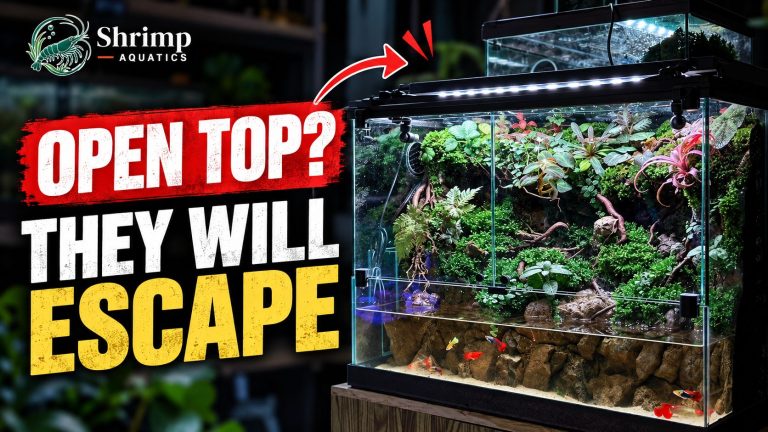

No. Every vampire crab line in the hobby needs a land floor of soft, damp substrate it can dig into. It also needs enough cover for each crab to get out of sight, and that includes the ones that climb a lot. Height is a bonus you can add on top; it never replaces the ground.
Do climbing vampire crabs still need ground to dig in?
Yes. A vampire crab that climbs well still spends its quiet hours hidden at ground level, so a tall tank full of branches with a thin, hard floor shortchanges it. In the wild, the two Javan species long sold as vampire crabs live on land near streams, hiding under rocks and dense plants and digging burrows near the water’s edge.1
What about the crabs described as climbers? Even they use cover low down. One large wild species from the Philippines turns up more often on trees, in wet knotholes, than on the ground. Yet it hides in rock crevices by day.2 Another, thought to climb, was collected in burrows on a forest slope at night, with only some crabs up on a low shrub.3 If a line is sold to you as a climber, read that as “uses height as well,” never as “doesn’t need a floor.”
What vampire crabs use a burrow for in your tank
Mostly, it’s where they spend the day. Vampire crabs are mostly out in the evening, at night and in the early morning. By day they sit in tunnels they’ve dug, in caves and crevices, under stones, cork or leaves, or deep in dense plants. You can easily go days without seeing a crab, and some keep out of sight for weeks while still alive and well.
A female carrying eggs leans on that cover even harder. She spends most of the brooding time hidden, often dug in or in a burrow, and you’ll rarely see her until the crablets turn up. Take away the soft ground and you take away the place she’d choose. Give a pregnant vampire crab soil for burrowing, not a thin, hard floor.
Does a crab need a burrow to molt? One field study of wild vampire crabs in Java describes them as shy, slipping into their burrows when disturbed. It also reports that they use those burrows when molting.4 Our crabs molt somewhere else, and that changes how you build the tank:
In our paludariums, vampire crabs go into the water to molt, so the water section has to be one a crab can climb into and fully enter.
So give them both. Digging space doesn’t stand in for water they can get all the way under, and a water section doesn’t stand in for somewhere to hide. That way vampire crab molting has a safe spot whether your crabs shed in a burrow or in the water.
How much ground to give vampire crabs to dig in
Give them a land section of soft, damp substrate deep enough that a crab can dig itself completely out of sight. Spread the cover across it, not all in one corner. These are small crabs, but a floor only one crab deep won’t hold a tunnel. Several shell-widths of depth lets a burrow keep its shape and gives a crab room to turn. Build that depth in at the start of your vampire crab tank setup.
Keep the floor damp, not soggy. Mold is common in closed vampire crab tanks, especially in the first weeks. It grows on damp wood, coconut shells, substrate and moss where water sits and the air is still. A drainage layer under the soil, a little ventilation and a cleanup crew of springtails or isopods keep a deep, damp floor from going sour.
How many hides? Enough that every crab can get out of sight at the same time. Vampire crabs kept in a group often fight, most often when a dominant male chases the others, and they lose legs and claws that way. A crab that keeps getting chased out of cover needs more cover, or a different tank. Cover for every crab is as basic to vampire crab care as the dig-in floor.
If crablets appear, dense planting and plenty of ground cover give some of them a chance with the adults around, because adults eat the crablets they catch. Moving the young to their own tank still raises the most.
Can cork bark and caves replace soft substrate?
Partly, and we wouldn’t rely on them alone. Keepers’ crabs use ready-made cover and the tunnels they dig themselves. Give both: a floor deep enough to dig, and cork, leaf litter, stones and plants on top of it.
Everything in our catalog is bred or propagated in our own tanks rather than collected from the wild. If you’re planning a group of our tank-bred vampire crab lines, build the dig-in floor and the water section first, then choose male or female on each product page.
References
4 Sources
- New species of “vampire crabs” (Geosesarma De Man, 1892) from central Java, Indonesia, and the identity of Sesarma (Geosesarma) nodulifera De Man, 1892, Ng, Schubart and Lukhaup, Raffles Bulletin of Zoology 63: 3-13, 2015.
- Two new species of Geosesarma De Man, 1892 (Crustacea: Brachyura: Sesarmidae) from Palawan, the Philippines, Manuel-Santos, Ng and Freitag, Raffles Bulletin of Zoology 64: 335-342, 2016.
- On a new species of vampire crab from the Geosesarma foxi species-group (Crustacea: Brachyura: Sesarmidae) in northern Peninsular Malaysia, Ng, Khadijah-Ahmad and Ahmad, Raffles Bulletin of Zoology 73: 162-168, 2025.
- Habitat and Food of Vampire Crabs (Geosesarma sp.) in Menoreh Mountain, Yogyakarta, Indonesia, Kurniawan, Waluyo, Nofreeana and Aji, Media Konservasi 30(1): 141-153, 2025
Ready to get started?
Shop our Vampire Crab collection
8 products available · Live Arrival Guarantee