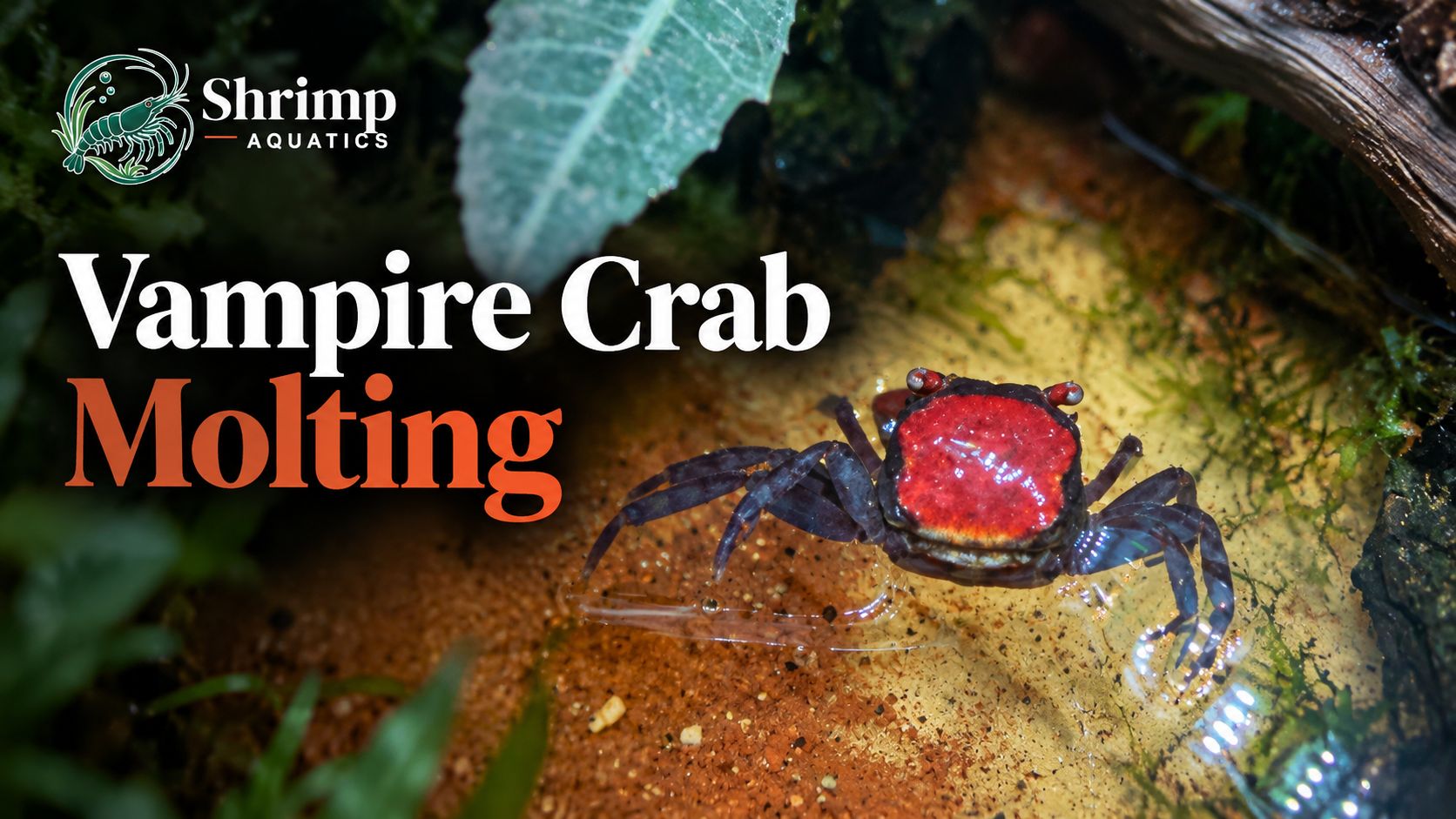
A vampire crab (Geosesarma) grows by climbing out of its whole old shell, and that empty shell can look just like a dead crab. Check the eyes: a shed has empty, see-through eye shells, while a dead crab still has its eyes. In our paludariums, vampire crabs go into the water to molt and stay down there for a few hours. If a crab has vanished or sits still in the water, leave it alone until you know which you’re looking at.
Is your vampire crab dead or molting?
Look at the eyes first: a vampire crab’s shed has empty, see-through eye shells, while a dead crab still has its eyes. A shed looks like a whole crab, legs and all, so it’s easy to take one for a body. It’s hollow, though, and the back of the shell lifts open. A dead crab is full inside, won’t open at the back and soon smells. Look closely at the color, too: in our tanks the empty shell is clearer, more see-through, than a dead crab.
| Check | Shed shell | Dead crab |
|---|---|---|
| Eyes | Empty, see-through shells | Still in place |
| Inside | Hollow | Full |
| Back of the shell | Lifts open | Won’t open |
| Smell | Smells of nothing | Soon smells |
| Look, in our tanks | Clearer, more see-through | Less see-through |
Is a soft, pale vampire crab in the water molting or dying?
Treat it as a molting crab until it shows you otherwise. Right after a molt, a vampire crab is soft and often looks pale, washed out or yellowish: red crabs can look yellow or orange, and the claws almost white. Its color comes back as the new shell hardens, usually within a few days and at most about a week. A soft, pale crab with an empty shell close by is a molt that went fine, so leave it to harden.
Paleness with no fresh shed behind it is the one to take seriously. A crab that turns pale, grey or blotchy and also sits still, has limp legs or has lost a claw can die within days, though not every pale crab does. If that’s what you see, vampire crab losing color sets out what to check the same day.
How to check a still vampire crab without disturbing a molt
Not sure which you’re looking at? Work through these checks in order, and keep your hands off anything in the water.
- Look from where you stand. If the crab or the shape is in the water, leave it there, because a crab partway through a molt is soft and easy to hurt.
- Get closer with a flashlight and check the eyes. Empty, see-through eye shells mean a shed. Eyes in place mean a crab, alive or dead.
- If the shape is out of the water and you still can’t tell, lift the back of the shell gently with tongs. A shed opens there; a dead crab doesn’t.
- Wait a few hours and look again. A crab that has moved is alive. One that hasn’t moved, still has its eyes and has started to smell is dead.
Once you’re sure a crab is dead, lift it out and go through why vampire crabs are dying for the crabs that are left. If a crab has simply vanished, count your crabs again over the next day or two before you go digging under hides. A crab that keeps hiding on land for days is a different question, and the answer may lie in how many vampire crabs can live together on your land and hides.
Where do vampire crabs molt in a paludarium?
In our paludariums, vampire crabs go into the water to molt and stay down there for a few hours. So the water section has to be one a crab can climb into and fully enter. One field study of an unnamed wild vampire crab in Java reports that the crabs use their burrows when molting, though the authors don’t describe watching a molt.1 Keepers of two other species, Geosesarma notophorum and G. krathing, report molts on land. A missing vampire crab may simply be molting, in the water or in a burrow on land.
So where a crab molts can differ by species. Your tank should offer both: water every crab can climb into, get fully under and leave, plus damp hides on land. If your water section has steep sides or no easy way out, fix that before anything else, because a sound vampire crab tank setup gives every crab a gentle way in and out.
What to do while a vampire crab is molting
Leave it where it is. Don’t lift hides or pull a crab out of the water to see what’s going on. Keep food and your hands away from that spot until the crab climbs out and moves normally. It’s tempting to check every hour. Looking is fine; touching isn’t.
Should you leave a vampire crab’s old shell in the tank?
Yes, leave a vampire crab’s old shell where it is for a few days. Land crabs, a separate group of crabs that moved onto land from the sea, rely on eating their shed shell to take back its calcium,2 and a shed left in place gives your crab the same chance. Do that before you reach for a molting mineral supplement for vampire crabs.
If the shell is still whole after a few days, nobody’s eating it, so lift it out before it starts to foul the water. For calcium foods around a molt, keep to the same varied mix of what vampire crabs eat on any other day.
How often do vampire crabs molt?
Leave a vampire crab that’s gone quiet in the water alone whenever it happens, because you can’t read its next molt off a calendar. No study or keeper group has timed how often vampire crabs molt, so don’t plan around the monthly figure you’ll often read.
Will a vampire crab’s missing legs grow back after a molt?
Yes. A vampire crab’s lost legs and claws grow back at a later molt, often smaller, and sometimes paler, at first. A leg lost just before a molt may not come back at that one and only return at a later molt. Leave the crab to molt in peace, and the next molts do the rest.
What to check in your tank after a vampire crab molt goes wrong
When a vampire crab dies in or soon after a molt, check these four things for the crabs that are left, before the next one molts.
- Humidity stays high all the time, with the lid closed and the substrate and moss kept damp.
- The tank sits at about 78°F (26°C), inside 72-85°F (22-29°C).
- Every crab can climb into the water, get fully under and walk back out.
- Nothing in the water section chases or nips a crab that has come down to molt.
Those four checks are the same conditions good vampire crab care asks of your tank every day, so fix whichever one is off.
Buying vampire crabs for a tank that’s ready for molting
Order vampire crabs once your water section is one every crab can climb into, get fully under and leave, with damp hides on the land. You choose Male or Female for each crab on the product page when you buy tank-bred vampire crabs. Everything in our catalog is bred or propagated in our own tanks rather than collected from the wild. When your crabs arrive, follow the instructions supplied with your order.
References
2 Sources
- Kurniawan, Waluyo, Nofreeana and Aji, Habitat and Food of Vampire Crabs (Geosesarma sp.) in Menoreh Mountain, Yogyakarta, Indonesia, Media Konservasi 30(1), 2025.
- Wheatly, Calcium Homeostasis in Crustacea: The Evolving Role of Branchial, Renal, Digestive and Hypodermal Epithelia (hosted copy on a University of Massachusetts lab page), Journal of Experimental Zoology 283, 1999.
Ready to get started?
Shop our Vampire Crab collection
8 products available · Live Arrival Guarantee