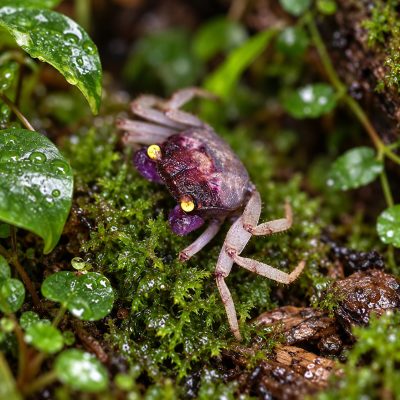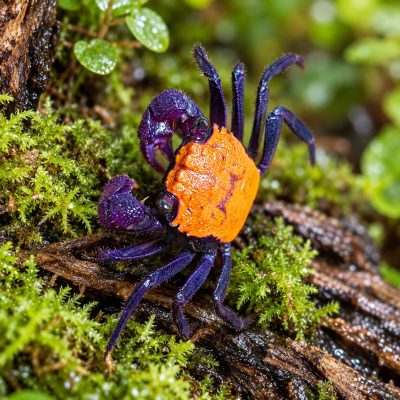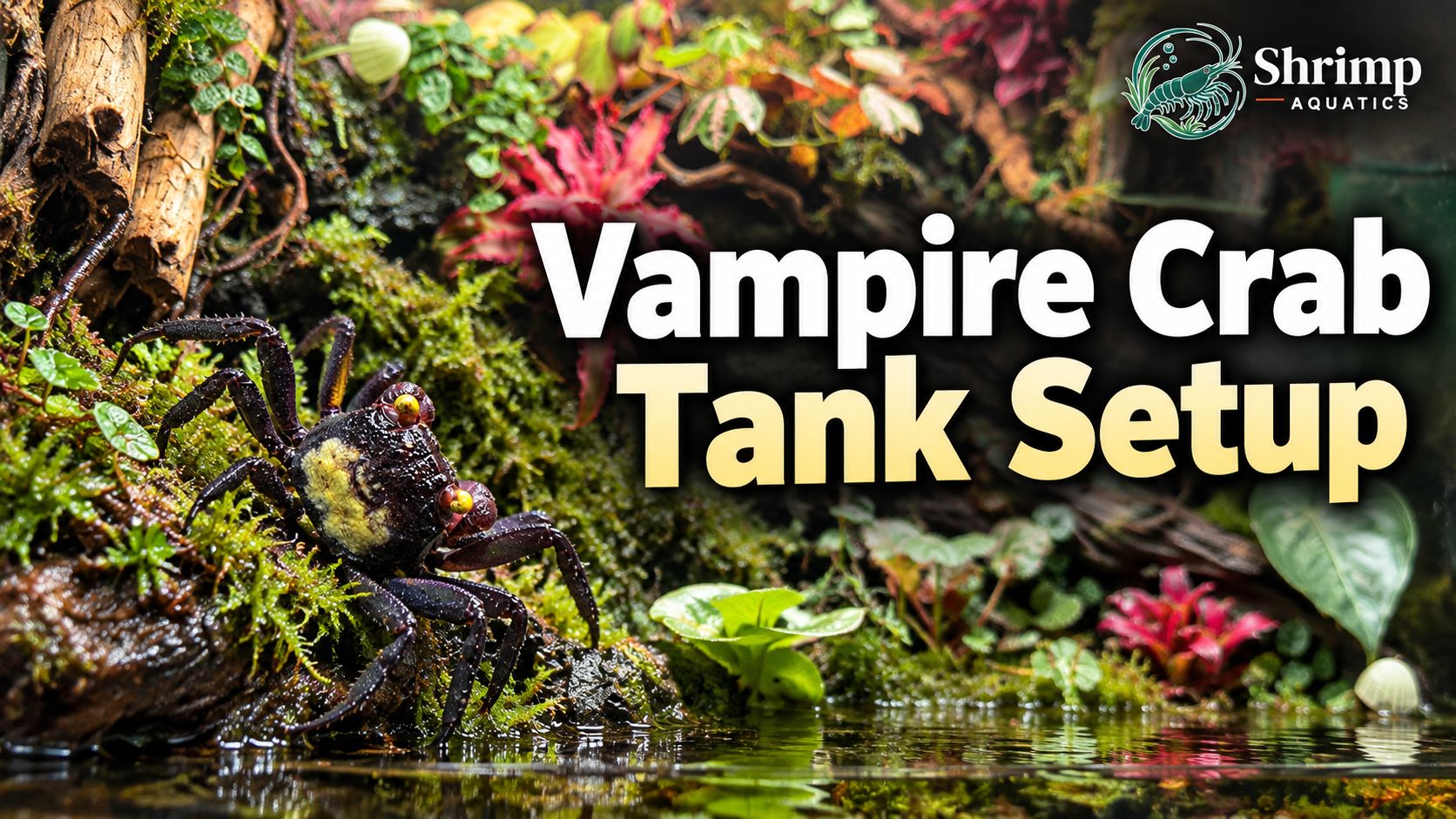

What should a vampire crab tank have in it before the first crab goes in? A vampire crab tank is a lidded paludarium that’s mostly land, with a substrate the crabs can dig into, more hides than crabs, and a water section every crab can climb into, fully enter and climb out of. Hold the air humid with the lid, moss and misting, and keep it at about 78°F (26°C) within 72-85°F (22-29°C).
Some keepers call this a crabitat, and the build is the same whatever you call it. The steps below follow the order you’d actually build in, from the empty tank to the day the crabs go in. If you’re fixing a tank where crabs keep dying off, check the lid, humidity and water access steps first.
Give vampire crabs a tank that is mostly land
Most of the floor should be land, with the water section taking the smaller share. Geosesarma, the genus sold as vampire crabs, is a large group of semi-terrestrial and terrestrial crabs from freshwater habitats in Southeast Asia and nearby islands.1 Your crabs will spend their days on the land, so that’s where the space goes.
Whatever tank you choose needs a lid that fits it properly, so check that before you buy. Decide how many vampire crabs can live together in it before you settle on a size, because the land area and hides set that number, not the gallons.
Build a water section every crab can walk into and out of
Make the water section one that every crab can climb into, get fully under and climb back out of without effort. Vampire crabs usually molt in the water, so a pool a crab can’t fully enter, or can’t leave easily, lets it down when it matters most. In our paludariums, the crabs live on the land section and go down into the water from time to time to feed and to molt, so the water section has to be one a crab can climb into and fully enter.
What makes it easy to enter? A gentle slope is the simplest answer. Build the bank down into the water with gravel or rock, or lean a piece of wood or stone from the land into the pool. A crab should be able to walk down and back up, not drop off a ledge. Make the water deep enough to cover your largest crab completely where it sits, and leave a rough path out on at least one side.
Don’t flood the whole tank. Vampire crabs aren’t aquatic, and a tank that’s mostly water is the wrong home for them, however good it looks. Whatever you call the build, keep the water area in a vampire crab vivarium the smaller share of the floor.
What land substrate lets vampire crabs dig and hide?
Use a land substrate that holds a burrow when a crab digs into it, and add more hides than you have crabs. In the wild, G. hagen hides under dense vegetation and between rocks, and sometimes digs burrows at the edge of the water.2 G. mirum digs its burrows under stones near the water’s edge.1 Whichever line you keep, plan burrowing space for vampire crabs like this on the land.
So copy that at home. A damp, soft substrate that keeps its shape when a crab tunnels into it does the job. Keep the land nearest the water damp enough to dig into, since that’s where wild crabs make their burrows. Then add cover: flat stones resting on the substrate, pieces of wood, cork bark and dense moss. If you can count all your crabs at once in daylight, there probably isn’t enough cover yet, and the crabs would agree. Keep that cover in a simple vampire crab enclosure too.
Seal the lid and every gap before the crabs go in
Fit a lid that closes tight and close every gap around it before a single crab goes in. Treat every gap as a way out.
- Cable gaps: heater and light cords pass through without leaving an open slot beside them.
- Tubing gaps: airline and filter tubing fit their holes snugly.
- Hinge gaps: the back strip and hinges of the lid close flush, with no open line along the edge.
- After maintenance: the lid is fully shut and latched every time you’ve had it open.
That last check is the one people forget. You mist, feed, close up in a hurry and leave a corner raised. Make shutting the lid the final step of every session. A tight lid holds the humidity in as well.
Do vampire crabs escape from a closed tank?
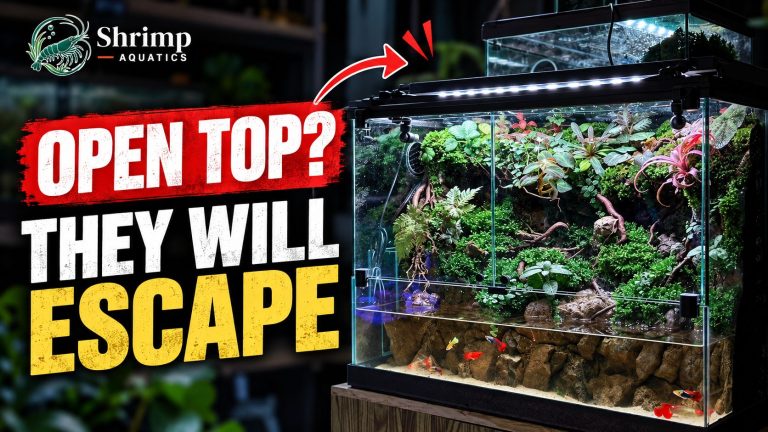
Yes, if the tank leaves them a way out, so set it up as if every crab will go looking for one. With the cords, tubing and hinges sealed, the gaps to watch are the ones that open up later. Keep decor and plants a little below the lid, so nothing bridges the land and the lid and nothing props a corner up. Plants keep growing, and a stem that cleared the lid last month can reach it now. After every feeding and every maintenance session, run your eye along the edge and make sure the lid sits flush all the way round. Going without a lid is no shortcut either, because vampire crabs can escape an open-top enclosure too.
How small is too small for a gap? Size every gap to the smallest crab you keep. In two described Java species, an adult’s shell measures roughly 11-15 mm (about half an inch) across,2 and crablets are far smaller than that. A slot an adult can’t fit through may still let a young crab out, so check any vents or mesh on the lid against your smallest crab, too.
If a crab goes missing, look inside the tank first. Check the water section from where you stand, without lifting anything. In our paludariums, a molting crab stays down in the water for a few hours, and a shed shell can look just like a dead crab, so read the signs of vampire crab molting before you decide it’s gone. Then check the lid and every gap. If everything was shut, count your crabs again over the next day or two before you dig under hides. If a corner was raised or a gap is open, search the room straight away, starting with the floor around the tank and under nearby furniture. One keeper reports finding a missing crab under the sofa the same morning.
How do you keep a vampire crab tank humid?
Keep the humidity high by closing the lid, covering the land with moss and misting regularly. Dry air is the usual failure in a vampire crab tank, and it’s easier to prevent than to fix once crabs start dying off. Hang a hygrometer at crab level, not near the lid, so it reads the air the crabs actually live in.
Watch the moss as well as the gauge. If it dries out between mistings, mist more often or close more of the lid. New plants change the routine too: one keeper with a glass-lidded tank misted every day while the plants adapted, and now mists every few days. Little adjustments like these are how you keep a vampire crab tank humid once it’s running.
Another keeper reports running a tank with no lid, at temperatures in the 60s Fahrenheit and 40-50 percent humidity, and losing crab after crab over four months. The cause was never pinned down, but it’s exactly the setup this page is built to avoid.
What temperature should a vampire crab tank run at?
Run the tank at about 78°F (26°C), within about 72-85°F (22-29°C). If your room stays inside that band day and night, you don’t need a heater. If the room runs cooler, a small aquarium heater in the water section is the simple way to warm the tank.
Put a thermometer at crab level on the land as well as one in the water, and read both in the morning and the evening for a few days. A reading in the water doesn’t tell you what the air on the land is doing, and the land is where your crabs live.
Prepare the water section and let the tank run before adding crabs
Fill the water section with dechlorinated fresh water and keep it clean with a small filter or regular partial water changes. Then let the finished tank run before any crab goes in. A gentle sponge filter suits a small pool. If you’d prefer to skip the filter, change part of the water regularly and keep the pool small enough to make that easy. Running the tank first is the heart of land cycling in a vampire crab paludarium.
Let the tank run with the lid closed, the heater on if you use one and the moss misted, until the hygrometer and thermometer hold steady from one day to the next. How do you know it’s ready? Not by the calendar: steady readings tell you. If shrimp will share the water section, that water has to suit the shrimp too, so pick a kind whose temperature range overlaps the crabs’. The main vampire crab care page names which ones fit.
Finish the land section with moss, plants and springtails
Cover much of the land with moss, add live plants that like wet roots and humid air, and seed the substrate with a cleanup crew. Moss holds moisture and gives the crabs more cover. Plants add shade and more places to hide.
Springtails and isopods make a cleanup crew for the land section. Put food where the crabs will find it, and lift whatever’s left before it goes moldy in the damp air. Since what vampire crabs eat is mostly small animal food that spoils fast, give the land section one or two flat feeding spots you can reach.
Adding vampire crabs once the paludarium is ready
Add the crabs once the tank holds its humidity and temperature steadily and every gap is closed. Our tank-bred vampire crabs come from several lines, with more being added over time. Everything in our catalog is bred or propagated in our own tanks rather than collected from the wild.
You choose male or female on each product page, so decide the mix before you order, and check male vs female vampire crabs by the flap underneath once they arrive. We can’t promise that a group will breed. If crablets do turn up later, plan to move them to their own container, because adults eat the young they find. Before the crabs go in, run through the common vampire crab mistakes once more.
References
2 Sources
- Shy and Ng, Geosesarma mirum, a new species of semi-terrestrial sesarmid crab (Crustacea, Decapoda, Brachyura) from central Taiwan, ZooKeys 858, 2019.
- Ng, Schubart and Lukhaup, New species of “vampire crabs” (Geosesarma De Man, 1892) from central Java, Indonesia, and the identity of Sesarma (Geosesarma) nodulifera De Man, 1892 (Zenodo archive copy of the paper), Raffles Bulletin of Zoology 63: 3-13, 2015.