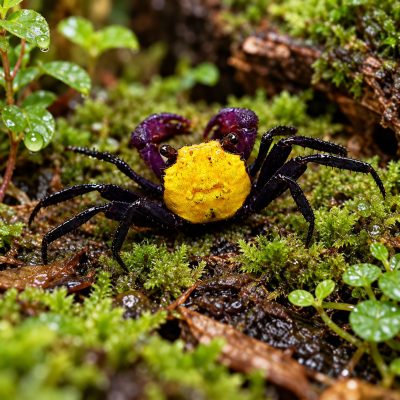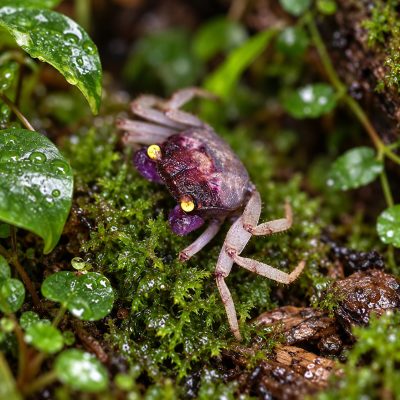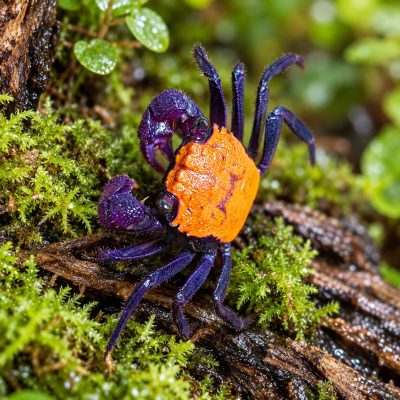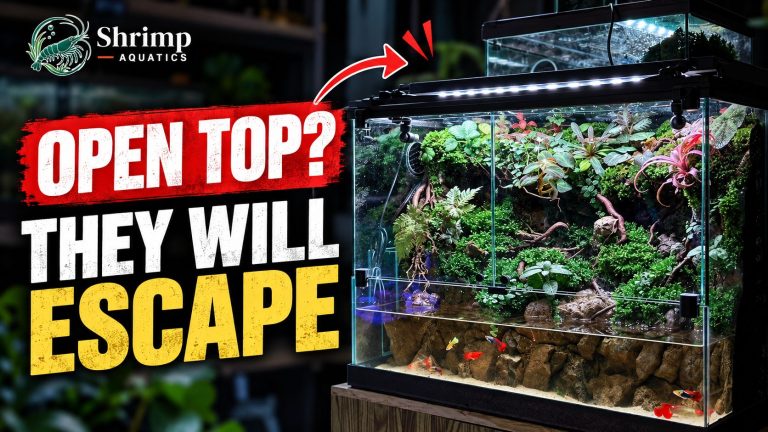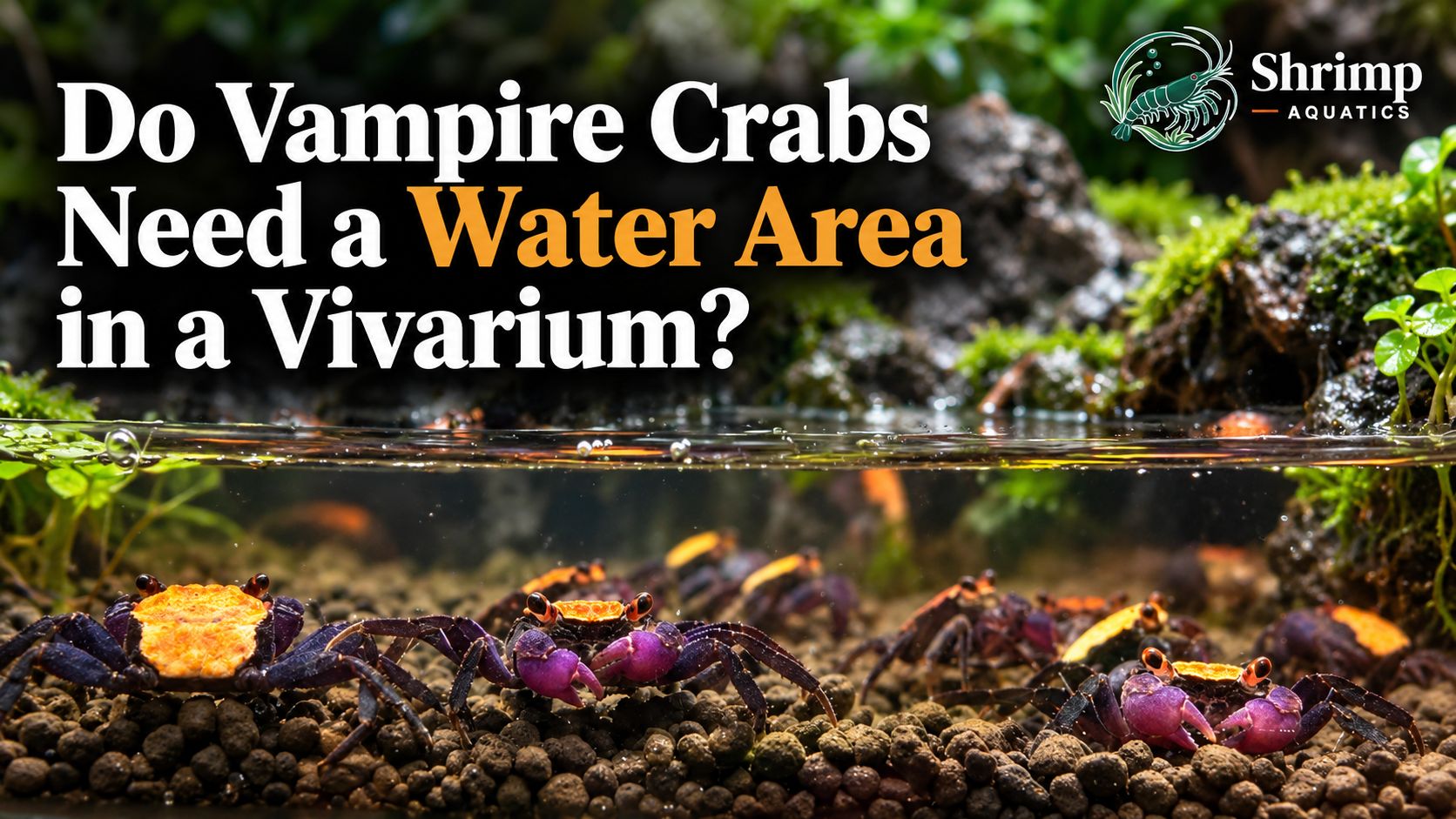
Yes. Vampire crabs need a water area in their vivarium, and it has to be one a crab can climb into, get fully under and climb back out of. They live mostly on land, so the water takes the smaller share of the floor, but a dry terrarium or a saucer that only wets their legs won’t do. Vampire crabs (Geosesarma) usually go into the water to molt, and their gills need to stay moist.
If you’re coming from frogs or geckos, the word you want is paludarium: a vivarium that’s part land and part water. That’s the kind of vivarium a vampire crab can live in long term.
Why can’t vampire crabs live in a dry vivarium?
A dry vivarium gives a vampire crab no water to molt in and nothing to keep its gills wet. In our paludariums, the crabs spend their time on land and climb down into the water from time to time to feed and to molt, so the water section has to be one a crab can climb into and fully enter.
Breathing is the other half. Crabs of their family, the Sesarmidae, hold water in their gill chambers and keep it moving while they’re out in the air.1 In land crabs that dry out, the gill surfaces collapse and breathing drops, and a land crab that doesn’t drink loses body fluid.2 So the water isn’t decoration. It’s how the crab tops itself up. So vampire crabs can’t live in water full time, and they can’t live without it either: they need land and water they can reach.
How long can a vampire crab manage without water?
A vampire crab can manage a while without water only as long as its body stays damp, so keep water in the vivarium every day. One field study of wild vampire crabs in Java found they can stay away from water for long stretches, as long as their bodies stay moist.3 Damp substrate and humid air buy a crab that time. A dry setup doesn’t. No one has put a safe number of days on it, so treat a crab that’s been left without water as a crab in trouble.
You may also read that vampire crabs can molt without water. Keepers of a few other Geosesarma do report molts on land, so where a crab molts can differ between species. That’s why a good setup offers both: water every crab can fully enter, and damp hides on land. If a crab goes quiet in the water, the signs of vampire crab molting tell you whether to leave it be.
Is a water dish enough for vampire crabs, or do they need a pool?
A dish is enough only if your largest crab can walk into it, sit completely under the surface and walk back out. That rules out a bottle cap, a sponge dish or a saucer that just covers the legs. It also rules out a steep-sided bowl, even a deep one, because a crab has to be able to climb out without effort.
What works? A shallow tray sunk level with the substrate, a pond-style dip in the hardscape, or a glass divider with a sloped bank all do the job. Call it a dish, a pool or a water section, it doesn’t matter. The crab’s way in and way out is what you’re really building.
Size changes the upkeep, though. A few cups of water foul fast in a warm, humid tank, so a tiny dish needs changing often. A slightly larger water section with a small sponge filter is usually less work, and it gives a molting crab clean water to sit in. In a simple vampire crab enclosure with no filter, that means changing the dish often.
How much of a vampire crab vivarium should be water?
Keep most of the floor as land and give the water the smaller share, sized so every crab can get fully under. You’ll see 80/20, 70/30 and even half and half quoted for vampire crabs. We wouldn’t get hung up on the ratio. Two checks matter more: the water covers your largest crab completely where it sits, and there’s a gentle slope or rough path out on at least one side.
Adult vampire crabs are small. In two described Java species, the shell measures roughly 11-15 mm across, about half an inch.4 So you don’t need deep water, just water deep enough for the biggest crab you keep. Build the slope with gravel, rock or a piece of wood leaning into the water, as in a vampire crab tank setup, so a crab walks down and back up instead of dropping off a ledge.
Don’t flood the vivarium to be safe
More water isn’t safer. A crab that can’t get out of the water is at risk of drowning, and a tank that’s mostly water is the wrong home for vampire crabs, however good it looks.
Add a water section to an existing vivarium for vampire crabs
You can turn a dry terrarium or frog vivarium into a vampire crab home by giving it a water section, a way out and a lid with no gaps. Work through it in this order.
- Make room for the water. Clear one end or a corner and sink a tray, or fit a divider, so the water sits level with the land along at least one edge.
- Build the way out. Slope gravel or stone from the land into the water, or lean a piece of wood across, so every crab can walk in and out.
- Fill it with dechlorinated fresh water. Keep it clean with a small sponge filter or regular partial changes, because a small pool fouls quickly.
- Close every new gap. Filter tubing and cords make new escape routes, so check the lid again once the water section is in.
- Let it settle. Run the converted vivarium until humidity and temperature hold steady from one day to the next before any crab goes in.
Keep the land as damp as it was before. The water doesn’t replace humid air, and a tank that dries out is still one of the ways vampire crab keeping goes wrong. Humidity and the lid are the other two pillars of vampire crab care, and they matter just as much once the pool is in.
Getting vampire crabs once the water area is ready
Order your crabs once the water section is in, the lid is sealed and the vivarium holds its humidity. Our tank-bred vampire crabs come from several lines, and you choose Male or Female for each crab on the product page. Everything in our catalog is bred or propagated in our own tanks rather than collected from the wild. When your crabs arrive, follow the instructions supplied with your order.
References
4 Sources
- Species-specific gill’s microbiome of eight crab species with different breathing adaptations, Scientific Reports 13, 2023.
- Lucu and Turner, Ionic regulatory strategies of crabs: the transition from water to land, Frontiers in Physiology 15, 2024.
- Kurniawan, Waluyo, Nofreeana and Aji, Habitat and Food of Vampire Crabs (Geosesarma sp.) in Menoreh Mountain, Yogyakarta, Indonesia, Media Konservasi 30(1), 2025.
- Ng, Schubart and Lukhaup, New species of “vampire crabs” (Geosesarma De Man, 1892) from central Java, Indonesia (archived copy on Zenodo), Raffles Bulletin of Zoology 63, 2015.
Ready to get started?
Shop our Vampire Crab collection
8 products available · Live Arrival Guarantee