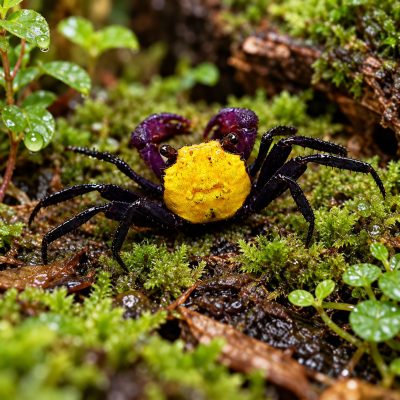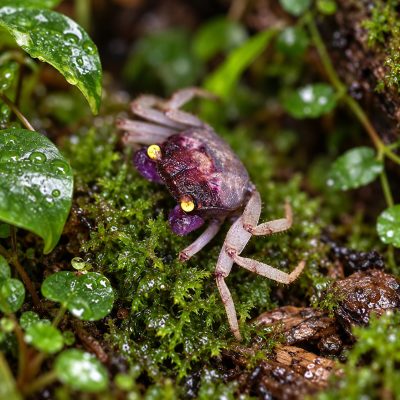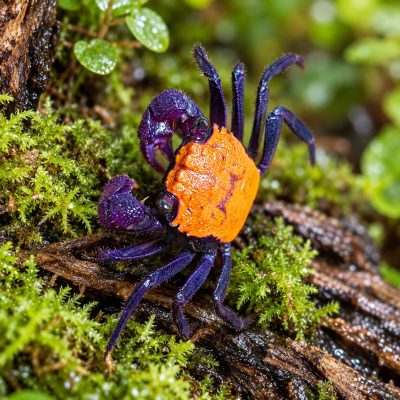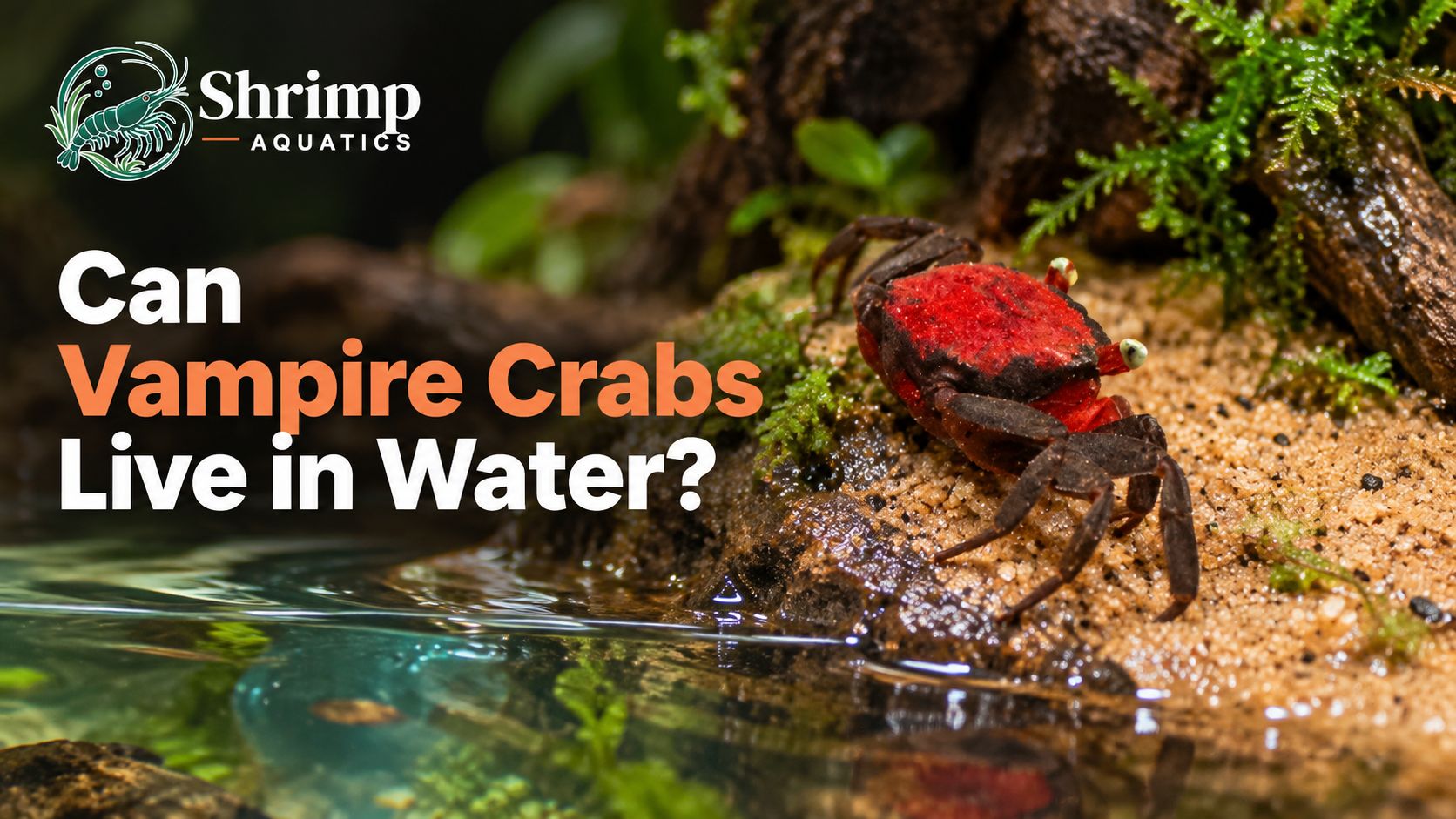
Could your vampire crabs live in an ordinary aquarium, fully under water? No, a vampire crab (Geosesarma) can’t live under water full time. It’s a semi-terrestrial crab that lives mostly on land, breathes air through gills it keeps moist, and climbs into fresh water to feed and, usually, to molt. So it needs land plus a water section it can fully enter and leave, never a flooded tank. Even among true crabs that have moved onto land, none is known to be completely independent of water through its whole life cycle.1
How do vampire crabs breathe out of water?
Vampire crabs breathe air with gills, and they keep those gills moist to do it. You may have read that vampire crabs have no gills. They do. Crabs of their family, the Sesarmidae, hold water in their gill chambers and recirculate it, which keeps oxygen up while they’re out in the air.2
That water has to come from somewhere. Land crabs lose water mainly across the shell and the gills, and a crab that dries out breathes less well.3 So your tank has two jobs: moist air on the land, and water the crab can reach whenever it wants to top up.
A crab sitting on land for hours? That’s fine. A field study of an unnamed wild vampire crab in Java found the crabs can stay away from water for long periods, as long as their bodies stay moist.4
When do vampire crabs go fully under water?
Vampire crabs go fully under water to feed and, usually, to molt, then climb back out onto land. In our paludariums, the crabs spend their time on land and climb down into the water from time to time to feed and to molt. A molting crab stays down in the water for a few hours.
Age makes a difference, too. In two wild species from central Java, Geosesarma dennerle and G. hagen, young crabs were often in the water or right beside it, while adult G. hagen kept mostly to moist banks.5 If you ever have crablets, give them an easy way into and out of the water.
Can a vampire crab drown if it can’t climb out of the water?
Treat drowning as a real risk for a vampire crab, and give it a way out of the water at all times. When a land crab from a different family was tested under water, its oxygen uptake fell sharply, and that species can’t survive prolonged submersion.6
How long can a vampire crab stay under, then? Nobody has timed it, so any figure you read isn’t safe to rely on. What you can control is the way out. Don’t count on a crab swimming to safety. Build the water so it never has to, with a gentle slope or a rough path out on at least one side. How deep to make the water and how to shape that exit belong to your vampire crab tank setup, and a fully flooded tank is never the answer.
Do vampire crabs need fresh or salt water?
Vampire crabs need fresh water. Most Geosesarma are wholly freshwater crabs that never return to the sea to breed, because their large eggs hatch straight into young crabs.7 That’s true of over 90 percent of the species whose egg size was known by 2019.8
There are exceptions. G. hednon, a small-egged species from Taiwan and the Philippines, is one: its egg-carrying females migrate to the sea to release their larvae.9 That’s a trait of that species, not something your crabs need. If crablets ever appear in your tank, vampire crab breeding happens in the same fresh water, with no brackish step to manage.
Why is your vampire crab staying in the water?
Your vampire crab may be molting, so leave it alone in the water for a few hours before you change anything. Vampire crabs usually molt in the water, and the signs of vampire crab molting help you tell whether that’s what you’re watching. Don’t scoop it out to check.
What if it isn’t molting and keeps to the water day after day? Then run these checks on the land side of your tank.
- Humidity stays high all the time, with the lid closed.
- The land stays damp, not dried out on top.
- There are enough hides on land for every crab to have cover.
- The tank sits at about 78°F (26°C), within 72-85°F (22-29°C).
Fix whichever one is off. Those four checks cover the basics of vampire crab care for every crab in your tank, not only the one in the water.
What the research says about crabs living in and out of water
Most of the physiology behind this page comes from other crabs. It explains why vampire crabs need land and water, but gives no figure for how long yours can stay dry or under. Wolfe and colleagues rank true crabs by how far they’ve broken free of standing water. No known crab has done so for its whole life cycle.1 The gill study sampled two mangrove crabs from the vampire crabs’ family, and treats recirculating water in the gill chambers as a family trait.2
Lucu and Turner’s review adds that when crustaceans dry out, the fine gill surfaces collapse and gas exchange falls.3 And when the land crab Gecarcinus lateralis was submerged, its oxygen uptake fell to about a seventh of its value in air.6 That’s one land crab from a different family, so read it as a reason for caution, not a drowning time.
Get your paludarium ready before you buy vampire crabs
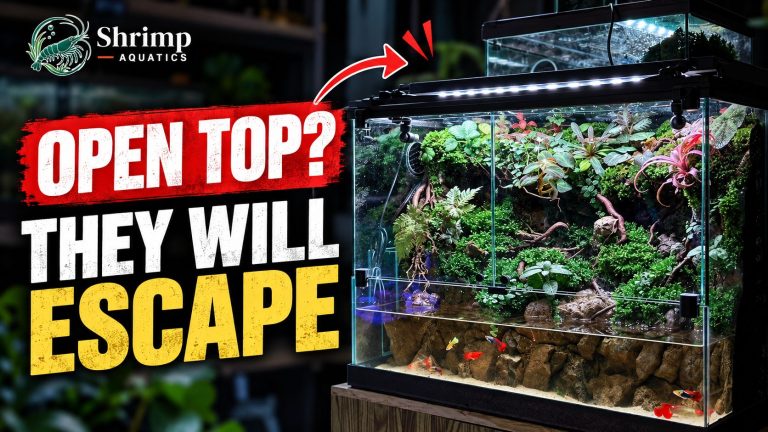
Have the land, the water section and a tight lid ready before you order, because vampire crabs are bought for a paludarium, not a fish tank. Once it’s set up, you can pick tank-bred vampire crabs and choose Male or Female for each crab on the product page. Everything in our catalog is bred or propagated in our own tanks rather than collected from the wild. When your crabs arrive, follow the instructions supplied with your order.
References
9 Sources
- Wolfe et al., Convergent Adaptation of True Crabs (Decapoda: Brachyura) to a Gradient of Terrestrial Environments, Systematic Biology 73(2), 2024.
- Species-specific gill’s microbiome of eight crab species with different breathing adaptations, Scientific Reports 13, 2023.
- Lucu and Turner, Ionic regulatory strategies of crabs: the transition from water to land, Frontiers in Physiology 15, 2024.
- Kurniawan, Waluyo, Nofreeana and Aji, Habitat and Food of Vampire Crabs (Geosesarma sp.) in Menoreh Mountain, Yogyakarta, Indonesia, Media Konservasi 30(1), 2025.
- Ng, Schubart and Lukhaup, New species of “vampire crabs” (Geosesarma De Man, 1892) from central Java, Indonesia (archived copy on Zenodo), Raffles Bulletin of Zoology 63, 2015.
- O’Mahoney and Full, Respiration of crabs in air and water (hosted copy on a University of California, Berkeley lab site), Comparative Biochemistry and Physiology Part A 79(2), 1984.
- Ng, Khadijah-Ahmad and Ahmad, On a new species of vampire crab from the Geosesarma foxi species-group (Crustacea: Brachyura: Sesarmidae) in northern Peninsular Malaysia, Raffles Bulletin of Zoology 73, 2025.
- Shy and Ng, Geosesarma mirum, a new species of semi-terrestrial sesarmid crab (Crustacea, Decapoda, Brachyura) from central Taiwan, ZooKeys 858, 2019.
- Ng, Liu and Schubart, Geosesarma hednon, a new species of terrestrial crab (Crustacea: Decapoda: Brachyura: Sesarmidae) from Taiwan and the Philippines, Raffles Bulletin of Zoology 52(1), 2004.
Ready to get started?
Shop our Vampire Crab collection
8 products available · Live Arrival Guarantee