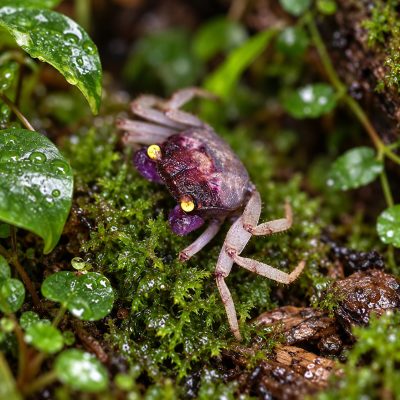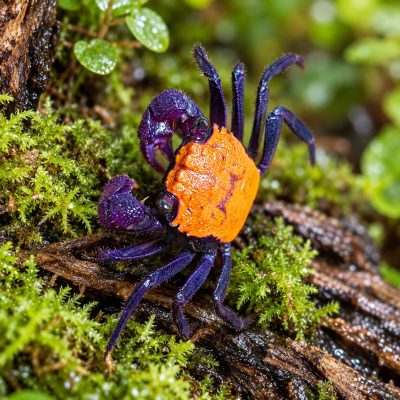

Do you need brackish water or a separate larval tank to breed vampire crabs? No: the vampire crabs (Geosesarma) sold in the hobby breed in fresh water with no larval stage, and their large eggs hatch straight into tiny crabs, up to about 40 from one clutch. You don’t need brackish or salt water at any point. Move the crablets out as soon as you find them, because adult vampire crabs eat the crablets they find.
If you have a mixed group of males and females, most of the work is keeping the tank steady and checking the hides. If you’ve just found tiny crabs, skip ahead to moving them out and raising them.
Do vampire crabs need brackish water to breed?
Fresh water is all they need. The vampire crabs sold in the hobby skip the larval stage altogether. The young come out as tiny crabs in the same tank, with no salt or brackish step for you to manage.
That fits what’s known about crabs in general. Among true crabs, shortened development shows up in some freshwater members of the sesarmid family, which includes vampire crabs, and some of them hatch directly as tiny crabs.1 Within the vampire crab genus, over 90 percent of the species whose egg size had been recorded by 2019 have large eggs and develop directly.2 Crablets turning up in home paludariums show the hobby crabs do the same.
It isn’t true of all 73 described species in the genus, though. The egg-carrying female of a species described in 2026 had small eggs, only about 0.5 mm across.3 A few other species have small eggs and young that start life as larvae feeding in the plankton.2
What helps a vampire crab group breed at home
Start with what you control: a group with both males and females, living in a steady tank that meets the vampire crab care basics. That means high humidity, a temperature around 78°F (26°C) within 72-85°F (22-29°C), a water section the crabs can climb into and fully enter, and plenty of hides on land.
Settle the mix of males and females, and how many vampire crabs can live together in your tank, before you add more crabs. Then leave the tank alone as much as you can. We know it’s tempting to lift every hide looking for eggs, but that disturbs the very crabs you’re hoping will breed.
How to tell a female vampire crab is carrying eggs
You usually can’t see the eggs, so the check is indirect: notice when a female stops showing herself, then look for crablets under the hides. You’ll need to tell females from males first, so you know which crabs to keep an eye on. The flap underneath settles male vs female in vampire crabs.
So where are the eggs? In crabs generally, the female carries them stuck to small paired limbs, the pleopods, under her abdomen. In females that abdomen is broad for the job and lies flat against the underside of the body.1 You won’t see the eggs unless she turns over, and a berried female spends most of the brooding time hidden, often dug in or in a burrow, until the crablets appear. One keeper’s berried female disappeared from sight for two weeks, and when she showed herself again, the eggs were gone.
If a female you used to see every day goes missing, don’t dig her out. Check gently under bark, moss and the edge of the water, and put everything back the way it was.
How long until vampire crablets appear?
Expect about three to seven weeks. Keepers count from different points, some from when they first see the eggs and others from when the female goes into hiding. Start your count from whichever you notice, and keep checking the hides from then on.
Don’t give up on a female because the count has run out. Crablets under the bark or in the moss are the sign you’re waiting for. Stop looking after a fixed date and you can miss a clutch that the adults find first.
What happens when baby vampire crabs hatch
The young come out as complete tiny crabs, up to about 40 from one clutch. Some keepers call them fry, but they’re crabs from day one, so look for them under bark and in moss.
Newly hatched crablets stay on or under the mother for a short time before they go off on their own. In Geosesarma notophorum, a species from Sumatra, the mother carries them on her back.4 Either way, don’t wait for the young to leave her before you move them.
Should vampire crablets stay with the adults?
Move them out if you want the most crablets to survive. Adult vampire crabs eat the crablets they catch, so moving the crablets, or the adults, to another tank raises the most young. In a large, densely planted paludarium some crablets also grow up alongside the adults. If you’d rather move the adult vampire crabs after the babies appear, give them a complete second tank.
There are two ways to do it. If you know which female is carrying eggs, move her into a container of her own before the young hatch, with the same humidity and a water section she can fully enter. Once they’ve hatched, put her back with the group and leave the crablets in that container. If you find crablets in the main tank first, catch them with a small cup. Slide it under the crablet, lift it out with a little moss and tip it into the new container.
Raising vampire crablets with easy water access
Give crablets a small container of their own with water they can reach and climb out of easily, damp moss and high humidity. That matches the wild, where young G. dennerle and G. hagen, two species from central Java, are often found at the waterline.5 A lidded plastic box, tub or small tank is enough, often about 5 to 20 liters (1 to 5 gallons). Fill it with damp humus, soil or wet leaves, add moss or leaf litter for cover, and keep the water very shallow: about 1 cm (under half an inch) deep, or a dish the crablets can walk out of. Keep the lid on. It holds the humidity in and stops crablets that small from slipping out.
Feed them the same foods vampire crabs eat as adults, crushed finer: crushed or powdered fish flakes, fine granules or small pellets, scattered on the land and along the water’s edge. Crablets also catch springtails and other tiny animals living in the container, so a springtail culture is worth adding. Offer a little every day or every two or three days. A clump of moss and some leaf litter from an established tank gives them small life to pick at between feeds. Lift leftovers before they go moldy, because a small container spoils fast. Growing them on to adult size is a longer job, but it starts with this setup. Don’t expect color yet: crablets start out clear or brown, and vampire crab losing color covers when they color up.
How fast do vampire crablets grow?
Slowly, and not all at the same pace. Crablets measure about 2 to 3 mm across when you first see them and about 3 mm at about 1.5 months. They’re about 5 to 8 mm at about 3 to 6 months, and about 1 cm (0.4 inch) at about 6 to 7 months. Young from one brood soon differ in size, so a small crablet next to bigger siblings isn’t necessarily a weak one. Don’t expect much color along the way: baby vampire crabs start to color up at about 1 cm.
When to split up a brood of young vampire crabs
Crablets from one brood mostly live together without hurting each other. They sit in groups, squabble over food and spar, a lot like siblings anywhere, but young of a similar size aren’t seen eating each other. Split them once you can tell the sexes apart or they start to color up, at about 1 cm, which usually falls somewhere between 4 and 12 months. That’s also the point to plan where each young crab will live as an adult. If that adds up to too many vampire crab babies, rehome the extras through other keepers and never release them.
Is it normal to lose some vampire crablets?
Yes. In a tank shared with adults, losing crablets is expected, because adult vampire crabs eat the crablets they find. Moving the crablets out is the fix, and the sooner you find them, the more you can move.
How big is the difference? One keeper who raised broods both ways got only a few crablets to adult size when they stayed with the adults, and many more once they were moved into boxes of their own. Some crablets do grow up alongside the adults in a large, densely planted paludarium, so if you leave them in, give them plenty of moss and small hides near the water.
Buying vampire crabs to start a breeding group
Plan the group before you order, because you’ll need both males and females. You choose male or female on each product page for our tank-bred vampire crabs, so you can put together the mix you want. Everything in our catalog is bred or propagated in our own tanks rather than collected from the wild.
Both sexes give a group the chance to breed; they don’t promise crablets or a number of young. When the crabs arrive, follow the instructions supplied with your order. If you’ll breed one line for years, add an unrelated crab of that line now and then, since inbreeding can affect vampire crabs.
References
5 Sources
- Ng, Guinot and Davie, Systema Brachyurorum: Part I. An annotated checklist of extant brachyuran crabs of the world, Raffles Bulletin of Zoology Supplement 17, 2008.
- Shy and Ng, Geosesarma mirum, a new species of semi-terrestrial sesarmid crab (Crustacea, Decapoda, Brachyura) from central Taiwan, ZooKeys 858, 2019.
- Grinang, Ng and Ng, A new species of vampire crab of the genus Geosesarma De Man, 1892 (Crustacea: Brachyura: Sesarmidae) from a montane forest in southwestern Sarawak, Malaysian Borneo, Raffles Bulletin of Zoology 74: 457-464, 2026.
- Ng, Semiterrestrial crabs of the genus Geosesarma De Man, 1892 from western Borneo, Indonesia, with descriptions of three new species (Geosesarma pontianak treatment, Plazi TreatmentBank copy of the paper), Zootaxa 4048, 2015.
- Ng, Schubart and Lukhaup, New species of “vampire crabs” (Geosesarma De Man, 1892) from central Java, Indonesia, and the identity of Sesarma (Geosesarma) nodulifera De Man, 1892 (Zenodo archive copy of the paper), Raffles Bulletin of Zoology 63: 3-13, 2015.
Ready to get started?
Shop our Vampire Crab collection
8 products available · Live Arrival Guarantee