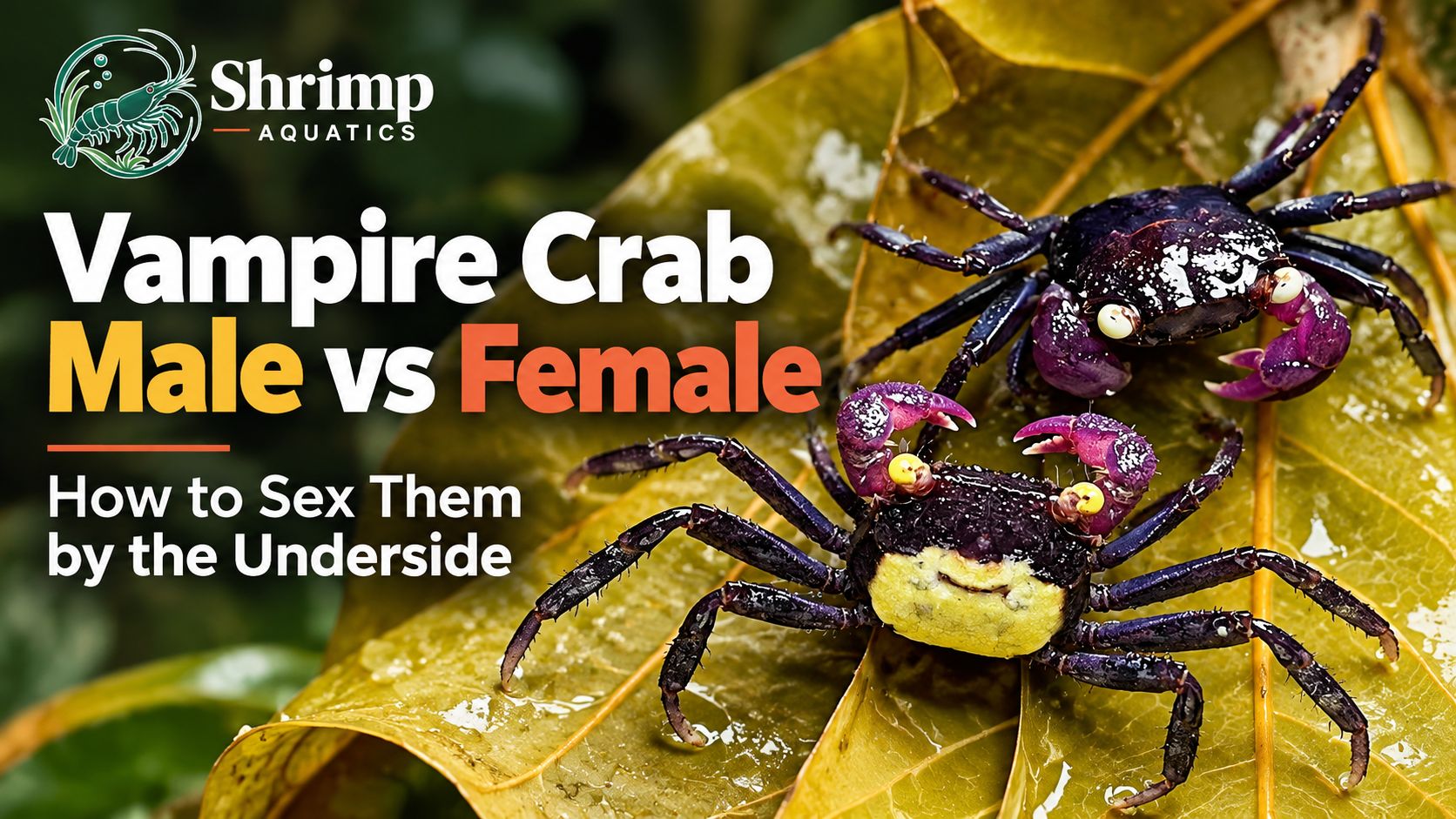
Which of your vampire crabs are males, and which are females? Check the abdominal flap, the plate folded flat under the body: a male’s is narrow and triangular, while a female’s is broad and spreads over the underside. That’s the usual pattern in true crabs, the group vampire crabs belong to, and her flap is wide because she carries her eggs under it.1 The claws can fool you. In most crabs where the sexes differ, the male has the bigger claws,1 so use the claws to guess and the flap to decide.
What does the underside of a male and a female vampire crab look like?
A male vampire crab’s flap is the narrow one, a triangle in most crabs, while a female’s is broadly expanded over her underside.1 In our paludariums, males have a narrow, triangular flap and females a broad one that covers most of the underside. Compare your own crabs side by side, and the one whose flap spreads across most of its underside is the likely female. The same pattern shows up in two vampire crabs described in 2026. The female’s flap covers most or nearly all of the underside in Geosesarma wongi2 and G. penrissen.3
The flap also hides the parts each sex breeds with.1 You don’t need to see those to sex a crab, though. The outline of the flap is enough.
Can you tell a vampire crab’s sex from its claws?
Claws give you a quick first guess, but they can’t settle it. In most crabs where the sexes look different, males have proportionately much larger claws,1 so a crab with big, heavy claws is probably a male.
And a crab with small claws? Age is the catch. In many decapods, crabs included, a male’s claws only pull ahead of a female’s after the molt that makes him mature.4 In our paludariums, adult males have bigger claws than females, but a young male’s claws look like a young female’s. Sort a group by claws alone and you can count young males as females, so check the flap on any crab you’re about to count as a female.
How to check a vampire crab’s underside without hurting it
Look from below, through a clear container, so the crab stays on its feet the whole time. You don’t need to hold it to see the flap.
- Coax the crab into a clear cup or small clear box with a little damp moss in it.
- Lift the container and look at the underside from below, or photograph it from below and zoom in.
- Never pick a crab up by a leg or a claw, and don’t hold it on its back.
- Keep the check short and keep the crab damp throughout.
Then put it straight back into a humid tank with its hides in place, the conditions good vampire crab care calls for every day.
When can you trust the sex of a small vampire crab?
Treat a small crab’s sex as a provisional call and check it again as it grows. In most true crabs, a young female’s flap locks onto her underside the way a male’s does until the molt that makes her mature.1 No one has published the size at which vampire crabs can be sexed reliably, so there’s no safe minimum to work from.
Young crabs are where both clues are weakest, because a young male’s claws haven’t yet outgrown a female’s. Check the flap, write down what you think each crab is, and look again once it has grown. A pencil note on the tank lid beats trying to remember. Don’t build a breeding plan around a crab you sexed while it was tiny.
Spotting a female vampire crab carrying eggs or young
A berried female carries her eggs under her wide flap, held on the small appendages there, as other true crabs do.1 In over 90% of vampire crab species with a known egg size, the eggs are large and hatch straight into tiny crabs.5 What you’ll see is crablets, not larvae. Some species go on caring for them, as in Geosesarma mirum, where the female broods the young under her flap,5 and G. notophorum, where she carries them on her back.6 Seeing eggs under her doesn’t mean you need to separate the pregnant vampire crab from the group.
One clutch gives up to about 40 crablets. If you think a female is carrying, leave her alone. Don’t catch her or turn her over to check, and let her stay out of sight if she wants to. One keeper’s berried female vanished from sight for two weeks. When she reappeared her eggs were gone, and the young were found under a piece of cork bark. The crablets that follow need moving out of the adult tank, so plan for vampire crab breeding before they appear.
What the research says about telling male and female crabs apart
The general rules on this page come from true crabs as a whole, not from studies of vampire crabs. Ng, Guinot and Davie describe the male flap as triangular in most crabs and the female flap as typically broad, lying over the underside to carry eggs.1 Males always have two pairs of gonopods, their mating appendages, under the flap. Females hold their eggs on branched, hairy appendages there. In most crabs, a young female’s flap can lock onto the underside like a male’s until her maturing molt.1
The claw clue comes from the abstract of a review on decapods. The claws of both sexes grow in step until the puberty molt, and then a male’s get disproportionately big.4 Neither source gives a size at which vampire crabs change.
Why does the mix of male and female vampire crabs matter when you buy?
You need both sexes for any chance of crablets, and a safe default is more females than males. Whether you’re after a pair or a trio, decide the mix before you order. Then sex the crabs you already have by the flap, not the claws. That tells you which sex you’re short of, so you buy only what the group needs. If you want no crablets at all, keep one sex, since nothing reliably keeps a male and female vampire crab without breeding.
Choosing male or female vampire crabs for your group
Pick the sex of each crab on the product page. Every one of our tank-bred vampire crabs is listed with a Male or Female option, so you can build the mix you planned, such as more females than males. Everything in our catalog is bred or propagated in our own tanks rather than collected from the wild.
Buying both sexes gives a group the chance to breed; it doesn’t promise crablets or a number of young. When the crabs arrive, follow the instructions supplied with your order.
References
6 Sources
- Ng, Guinot and Davie, Systema Brachyurorum: Part I. An annotated checklist of extant brachyuran crabs of the world, The Raffles Bulletin of Zoology Supplement 17, 2008.
- Ng, Geosesarma wongi sp. nov., a distinctive new species of semiterrestrial crab from Tapah Hills in Perak, Peninsular Malaysia; with notes on G. peraccae (Nobili, 1903) and G. cataracta Ng, 1986 (Crustacea, Brachyura, Sesarmidae), ZooKeys 1266, 2026.
- Grinang, Ng and Ng, A new species of vampire crab of the genus Geosesarma De Man, 1892 (Crustacea: Brachyura: Sesarmidae) from a montane forest in southwestern Sarawak, Malaysian Borneo, Raffles Bulletin of Zoology 74, 2026.
- Mariappan, Balasundaram and Schmitz, Decapod crustacean chelipeds: an overview (abstract), Journal of Biosciences 25(3), 2000.
- Shy and Ng, Geosesarma mirum, a new species of semi-terrestrial sesarmid crab (Crustacea, Decapoda, Brachyura) from central Taiwan, ZooKeys 858, 2019.
- Ng, Semiterrestrial crabs of the genus Geosesarma De Man, 1892 (Crustacea, Brachyura, Sesarmidae) from western Borneo, Indonesia, with descriptions of three new species: Geosesarma pontianak treatment, Zootaxa 4048(1), 2015, Plazi TreatmentBank.
Ready to get started?
Shop our Vampire Crab collection
8 products available · Live Arrival Guarantee