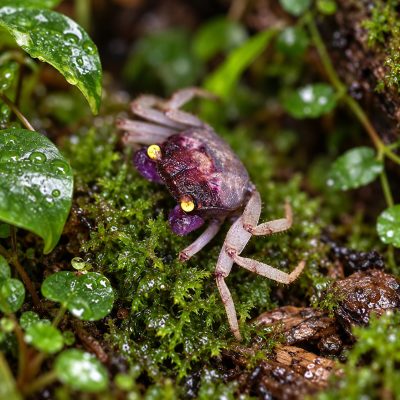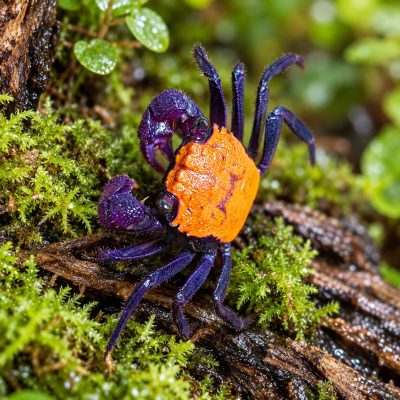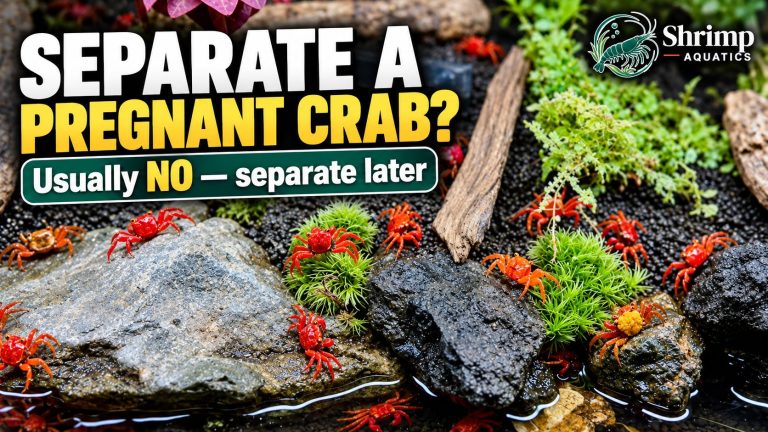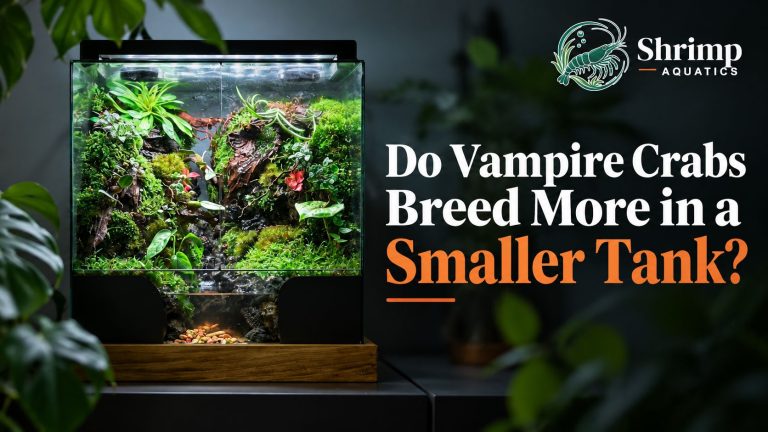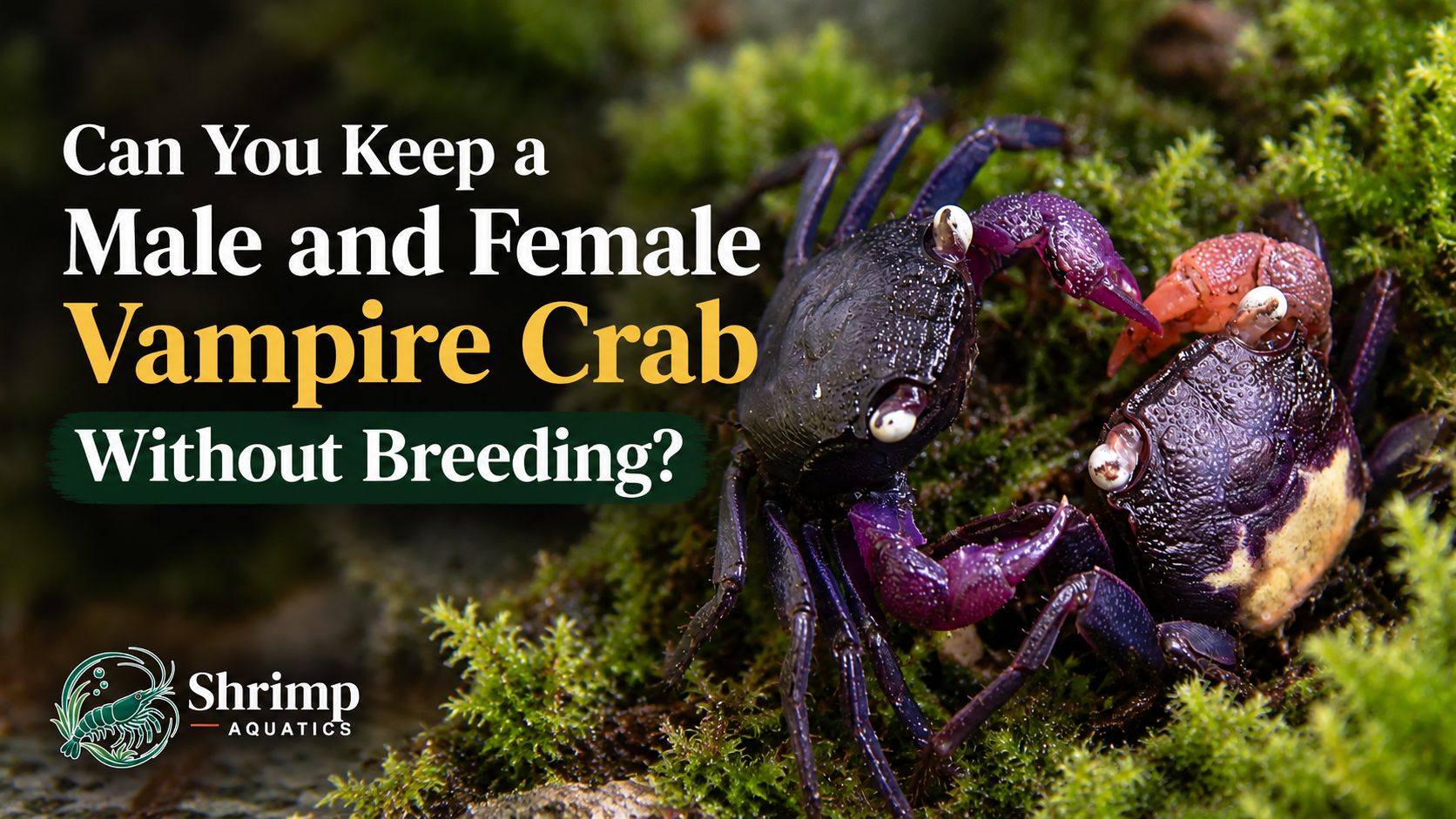
No, a male and female vampire crab kept together can’t be reliably stopped from breeding. If you keep an adult pair together, plan for crablets, because these crabs need nothing more than a freshwater paludarium to raise young, and there’s no setting you can change to switch breeding off. The only dependable way to keep a vampire crab tank free of babies is to keep one sex.
Why can’t you stop a vampire crab pair from breeding?
You can’t stop them because nothing in a normal setup stands in their way. Vampire crabs don’t need brackish or salt water to breed. In most species of the genus whose eggs have been measured, the eggs are large and hatch straight into tiny crabs with no larval stage.1 One recent species description calls them wholly freshwater crabs that don’t need to return to the sea to breed.2
That’s why keepers find crablets in ordinary home paludariums. We wouldn’t try to hold a pair back by changing humidity, temperature or food: pushing the tank away from what the crabs need puts the adults at risk, and nothing shows it would work. Keep humidity, temperature and food at normal vampire crab care levels whether or not you want young.
What to expect if your male and female vampire crab breed
Expect a hidden female first and a burst of tiny crabs later. A berried female spends most of the brooding time out of sight, often dug in or in a burrow, and you’ll rarely see her until the crablets appear. She carries her eggs for about three to seven weeks, and one clutch can run to about 40 crablets. A few clutches like that soon leave you with too many vampire crab babies.
What happens next depends on your tank. Adult vampire crabs eat crablets they catch, so moving the crablets (or the adults) to another tank raises the most young. In a large, densely planted paludarium some crablets also grow up alongside the adults. Please don’t treat the adults as your birth control. It’s unpredictable, and it isn’t kind to the young.
Why it matters before you buy
One clutch can bring up to about 40 crablets. If you don’t have room for a second tank or a plan to rehome young, decide on a single-sex group now, not after the first clutch.
How to keep vampire crabs without crablets
Keep one sex. Males only or females only can’t produce crablets, so a single-sex group is the one setup that actually prevents breeding. Everything in our catalog is bred or propagated in our own tanks rather than collected from the wild, and when you order vampire crabs from us you choose Male or Female on each product page.
If you already own crabs, sex each one before you split or add to a group, and go by the flap on the underside, because that is how you tell male and female vampire crabs apart. Small claws are not enough: in our paludariums, a young male’s claws look like a young female’s, and one missed male turns a single-sex group back into a pair.
Does a single-sex vampire crab group still fight?
Yes, a group of one sex can still fight, so give it room and cover. Vampire crabs kept in a group often lose legs and claws in fights with each other, most often when a dominant male chases or attacks the others. A crab can lose anything from one leg to both claws and several legs this way.
If you want a calm single-sex group, we’d start with females, because the bully in most of those reports is a male. Whichever sex you pick, give the tank more hides than crabs and enough floor and climbing space that a weaker crab can get out of sight. Lost legs and claws grow back at a later molt, but a crab that keeps losing them is telling you the group or the tank isn’t working.
Already have a vampire crab pair? Separate them or plan for crablets
You’ve got two honest choices: split them by sex, or keep them together and plan for the young. If you split them, put each crab with others of its own sex in a separate tank. A female who was already carrying eggs will still release her crablets, which can take up to about seven weeks, so don’t be surprised by a late clutch.
If you’d like to keep the pair, set up a second small tank before the first clutch appears so you can move crablets out, and think about where the young will go once they’re grown. Either way is fine for the crabs. What doesn’t work is keeping a pair and hoping they won’t breed.
References
2 Sources
- Geosesarma mirum, a new species of semi-terrestrial sesarmid crab (Crustacea, Decapoda, Brachyura) from central Taiwan, Shy and Ng, ZooKeys 858, 2019.
- On a new species of vampire crab from the Geosesarma foxi species-group (Crustacea: Brachyura: Sesarmidae) in northern Peninsular Malaysia, Ng, Khadijah-Ahmad and Ahmad, Raffles Bulletin of Zoology 73, 2025.
Ready to get started?
Shop our Vampire Crab collection
8 products available · Live Arrival Guarantee