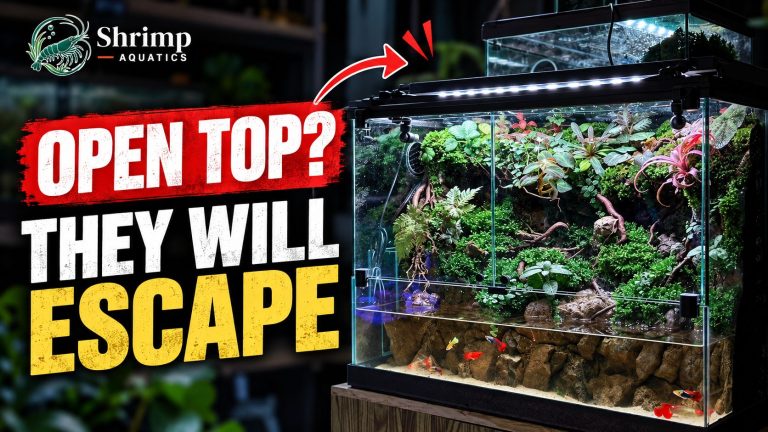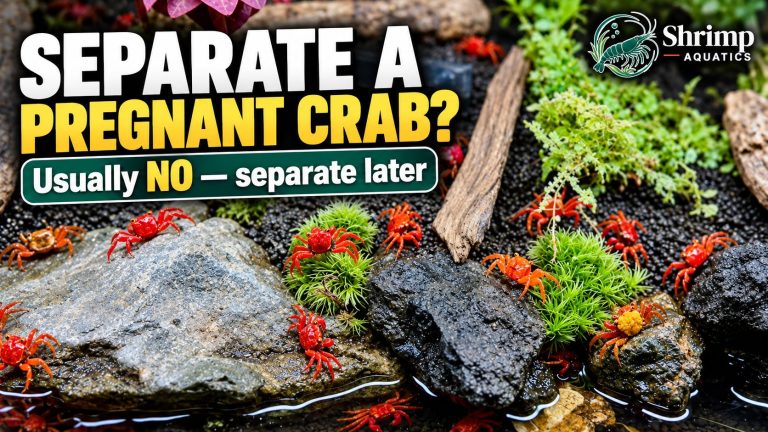

Move the vampire crab babies you want to raise into a separate grow-out tub, rehome the extras through other keepers or a local fish store once they’ve colored up, and keep males and females apart so the broods stop. Whatever you do, don’t let them go outdoors.
One clutch can mean up to about 40 crablets, so a colony that’s breeding well fills a small paludarium fast. Here’s how to sort out the ones you already have and slow down the next batch.
Should you separate vampire crab babies or let the colony thin itself?
Separate them if you want them to survive. Adult vampire crabs eat the crablets they catch, so moving the babies (or the adults) to another tank raises the most young. You can also move adult vampire crabs after the babies appear and leave the young where they hatched.
Don’t want to raise them all? Then leaving them where they are does keep numbers down. In a small tank the adults catch many of them. In a large, densely planted paludarium some still grow up alongside the adults; one keeper who left them in saw the colony quadruple in under a year. So decide first how many you actually want, then pull out that many and let the tank handle the rest.
Set up a simple grow-out tub for vampire crablets
A small lidded tub that copies your paludarium is all crablets need. They’re tiny vampire crabs, so the same rules apply: land to live on, water they can climb into and out of, and no way out of the tub.
- Seal the lid. Crablets fit through much smaller gaps than adults, so cover vents and cable holes with fine mesh before anything goes in.
- Build the land. Use damp substrate, a layer of moss or leaf litter and enough small hides that every crablet can be out of sight at once.
- Add shallow water. Give them a dish or low section they can walk into, go fully under and climb out of from any side. Fill it with dechlorinated water matched to your main tank.
- Keep it warm and humid. Vampire crabs are usually kept at about 78°F (26°C), within about 72-85°F (22-29°C). Keep the lid shut so the air stays damp.
- Move them gently. Herd each crablet into a small cup with a soft paintbrush instead of picking it up.
- Feed little and often. Crumble the adults’ food fine, offer a pinch, and lift anything uneaten before it molds.
Expect to see far fewer than you moved. Crablets start out clear, brown or dark and blend into the substrate, and their color comes in gradually over many molts, with full adult color at about 6 to 12 months. Check under hides before you decide any are missing.
How many grown crablets can stay in your paludarium?
Keep only as many as your tank has hides for, and let the crabs show you when it’s too many. You won’t find an agreed crabs-per-gallon figure, so watch behavior instead.
- One crab, usually a dominant male, keeps chasing the others out of cover.
- Crabs turn up missing legs or claws. Fights in a group can cost anything from one leg to both claws.
- Some crabs never manage to hold a hide of their own.
If you see any of these, add hides or move crabs out. Lost legs and claws do grow back at a later molt, but a crowded tank keeps costing them. Enough hides for every crab is basic vampire crab care at any colony size.
Where can surplus vampire crabs go?
We’d look for another keeper first, then a local fish store that takes invertebrates. Ask your local aquarium club, a keepers’ group online or the shop you buy livestock from whether they’ll take healthy young crabs. If you can, wait until they’ve colored up; colored crabs are easier to place and easier to sex.
Hand them over in a small vented container with damp moss, not sitting in water. If you sell or post them, check your local rules on selling and shipping live animals first.
Check the flap before you sort or rehome a batch
Sort by the flap underneath, not by the claws, because claws mislead on young crabs. That matters when you’re splitting adults by sex or telling a new keeper what they’re getting. Sex each crab this way as you move it, so no single-sex group ends up holding both male and female vampire crabs.
In our paludariums, males have a narrow, triangular flap and females a broad one that covers most of the underside.
In our paludariums, adult males have bigger claws than females, but a young male’s claws look like a young female’s.
Never release vampire crabs outdoors
Rehome them; don’t let them go. It can feel kinder than giving them away, but it isn’t.
Don’t let them loose
The U.S. Fish and Wildlife Service puts it plainly for any pet: most released pets don’t survive, many suffer before they die, and one that does survive can become an invasive species that harms native wildlife.1 The same goes for tipping crablets out with old tank water.
How do you stop vampire crabs breeding so much?
Keep males and females apart. Split the adults into single-sex groups, or move one sex to a second tank, and the colony stops growing from new matings. Separate tanks are how you keep male and female vampire crabs without breeding.
Expect at least one more batch first. A female who’s already carrying eggs keeps them for about three to seven weeks before the crablets appear, and she spends most of that time hidden, often dug in. A female you haven’t seen for weeks isn’t a reason to dig her up. That delay is a normal part of vampire crab breeding.
Adding crabs later? Pick one sex from our vampire crab lines; you choose Male or Female on each product page. Most of the fights keepers report start with a dominant male, which is worth remembering when you choose between an all-male and an all-female group. Everything in our catalog is bred or propagated in our own tanks rather than collected from the wild.
References
1 Source
- How to Break Up with Your Goldfish (The Right Way), U.S. Fish and Wildlife Service, 2021, updated 2025.
Ready to get started?
Shop our Vampire Crab collection
8 products available · Live Arrival Guarantee