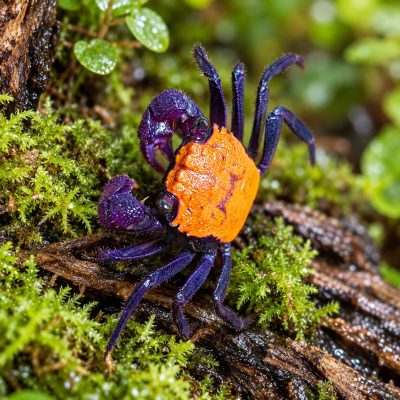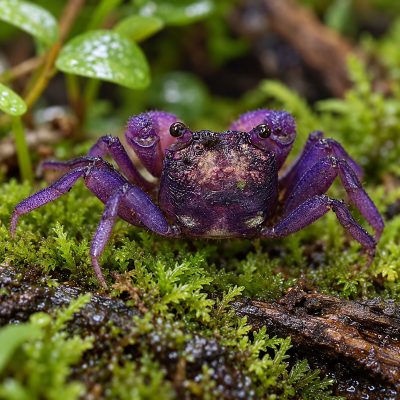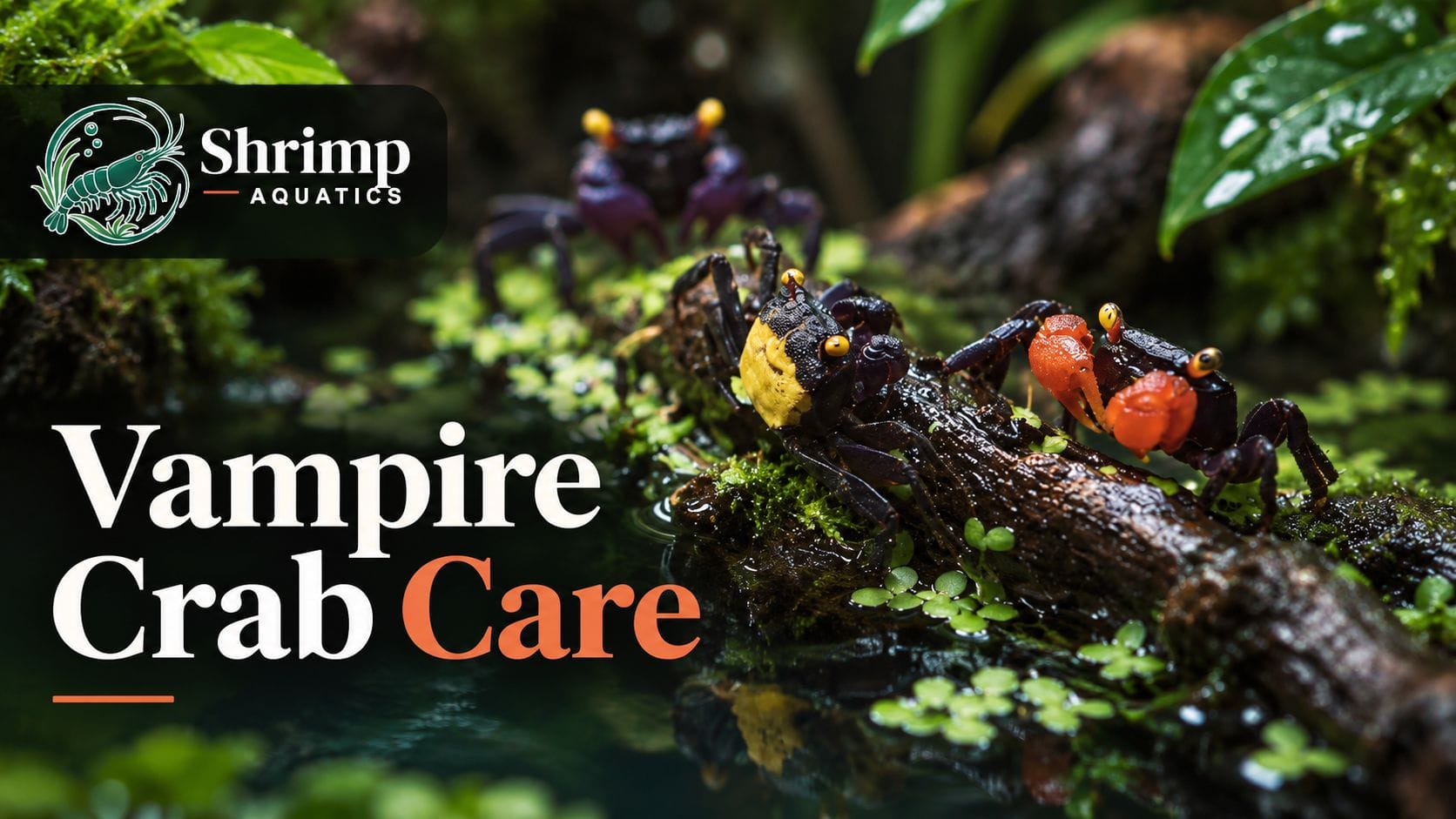
Vampire crabs are small semi-terrestrial crabs that live on land and use water. Keep a group in a lidded paludarium that is mostly land, kept humid by a closed lid, moss and misting. Hold it at about 78°F (26°C), within 72-85°F (22-29°C), and give it a water section every crab can climb into and fully enter, because they go into the water to molt.
The crabs sold as vampire crabs belong to Geosesarma, a large genus of semi-terrestrial and land-living crabs from freshwater habitats in Southeast Asia and nearby islands.1 A 2021 count put it at 67 species, found from Southeast and East Asia to the Solomon Islands.2 They’re sesarmid crabs, a family whose semi-terrestrial members breathe air by holding water in their gill chambers and recirculating it.3 That’s why a vampire crab needs land to live on and water it can get into. They aren’t aquarium animals, and a flooded tank is the wrong home for them.
Most of the work is keeping the air humid, the lid tight and the water section easy to reach. Get those three right and the rest of this page is fine tuning.
How do you set up a vampire crab paludarium?
Build a paludarium that is mostly land, with a water section a crab can climb into, fully enter and climb out of. Give every crab somewhere to hide, and fit a lid that closes tight. Keepers call this a crabitat as often as a paludarium, and the idea is the same. The land section is where your crabs spend their days, so it gets moss, cover and plenty of hides. The lid keeps the crabs in and the moist air in, and both matter.
What climate do vampire crabs need in their enclosure?
Keep the enclosure at about 78°F (26°C), within 72-85°F (22-29°C), and keep the air humid all the time. Warmth is the easier half. A small aquarium heater in the water section is one way to hold it. Whatever you use, put a thermometer at crab level as well as in the water.
Humidity is the harder half. Dry air is the common failure, and you fix it with a closed lid, moist substrate and moss, and regular misting. One keeper reports running at 75 percent humidity or higher. If you see the moss drying out between mistings, mist more often or close more of the gaps in the lid.
What do vampire crabs eat?
Vampire crabs eat small insects and probably some plant matter in the wild, so feed them both meaty and plant food at home. G. dennerle eats mostly small insects, and probably midge (chironomid) larvae and plant detritus too, while G. hagen feeds at least partly on insects.4 Keep portions small and varied, and lift whatever isn’t eaten before it goes moldy in the humid air.
Why vampire crabs must be able to get fully into the water to molt
Vampire crabs molt in the water, so the water section is something every crab needs to reach, get fully into and leave again. In our paludariums, the crabs spend their time on land and climb down into the water from time to time to feed and to molt, so the water section has to be one a crab can climb into and fully enter.
Give the water section a gentle slope or rough surface so a crab can walk in and back out, and keep the water clean. When you find a crab that has just molted, leave it alone and don’t try to lift it out.
Can vampire crabs live with shrimp, small fish or their own young?
Hardy shrimp and small, peaceful fish can share the water section, but crablets can’t stay with the adults. Adult vampire crabs eat crablets they find, so crablets are moved out to grow up.
Neocaridina shrimp are the easy first choice. Their range of 65-78°F (18-26°C) overlaps the crabs’ 72-85°F (22-29°C) comfortably between 72 and 78°F. At Shrimp Aquatics, we keep Neocaridina shrimp in the water section of our vampire crab paludariums. They breed there, the young grow up normally, and the crabs rarely manage to catch them. We keep only small, peaceful fish with our crabs, because an aggressive fish can eat a crab or harass one that has come down into the water to molt.
Bee and Crystal Caridina can share the water too, but the fit is tight. They’re kept at 60-72°F (15.5-22°C), which meets the crab range only at 72°F (22°C). If you keep them, the water stays inside the Bee range, and you never warm it for the crabs. Any fish you add also needs its own water needs met, and a fish that hunts the bottom or grows large doesn’t belong here at all.
How do vampire crabs breed without brackish water?
The vampire crabs sold in the hobby breed in fresh water: large eggs hatch straight into tiny crabs, with no larval stage, so you never need brackish or salt water. Direct development like this is described in several Geosesarma species.5 It isn’t true of the whole genus, though. Some Taiwanese Geosesarma have small eggs and swimming larvae instead.1
A clutch gives up to about 40 crablets. Since the adults eat the young they find, move the crablets to their own container to grow up, and keep that container as humid as the main enclosure.
Plan for a small vampire crab with a short life
How big do vampire crabs get?
Adult vampire crabs measure about 10-15 mm across the shell, roughly half an inch, in the species that have been described. Type specimens of G. dennerle and G. hagen measure 14.4 and 13.9 mm.4 G. pontianak measures 13.4 mm,5 and the two Java species described in 2024 measure 12.8 and 12.3 mm.6 You’ll often read that vampire crabs reach about 2 inches (5 cm). That figure could only describe the legs, and no leg span has been measured, so don’t size a tank or a water section around it.
How long do vampire crabs live?
Vampire crabs are short-lived, about two years at most. A 2019 compilation of longevity in crabs, shrimp and lobsters lists about two years as the longest recorded life for G. bicolor, G. krathing and G. notophorum, a figure taken from keepers’ species profiles, not from crabs aged in a study.7 If you want vampire crabs for years, plan for a colony that replaces itself by breeding, and treat the crablets as the future of your group.
Why do vampire crabs die one after another?
When crabs start dying one after another, check the lid first, then humidity, temperature, water access and finally crowding. Work down the list in that order, because the first checks are the quickest to make and the easiest to put right.
- Lid: every gap is closed, including where tubing, cords or a heater cable pass through.
- Humidity: the moss and substrate stay moist between mistings, and the air doesn’t dry out when the lights are on.
- Temperature: a thermometer at crab level reads within 72-85°F (22-29°C), day and night.
- Water access: every crab can reach the water, get fully in and climb back out.
- Crowding: every crab can get out of sight at once, and none is chased out of cover again and again.
Still losing crabs after all five checks pass? Email contact@shrimpaquatics.com with your temperature, how you keep the air humid, a photo of the setup and what you’ve seen. We’ll help you work through it.
Ordering tank-bred vampire crabs from Shrimp Aquatics
Our vampire crabs come from two tank-bred lines: the Tomato Vampire Crab, Geosesarma sp. “Tomato”, and the White-handed Vampire Crab, a Geosesarma species. Everything in our catalog is bred or propagated in our own tanks rather than collected from the wild. That matters here, because several Geosesarma species are collected in large numbers for the aquarium trade.6 We can’t promise the sex of the crabs you receive, whether they’ll breed, or how many young you’ll get.
Confirming your own import rules is part of ordering. We cannot tell you that live freshwater invertebrates are legal to import where you live.
Have the paludarium humid and running before the box arrives. If your crabs arrive weak, follow the instructions supplied with your order. Our live arrival guarantee covers losses in transit. Livestock that arrives dead is replaced free of charge, counted from the first animal, when you report it within 2 hours of the carrier’s delivery time with an uncut unboxing video.
References
7 Sources
- Shy and Ng, Geosesarma mirum, a new species of semi-terrestrial sesarmid crab (Crustacea, Decapoda, Brachyura) from central Taiwan, ZooKeys 858, 2019.
- Ng, Geosesarma sodalis, a new species of vampire crab (Crustacea, Brachyura, Sesarmidae) from a limestone cave in central Sarawak, Malaysia, ZooKeys 1031, 2021.
- Species-specific gill’s microbiome of eight crab species with different breathing adaptations, Scientific Reports 13, 2023.
- New species of “vampire crabs” (Geosesarma De Man, 1892) from central Java, Indonesia (Geosesarma hagen treatment, Plazi TreatmentBank copy of the paper), Raffles Bulletin of Zoology 63, 2015.
- Ng, Semiterrestrial crabs of the genus Geosesarma De Man, 1892 from western Borneo, Indonesia, with descriptions of three new species (Geosesarma pontianak treatment, Plazi TreatmentBank copy of the paper), Zootaxa 4048, 2015.
- Ng and Wowor, Two new species of vampire crabs (Crustacea: Decapoda: Brachyura: Sesarmidae: Geosesarma De Man, 1892) from Java, Indonesia, Raffles Bulletin of Zoology 72, 2024.
- Vogt, A compilation of longevity data in decapod crustaceans, Nauplius 27, 2019.
Ready to get started?
Shop our Vampire Crab collection
5 products available · Live Arrival Guarantee