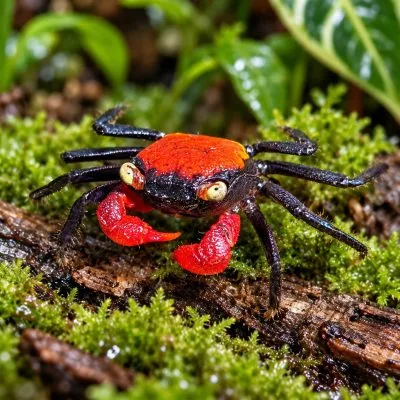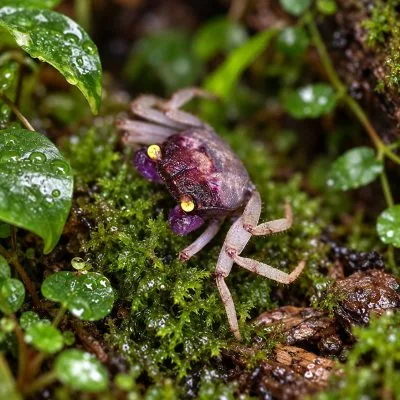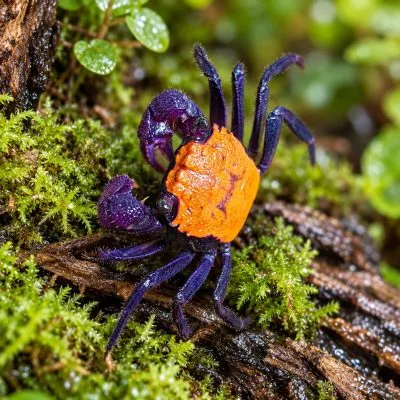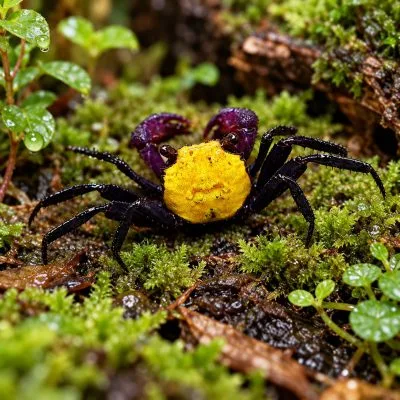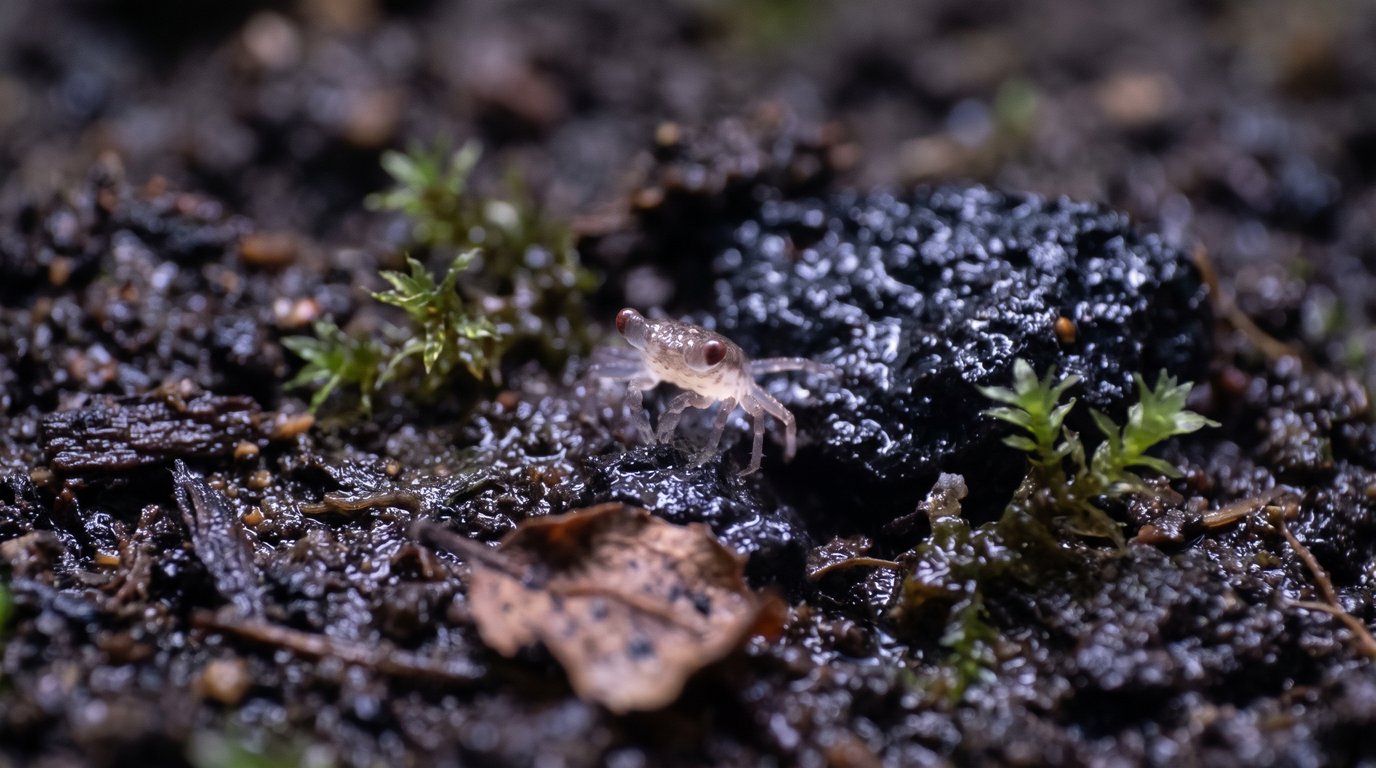
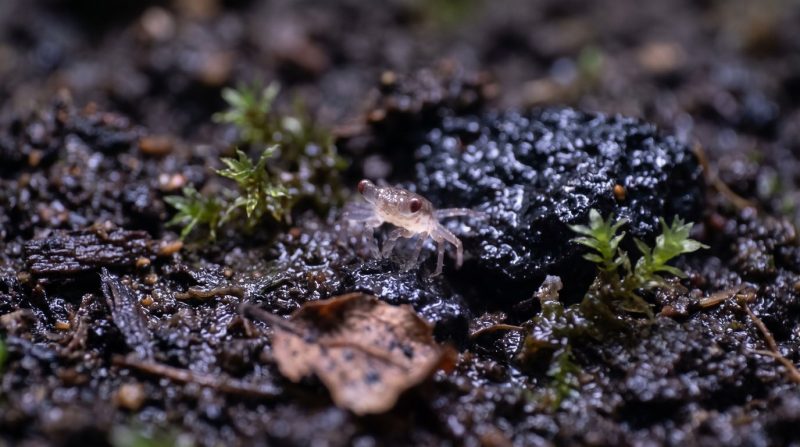
Baby vampire crabs need the same things as the adults, scaled down to a crab only 2 to 3 mm across: damp cover to hide in, water shallow enough to walk out of, a lid with no gaps and food crushed fine. They hatch as complete little crabs, so there’s no larval stage to nurse and no salt water to mix. The one big choice is where they grow up, because adult vampire crabs eat the crablets they catch.
Should baby vampire crabs stay with the adults or move out?
Move them out if you want to raise as many as you can. Adult vampire crabs eat the crablets they catch, so moving the babies, or the adults, to another tank raises the most young. In a large, densely planted paludarium, some crablets also grow up alongside the adults. That makes it the first decision in vampire crab breeding once the eggs hatch.
So start with what you want from this brood. A tub full of young crabs? Separate them. A few survivors to keep the group going? In a big tank with thick cover you can leave them in. Pack in more moss, leaf litter and small hides near the water’s edge first.
At Shrimp Aquatics, when we spot a female carrying eggs, we move her to a tank of her own. Once her crablets hatch, she goes back to the group and the crablets stay. Broods we don’t catch in time grow up alongside the adults, and we haven’t seen our adult crabs eat crablets.
That’s what happens on a breeding farm, so don’t read it as a rule for your tank. Other keepers have lost crablets to their adults, and moving the young is still the safer plan if you want the most of them. Moving the mother is optional, though. At home you may not need to separate a pregnant vampire crab at all, and a female you’d have to dig out of her burrow is better left alone.
What if the babies are already out? Then you can move them or move their parents. Catching crablets is fiddly: slide a small cup under each one, or herd it in with a soft paintbrush, and lift it out with a little moss. With a big brood in a planted tank, it can be easier to move the adult vampire crabs after the babies appear and let the young keep the tank they know.
Don’t wait for a sign that they’re ready. Newly hatched crablets stay on or under their mother for a short time, then go off on their own. They’re finished crabs by then: in most Geosesarma with a known egg size, large eggs hatch straight into small crabs with no swimming larval stage.1
Build a nursery tub that keeps baby vampire crabs damp and contained
A small lidded tub that copies your paludarium is all a brood needs. Most keepers use a plastic box, a tub or a small tank of about 5 to 20 liters (roughly 1 to 5 gallons), and broods have been raised in tanks of up to about 55 liters (15 gallons).
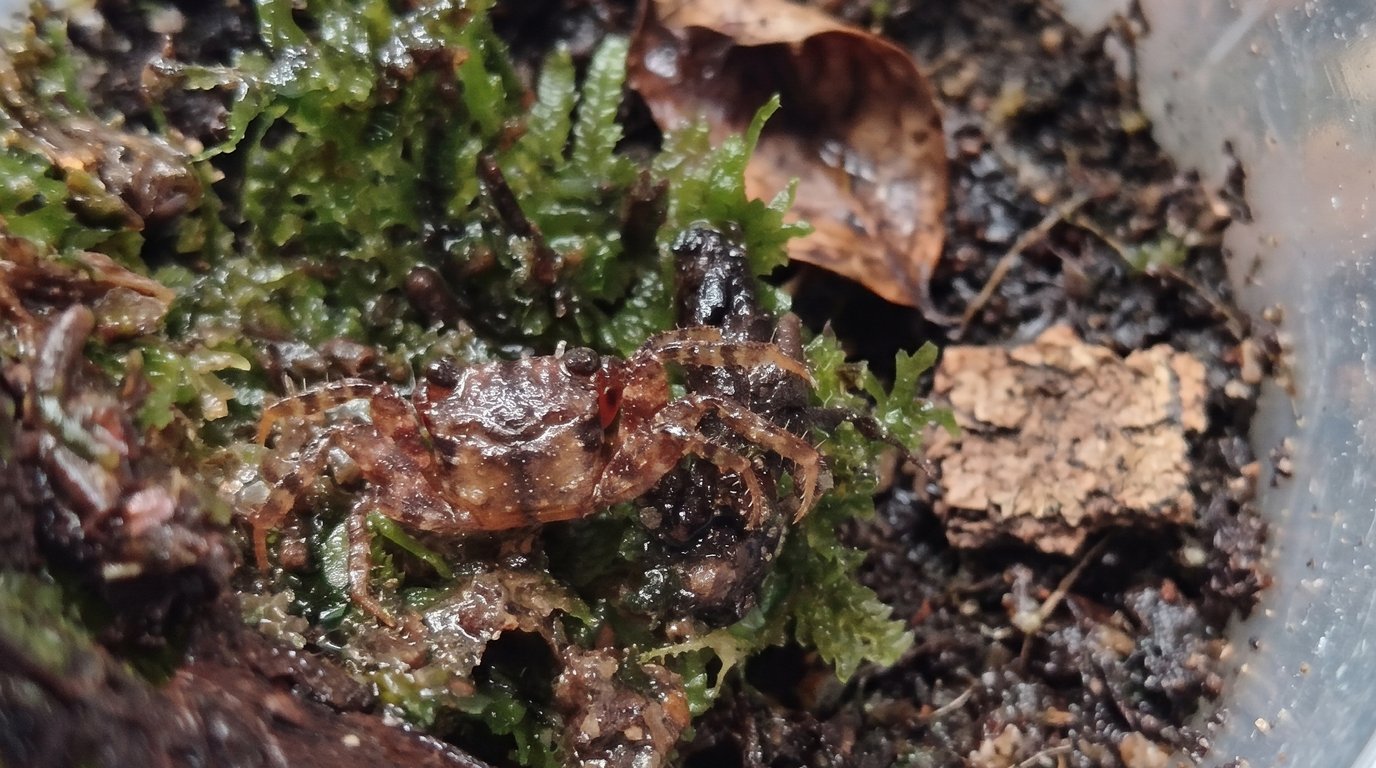
These are still vampire crabs, so the basics of vampire crab care don’t change: land to live on, water they can get into and out of, warm damp air and no way out. What changes is the scale.
- Ground: damp humus, soil or wet leaves.
- Cover: moss and leaf litter over the ground, with enough small hides that every crablet can be out of sight at once.
- Lid: on, or nearly closed. It holds the damp air in and keeps the crablets from climbing out.
- Warmth: the same as the adults, about 78°F (26°C), anywhere within 72-85°F (22-29°C).
Look hard at that lid. A crablet 3 mm wide fits through gaps an adult never could, so cover vents and cable holes with fine mesh before the first one goes in.
A closed lid is also most of how you keep a vampire crab tank humid. You don’t need a humidity number for this. If the moss stays damp to the touch, the air around it is damp enough, and if it’s drying out between mistings, close the lid further before you mist more.
How deep should the water be for baby vampire crabs?
Keep the water for baby vampire crabs very shallow: about 1 cm (under half an inch) deep, or a dish they can walk out of. Fill it with the same water you use in the main tank.
Is that enough? It’s still several times deeper than a crablet is wide, so a baby can go fully under. And it needs to. Vampire crab molting happens in the water, and a crab only grows by molting.
How much does that water matter? In a lab study of a small land crab from Jamaica, young kept with water deep enough to go under molted about five times in eight months. Young kept on damp ground alone never molted, and they died.2 It’s a different crab, but it’s reason enough not to leave the water out.
Young vampire crabs stay near water in the wild, too. In two species from central Java, the young are often found right at the waterline, closer to the water than the adults.3
The way out matters as much as the depth. Give the water a sloped bank, or drop in pebbles, a twig or a tuft of moss that breaks the surface, so a crablet can climb out from any side.
After a molt you may find what looks like a dead baby. Look again. A shed skin is hollow, its eyes are empty and see-through, and the back of the shell lifts open. Leave it where it is, because land crabs in general eat their shed shell to take its calcium back.4
Tempted to add cuttlebone or calcium powder for all that molting? You can skip both. The shed shell and varied food cover it, so the mineral supplement vampire crabs need to molt is none at all.
What do baby vampire crabs eat?
Baby vampire crabs eat the same foods as the adults, made small: crushed or powdered fish flakes, fine granules or small pellets. Scatter a little on the land and along the water’s edge, daily or every two to three days.
Do they need live food? No. Crablets do catch springtails and other tiny animals living in the tub, and some keepers add baby brine shrimp, fruit flies or frozen food. But broods have been raised on fish food plus whatever was already living in the moss. So count it as a bonus that young vampire crabs eat springtails, not as a job you have to set up.
So you don’t have to feed every day, though a daily pinch is fine if you lift what’s left. Spread the food over several spots, so a crablet doesn’t have to cross open ground to reach it. Take leftovers out the next day, before they mold in the warm, damp air.
As the young grow, crush the food less. By the time they’re near full size they’ll be taking what vampire crabs eat as adults, whole.
How fast do baby vampire crabs grow?
Slowly. Baby vampire crabs take about six to seven months to reach 1 cm across the shell, and about 6 to 12 months to show full adult color.
| Age | Size across the shell | What you’ll see |
|---|---|---|
| When you first see them | About 2 to 3 mm | Clear, brown or dark, and hard to spot against the soil |
| About 1.5 months | About 3 mm | The first color can show, often as red claw tips |
| About 3 to 6 months | About 5 to 8 mm | Color building molt by molt, and brood mates of different sizes |
| About 6 to 7 months | About 1 cm | Near the size of a small adult |
| About 6 to 12 months | 1 cm and up | Full adult color |
Full size isn’t far off by then. Adult specimens of the two Java species above measured about 11 to 14.5 mm across the shell.3
Don’t expect a brood to keep pace with each other. Young from one clutch soon differ in size, and they color up at different times, so a small brown crab among bigger, brighter brood mates is normal. Color comes in gradually over many molts, and how long baby vampire crabs take to color up varies even within one clutch.
When will they breed? Nobody has recorded the age at which vampire crabs first breed, so we wouldn’t plan around a number.
Why do baby vampire crabs seem to disappear?
Check under the hides before you count a baby vampire crab as lost. Crablets are clear, brown or dark and blend into the soil, so a brood can look half gone when it’s only out of sight.
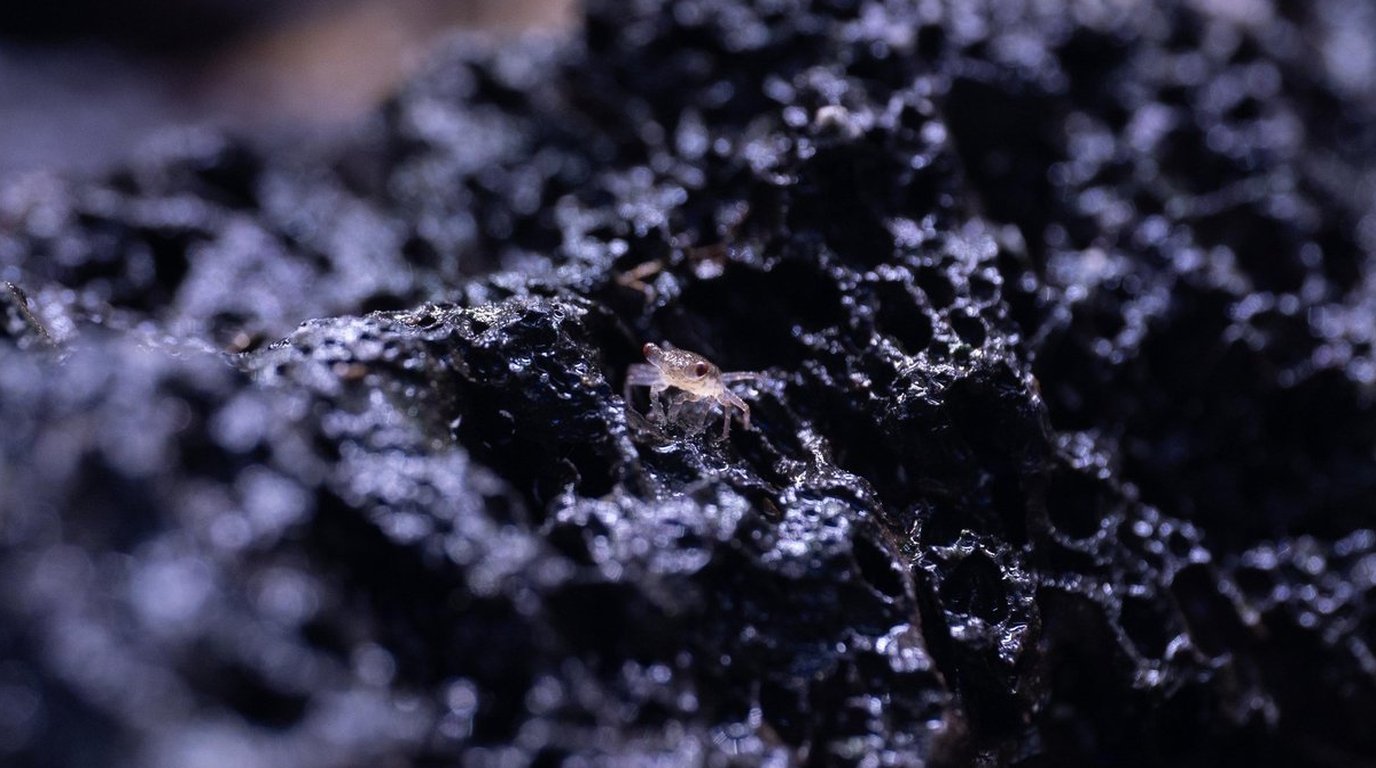
If they share a tank with adults, though, some really are gone. Adults eat the crablets they catch, so expect to lose some of each brood in a group tank.
Brood mates are less of a worry. Crablets of a similar size mostly live together without hurting each other. They sit in groups and squabble over food, but keepers don’t report them eating each other, so there’s no need to split a young brood into separate boxes.
In a tub of their own, check the things that fail quietly: a gap in the lid, moss that has dried out and leftovers going moldy. Dry air is the common failure with these crabs, so the lid and the moss come first.
When can young vampire crabs go back in with the adults?
Wait until the young vampire crabs are close to adult size. We wouldn’t trust a half-grown crab with the adults, so we’d keep them apart longer than feels necessary.
About 1 cm is the size to start sorting them. Keepers split a brood at about that size, anywhere from 4 to 12 months old, once the young start to color up or they can tell a male vampire crab from a female. One breeder saw brood mates start to fight at about a year.
Adding crabs in the meantime? Put them in with the adults, never in the nursery tub. Our tank-bred vampire crabs are sold as Male or Female, so you choose the sex of each crab on the product page. Everything in our catalog is bred or propagated in our own tanks rather than collected from the wild.
Last, plan for room. Groups that started with two to four adults have reached about 15 to 50 or more crabs in the same tank within one to a few years. Ending up with too many vampire crab babies has a few good answers, and all of them are easier before the tub is full.
References
4 Sources
- Geosesarma mirum, a new species of semi-terrestrial sesarmid crab (Crustacea, Decapoda, Brachyura) from central Taiwan, Shy J.-Y. and Ng P.K.L., ZooKeys 858: 1-10, 2019.
- Breeding in a snail shell: ecology and biology of the Jamaican montane crab Sesarma jarvisi (Decapoda: Grapsidae), Diesel R. and Horst D., Journal of Crustacean Biology 15(1), 1995.
- New species of “vampire crabs” (Geosesarma De Man, 1892) from central Java, Indonesia, and the identity of Sesarma (Geosesarma) nodulifera De Man, 1892, Ng P.K.L., Schubart C.D. and Lukhaup C., Raffles Bulletin of Zoology 63: 3-13, 2015.
- Calcium Homeostasis in Crustacea: The Evolving Role of Branchial, Renal, Digestive and Hypodermal Epithelia, Wheatly M.G., Journal of Experimental Zoology 283: 620-640, 1999.
Ready to get started?
Shop our Vampire Crab collection
8 products available · Live Arrival Guarantee