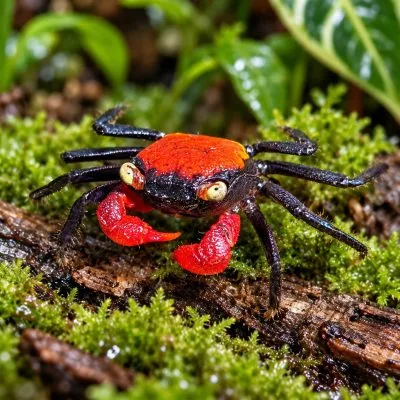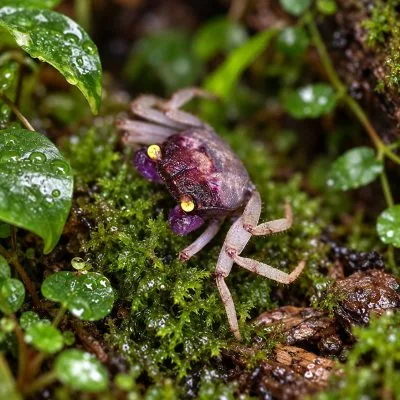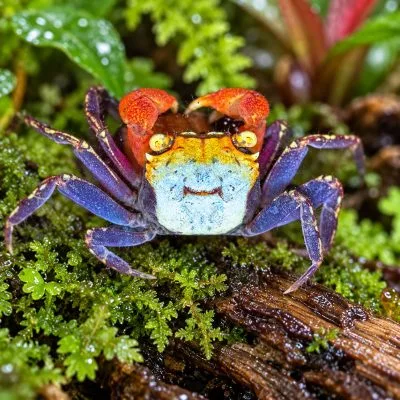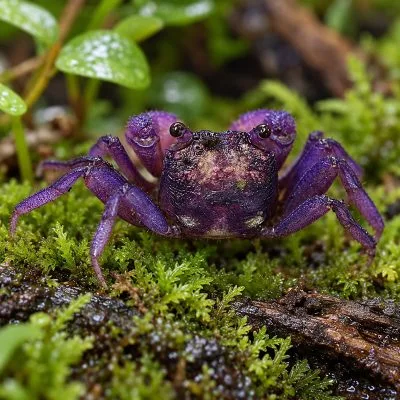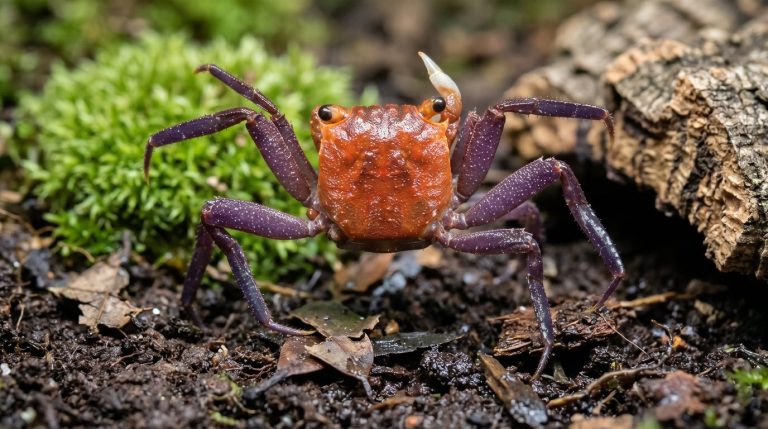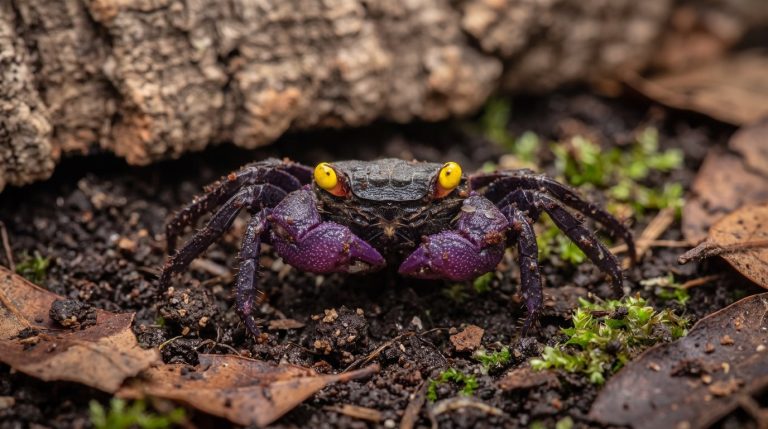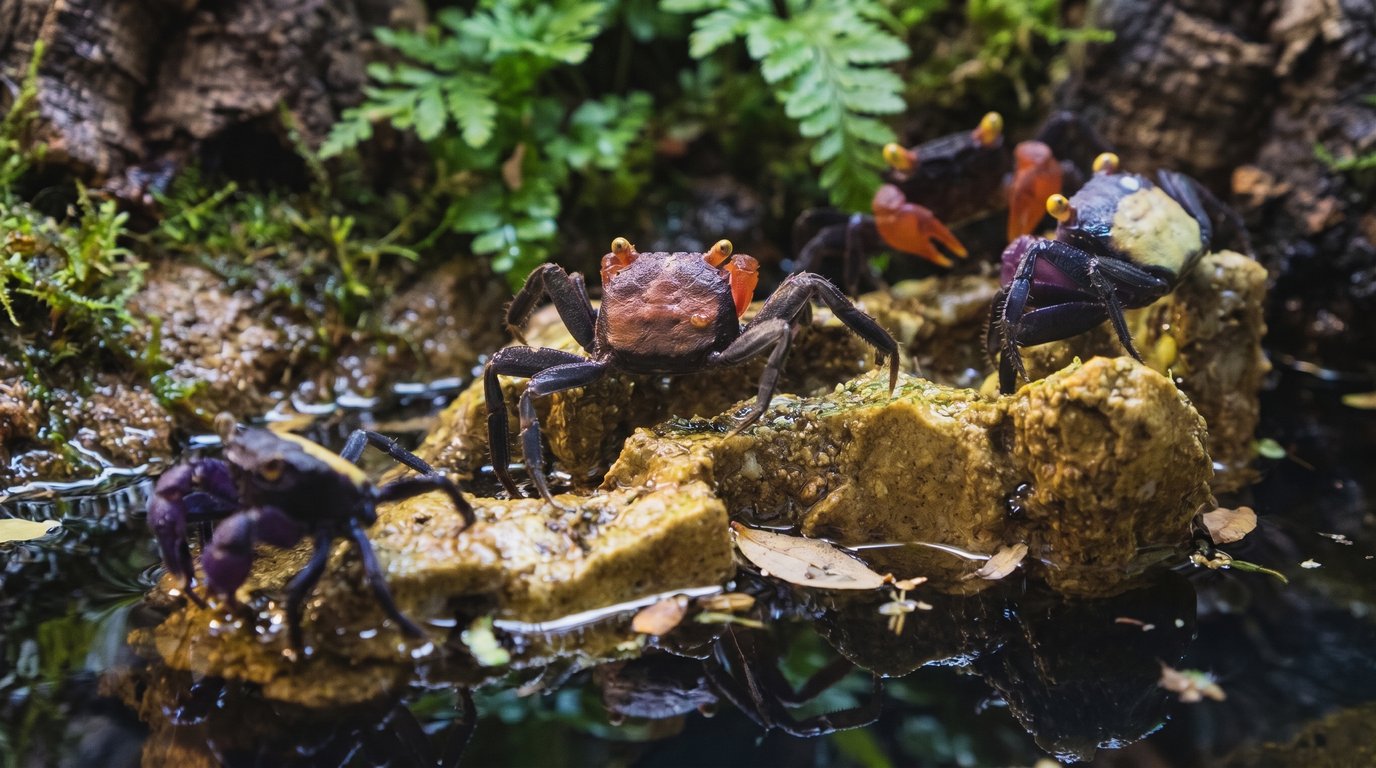
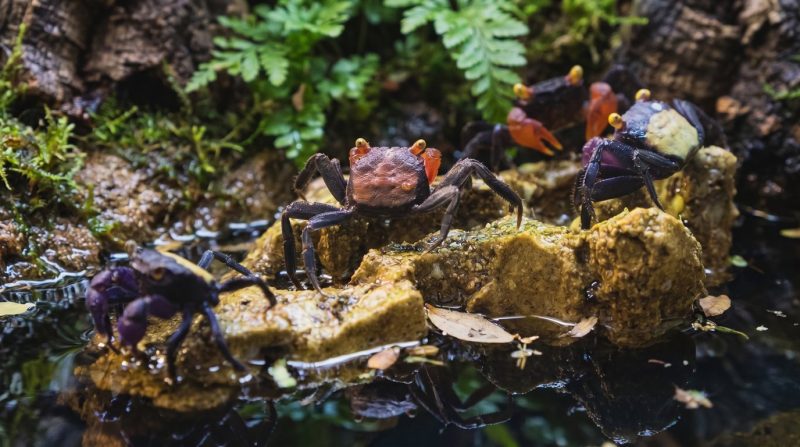
You can put different vampire crab colors in one tank, and some mixed tanks run without trouble, but one color per tank is the better plan. Two colors may be two different species, crabs of different lines kept together can crossbreed, and some mixed tanks end with crabs missing legs or dead. If you want more than one color, give each its own paludarium.
Are different vampire crab colors different species?
They can be, and you usually can’t tell from the label. A color name such as Purple, Red Devil or Rainbow is a trade name, not a species name.
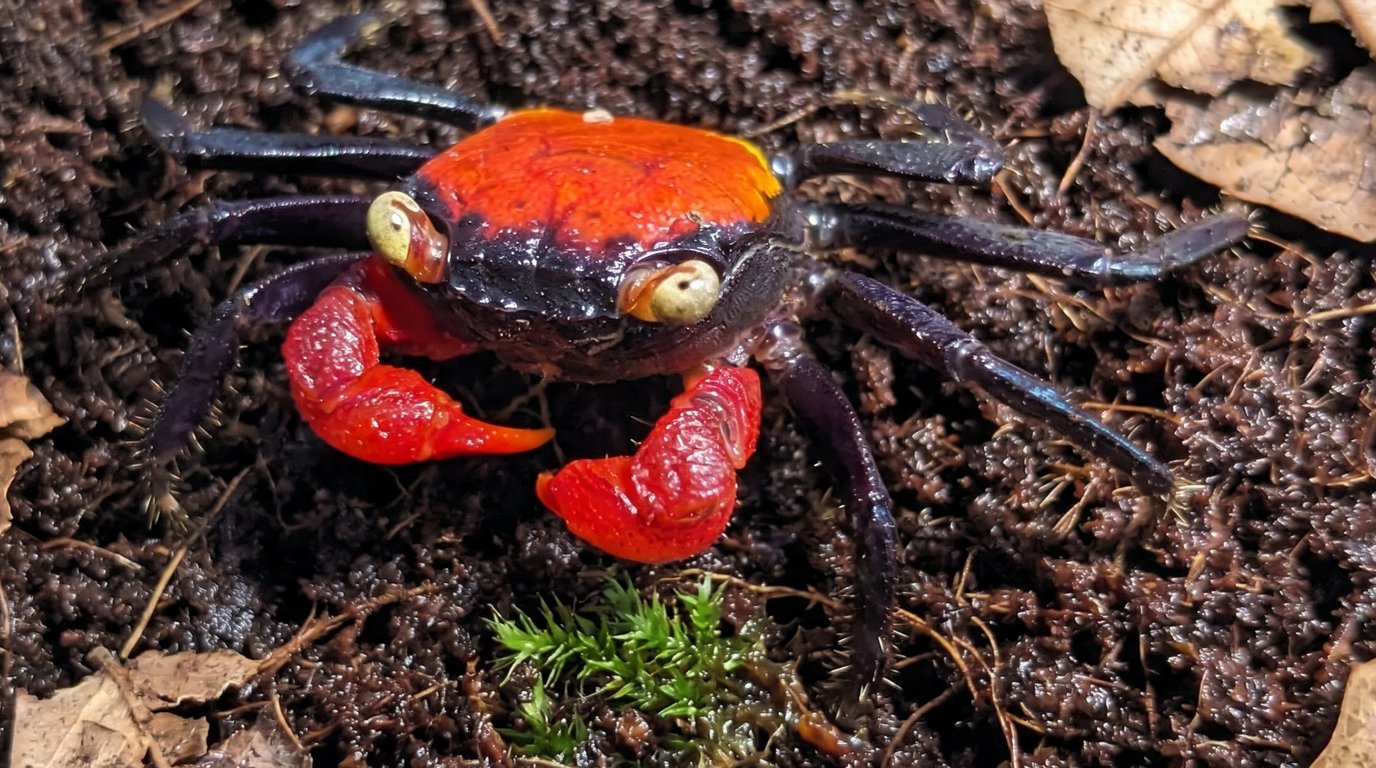
The two most common color forms in the trade turned out to be two species. In 2015, scientists named the cream and violet crab Geosesarma dennerle and the dark brown and bright orange crab G. hagen, both from hill streams in central Java, after both had been sold for years as plain vampire crabs.1 That’s why the basics of vampire crab care are written for the genus, while each color can still be its own animal.
Names on sale today are no more reliable. A 2024 study bought crabs online under six trade names and checked them by DNA and by the male’s reproductive organs. Two names matched those two species, but crabs sold under the other four matched neither and formed separate lineages, which the authors think may include species that don’t have a scientific name yet. Differences in how much of the shell is colored also made shell color an unreliable way to tell the species apart. Even the two named species are close relatives, differing by only about 1.6 to 2.7 percent in a standard DNA barcode gene, which the researchers read as a recent split.2
Sellers add to the muddle. In a survey of online land crab listings, “rainbow vampire crab” appeared beside three different species names, and more than half of all listings gave no species name at all.3 So read the types of vampire crabs you see for sale as color names, not species labels.
Will different vampire crab colors crossbreed?
Yes, they can. Crabs of different lines that share a tank can mate, and the young won’t be either line.
At Shrimp Aquatics, different lines kept together have crossbred, and the young came out in a mix of their parents’ colors. That’s why we keep each of our vampire crab lines in its own tank, so the crab you order is the line you picked. Young from a cross between two of our lines are never sold under a line name such as Tomato or Purple.
No published study has crossed vampire crab species on purpose, so nobody can tell you in advance whether a given pair will breed, how many young survive or whether those young breed in turn.
What you can count on is that a mixed tank gives you crabs you can’t name. If you ever want to sell, swap or breed a line on, start from crabs that came from one line. Over many generations a closed line can run into the question of whether inbreeding affects vampire crabs, and the answer there is an unrelated crab of the same line, not a crab of another color.
Do mixed vampire crab colors fight?
They can, but not every mixed tank turns into a fight. Keepers who have tried it are split: some kept two or three kinds together with nothing worse than small squabbles over territory, while others lost crabs.
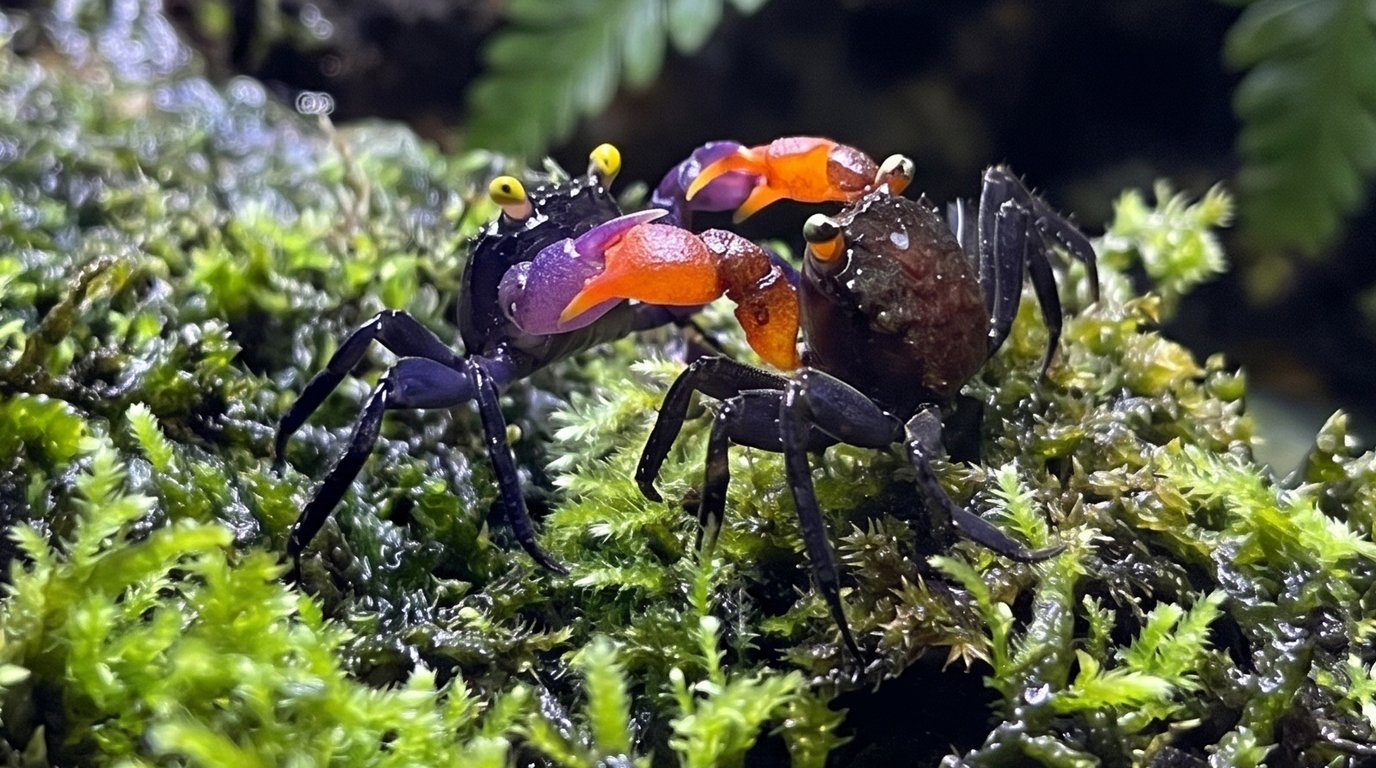
In one mixed tank of four crabs, the plain vampire crab molted twice and grew noticeably bigger than the rest, and then the others died, missing legs and claws. A crab that outgrows its tank mates, in a tank with few places for them to hide, is the situation to avoid, whatever the colors.
Our different color lines have shared a tank without trouble, but one line is different. In our paludariums, the Rainbow Vampire Crab is more aggressive than our other lines, and we never put our Rainbow Vampire Crabs in with another line.
Mixing colors isn’t the only cause of fights, either. Crabs of one color fight too, and the room and cover that help with aggressive vampire crabs in a single-line tank matter just as much in a mixed one.
How to keep more than one vampire crab color
Give each color its own tank. It’s the only setup that keeps every line pure, and it keeps a crab that starts trouble away from crabs of another line.
Size a second tank to the land area and hides, as you would for any group. The right vampire crab tank size comes from the floor the crabs walk on, not the gallons.
Already have a mixed group, say from a mixed-color pack? Sort the crabs into tanks by how they look, matching shell, leg and claw colors as closely as you can. It won’t prove that two crabs are one species, but it keeps the most unlike crabs apart, and any young from then on are easier to place.
If you still want to mix colors in one paludarium, these are safe defaults:
- Leave the Rainbow line out of any mixed tank.
- Pick crabs of about the same size, so no single crab starts out able to push the rest around.
- Start with fewer males than females, and give every crab a hide of its own with spares, the same way you’d plan how many vampire crabs live together.
- Have a spare tank or tub ready, and move a crab that keeps chasing others out of the group.
- Treat any crablets as unnamed crabs, don’t pass them on under either parent’s color name, and never release spare crabs outdoors; rehome them with another keeper instead.
Watch a mixed group most closely in the weeks after a molt. A crab that has just molted and grown can start to dominate a tank that was calm before, and that’s when you’ll be glad of the spare tank. If one male is the trouble, separate the aggressive male vampire crab first.
Buying vampire crabs for more than one tank
Set up a tank for each color before you order, then pick each line on its own product page. Everything in our catalog is bred or propagated in our own tanks rather than collected from the wild. Browse our tank-bred vampire crabs, choose male or female on each product page, and order the lines you’ve planned a tank for.
References
3 Sources
- Ng, Schubart and Lukhaup, New species of “vampire crabs” (Geosesarma De Man, 1892) from central Java, Indonesia, and the identity of Sesarma (Geosesarma) nodulifera De Man, 1892 (Zenodo archive copy of the paper), Raffles Bulletin of Zoology 63: 3-13, 2015.
- Mahendra, Nuryanto and Hernawati, Morphological and molecular tracing of two ornamental vampire crabs (Decapoda: Sesarmidae) from Central Java, Arthropoda Selecta 33(4): 549-558, 2024.
- Whitaker, Roberts, Spicer and Turner, A systematic survey of brachyuran land crabs in the online tropical aquarium trade, Oryx, Cambridge University Press, 2026.
Ready to get started?
Shop our Vampire Crab collection
8 products available · Live Arrival Guarantee