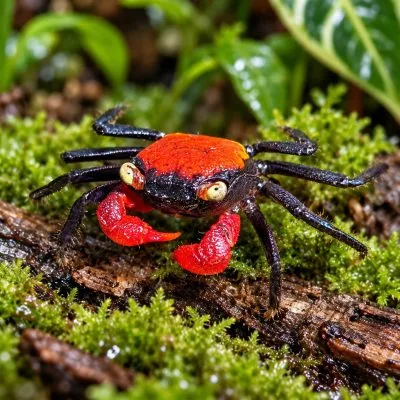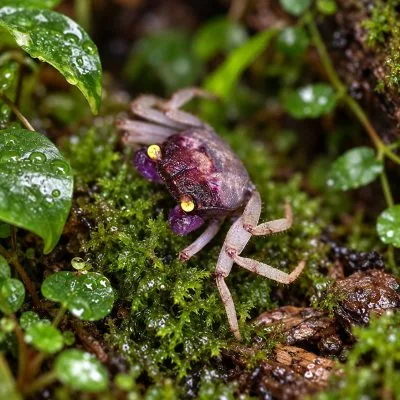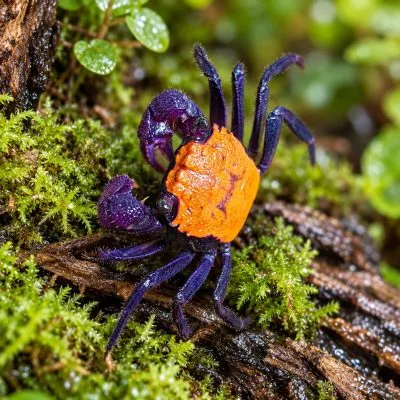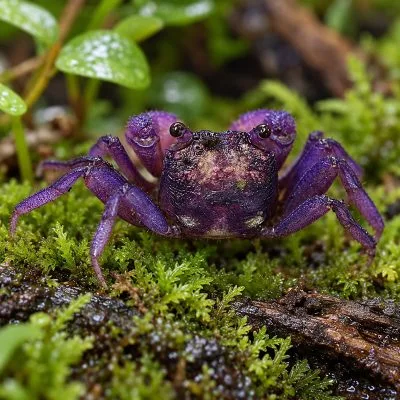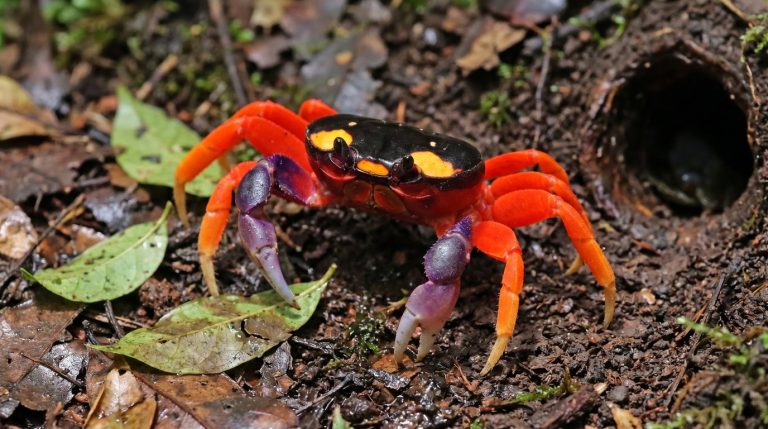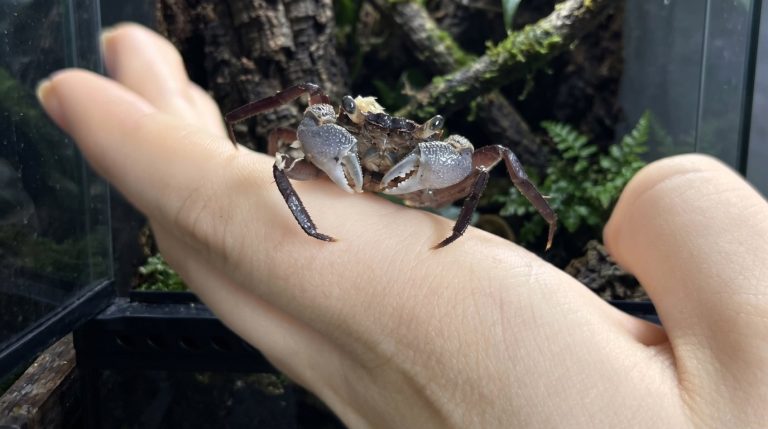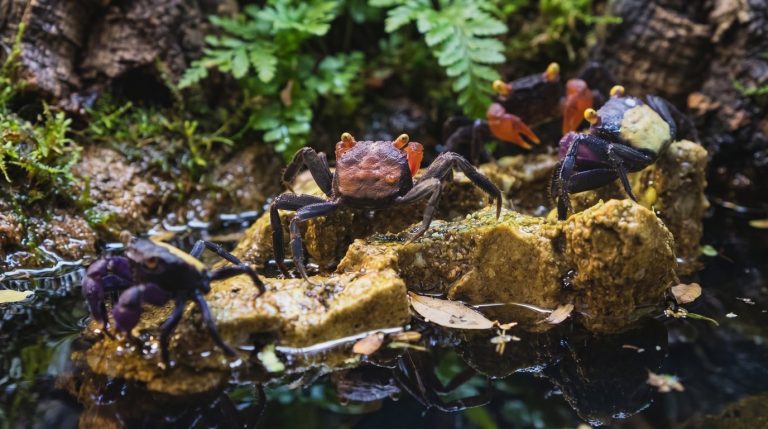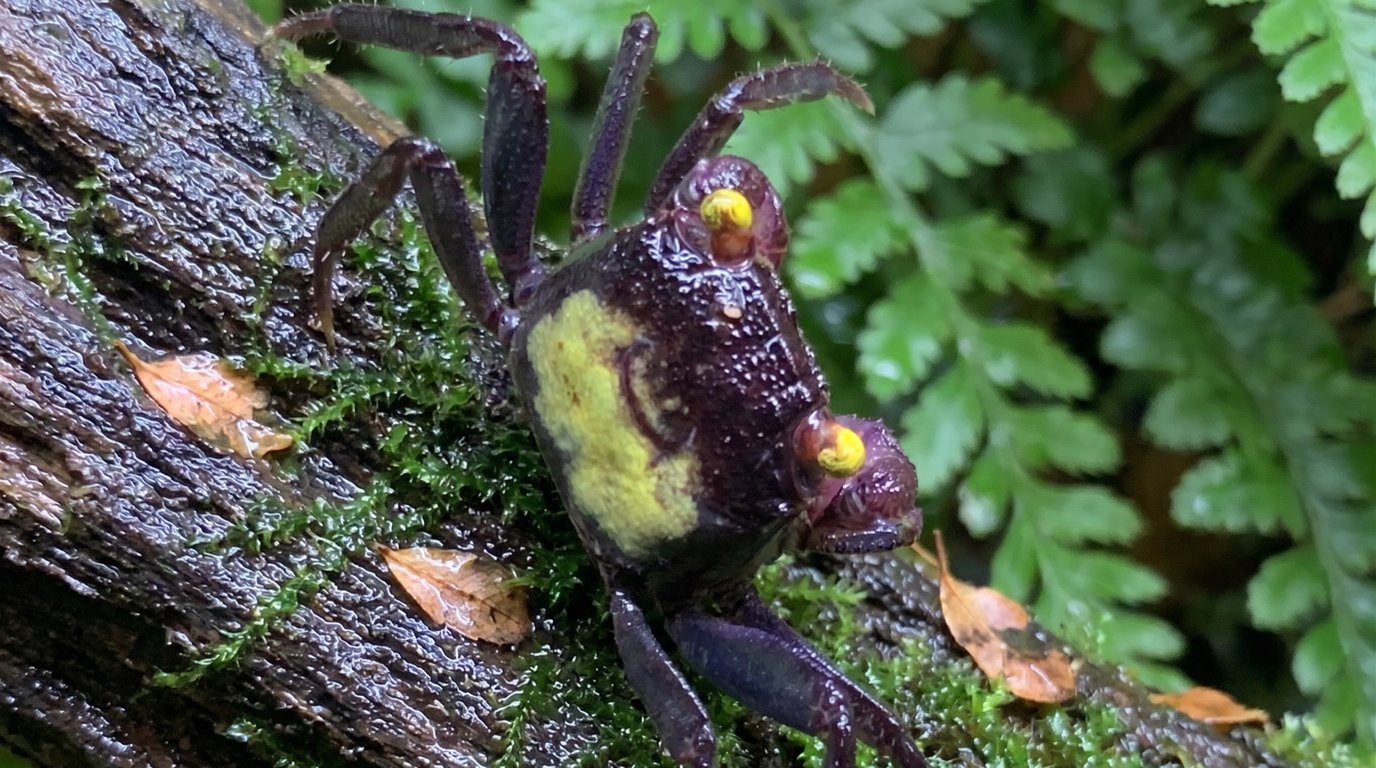
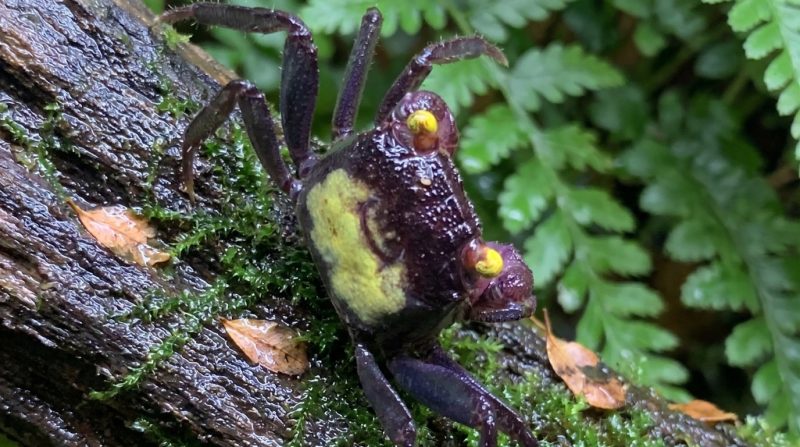
The types of vampire crabs you see for sale, such as Purple, Red Devil, Tomato, Rainbow and Lemon, are names for a crab’s colors, not species names. They’re all small land-and-water crabs of the genus Geosesarma, and they all need the same vampire crab care: a humid, lidded paludarium that’s mostly land.
What do the common types of vampire crab look like?
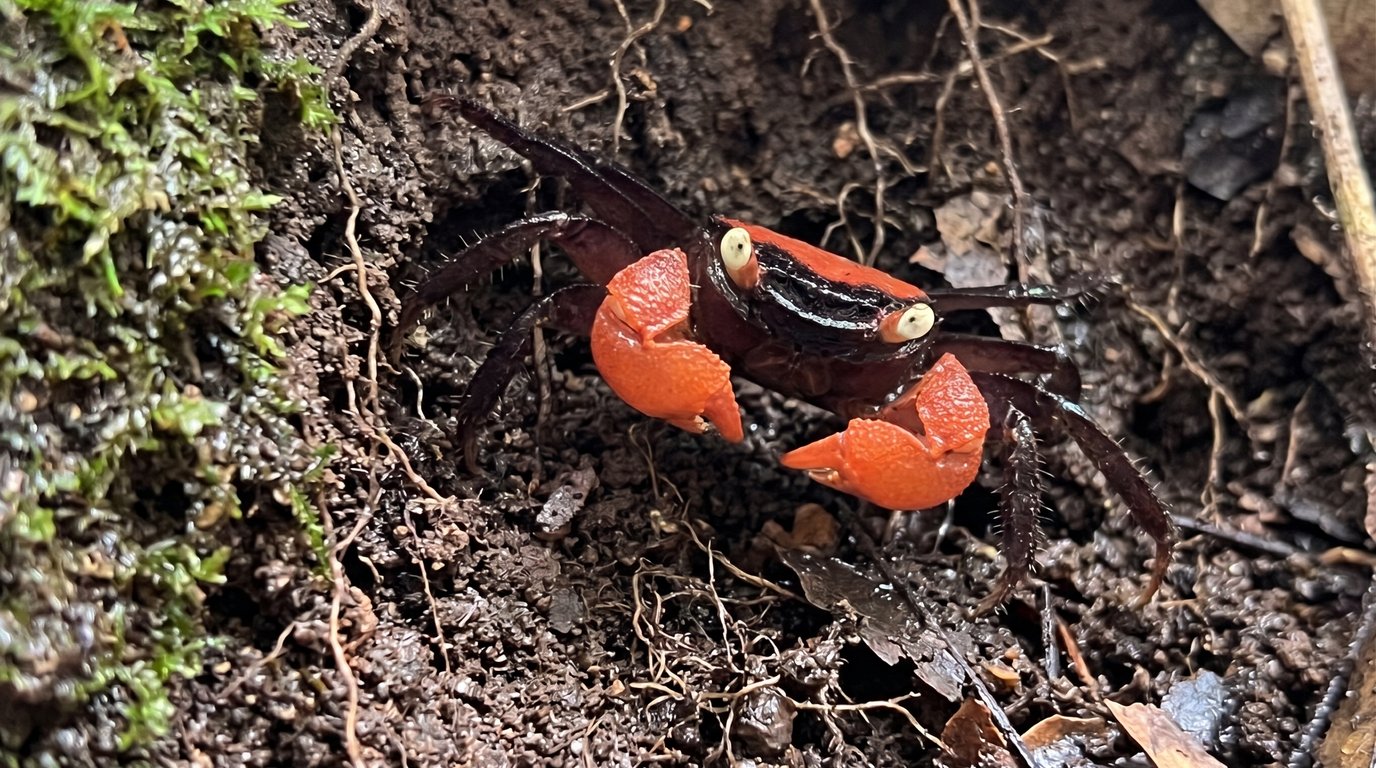
Each type of vampire crab is named for its colors, so the name is a fair guide to the look. Here’s what adults of our tank-bred vampire crabs look like, line by line.
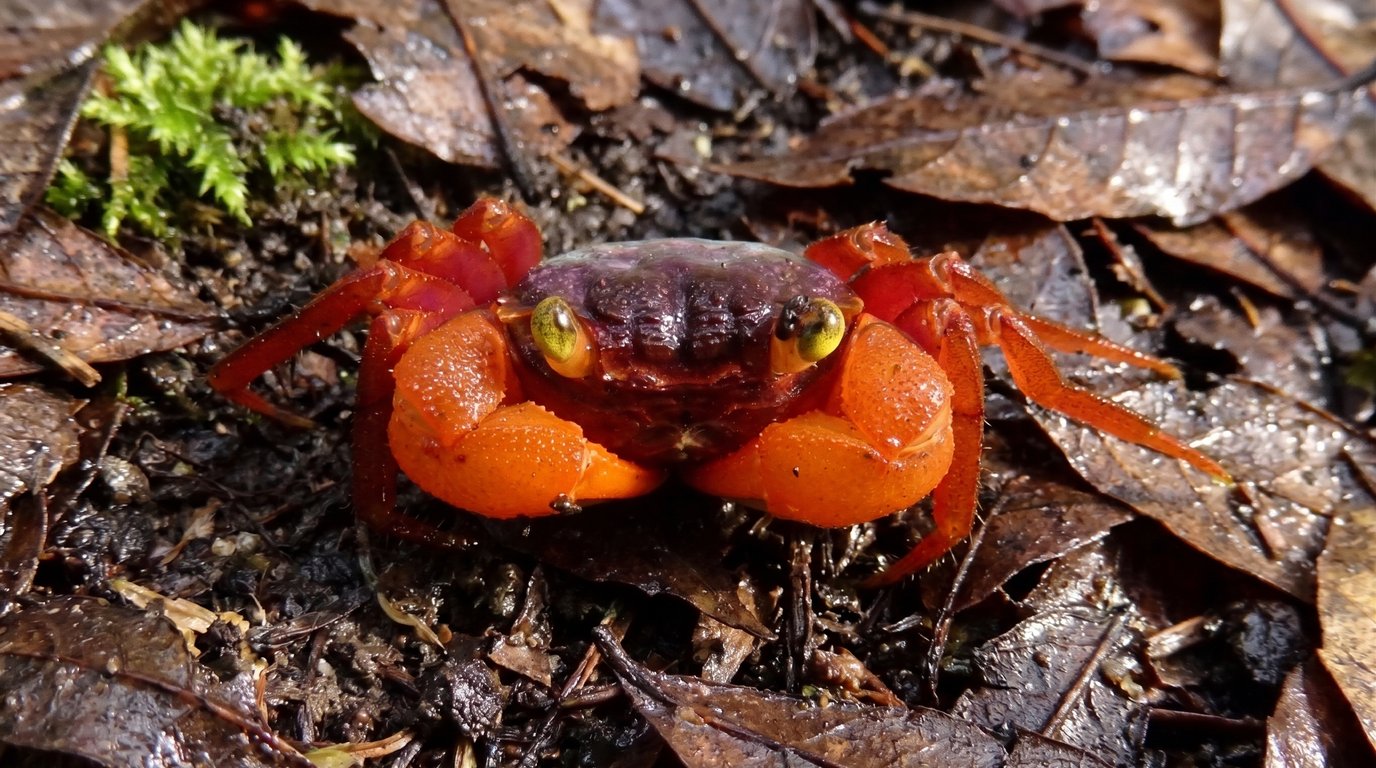
| Type | Adult colors |
|---|---|
| Tomato Vampire Crab | Orange-red all over: body, legs and claws |
| Purple Vampire Crab | Purple all over: body, legs and claws |
| Rainbow Vampire Crab | Orange-red claws, a shell that runs from orange at the front through yellow to pale blue at the back, and blue-violet legs |
| Red Devil Vampire Crab | Red claws, an orange-red front half of the shell, a black back half and black legs, yellow eyes |
| Halloween Vampire Crab | An orange shell, purple claws and dark purple legs |
| Lemon Vampire Crab | A bright yellow shell, purple claws and dark legs |
| Orchid Vampire Crab | A purple-gray shell, violet claws, pale legs and yellow eyes |
| White-handed Vampire Crab | A dark, blue-black body and legs, cream-white claws and yellow eyes |
Read the table as a guide to adults. Shades vary from crab to crab, and a crab that has just molted often looks pale or washed out until its color comes back, usually within a few days. Young crabs are the bigger surprise. Crablets start out clear, brown or dark. How long baby vampire crabs take to color up is measured in months, with full adult color at about 6 to 12 months.
You’ll meet other type names on listings too, such as disco, mandarin and carnaval. One survey looked at 574 online land crab listings. The words “vampire crab” appeared on 326 of them, and more than nine in ten of those added a second word for the look.1 We can only describe the lines we keep, so this page doesn’t guess at the rest.
Is each type of vampire crab a different species?
No. A vampire crab type is a color name, and color names don’t line up with species. Scientists have described 73 species in the genus,2 and the authors of a 2024 paper estimate that dozens more Indonesian crabs in the trade still have no scientific name.3
Sellers add to the muddle. In that listing survey, “rainbow vampire crab” appeared beside three different species names, and Halloween, purple and red devil each appeared beside two. One species alone, Geosesarma dennerle, was sold under 14 different common names, and more than half of all the listings gave no species name at all.1 The Halloween name causes a second mix-up, too. A Halloween crab, also called a moon crab, is a far bigger land crab whose young grow up in the sea. So vampire crab vs Halloween crab comes down to size and water, not color.
Two color forms do have a clear history. In 2015, scientists named the two forms that were then the most common in the trade. A cream and violet crab became G. dennerle, and a dark brown and bright orange crab became G. hagen, both from hill streams in central Java.4 Both had been sold for many years before anyone established where vampire crabs come from. Their description gives the adult colors in life like this.
| Feature | G. dennerle | G. hagen |
|---|---|---|
| Front of the shell and legs | Violet purple to purplish-brown | Dark brown |
| Back of the shell | Cream to yellowish-white | Orange or yellow |
| Claws | Bright purple | Bright orange |
| Eyes | Bright yellow | Bright yellow |
| How much it varies | Some crabs have most of the shell cream with only the front edge purple, and the claws can be pale purple or almost white | The orange on the back varies a lot, and some crabs are almost completely orange |
Don’t read that table backward, though. A crab sold as Purple or Red Devil isn’t automatically one of those two species. In the survey, each of those names appeared beside two species names. A purple crab with white claws that sellers listed as G. dennerle fits G. bicolor better, the survey’s authors say.1 That’s why this page describes our lines by their colors and doesn’t put a species name on them.
Rainbow shows how far a name can drift. Sellers listed rainbow crabs under three species names, one of them G. rouxi.1 Science knows that species from specimens collected in East Java in 1929. The paper that redescribed it lists its color in life as “not known”,5 so there’s no published color to match a living crab against.
Can you identify a vampire crab’s species from its color?
No, you can’t identify a vampire crab’s species from color alone. Color varies inside a species, as the last row of the table above shows, and different species can share a pattern.
So what do specialists look at? The published key to the Javan species counts the small bumps along the finger of the male’s claw. It also uses the shape of his abdomen, the proportions of the shell and his first gonopod, the paired appendage he mates with. Color is one clue among several.5 Look-alikes are handled the same way. The cream and violet species has a color pattern close to another Javan species, and the two are told apart by the claws, the male’s abdomen and that gonopod.4
DNA tells the same story. A 2024 study bought vampire crabs online under six trade names and compared them with wild crabs from central Java.6 Crabs sold under two of the names matched the two species named in 2015. Crabs sold under the other four came out as separate lineages, which the authors treat as possible new species. They also found that how much of the shell is colored varies too much to rely on for identification.6
What does that mean when you’re reading a listing? Take the type name as a description of the look. Ask for a photo of the actual adults for sale, because the same stock photos turn up across listings.1 And don’t pay more for a species name the seller can’t back up.
Does the type of vampire crab change its care, size or temperament?
The care and the size don’t change with the type of vampire crab, and temperament stands out in only one of our lines. Whichever type you choose, set up the same paludarium. It needs a tight lid, humid air, mostly land with hides, and a water section every crab can climb into and fully enter.
Size won’t split them either. Whatever the color, how big vampire crabs get stays small: about 10-15 mm across the shell in the species scientists have measured. The type specimens of the two species named in 2015 are 14.4 mm and 13.9 mm across.4
Adults of all our lines are close to the same size. We haven’t found one of our lines clearly easier or harder to keep or breed than the others. In our paludariums, the Rainbow Vampire Crab is more aggressive than our other lines.
That last point is the one to weigh. If you want a group that gets along, think twice before you add Rainbows to it. For every other line, pick on looks.
Could another seller’s crabs need something different? The researchers behind the listing survey point out that different species may have different diet or husbandry needs.1 Since a type name doesn’t tell you the species, the careful plan is the full setup for every type.
Can you keep different types of vampire crabs in one tank?
Keep one type of vampire crab per tank if you can. It’s the only way to know what any young are. Two crabs sold under different color names may be close relatives or even the same species, and nothing on the label settles it. If you still want to mix vampire crab species or colors in one tank, give every crab a hide and keep a spare tank ready.
Do different types really breed with each other? At Shrimp Aquatics, different lines kept together have crossbred, and the young came out in a mix of their parents’ colors. So a tank with a male of one type and a female of another can give you crabs that match neither name.
Some vampire crab species are close relatives, too. The two named in 2015 differ by only about 1.6 to 2.7 percent in a standard DNA barcode gene, which the researchers read as a recent split.6
Mixing types doesn’t change how many vampire crabs can live together, either. You still size the group to the land area and the number of hides, and a tank per type means you’ll always know which crab came from which line.
Which type of vampire crab should you choose?
Choose the type of vampire crab whose colors you like best, because care and adult size won’t decide it for you. Then settle three things before you order.
- One type or several. One type per tank means you always know what any young are.
- Tank-bred or wild-caught. Some species are collected from the wild in large numbers for the trade,3 so ask any seller how their crabs were produced. Everything in our catalog is bred or propagated in our own tanks rather than collected from the wild.
- Males, females or both. Each of our vampire crab product pages has a Male or Female option, so you pick the sex of every crab. If you’re buying elsewhere, vampire crab male vs female comes down to the flap on the underside, not the claws.
Whatever you choose, expect some variation. Shades differ from crab to crab, so read any listing photo, ours included, as a picture of the line and not of the crab in your box. Have the paludarium humid and running before the crabs arrive.
References
6 Sources
- Whitaker, Roberts, Spicer and Turner, A systematic survey of brachyuran land crabs in the online tropical aquarium trade, Oryx, Cambridge University Press, 2026.
- Grinang, Ng and Ng, A new species of vampire crab of the genus Geosesarma De Man, 1892 (Crustacea: Brachyura: Sesarmidae) from a montane forest in southwestern Sarawak, Malaysian Borneo, Raffles Bulletin of Zoology 74: 457-464, 2026.
- Ng and Wowor, Two new species of vampire crabs (Crustacea: Decapoda: Brachyura: Sesarmidae: Geosesarma De Man, 1892) from Java, Indonesia, Raffles Bulletin of Zoology 72: 469-478, 2024.
- Ng, Schubart and Lukhaup, New species of “vampire crabs” (Geosesarma De Man, 1892) from central Java, Indonesia, and the identity of Sesarma (Geosesarma) nodulifera De Man, 1892 (Zenodo archive copy of the paper), Raffles Bulletin of Zoology 63: 3-13, 2015.
- Ng and Wowor, The vampire crabs of Java, with descriptions of five new species from Mount Halimun Salak National Park, West Java, Indonesia (Crustacea: Brachyura: Sesarmidae: Geosesarma), Raffles Bulletin of Zoology 67: 217-246, 2019.
- Mahendra, Nuryanto and Hernawati, Morphological and molecular tracing of two ornamental vampire crabs (Decapoda: Sesarmidae) from Central Java, Arthropoda Selecta 33(4): 549-558, 2024.
Ready to get started?
Shop our Vampire Crab collection
8 products available · Live Arrival Guarantee