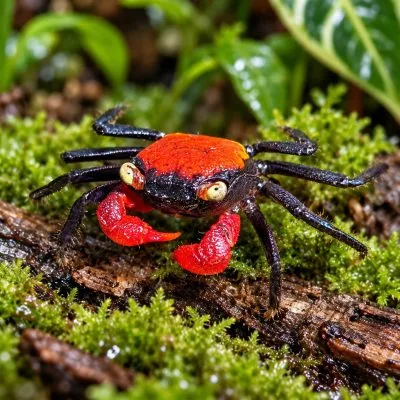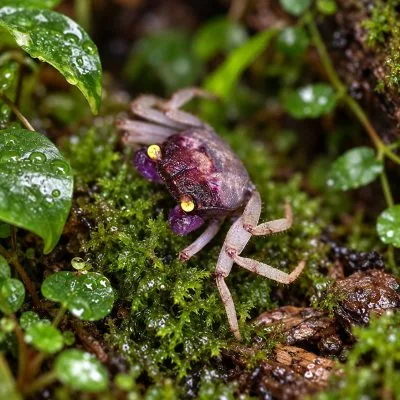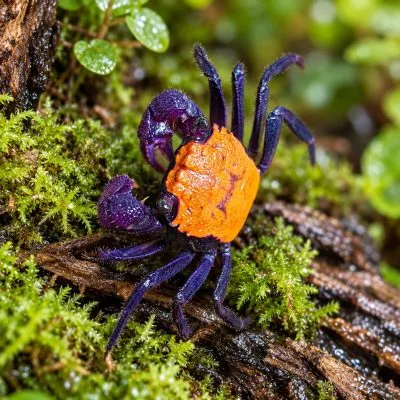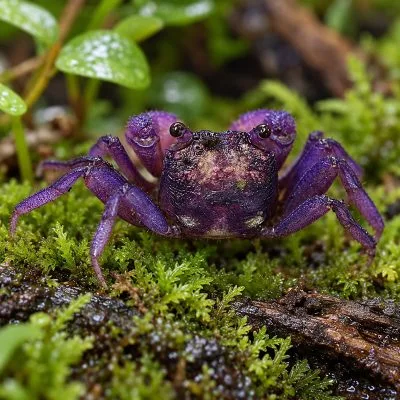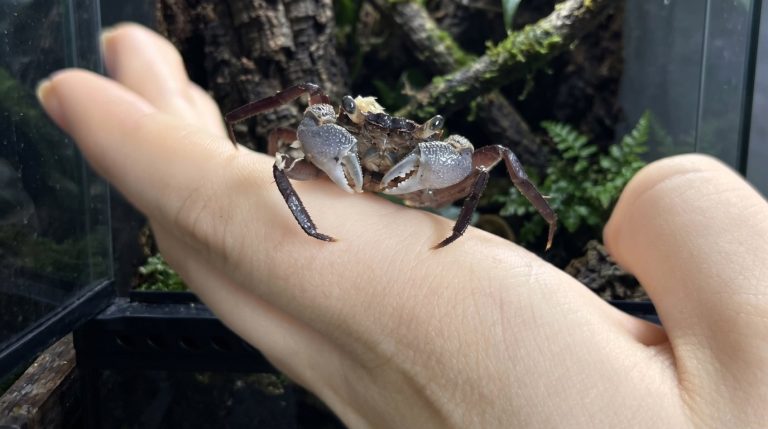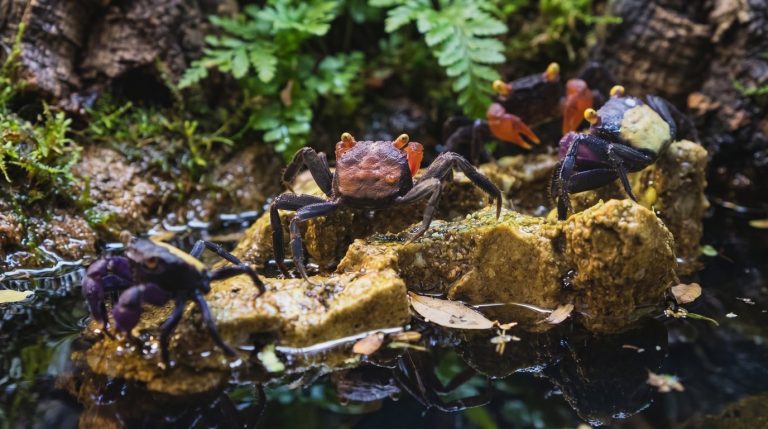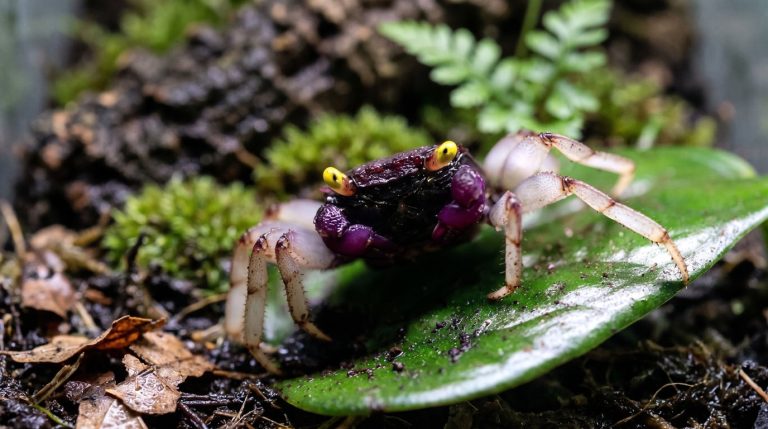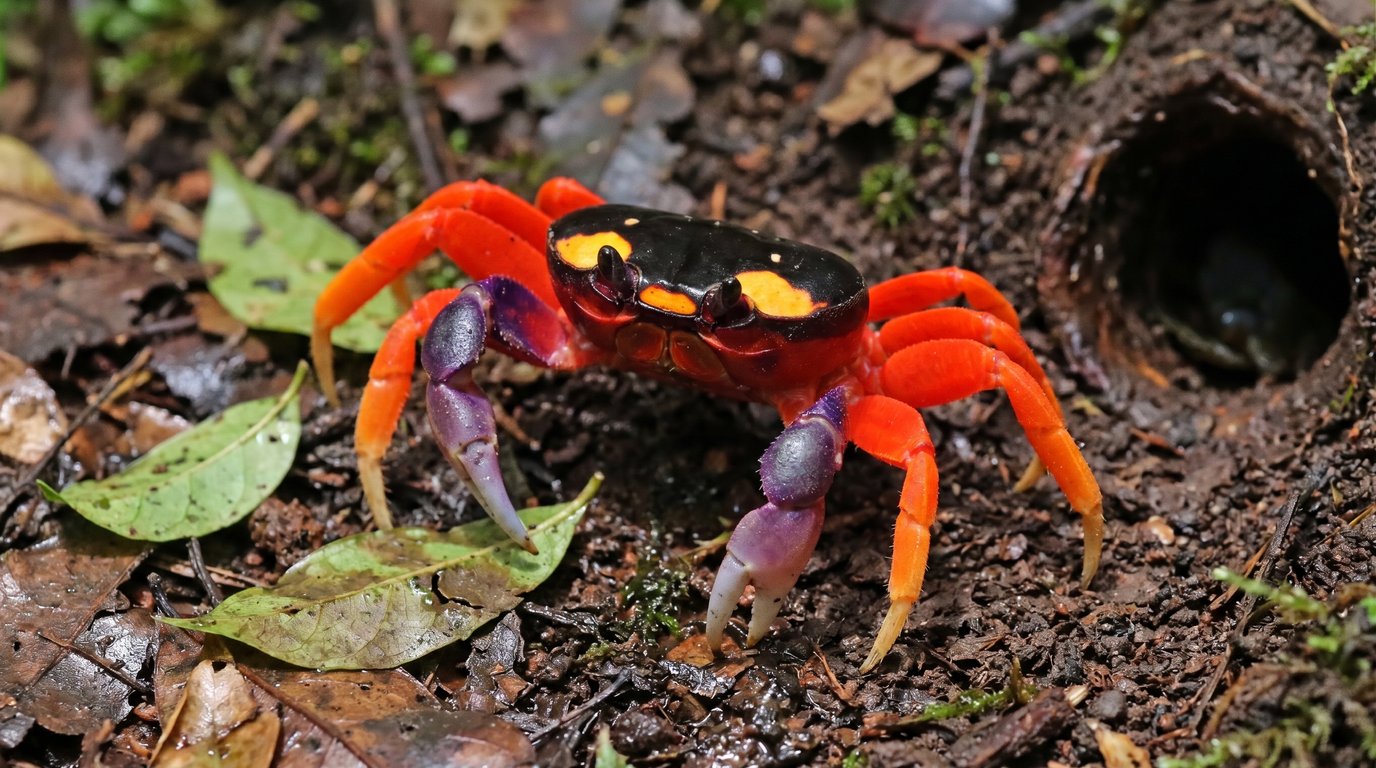
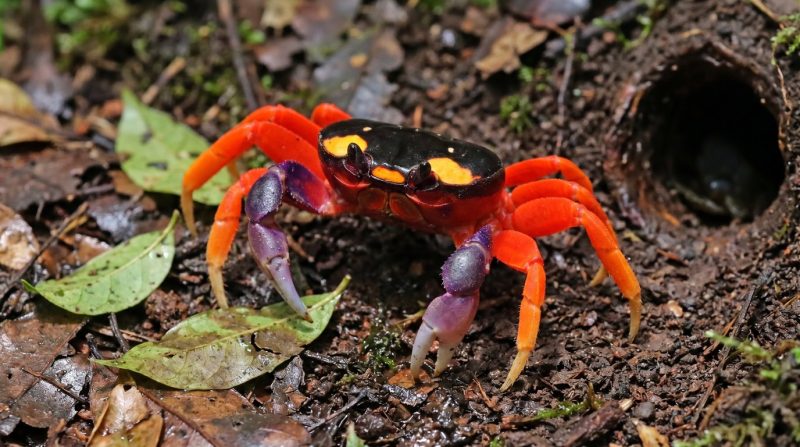
A Halloween crab isn’t a vampire crab. The name belongs to a land crab from the Pacific coast of Mexico and Central America, much bigger than a vampire crab. A Halloween vampire crab is one color line of the small freshwater vampire crab. Hermit crabs and fiddler crabs differ again, and all three of the others need salty water for their young, so none of them belongs in a vampire crab paludarium.
| What you’re comparing | Vampire crab | Halloween moon crab | Land hermit crab | Fiddler crab |
|---|---|---|---|---|
| Where it lives | Freshwater habitats across Southeast Asia and nearby islands.1 | Burrows in forest and mangroves on the Pacific coast of Mexico and Central America.2 | Close to the shore, with land and water both within reach.3 | Tidal mud flats in and around mangrove forests.4 |
| Where the young grow up | In fresh water: in most species, large eggs hatch straight into tiny crabs.1 | In the sea: females release their eggs into the ocean, and the larvae drift for about a month.5 | In the sea: the eggs hatch into larvae as soon as they touch sea water.6 | In estuary and coastal water, before they settle back in the marsh.7 |
| Adult size | About 10-15 mm (0.4-0.6 inch) across the shell, which is how big vampire crabs get in the described species.8 | Up to 56 mm (2.2 inches) across the shell, the biggest male in a survey of Costa Rica’s land crabs.2 | Up to 38.8 mm (1.5 inches) along its own body shell, the biggest male of the Caribbean species in the same survey.2 | About 10-19 mm (0.4-0.7 inch) across the shell on average in males of one US species, up to 23.4 mm.9 |
| Shelter | Hides on damp land, plus a water section every crab can climb into and fully enter. | Digs burrows up to 1.5 m (about 5 feet) long and more than 1 m (3 feet) deep.10 | Lives in an empty snail shell and picks new shells by inspecting them.3 | Burrows in salt marsh mud.9 |
| Shrimp Aquatics | We breed and sell them. | We don’t keep Halloween moon crabs, hermit crabs or fiddler crabs ourselves. | ||
Is a Halloween crab the same as a Halloween vampire crab?
No. A Halloween crab is a different animal from a Halloween vampire crab. Both names belong to one land crab, Gecarcinus quadratus, now listed as Hartnollius quadratus.11 Here we call it the Halloween moon crab.
A Halloween vampire crab is a vampire crab named for its colors. Our Halloween Vampire Crab has an orange shell, purple claws and dark purple legs, and it’s close to the same size as our other vampire crab lines.
That means it needs the same vampire crab care as any other line: a humid, lidded paludarium that’s mostly land, with a water section every crab can fully enter.
Don’t lean on the vampire crab name, either. An online trade survey found “Halloween vampire crab” used for two different described species.12 Read it as a color name, like the other types of vampire crabs for sale.
The purple claws are about all the two share. A 1966 survey describes the moon crab’s large claws as light reddish purple,2 and its size gives it away at once.
How big is a Halloween moon crab next to a vampire crab?
A Halloween moon crab can grow several times wider than a vampire crab. Vampire crabs measure about 10-15 mm (0.4-0.6 inch) across the shell.8 In the 1966 survey of Costa Rica’s land crabs, the biggest moon crabs measured 56 mm (2.2 inches) for a male and 52 mm for a female.2 Those were the biggest crabs examined, not an average.
It lives on a different scale, too. In one Costa Rican rainforest, 1 to 6 moon crabs lived on every square meter of a forest strip reaching about 600 m (2,000 feet) inland. Each dug its own burrow, up to 1.5 m long and more than 1 m deep. At night they came out to forage for fallen leaves, fruit, seeds and seedlings.10
Then there’s the sea. Once the rainy season starts, females walk down to the ocean and release their eggs into the water. The larvae drift in the sea for about a month, then young crabs move onto land for good.5 A vampire crab skips all of that. In most species the eggs hatch as tiny crabs, and the whole life cycle runs in fresh water.1
So a moon crab isn’t a bigger version of a vampire crab. It needs room and soil deep enough to dig, and its young need the sea, not a freshwater tank.
What makes a land hermit crab different from a vampire crab?
A land hermit crab lives in an empty snail shell it carries around, and a vampire crab has no such shell. A hermit crab molts as it grows and picks a new shell by inspecting it step by step.3 That’s why a hermit crab tank needs spare shells as well as food and water.
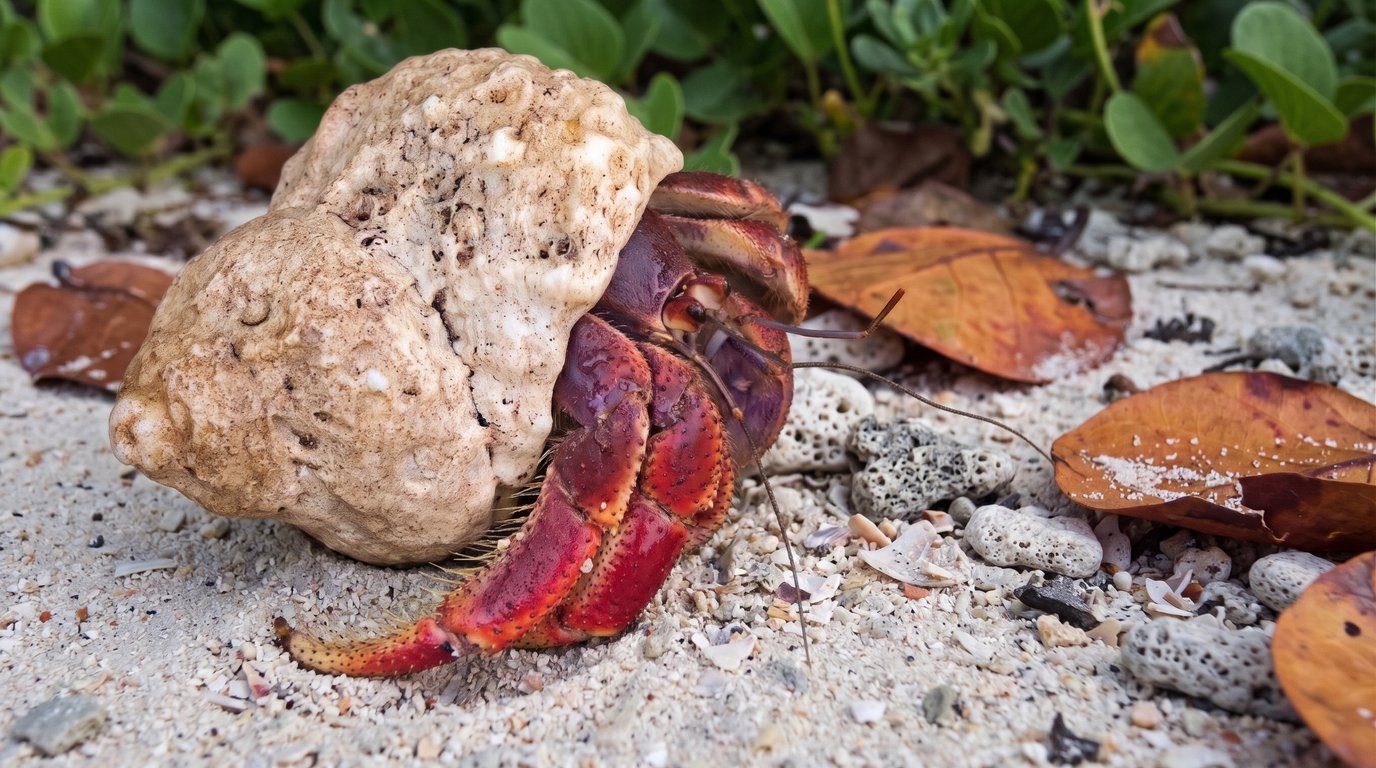
Water is the bigger difference. Land hermit crabs need both land and water, and they use pools of sea water to wet their gills and the inside of their shells.3 In a study on Curaçao, Caribbean hermit crabs (Coenobita clypeatus) kept the water in their shells at about 32-33 parts per thousand, a little below sea water. Crabs living inland relied on fresh water to drink.6 A vampire crab needs none of that, because vampire crabs don’t need salt water at any stage of life.
Their young need the sea as well. Females drop their eggs at the low-water line over several nights, and the larvae hatch the moment the eggs reach sea water and drift off on the tide.6 The Smithsonian’s National Zoo says land hermit crabs don’t breed in human care, so every hermit crab in a pet store was caught in the wild.3
Big ones get heavy, too. On Curaçao, old hermit crabs in large snail shells weighed up to 500 g (about 1 pound) with the shell, while small adults weighed about 2 g.6 And if you’re wondering about the food, hermit crab food isn’t a shortcut for vampire crabs: many vampire crabs ignore it.
Is a fiddler crab a freshwater crab like a vampire crab?
No. A fiddler crab is a tidal crab, and a vampire crab is a freshwater one. Fiddler crabs live on mud flats in and around mangrove forests.4 Along the mid-Atlantic coast of the US, two species are abundant in high-salinity salt marshes, one on sand at the creek edge and one on muddier, higher ground.7
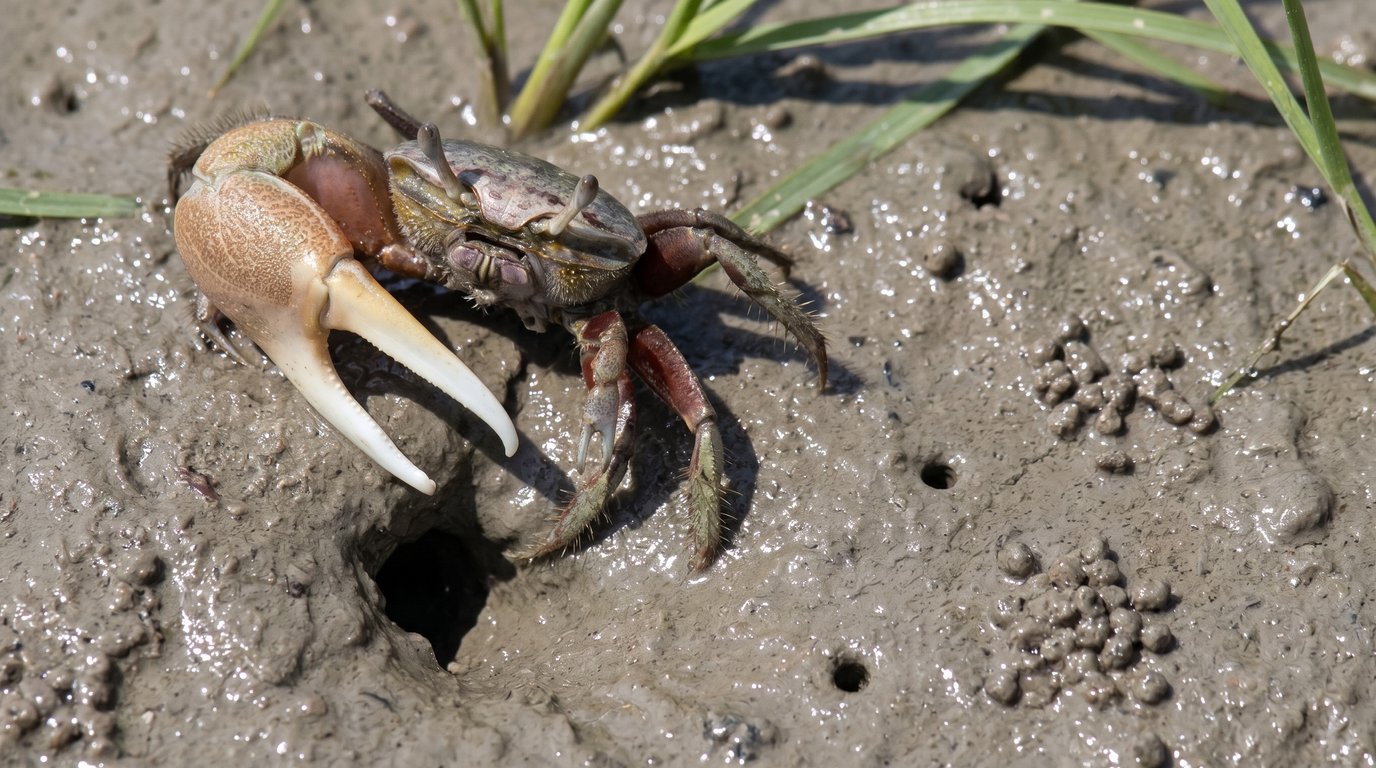
Their larvae leave the marsh for estuaries and coastal water and come back to settle in the marsh only at their last larval stage.7
Red claw crabs follow the same pattern. In a lab study of one brood from Japan, red claw crab larvae died in fresh water within 12 hours.13 So vampire crab vs red claw crab is also a choice between fresh and salty water.
Size is closer than with the other two crabs. Males of one US marsh species averaged about 10-19 mm (0.4-0.7 inch) across the shell from marsh to marsh, and the largest measured 23.4 mm.9 The male’s claw is what sets a fiddler crab apart. In all 103 recognized species, he has one greatly enlarged claw that can make up as much as half his weight. He uses it to fight other males and waves it to attract females.4
Fiddler crabs also feed differently. They scoop up sediment with the small claw and sort it in the mouth. A European fiddler crab fed mostly on microalgae picked out of the sediment, and only at low tide.14
Can vampire crabs live with Halloween moon crabs, hermit crabs or fiddler crabs?
No. Vampire crabs shouldn’t share a tank with any of the three. Each of the others lives where salty water is part of daily life, from a hermit crab’s sea pools to a fiddler crab’s tidal mud. A vampire crab lives and breeds in fresh water.
No published study has kept any of them with vampire crabs, so nobody can tell you how a mixed tank would go. For the moon crab and the hermit crab, the size gap is reason enough on its own. A crab several times wider, or one that can weigh a pound with its shell, is a risk you don’t need to take beside half-inch vampire crabs. The same mismatch of salty and fresh water means vampire crabs and ghost crabs don’t belong together either.
If you want company for your vampire crabs, pick vampire crab tank mates that live in the same fresh water and temperature. Give a seashore crab a tank of its own.
Should you choose a vampire crab or one of the bigger pet crabs?
Choose a vampire crab if your setup is a small, lidded freshwater paludarium. A Halloween moon crab or a land hermit crab suits a keeper who can give it far more space and deep soil. A hermit crab also needs sea water and spare shells. A fiddler crab suits a tank built around salty, tidal mud.
If the small freshwater crab is the one you want, start with ours. Everything in our catalog is bred or propagated in our own tanks rather than collected from the wild. Browse our tank-bred vampire crabs and choose male or female on each product page.
References
14 Sources
- Shy and Ng, Geosesarma mirum, a new species of semi-terrestrial sesarmid crab (Crustacea, Decapoda, Brachyura) from central Taiwan, ZooKeys 858: 1-10, 2019.
- Bright, The land crabs of Costa Rica, Revista de Biología Tropical 14(2): 183-203, 1966.
- Land hermit crab, Smithsonian’s National Zoo and Conservation Biology Institute, accessed 2026-11-13.
- Backwell, Synchronous waving in fiddler crabs: a review, Current Zoology 65(1): 83-88, 2019.
- Madin, A torrent of crabs running to the sea, Oceanus magazine, Woods Hole Oceanographic Institution, 2010.
- de Wilde, On the ecology of Coenobita clypeatus in Curaçao with reference to reproduction, water economy and osmoregulation in terrestrial hermit crabs (Internet Archive scan), Studies on the Fauna of Curaçao and other Caribbean Islands 44: 1-138, 1973.
- O’Connor, Settlement and recruitment of the fiddler crabs Uca pugnax and U. pugilator in a North Carolina, USA, salt marsh, Marine Ecology Progress Series 93: 227-234, 1993.
- Ng and Wowor, Two new species of vampire crabs (Crustacea: Decapoda: Brachyura: Sesarmidae: Geosesarma De Man, 1892) from Java, Indonesia, Raffles Bulletin of Zoology 72: 469-478, 2024.
- Johnson and others, The fiddler crab, Minuca pugnax, follows Bergmann’s rule, Ecology and Evolution 9(24): 14489-14497, 2019.
- Sherman, Influence of land crabs Gecarcinus quadratus (Gecarcinidae) on distributions of organic carbon and roots in a Costa Rican rain forest, Revista de Biología Tropical 54(1): 149-161, 2006.
- Gecarcinus quadratus de Saussure, 1853, DecaNet, World Register of Marine Species, accessed 2026-11-13.
- Whitaker, Roberts, Spicer and Turner, A systematic survey of brachyuran land crabs in the online tropical aquarium trade, Oryx, Cambridge University Press, 2026.
- Islam, Shokita and Nagai, Effects of salinity on the larval development of the mangrove dwelling semiterrestrial sesarmine crab, Perisesarma bidens (De Haan), Crustacean Research 29: 152-159, 2000.
- Wolfrath, Field experiments on feeding of European fiddler crab Uca tangeri, Marine Ecology Progress Series 90: 39-43, 1992.
Ready to get started?
Shop our Vampire Crab collection
8 products available · Live Arrival Guarantee