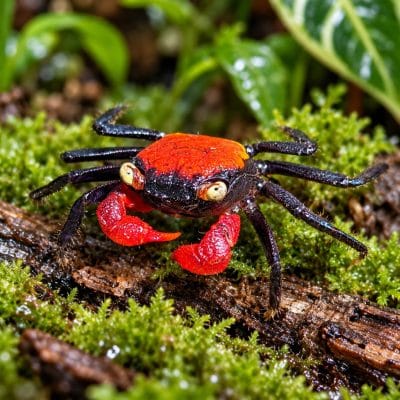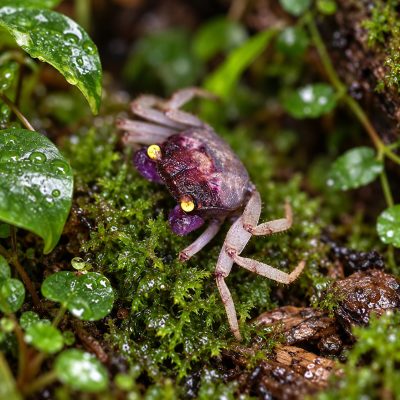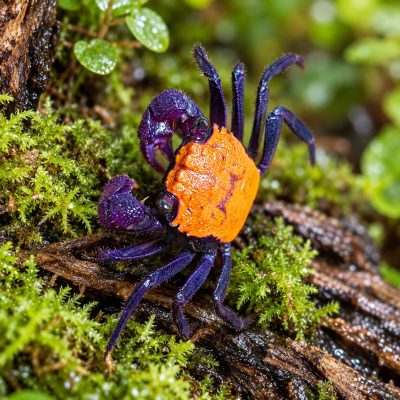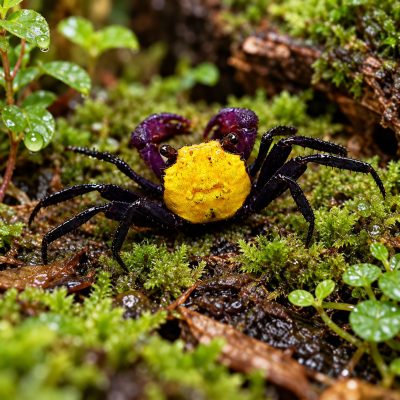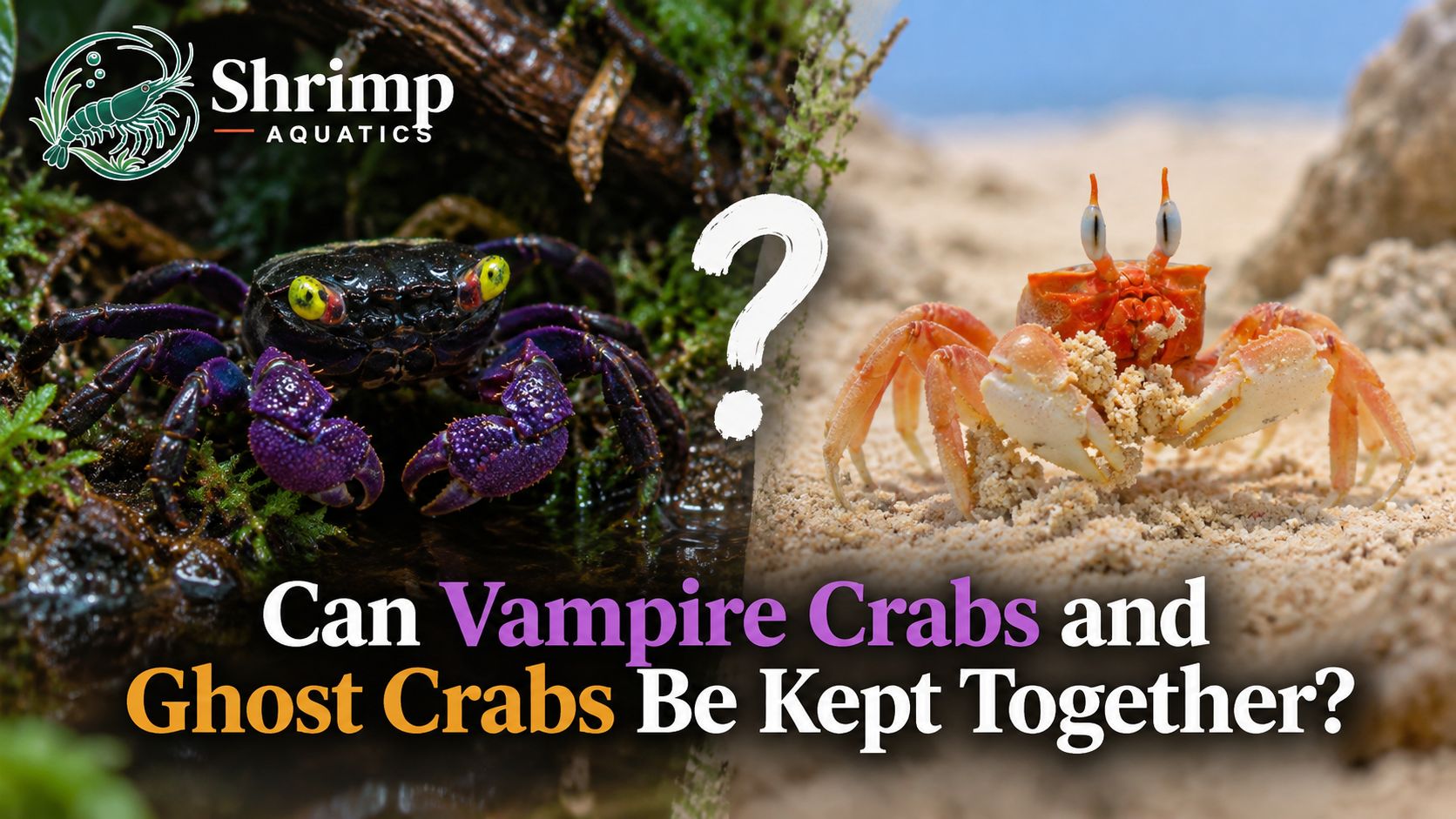
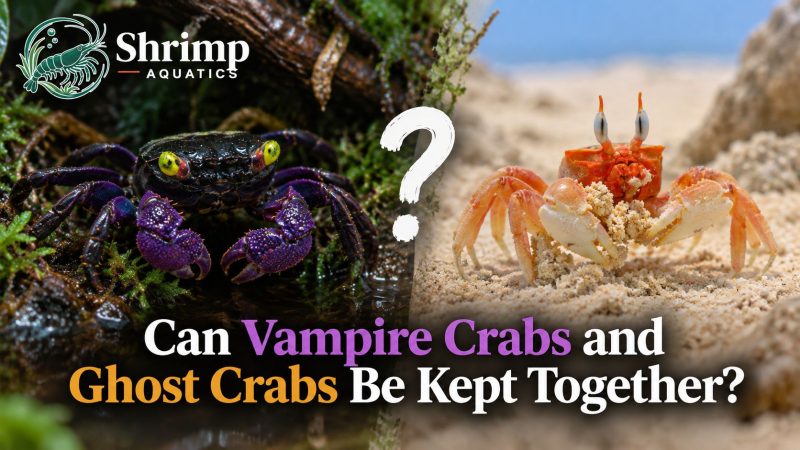
No, vampire crabs and ghost crabs can’t be kept together. Ghost crabs are ocean-beach crabs whose young grow up in the sea. Vampire crabs live and breed around fresh water. One enclosure can’t be both, and a ghost crab is a much bigger predator that eats almost anything it catches.
Ghost crabs need a sea beach, vampire crabs need fresh water
The water decides it before anything else: one crab’s life is built around the sea, the other’s around fresh water. Ghost crabs, the genus Ocypode, are the largest invertebrates on tropical and subtropical sandy shores. They dig burrows on the open beach and in the dunes behind it.1 Adults rarely go into the surf, but their young live there: females release their eggs in the swash, and the larvae start life in the sea.1 In the Atlantic ghost crab, Ocypode quadrata, the adult wets its gills at the water’s edge or from damp sand, and the larvae develop in saline water.2
Vampire crabs come from the other end of that spectrum. They’re semi-terrestrial crabs of fresh water. Most species whose eggs have been measured lay large eggs that hatch straight into tiny crabs, with no trip to the sea.3 You never add salt to a vampire crab tank. The beach crab would need a sea beach built for it. There’s no middle setting that serves both. Even then, vampire crabs live in water only part of the time and need land to climb out on.
| Trait | Ghost crabs | Vampire crabs |
|---|---|---|
| Wild home | Sandy sea beaches and dunes | Damp ground beside freshwater streams |
| Where the young develop | In the sea, as larvae | Hatch as tiny crabs, no salt water needed |
| Adult size | About 2 inches (5 cm) long in the Atlantic ghost crab | About half an inch (10-15 mm) across |
Would a ghost crab eat your vampire crabs?
We’d assume it would, given the chance. They’re omnivorous predators and scavengers that will take almost any food they find.1 Ocypode quadrata feeds largely on bean clams and mole crabs. It grows a shell about 2 inches (5 cm) long.2 The vampire crabs described from the trade measure roughly half an inch (about 11-14.5 mm) across.4
That puts a big beach predator next to a small crab whose defense is hiding. In the wild, the described trade species shelter under stones and dense plants and in burrows near the water’s edge.4 We wouldn’t bet a colony on those hiding places holding up against a crab several times their size. A divider or a bigger tank doesn’t change the size gap, and it doesn’t fix the water problem above.
Check the scientific name on any crab sold as a ghost crab
Read the genus before you trust the trade name. Crab trade names are loose, and a survey of online crab listings found that many gave no species name at all.5 The name that settles it is the genus: Ocypode is a ghost crab, and Geosesarma is a vampire crab, whatever word the trade name uses. Reading the genus also settles a vampire crab vs red claw crab listing, since both get loose trade names.
If the listing says Geosesarma, you’re looking at a vampire crab, and the salt-water problem goes away. If you meant ghost shrimp, that’s a shrimp, not a crab, and keeping ghost shrimp with vampire crabs is a freshwater question.
What to put with vampire crabs instead of a ghost crab
Keep vampire crabs with more vampire crabs on land, and with small freshwater animals in the water section. Good vampire crab tank mates all live in fresh water. Fresh water on one side and damp land on the other is the base of vampire crab care, and no ghost crab fits it.
If you’re stocking a new paludarium, our tank-bred vampire crabs are the place to start. Everything in our catalog is bred or propagated in our own tanks rather than collected from the wild. Each vampire crab line is sold as male or female, so you choose the sex on the product page.
References
5 Sources
- Human threats to sandy beaches: A meta-analysis of ghost crabs illustrates global anthropogenic impacts, Schlacher T.A. et al., Estuarine, Coastal and Shelf Science 169: 56-73, 2016 (co-author’s copy of the published paper).
- Ocypode quadrata (Atlantic ghost crab), Izzo L. and Kothari N., Animal Diversity Web, University of Michigan Museum of Zoology, 2011.
- Geosesarma mirum, a new species of semi-terrestrial sesarmid crab (Crustacea, Decapoda, Brachyura) from central Taiwan, Shy J.-Y. and Ng P.K.L., ZooKeys 858: 1-10, 2019.
- New species of “vampire crabs” (Geosesarma De Man, 1892) from central Java, Indonesia, and the identity of Sesarma (Geosesarma) nodulifera De Man, 1892, Ng P.K.L., Schubart C.D. and Lukhaup C., Raffles Bulletin of Zoology 63: 3-13, 2015.
- A systematic survey of brachyuran land crabs in the online tropical aquarium trade, Oryx, Cambridge University Press, 2026.
Ready to get started?
Shop our Vampire Crab collection
8 products available · Live Arrival Guarantee