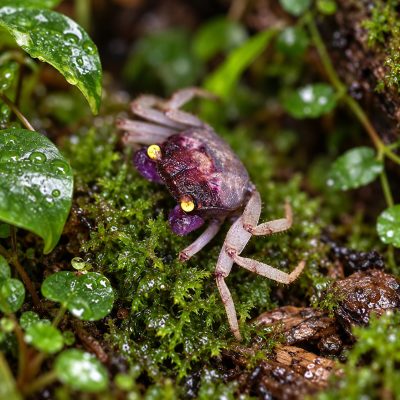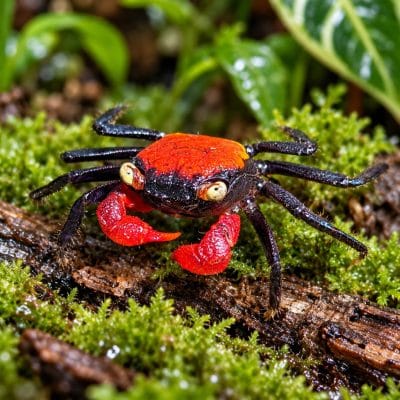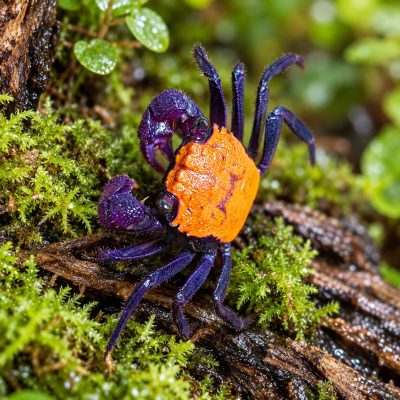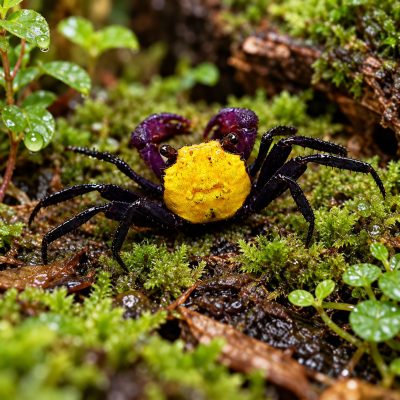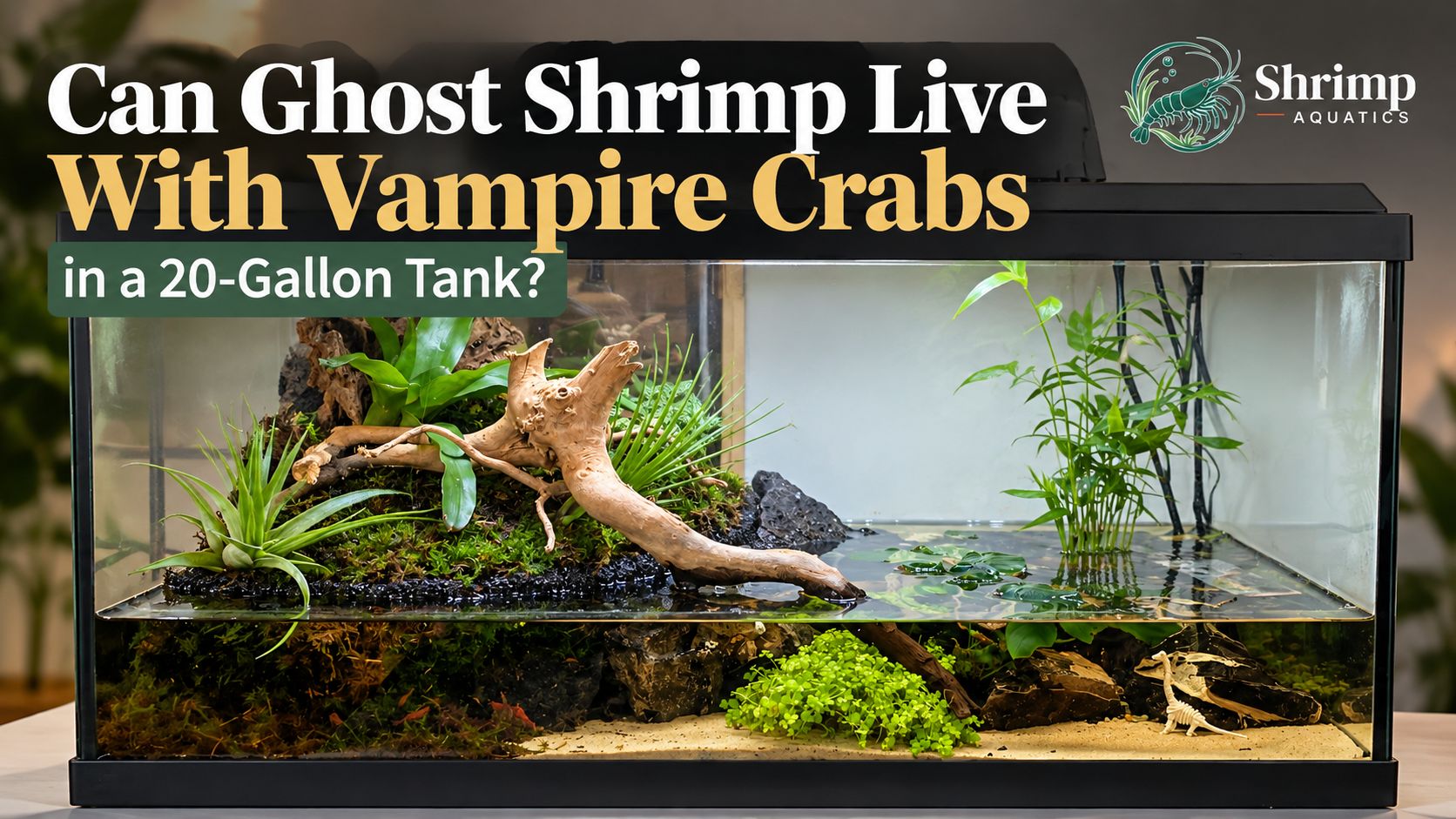
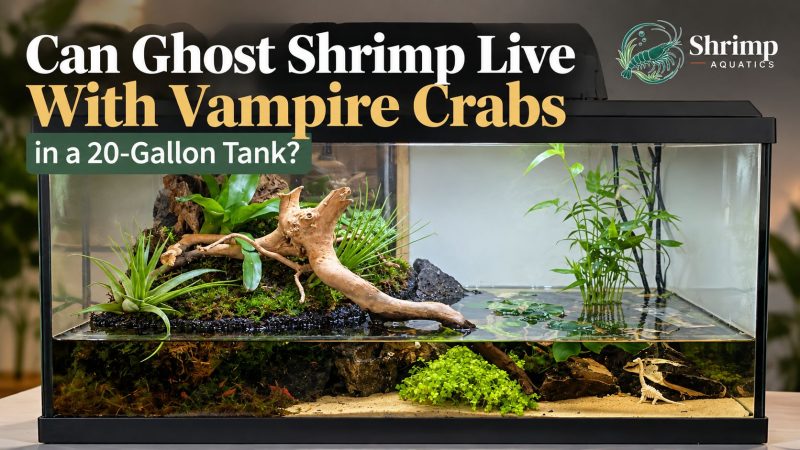
Yes, adult ghost shrimp usually work with vampire crabs in a 20-gallon paludarium. A grown ghost shrimp is several times longer than a vampire crab’s shell is wide. Both animals are happy at the temperature you’d keep the crabs at, and the crabs spend most of their time on land. The trouble spots are a water section that’s too small or too bare, the hours a crab spends molting in the water, and any crablets.
Will vampire crabs eat ghost shrimp?
Rarely, as long as the shrimp are healthy adults. An adult ghost shrimp reaches about 2 inches (50 mm) long.1 A vampire crab’s shell is only about half an inch across,2 so the crab is chasing something several times its own width.
Vampire crabs go after dwarf shrimp, which are far smaller than ghost shrimp, but they catch few of them, and Neocaridina keep breeding in crab tanks. The heavy losses keepers do report came from a handful of shrimp dropped into a small or newly planted water section. We’d expect a grown one to be an even harder catch. Still, a crab does take a shrimp now and then, so don’t count on every one making it.
Make sure you know what you’re buying, too. Ghost shrimp is a common name for the eastern grass shrimp, Palaemonetes paludosus, a popular aquarium shrimp from the eastern US,3 but it looks a lot like other Palaemonetes species.1 Buy from a seller who can tell you which shrimp you’re getting, because everything on this page assumes that one.
Do ghost shrimp and vampire crabs need the same temperature?
Yes, close enough. Vampire crabs are kept at about 78°F (26°C), within roughly 72-85°F (22-29°C). That whole band sits inside the 50-95°F (10-35°C) the shrimp prefer in the wild.1
Don’t read that wild range as a target for your tank. Set the heater for the crabs and keep it steady. The shared water also has to suit the shrimp in its own right, so never push it somewhere uncomfortable for them just because the crabs would cope. That rule holds for any vampire crab tank mates sharing the pool.
Set up the 20-gallon water section before ghost shrimp go in
Size the water section, not the tank. A vampire crab paludarium needs a real land section the crabs live on. In a 20-gallon, that leaves only part of the floor as water, and that part is all the shrimp ever get. They’re swimming shrimp that grow to about 2 inches, and in the wild they’re most common in dense beds of underwater plants and scarce where there’s little or no cover.3
- The water section is filtered and fully cycled, with ammonia and nitrite at zero, before any shrimp go in.
- Moss and fine-leaved plants fill much of the water, so shrimp can get out of a crab’s reach.
- The crabs can walk in, go fully under and climb out at more than one point.
- You stock the shrimp to the size of the water section, not the 20-gallon label on the glass.
Why does the label matter so little? Because a 20-gallon paludarium with a small pool holds far less water than a 20-gallon aquarium, and the shrimp’s waste all lands in that pool. Start with a few, watch how the crabs and shrimp settle over the first weeks, and add more only if the water stays clean.
Give a molting vampire crab cover in the shared water
Plan the water around the crab’s molt, because that’s when the crab, not the shrimp, is the vulnerable one. In our paludariums, vampire crabs go into the water to molt, and a molting crab stays down there for a few hours. Right after a molt a crab’s new shell is soft, and in crabs generally the animal is close to helpless until it hardens.4 Planning for the molt is part of vampire crab care, with or without shrimp.
Ghost shrimp are omnivores that eat aquatic insects and detritus as well as algae,1 so we wouldn’t leave a soft crab with nowhere to hide from them. Thick moss at the water’s edge and a few sheltered spots under wood or leaves give a molting crab somewhere to sit undisturbed. If you ever see shrimp picking at a crab that hasn’t hardened yet, move the shrimp.
Raise vampire crablets away from ghost shrimp
If your crabs breed, move the crablets out to grow up, and it matters more with ghost shrimp in the pool. Most vampire crab species hatch straight into tiny crabs, with no larval stage.5 Adult crabs eat the crablets they catch, so moving the crablets (or the adults) to another tank raises the most young.
The young don’t stay up on the land, either. In two wild Javan species long sold as vampire crabs, young were found closer to the water than adults.2 Ghost shrimp eat small animals such as mayfly nymphs and midge larvae in the wild,3 and we wouldn’t trust one around a crablet that tumbles into the pool.
Ghost shrimp or Neocaridina for a vampire crab paludarium?
For most keepers we’d pick Neocaridina, and save ghost shrimp for someone who wants a few bigger shrimp and has a decent-sized pool. Ghost shrimp have an annual life cycle and die after spawning,1 and wild ones live about 6-13 months.3 Their young hatch as free-swimming larvae,1 so we’d expect a group in a small crab pool to thin out, not build up. A dwarf shrimp colony that breeds in the pool is the easier way to have vampire crabs live with shrimp.
At Shrimp Aquatics, we keep Neocaridina shrimp in the water section of our vampire crab paludariums. They breed there, and the young grow up normally; the crabs rarely manage to catch them. We haven’t kept ghost shrimp with our crabs, so for them you’re relying on what’s above. Whichever shrimp you choose, keep the water inside that shrimp’s own range.
If you’re still choosing crabs, our tank-bred vampire crab lines come from our own paludariums. Everything in our catalog is bred or propagated in our own tanks rather than collected from the wild.
References
5 Sources
- Palaemonetes paludosus (Gibbes, 1850): Nonindigenous Aquatic Species fact sheet, W.M. Daniel, U.S. Geological Survey, revision 2019-09-24.
- New species of “vampire crabs” (Geosesarma De Man, 1892) from central Java, Indonesia, and the identity of Sesarma (Geosesarma) nodulifera De Man, 1892, Raffles Bulletin of Zoology 63: 3-13, 2015.
- Palaemonetes paludosus (riverine grass shrimp), C. Baranowski, Animal Diversity Web, University of Michigan Museum of Zoology, 2011.
- Edible Crabs of the United States (Fishery Leaflet 550), G.H. Rees, U.S. Fish and Wildlife Service, 1963, hosted by NOAA Fisheries.
- Geosesarma mirum, a new species of semi-terrestrial sesarmid crab from central Taiwan, Shy and Ng, ZooKeys 858: 1-10, 2019.
Ready to get started?
Shop our Vampire Crab collection
8 products available · Live Arrival Guarantee