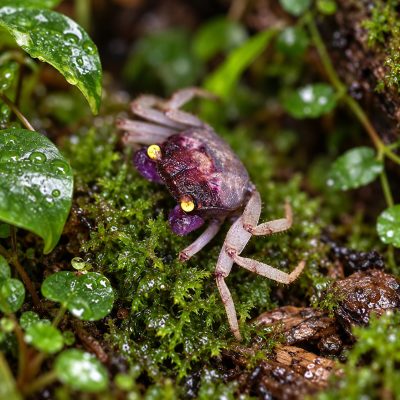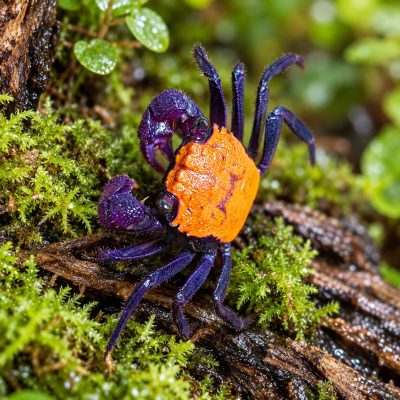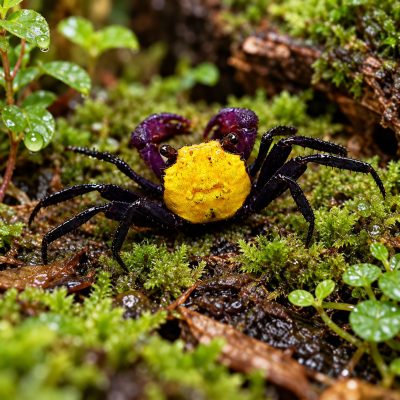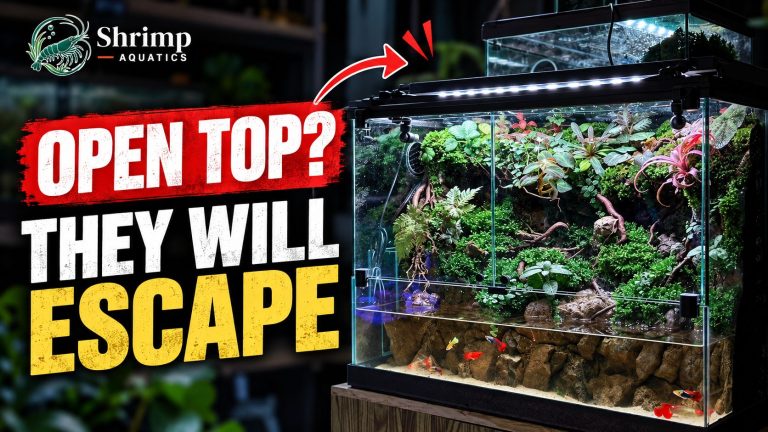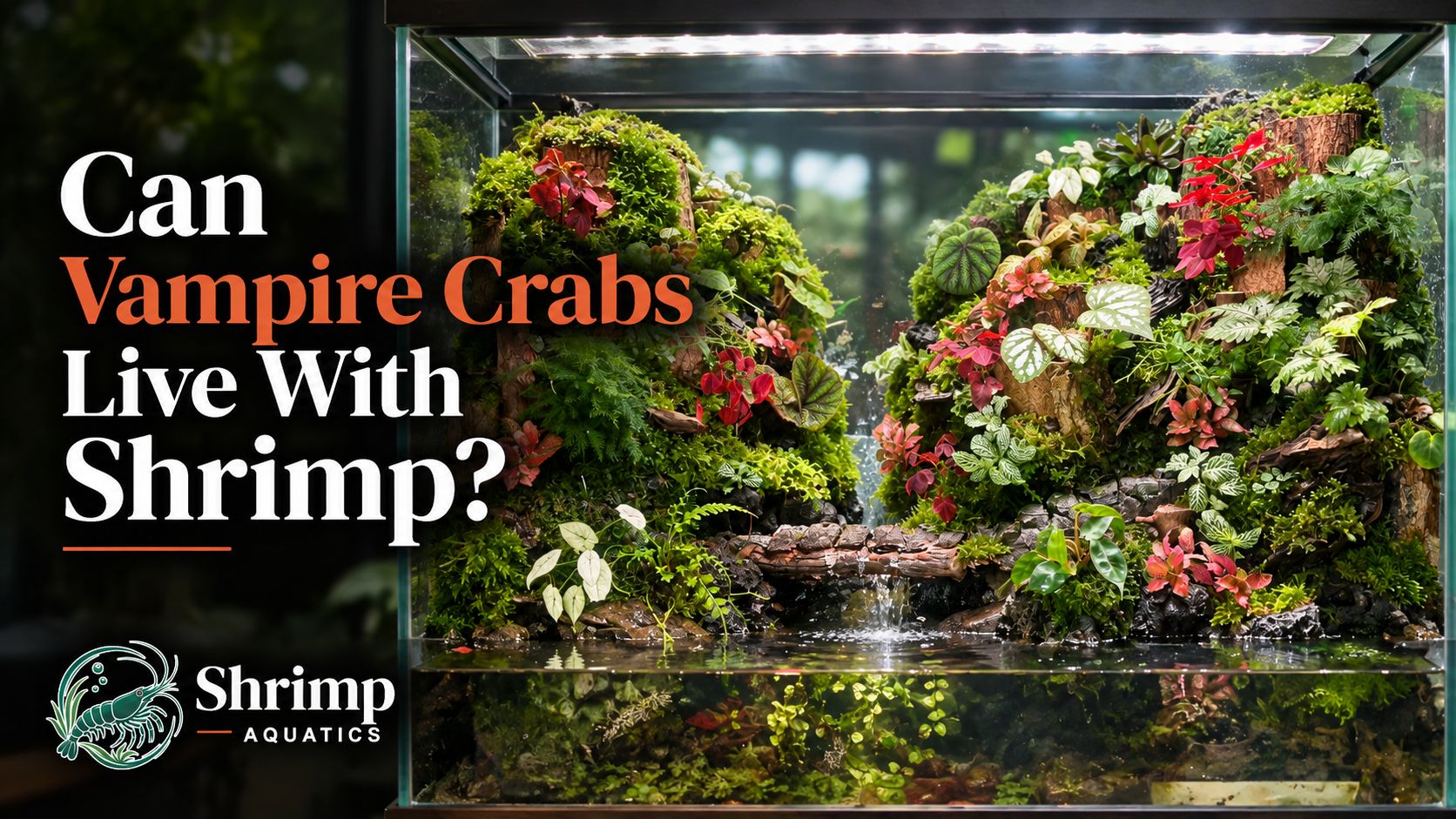
Yes. In most tanks vampire crabs and dwarf shrimp live together fine: the crabs chase shrimp but catch few, and Neocaridina keep breeding in the water section. Losses pile up when a handful of shrimp go into a small, thinly planted water section, or when the shrimp end up in water that’s warmer than their own range.
How often do vampire crabs actually catch shrimp?
Not often. A crab takes a shrimp now and then, but not enough to thin out a healthy group, and Neocaridina keep breeding right alongside the crabs. You’ll still see your crabs try. The vampire crabs described from Java feed at least partly on small insects in the wild,1 and in a paludarium they reach for shrimp too.
At Shrimp Aquatics, we keep Neocaridina shrimp in the water section of our vampire crab paludariums. They breed there, and the young grow up normally; the crabs rarely manage to catch them.
So when do shrimp disappear? The risky setup is a handful of shrimp dropped into a small or newly planted water section. In a tank like that, a small group can be lost almost entirely, which is why the setup steps further down matter more than which crab you pick.
Which shrimp can share the water with vampire crabs?
Neocaridina are the ones we’d pick. These are Neocaridina davidi, sold as cherry, blue dream and the other color lines, and their temperature fits the crabs without any stretching. Vampire crabs are kept at about 78°F (26°C), within a band of about 72-85°F (22-29°C), while Neocaridina usually live at 65-78°F (18-26°C). That leaves 72-78°F (22-26°C) where both are comfortable. The crab side of that band is the same temperature used in everyday vampire crab care.
A tank that runs a little warmer still suits them. In a 90-day study, Neocaridina grew, matured and bred best at 82°F (28°C), and at 90°F (32°C) the females lost their eggs.2 So 72-82°F (22-28°C) is the stretch where the crabs and the published shrimp data agree, and it’s where we’d keep a shared tank.
| What to hold | Vampire crabs | Neocaridina | Bee and crystal shrimp |
|---|---|---|---|
| Temperature | About 78°F (26°C), within 72-85°F (22-29°C) | 65-78°F (18-26°C) | 60-72°F (15.5-22°C) |
| pH | Keep to the shrimp’s numbers | pH 6.5-8.0 | pH 5.8-6.8 |
| GH | Keep to the shrimp’s numbers | 6-12 dGH | 4-6 dGH |
| KH | Keep to the shrimp’s numbers | 2-8 dKH | 0-2 dKH |
| TDS | Keep to the shrimp’s numbers | 150-300 ppm | 100-150 ppm |
Bee and crystal shrimp only meet the crabs at 72°F
Bee and crystal shrimp (Caridina) can share the water only if you hold it at 72°F (22°C). That’s the top of their 60-72°F (15.5-22°C) range and the bottom of the crab band, so a tank that drifts a degree either way is outside one of them. They also want soft, acidic water, as the table shows.
Don’t warm the water for the crabs
If bee or crystal shrimp share the water section, the shrimp set the temperature. Keep it inside 60-72°F (15.5-22°C). Only 72°F (22°C) is inside the crabs’ band as well, so any cooler and the crabs sit below it.
Bee and crystal shrimp also live with our crabs, but that doesn’t change the arithmetic: their water still tops out at 72°F (22°C). Neocaridina and bee or crystal shrimp are the only shrimp we’ve kept with our crabs, so those are the two we’ll speak for. If you want an easy first try, start with Neocaridina. Keeping ghost shrimp with vampire crabs is a separate case, because a grown ghost shrimp is far bigger than a dwarf shrimp.
Set up the water section so a shrimp group can stay out of reach
Thick cover and a real group of shrimp are what keep losses rare. The tanks that lost their shrimp usually had a few shrimp in a bare, young water section. Before the shrimp go in, run through these checks.
- Plant the water section densely with moss or other fine-leaved plants, and let it grow in before the shrimp arrive.
- Add a group of shrimp, not two or three.
- Give the shrimp as much water as your layout allows. A small water section raises the risk.
- Feed the crabs on a regular schedule, so a shrimp is never the only food in reach.
- Hold the water inside the shrimp’s numbers in the table, not just the crabs’ temperature band.
We know you’d like to add everything on the same day and be done. Waiting until the plants have filled in costs you some time, and it’s the step that most often decides whether the shrimp make it.
Move the shrimp out if their numbers keep falling
If you count fewer shrimp every week, give them their own tank. Count them at feeding time, when they come out to eat. Before you blame the crabs, check the thermometer: shrimp that hide all day or keep dying in a warm tank belong in cooler water, whatever the crabs are doing. That rule, the animal’s own range first, holds for all vampire crab tank mates.
Buying vampire crabs for a tank that already has shrimp
Get the shrimp side settled first, then add the crabs. When you’re ready, our vampire crab lines go into the same kind of paludarium, and you choose male or female on each crab’s product page. Everything in our catalog is bred or propagated in our own tanks rather than collected from the wild. We don’t promise breeding or the number of young from any order. Confirming your own import rules is part of ordering. We cannot tell you that live freshwater invertebrates are legal to import where you live.
References
2 Sources
- New species of “vampire crabs” (Geosesarma De Man, 1892) from central Java, Indonesia, and the identity of Sesarma (Geosesarma) nodulifera De Man, 1892, Raffles Bulletin of Zoology 63: 3-13 (Ng, Schubart and Lukhaup), 2015.
- Effect of Temperature on Biochemical Composition, Growth and Reproduction of the Ornamental Red Cherry Shrimp Neocaridina heteropoda heteropoda (Decapoda, Caridea), PLOS ONE 10(3): e0119468 (Tropea, Stumpf and López Greco), 2015.
Ready to get started?
Shop our Vampire Crab collection
8 products available · Live Arrival Guarantee