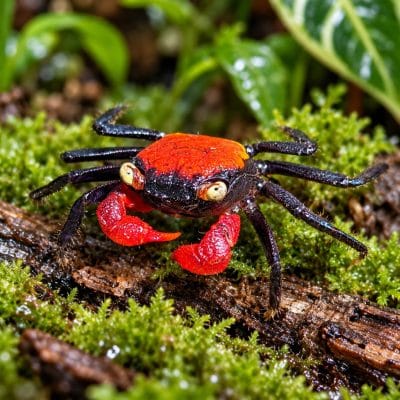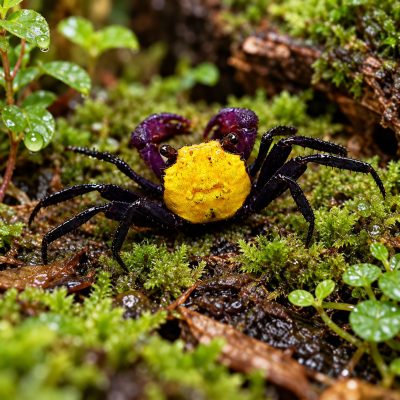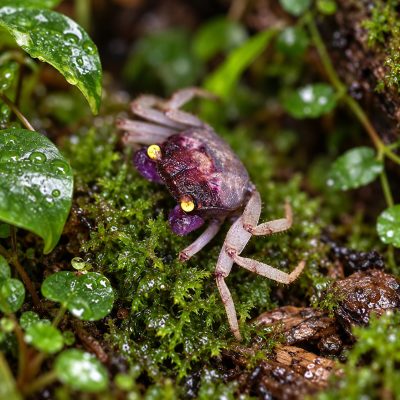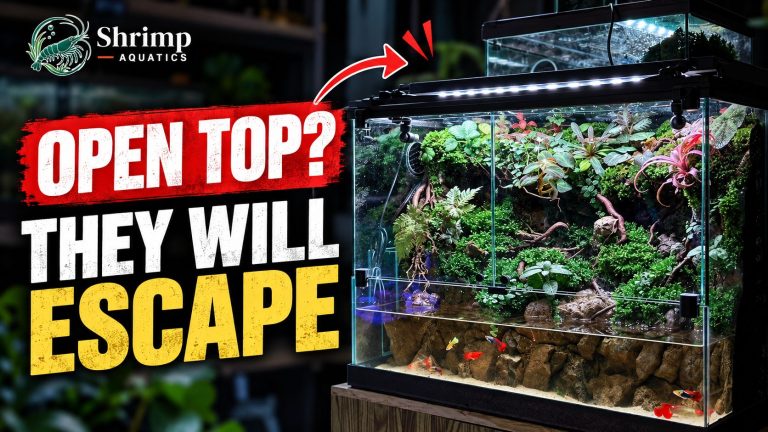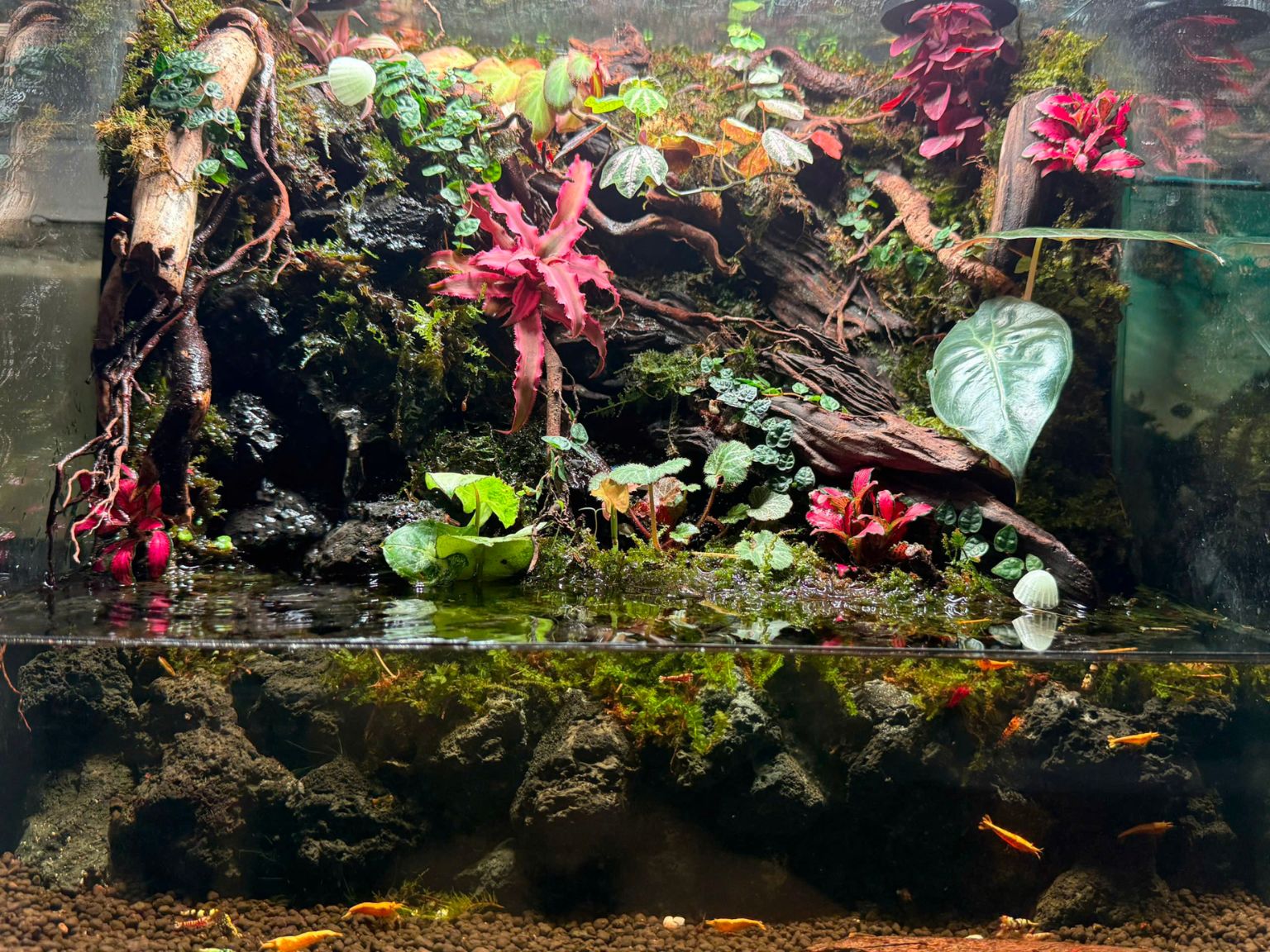
Which animals can share a vampire crab paludarium without one side eating the other? Neocaridina shrimp are the best tank mates for vampire crabs, because at about 78°F (26°C) both are in their usual range. In our paludariums the shrimp breed in the water section, and the crabs rarely catch them. Small, peaceful fish such as Endlers or guppies and small snails such as nerites also share our crab tanks. Bee and Crystal shrimp fit only at the cool edge, and large, predatory or aggressive fish stay out. Get the land, the water section and the lid of vampire crab care right before you add anything else.
Which animals can share the water section with vampire crabs?
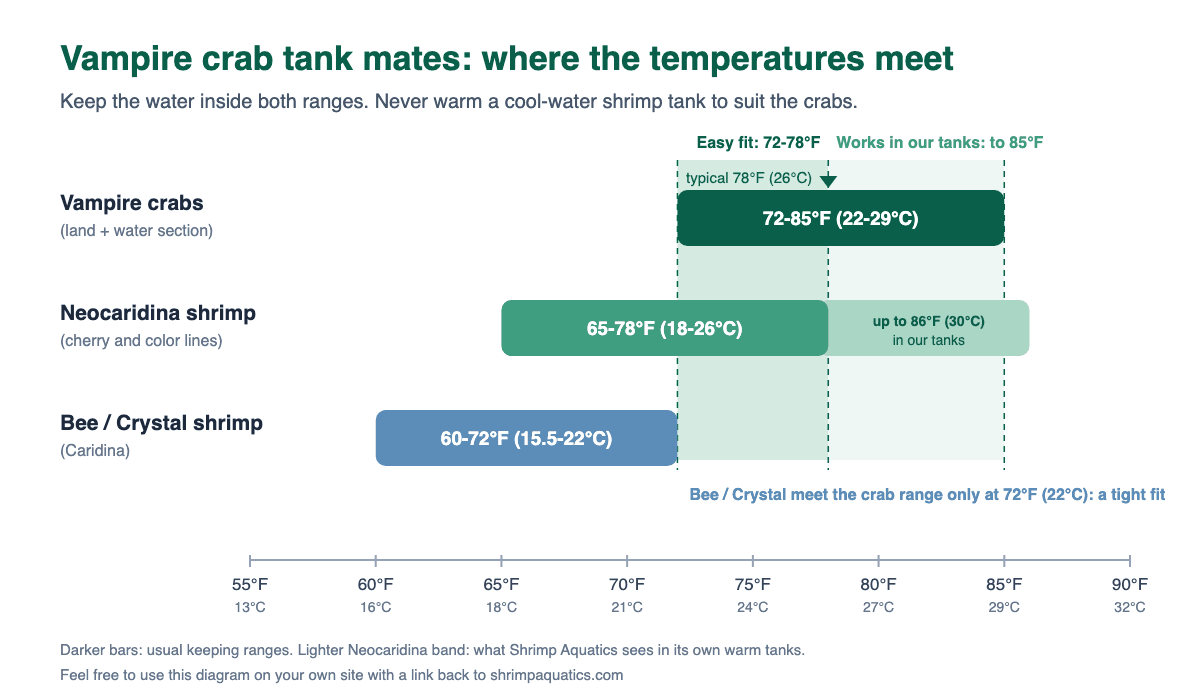
Shrimp, small fish and small snails can share the water section with vampire crabs, and the 8 below are ranked best first. Each one has to fit the crabs’ temperature, which sits at about 78°F (26°C) within 72-85°F (22-29°C). For every fish and snail below, check that its own temperature range overlaps that band before you buy, and keep the water inside what that animal needs as well as what the crabs need. The ranking is our advice, built from what lives in our own crab tanks.
-
Neocaridina shrimp, the easiest fit for the water section
Neocaridina are usually kept at 65-78°F (18-26°C), so they overlap the crabs between 72 and 78°F. At Shrimp Aquatics, Neocaridina share the water section of our vampire crab paludariums: they keep breeding there, their young grow up normally, and the crabs rarely manage to catch them. So, yes, vampire crabs live with shrimp well in a tank set up for both.
Expect the crabs to go after the shrimp all the same. They catch few, and in most crab tanks Neocaridina live alongside them and keep breeding. A crab does take one now and then, though, and a few shrimp in a small or sparsely planted water section can disappear within weeks. One keeper put a few cherry shrimp in with the crabs and had none left four weeks later. So plant the water densely and start with more than a handful. The same advice holds if you keep ghost shrimp with vampire crabs instead.
What if your crab tank runs warm? Of the three temperatures in one laboratory study, Neocaridina did best at 82°F (28°C), and at 90°F (32°C) every female that carried eggs lost them.1 In our Sulawesi tanks, Neocaridina live and breed at up to 86°F (30°C), which covers the whole crab range. That’s our experience, not a published figure, and it’s no reason to take the water any higher.
-
Endlers or guppies, our top pick among fish
We have kept small, peaceful fish with our vampire crabs, such as Endlers or guppies, small rasboras and small tetras, and Endlers or guppies head that group. FishBase lists the guppy (Poecilia reticulata) from 64°F (18°C) up to 82°F (28°C), so it shares 72-82°F (22-28°C) with the crabs.2 Guppies usually do fine in the water section with vampire crabs. A crab can still catch one, though: one keeper lost two adult male guppies within two hours, about a month after the crabs arrived. Endler’s livebearers (Poecilia wingei) are smaller, and a published working temperature for them, 81-82°F (27-28°C), sits inside the crab range.3 That isn’t a full range, so ask your seller what their Endlers are kept at.
-
Small rasboras, once their range fits the crabs’
A small rasbora is a good second fish, as long as you pick the species and check its range yourself. On temperature, FishBase puts the chili rasbora (Boraras brigittae) at 77-82°F (25-28°C), entirely inside the crab range, and the harlequin rasbora (Trigonostigma heteromorpha) at 72-77°F (22-25°C).45 So the harlequin shares only the cool half of the crab range, below the 78°F (26°C) the crabs are usually kept at, and it’s the bigger fish of the two. Small rasboras often eat shrimplets, so if Neocaridina share the water, give the shrimp dense plants or moss to retreat into.
-
Small tetras, checked species by species
Small tetras work too, as long as you check the exact species you’re buying against 72-85°F (22-29°C). The ember tetra (Hyphessobrycon amandae) is the easier match, listed at 75-82°F (24-28°C), inside the crab range.6 The neon tetra (Paracheirodon innesi) is listed from 68°F (20°C) up to 79°F (26°C), so it overlaps the crabs only at 72-79°F (22-26°C), and it’s listed for soft, acidic water,7 a poor match for the harder water Neocaridina need. Like rasboras, small tetras pick off shrimplets.
-
Nerite snails for the water section
We keep small aquatic snails with our vampire crabs, such as nerite, ramshorn and Malaysian trumpet or bladder snails. Nerites lead that group. One keeper reports nerites going untouched by the crabs. Nerites also stay at the number you buy. Their eggs generally need different salinity to develop, so the eggs you may see on wood or stone won’t turn into a crowd of snails. The flip side is that a nerite you lose isn’t replaced. We can’t give you a range for nerites here, so ask your seller about the exact nerite you’re buying and check its range against 72-85°F (22-29°C) before it goes in.
-
Ramshorn snails as a second small snail
Ramshorn snails are another small snail that lives with our crabs. Our crabs do eat young snails and snail eggs. Vampire crabs catch young and small ramshorns and eat their egg clutches, sometimes until none are left, while ramshorns larger than about 1 cm across mostly survive. Start with a few grown snails, let them breed, and treat the young as part of the crabs’ menu. As with any snail, check the range of the ramshorn you’re buying against 72-85°F (22-29°C) before it goes in.
-
Malaysian trumpet or bladder snails, small ones only
Malaysian trumpet or bladder snails also live in our crab tanks, but keepers say the two fare very differently with crabs. Bladder snails get eaten, eggs and all, sometimes until none are left, so they work mainly as live food that breeds between feedings. A few keepers report that Malaysian trumpet snails mostly survive and keep breeding in their crab tanks, though some get eaten. In a laboratory study, the Malaysian trumpet snail (Melanoides tuberculata) did best at the warm end of a temperature span that reaches past both ends of the crab range.8 Our experience covers small snails only, so we can’t vouch for a large one.
-
Bee and Crystal shrimp, only at the cool edge
Bee and Crystal Caridina also live with our crabs, but they rank last because the fit is so narrow. Their range of 60-72°F (15.5-22°C) meets the crab range only at 72°F (22°C), with no margin on either side. If you keep them, hold the water inside the Bee range and never warm it for the crabs. That leaves the crabs at the cool end of their own range, well below the 78°F (26°C) they’re usually kept at. Bee shrimp also need soft, acidic water, pH 5.8-6.8 and 4-6 dGH, so plan the water section as a Bee tank first. Does your room run warm? Then Neocaridina are the better choice.
Which fish should you keep away from vampire crabs?
Keep large, predatory or aggressive fish away from vampire crabs, and leave out slow fish that live on the bottom. The risk runs both ways, because vampire crabs can catch and eat small fish. A catch is possible, not certain. A sleeper goby has been found half eaten beside a crab burrow, and half of a group of community fish was lost while the crabs went unfed for two days. Our own crabs rarely manage to catch fish, and we haven’t lost any to them. So choose small, quick fish that swim in mid-water, keep your crabs fed, and leave out the two kinds below.
-
Large, predatory or slow bottom-dwelling fish
Keep large, predatory and bottom-hunting fish out of a vampire crab tank. A fish like that can eat a crab or disturb one while it molts. Slow fish that spend their day on the bottom are at risk the other way round. They share the floor of the water section with the crabs, where a crab can reach them, and that’s where the half-eaten goby turned up. If a fish lives on the bottom and doesn’t dart away, give it a tank of its own.
-
Aggressive fish that harass a molting crab
We keep only small, peaceful fish with our crabs. An aggressive fish can eat a crab, or harass one that has come down into the water to molt, and a molt that’s disturbed can fail. A fish with a reputation for chasing or nipping its tank mates belongs in another tank, however small it is. The signs of vampire crab molting tell you when a crab is down there for that reason and needs to be left alone.
Why frogs, geckos, isopods and springtails aren’t on our vampire crab list
Frogs, isopods and springtails aren’t on this list because we haven’t kept them with our crabs, and geckos are left off too. Isopods and springtails are often added to paludariums as a cleanup crew for the land, though you’ll still need to lift leftover food before it goes moldy. Frogs and geckos are a different call. Each brings its own temperature, humidity and food needs into one closed, humid box, and that’s a lot of tenants with different rent. No study has tested tank mates for vampire crabs, so if you want a dart frog or mourning gecko display, give it an enclosure of its own.
Keep crayfish and other crabs out of the vampire crab water section
Keep crayfish and other crabs out of a vampire crab tank. None of them is on our list, and the water section is where vampire crabs usually go down to molt, so keep it for animals that leave a molting crab alone. Red claw crabs are no exception: vampire crab vs red claw crab explains why the two don’t share a tank.
Planning to add a second vampire crab line instead? Work out how many vampire crabs can live together on your land section first, and keep each line in its own tank.
Move vampire crab crablets out, whatever else shares the tank
Move crablets out to grow up, whatever tank mates you keep, because adult vampire crabs eat the crablets they catch. Tank mates don’t change that. In a large, densely planted paludarium some crablets do grow up alongside the adults, but moving them, or moving the adults, gives the most young a chance. Have a humid container ready before the first crablets turn up, since raising them apart is the heart of vampire crab breeding at home.
What the research says about vampire crab tank mates
Every figure in this section was measured on the tank mate alone, never alongside vampire crabs, so use it to check each animal’s own needs, not how it gets along with crabs. The warm-water advice for Neocaridina comes from a 90-day laboratory study of the red cherry shrimp at three temperatures. The shrimp grew, matured and bred at 82°F (28°C), the best of the three, while at 90°F (32°C) every female that carried eggs lost them.1 So breeding fails at 90°F (32°C).
The fish ranges are FishBase listings and a few published measurements. Most guppies grow to about 1.1 inches (2.8 cm).2 In the wild, guppies live in waters of 64-86°F (18-30°C), which reaches past the top of the crab range.9 Endler’s females reach about 0.8 inch (2 cm),10 and the working temperature above comes from one laboratory group that was kept and bred at 81-82°F (27-28°C).3 The chili rasbora usually grows to only about 0.7 inch (1.8 cm),4 while the harlequin reaches about 2 inches (5 cm).5 The ember tetra reaches only about 0.8 inch (2 cm),6 and the neon about 1 inch (2.5 cm).7
For the snails, the Malaysian trumpet study tested how this introduced snail copes with common stressors, temperature among them.8 Its shell averages 0.8-1.1 inches (20-27 mm).11 The bladder snail grows to about 0.6 inch (16 mm),12 and it lives in fresh water from the tropics to cold northern latitudes.13 Neither figure says anything about crabs, which is why the snail advice above leans on keeper reports.
Order vampire crabs once the shared paludarium is ready
Order your crabs once the land, the lid and the water section are settled and any shrimp, fish or snails are already doing well in that water. Our tank-bred vampire crabs come from several lines, such as the Tomato Vampire Crab, Geosesarma sp. “Tomato”, and you choose Male or Female for each crab on the product page. Everything in our catalog is bred or propagated in our own tanks rather than collected from the wild. We can’t promise that your crabs will breed.
References
13 Sources
- Tropea, Stumpf and Lopez Greco, Effect of Temperature on Biochemical Composition, Growth and Reproduction of the Ornamental Red Cherry Shrimp Neocaridina heteropoda heteropoda (Decapoda, Caridea), PLOS ONE 10(3): e0119468, 2015.
- Poecilia reticulata, Guppy: FishBase species summary, FishBase (Froese and Pauly, eds.), accessed 2026-10-03.
- Life history traits of Endler’s fish (Poecilia wingei), AACL Bioflux 14(3): 1727-1733, 2021.
- Boraras brigittae: FishBase species summary, FishBase (Froese and Pauly, eds.), accessed 2026-10-03.
- Trigonostigma heteromorpha, Harlequin rasbora: FishBase species summary, FishBase (Froese and Pauly, eds.), accessed 2026-10-03.
- Hyphessobrycon amandae: FishBase species summary, FishBase (Froese and Pauly, eds.), accessed 2026-10-03.
- Paracheirodon innesi, Neon tetra: FishBase species summary, FishBase (Froese and Pauly, eds.), accessed 2026-10-03.
- Life history traits of the exotic freshwater snail Melanoides tuberculata Muller, 1774 (Gastropoda, Thiaridae), and its sensitivity to common stressors in freshwaters, Acta Limnologica Brasiliensia, 2020.
- Poeser, Kempkes and Isbrucker, Description of Poecilia (Acanthophacelus) wingei n. sp. from the Paria Peninsula, Venezuela, including notes on Acanthophacelus Eigenmann, 1907 and other subgenera of Poecilia Bloch and Schneider, 1801 (Teleostei, Cyprinodontiformes, Poeciliidae), Contributions to Zoology 74(1/2): 97-115, Naturalis Biodiversity Center repository, 2005.
- Poecilia wingei: FishBase species summary, FishBase (Froese and Pauly, eds.), accessed 2026-10-03.
- Melanoides tuberculata (Muller, 1774): Nonindigenous Aquatic Species fact sheet, U.S. Geological Survey, revised 2019.
- Physella acuta (Draparnaud, 1805): Nonindigenous Aquatic Species fact sheet, U.S. Geological Survey, revised 2021.
- Species Account: Physa acuta, Freshwater Gastropods of North America, FWGNA project, College of Charleston, accessed 2026-10-03.
Ready to get started?
Shop our Vampire Crab collection
8 products available · Live Arrival Guarantee