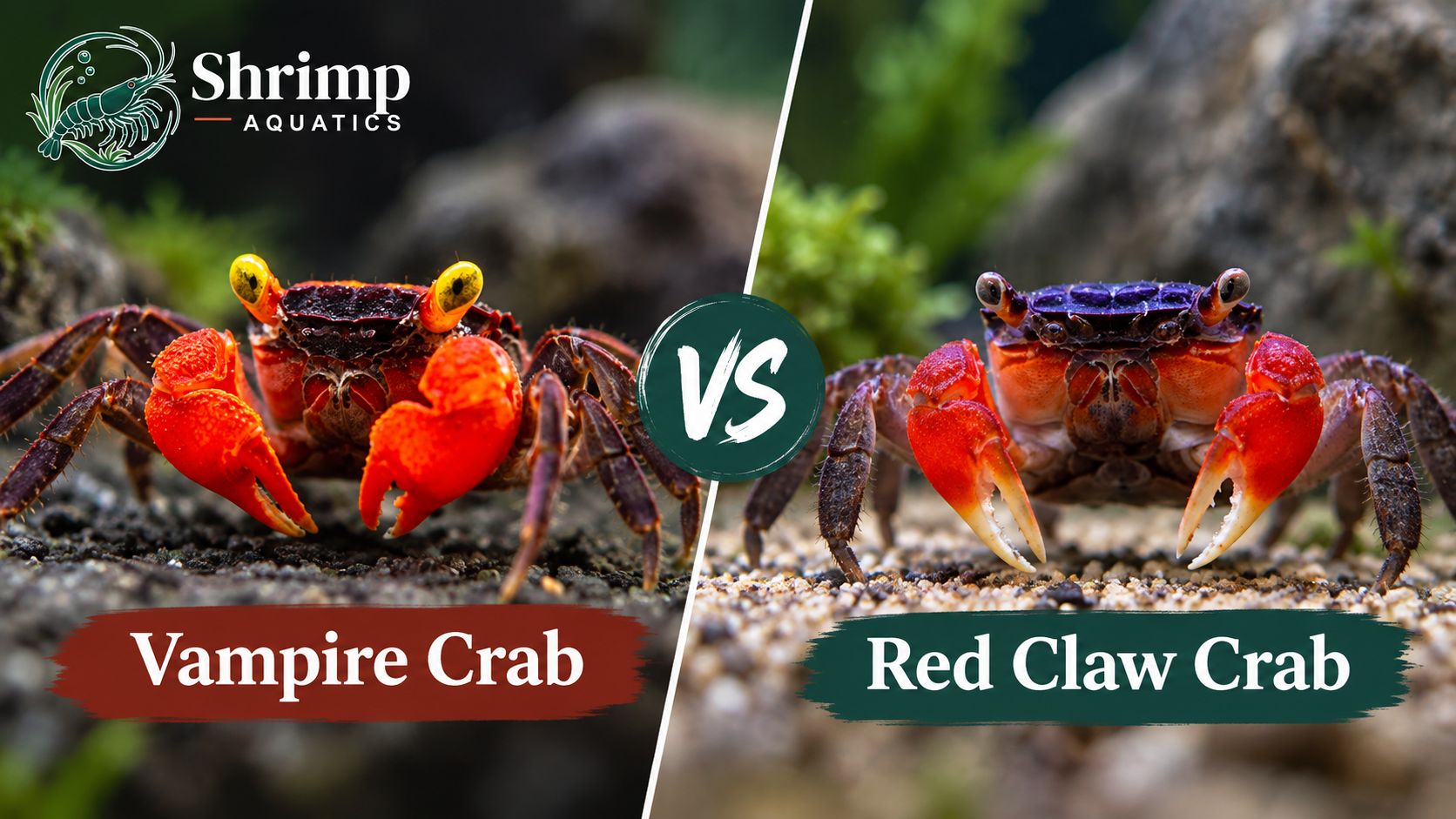
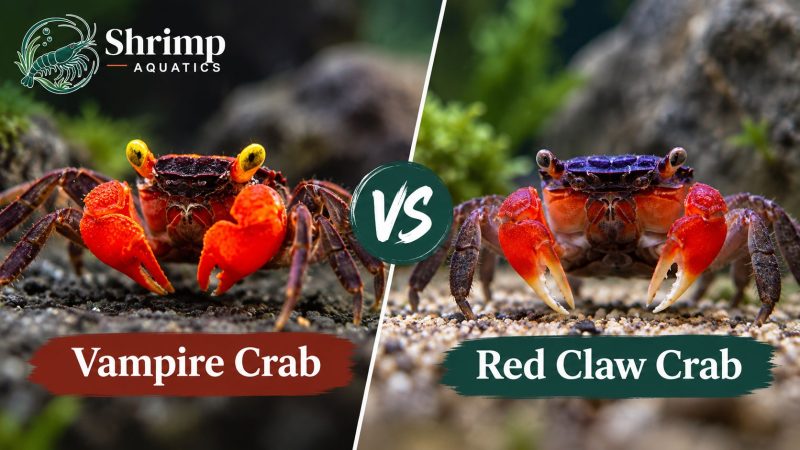
You’ve found vampire crabs and red claw crabs in the same shop, both sold as freshwater crabs. The clearest difference between them is the water: vampire crabs (Geosesarma) are freshwater crabs whose eggs, in most species, hatch straight into tiny crabs, while red claw crab larvae die in fresh water and need salty water to grow up. What adult red claws need is less settled. Either way, the two don’t belong in one tank, because they want different water, red claws grow bigger, and both fight.
| What you’re comparing | Vampire crab (Geosesarma) | Red claw crab |
|---|---|---|
| Water | Fresh water at every stage of life.1 | Young need salty water. What adults need long term isn’t settled. |
| How the young start out | Large eggs hatch as tiny crabs in most species.1 | Swimming larvae that die in fresh water within hours.2 |
| Adult size across the shell | About 10-15 mm (0.4-0.6 inch).3 | Up to 31.6 mm (about 1.2 inches), the biggest male in one study of wild crabs.4 |
| Temper | Fights within a group, often costing legs and claws. Can catch small fish. | Aggressive in the wild.5 Fights within a group, sometimes to the death. Can catch fish. |
| Land and water | Mostly land, plus a water section every crab can climb into and fully enter. | A strong climber.5 How much land it needs is not published. |
| Escapes | Needs a tight lid. | Climbs out through any gap and can dry out and die once it’s loose. Needs a tight lid. |
| Lifespan | About two years at most.6 | About one to five years after purchase in keepers’ tanks. |
| Shrimp Aquatics | We breed and sell them. | We don’t keep red claw crabs ourselves. |
What is the red claw crab sold in aquarium shops?
The red claw crab is a small crab of estuaries, mangroves and muddy shores, the places where river water meets the sea,4 and the name on the label covers more than one species. It’s traded under the name bidens. The accepted scientific name for that crab today is Parasesarma bidens, and the older names Perisesarma bidens and Sesarma bidens are no longer accepted.7
A 2023 study split what had been called bidens into six species: true P. bidens lives in Japan and South Korea, while the crabs from Hong Kong and Vietnam are P. continentale.4 The trade also sells a separate crab as moeschii, now listed as Manarma moeschii.8 So the label on the tub doesn’t tell you exactly which species you’re taking home.
Vampire crabs come from freshwater habitats across Southeast Asia and the western Pacific.1 Their trade names are just as loose, though: many colorful vampire crabs are sold under trade names with origins nobody can check.3 Read where vampire crabs come from before you trust a label on either crab.
Do red claw crabs need brackish water?
Red claw crab larvae do. In a lab study, larvae from one Japanese female died within 12 hours in fresh water without molting, and only grew into young crabs in water from brackish up to sea strength.2 The authors think the larvae drift in estuary or sea water and only move back into the mangroves at their last larval stage. So red claw young can’t grow up in a freshwater tank, while vampire crablets can.
What about the adults? That’s a different question. No study has tested how adult red claws cope with fresh water, and keepers disagree: some have kept them in plain fresh water with no trouble, while others lost theirs and blamed the missing salt. If you choose red claws, plan a tank that can run brackish, because that matches where they live in the wild and what their young need. Don’t count on a red claw doing well in a freshwater community tank just because the label said freshwater.
Vampire crabs need none of this. They live and breed in fresh water, and in most species the crablets hatch as tiny crabs from large eggs, with no larval stage that needs salt.1 The same split runs between vampire crabs and ghost crabs, since ghost crab young also grow up in salt water.
How big do vampire crabs and red claw crabs get?
Red claw crabs get noticeably bigger. Adult vampire crabs measure about 10-15 mm (0.4-0.6 inch) across the shell, and the type specimens of two species described from Java in 2024 measure 12.8 and 12.3 mm.3
For red claws, the biggest male in the 2023 study measured 31.6 mm (about 1.2 inches) across the shell.4 That’s the largest wild crab in one study, not a typical adult, so don’t plan your tank around it. Even the egg-carrying female in the larval study measured 19.3 mm,2 bigger than a large vampire crab.
Are red claw crabs more aggressive than vampire crabs?
Red claws are the bigger fighters, but vampire crabs fight too, so neither is a peaceful choice. Red claws kept together chase and grapple, sometimes locked together for up to an hour. Crabs lose claws and legs, and some are killed and eaten by their tank mates, most often a newcomer, a smaller crab or one that has just molted. Some groups stay calm, and a male with one or two females is the usual grouping. Field notes from Hong Kong, on crabs now placed in P. continentale, describe them as aggressive in the wild and say they tend to cannibalize in captivity.5
Red claws can also catch fish, mostly sick, weak, slow or bottom-resting ones. Plenty of keepers have kept them with fish without a loss, so a catch is possible, not certain.
Vampire crabs in a group often lose legs and claws in fights too, most often when a dominant male chases or attacks the others. They can catch small fish as well, guppies among them, though many tanks lose none. At Shrimp Aquatics, we keep Neocaridina shrimp in the water section of our vampire crab paludariums; they breed there, and the crabs rarely manage to catch them. We keep only small, peaceful fish with our crabs, because an aggressive fish can eat a crab or harass one that has come down to molt.
Planning shrimp or fish of your own? Choose vampire crab tank mates that stay small and peaceful and are happy at the same temperature as the crabs, and keep the water inside their own range.
Vampire crabs and red claw crabs both escape from open tanks
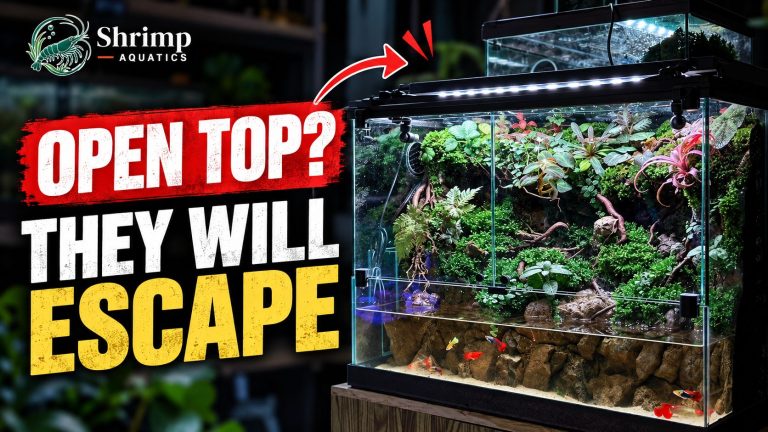
Both crabs climb out of any tank that isn’t closed tight, so a lid with no gaps comes first whichever one you pick. Red claws use the filter, heater, air line or plants to reach a gap, and in the wild they’re good climbers that cling to mangrove stems at high tide.5 Escaped red claws turn up inside the filter, in other rooms or behind furniture, and they’re found dried out and dead, in one case after only a day or two out of the tank. One keeper’s new filter pipes kept the lid from closing properly, and the crab used that small gap to climb out and couldn’t get back in. Cover every opening, including the one where the filter pipes go in.
Vampire crabs need the same tight lid, and for them it does a second job: it holds in the humidity they need on land. That land is where the two setups part ways. Vampire crabs belong to a genus of semi-terrestrial and land crabs,1 so their tank is mostly land, with a water section every crab can climb into and fully enter. Fresh water isn’t the same as a full tank of it, and the honest answer to can vampire crabs live in water full time is no. A vampire crab tank setup starts from that split between damp land and reachable water.
How long do red claw crabs and vampire crabs live?
Red claw crabs can outlive vampire crabs. Red claws that settle in have lived about one to five years in keepers’ tanks, counted from the day they were bought, though many are lost in the first weeks or months after purchase.
Vampire crabs are short-lived, about two years at most. A review of crab and shrimp lifespans lists two years as the longest for three vampire crab species, taken from species profiles written by experienced crab specialists, not from crabs aged in a study.6 If a long-lived pet matters to you, a settled red claw has the edge.
Can vampire crabs and red claw crabs live together?
No. Keep vampire crabs and red claw crabs in separate tanks, for three reasons that add up:
- Water. Vampire crabs live and breed in fresh water. A red claw tank that runs brackish for its crab is no longer the tank vampire crabs need.
- Size. A grown red claw is bigger than a vampire crab, and among themselves red claws most often turn on the smaller crab or the one that has just molted.
- Temper. Both crabs fight their own kind and both hunt. Put the two in one tank, and you add a second set of fights to the ones each already has.
The riskiest moment is a molt. Vampire crabs molt in the water, and red claws are known to turn on crabs that have just molted. One keeper found small groups of red claws got along fine, until one of them molted.
Should you choose a vampire crab or a red claw crab?
Choose vampire crabs if you want a freshwater paludarium, and a red claw crab only if you’re ready to run brackish water for a bigger, bolder crab. Neither is a beginner’s toy, since both need a sealed lid and both fight, but the vampire crab asks you for fewer compromises.
Vampire crabs suit a first freshwater paludarium
- You want fresh water throughout, with no salt to mix or measure.
- You have room for mostly land and a water section every crab can climb into and fully enter.
- You’d like small shrimp or small, peaceful fish in the water section.
- A crab about 10-15 mm across fits the space you have.
A red claw crab suits a brackish setup and a bigger crab
- You’re ready to run the tank brackish and keep it that way.
- You want a bigger crab and accept that it can live several years.
- You’ll keep one male with one or two females, not a crowd.
- You won’t add slow or bottom-resting fish, and you’ll seal every gap.
If vampire crabs win, the everyday side of vampire crab care comes down to damp land, reachable water, a steady temperature and that lid.
Ordering tank-bred vampire crabs
When you order tank-bred vampire crabs, you choose Male or Female for each crab on the product page, so you can plan your group before the box arrives. Everything in our catalog is bred or propagated in our own tanks rather than collected from the wild. Our lines include the Tomato Vampire Crab, Geosesarma sp. “Tomato”. Set up the land and water and let it settle before you order, so the crabs go into a tank that’s ready for them.
References
8 Sources
- Shy and Ng, Geosesarma mirum, a new species of semi-terrestrial sesarmid crab (Crustacea, Decapoda, Brachyura) from central Taiwan, ZooKeys 858: 1-10, 2019.
- Islam, Shokita and Nagai, Effects of salinity on the larval development of the mangrove dwelling semiterrestrial sesarmine crab, Perisesarma bidens (De Haan), Crustacean Research 29: 152-159, 2000.
- Ng and Wowor, Two new species of vampire crabs (Crustacea: Decapoda: Brachyura: Sesarmidae: Geosesarma De Man, 1892) from Java, Indonesia, Raffles Bulletin of Zoology 72: 469-478, 2024.
- Shih, Hsu and Li, Multigene phylogenies of the estuarine sesarmid Parasesarma bidens species complex (Decapoda: Brachyura: Sesarmidae), with description of three new species, Zoological Studies 62: e34, 2023.
- Poon, Diversity at a glance: Perisesarma bidens, Porcupine! 27, Ecology Department, University of Hong Kong, 2000.
- Vogt, A compilation of longevity data in decapod crustaceans, Nauplius 27: e2019011, 2019.
- Parasesarma bidens (De Haan, 1835), World Register of Marine Species (DecaNet), accessed 2026-10-03.
- Manarma moeschii (De Man, 1892), World Register of Marine Species (DecaNet), accessed 2026-10-03.
Ready to get started?
Shop our Vampire Crab collection
8 products available · Live Arrival Guarantee