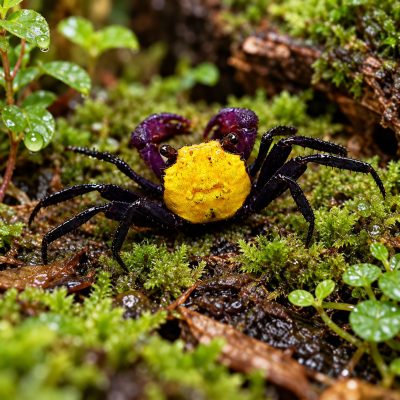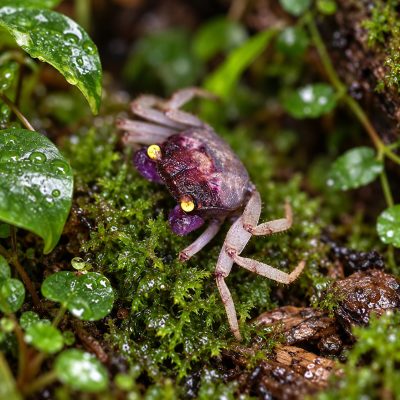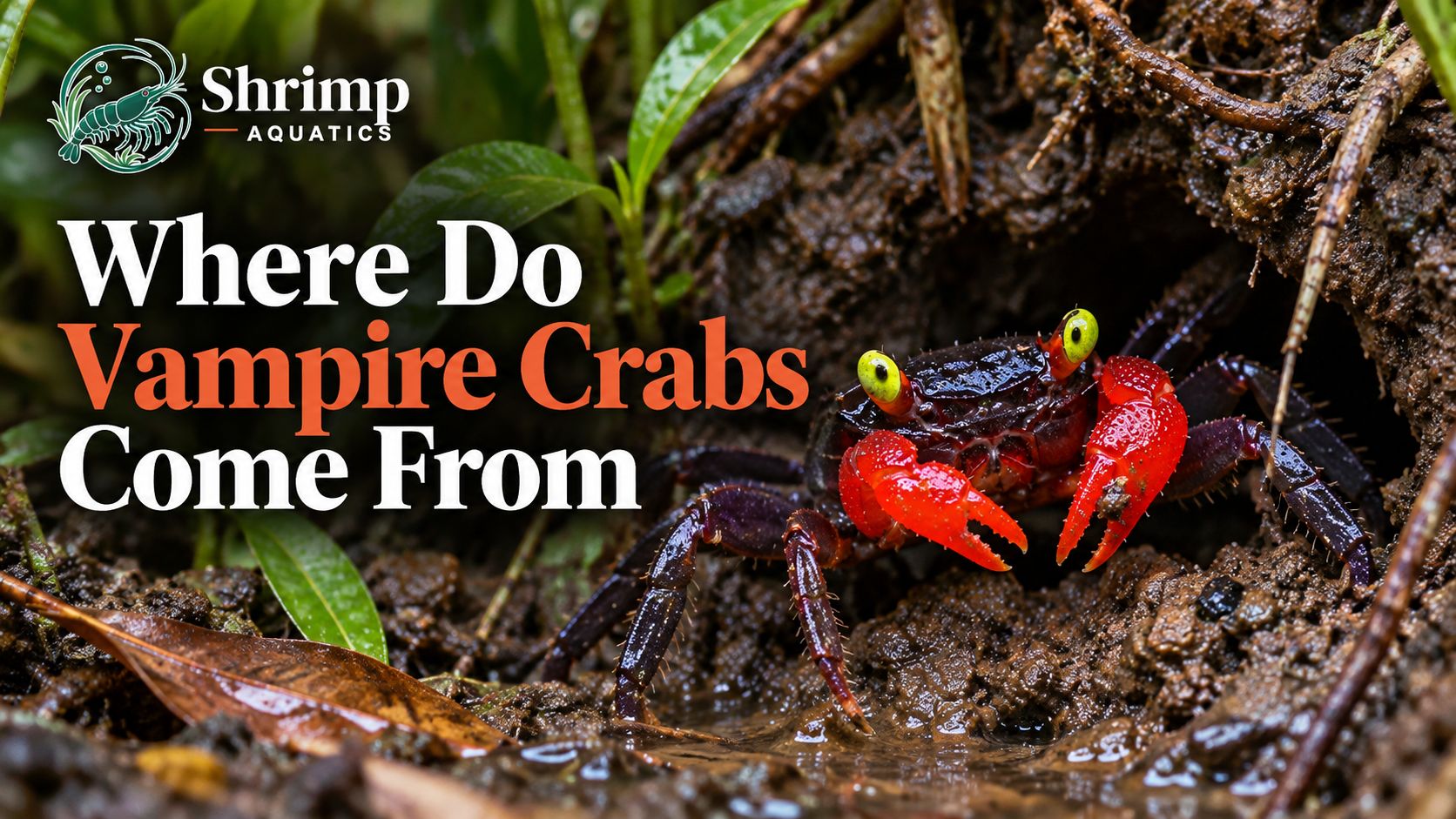
One listing says your vampire crab came from Sulawesi, another says Java, and a third names the Riau Islands. Vampire crabs come from Southeast Asia and the islands around it: their genus, Geosesarma, is known from the Andaman Islands through Southeast and East Asia to Papua New Guinea and the Solomon Islands.1 Two of the longest-traded vampire crabs turned out to be native to central Java, Indonesia, when scientists finally described them in 2015.2 None is listed as endangered, because the IUCN hasn’t assessed any Geosesarma species, and the scientists who study them warn about collecting for the pet trade.3
Where do vampire crabs live in the wild?
In the wild, the best-known vampire crabs live on land along hill streams. They hide under rocks and dense plants and dig burrows near the water’s edge.2 Young crabs there stay closer to the water than the adults do.2
Not every species lives like that. On Borneo, most vampire crabs live in lowland forest or in limestone caves, and three are known from mountain forest.4 The newest of those, Geosesarma penrissen, was described in 2026. It lives in steep, mossy, cool forest at 850-1,200 m in Sarawak, among leaf litter near intermittent streams.4 Wherever they live, vampire crabs are inland freshwater crabs, and most species never need to go back to the sea to breed.5
Can vampire crabs live in water full time? No, and they can’t do without it either. Good vampire crab care copies that stream bank. Give your crabs damp land with rocks and plants to hide under, soft ground to dig in, and fresh water they can walk into and out of.
How did scientists trace pet-trade vampire crabs to central Java?
Scientists traced two vampire crabs that had been sold for many years to hill streams in central Java, and described them as new species in 2015.2 Before that, dealers had given their origin as Sulawesi, Java, Krakatau or the Riau Islands, which covers a fair stretch of map. The paper named them Geosesarma dennerle and G. hagen and showed that both are native to central Java.2
It wasn’t a one-off. Many colorful vampire crabs found by local collectors have entered the trade with exotic names and stated origins. Few of those origins can be backed up, and claimed localities are often false.3 Two Javan species described in 2024 had already been sold in large numbers for several years before anyone pinned down where they came from. The same authors estimate that dozens of other Indonesian species in the trade are still undescribed.3
So what does a colorful trade name on a listing tell you? Mostly how the crab looks. Treat a trade name as a sales name, never as a species, and treat a locality on a listing as a claim you can’t check.
How many vampire crab species are there?
Scientists have described 73 species of vampire crab, by the count published in 2026.4 The number keeps climbing: a 2021 paper counted 67,1 and one from early 2025 counted 72.5 Expect it to rise again, since many crabs already in the trade are still waiting for a scientific name.3
| Region | Described species | Count as of |
|---|---|---|
| Java | 14, all found only on Java3 | 2024 |
| Borneo | 144 | 2022, before the newest Bornean species was described in 2026 |
| Peninsular Malaysia and Singapore | 125 | Early 2025, before that year’s new species |
| Philippines | 7, after two species from Palawan were added6 | 2016 |
Each regional count comes from a different paper and year, so don’t add them together. The 2026 figure of 73 is the total to use.
Are vampire crabs endangered?
No, vampire crabs aren’t listed as endangered, because the IUCN hasn’t assessed any Geosesarma species.3 In October 2026, the GBIF biodiversity database marked all 71 vampire crab species it could match as Not Evaluated on the IUCN Red List. Six recently described species weren’t in GBIF yet.7
Seen a vampire crab labeled Endangered or Data Deficient? That label didn’t come from an IUCN assessment, because there isn’t one. No vampire crab is on a CITES appendix either. In October 2026, the CITES species database listed no decapod crustacean at all.8 A 2026 survey of the online land crab trade also found none of the species it recorded on a CITES appendix.9
None of this means wild vampire crabs are doing fine. An unassessed species has no verdict either way. In Java, where several species live close together, the 2024 authors expect small ranges and small broods to leave populations exposed to collecting. They say an assessment is needed soon.3 Collectors in Java told the 2015 authors that both species described that year had been getting scarcer over the years. On that account, the authors judged continued collection unsustainable.2
Are vampire crabs wild caught or tank bred?
Both are sold, so if a listing doesn’t say the crabs were bred in a tank, ask the seller before you buy. Several species are still collected in large numbers for the global aquarium trade.2
How big is that trade online? One survey ran for four months and logged 574 online land crab adverts from 15 sellers. Vampire crabs had 210 of those listings, more than any other genus.9 Many gave no species name at all, and Geosesarma dennerle alone accounted for 65.9
The scientists behind both studies point to breeding as part of the answer. The 2015 authors expect a conservation plan, “probably including a captive breeding program”, to be needed if the crabs stay popular.2 The survey authors call for better data to guide captive breeding that eases pressure on wild stocks.9 If you hope to raise crablets yourself, vampire crab breeding at home is possible but never guaranteed, whoever you buy from.
Choosing tank-bred vampire crabs by line and sex
Pick a line from our tank-bred vampire crabs, then choose Male or Female for each crab on its product page. Everything in our catalog is bred or propagated in our own tanks rather than collected from the wild. That includes our vampire crab lines, such as the Tomato Vampire Crab, Geosesarma sp. “Tomato”, and the White-handed Vampire Crab, a Geosesarma species.
The wild sites on this page belong to species that scientists have studied in the field. They don’t tell you where any line on sale, from any seller, first came from.
References
9 Sources
- Ng, Geosesarma sodalis, a new species of vampire crab (Crustacea, Brachyura, Sesarmidae) from a limestone cave in central Sarawak, Malaysia, ZooKeys 1031, 2021.
- Ng, Schubart and Lukhaup, New species of “vampire crabs” (Geosesarma De Man, 1892) from central Java, Indonesia (archived copy on Zenodo), Raffles Bulletin of Zoology 63, 2015.
- Ng and Wowor, Two new species of vampire crabs (Crustacea: Decapoda: Brachyura: Sesarmidae: Geosesarma De Man, 1892) from Java, Indonesia, Raffles Bulletin of Zoology 72, 2024.
- Grinang, Ng and Ng, A new species of vampire crab of the genus Geosesarma De Man, 1892 (Crustacea: Brachyura: Sesarmidae) from a montane forest in southwestern Sarawak, Malaysian Borneo, Raffles Bulletin of Zoology 74, 2026.
- Ng, Khadijah-Ahmad and Ahmad, On a new species of vampire crab from the Geosesarma foxi species-group (Crustacea: Brachyura: Sesarmidae) in northern Peninsular Malaysia, Raffles Bulletin of Zoology 73, 2025.
- Manuel-Santos, Ng and Freitag, Two new species of Geosesarma De Man, 1892 (Crustacea: Brachyura: Sesarmidae) from Palawan, the Philippines (archived copy on Zenodo), Raffles Bulletin of Zoology 64, 2016.
- GBIF species API, IUCN Red List category for Geosesarma species (example record shown: Geosesarma dennerle), checked October 3, 2026, Global Biodiversity Information Facility, 2026.
- Species+ taxon search, CITES taxonomy, checked October 3, 2026, UNEP World Conservation Monitoring Centre and CITES Secretariat, 2026.
- Whitaker, Roberts, Spicer and Turner, A systematic survey of brachyuran land crabs in the online tropical aquarium trade, Oryx, 2026.
Ready to get started?
Shop our Vampire Crab collection
8 products available · Live Arrival Guarantee