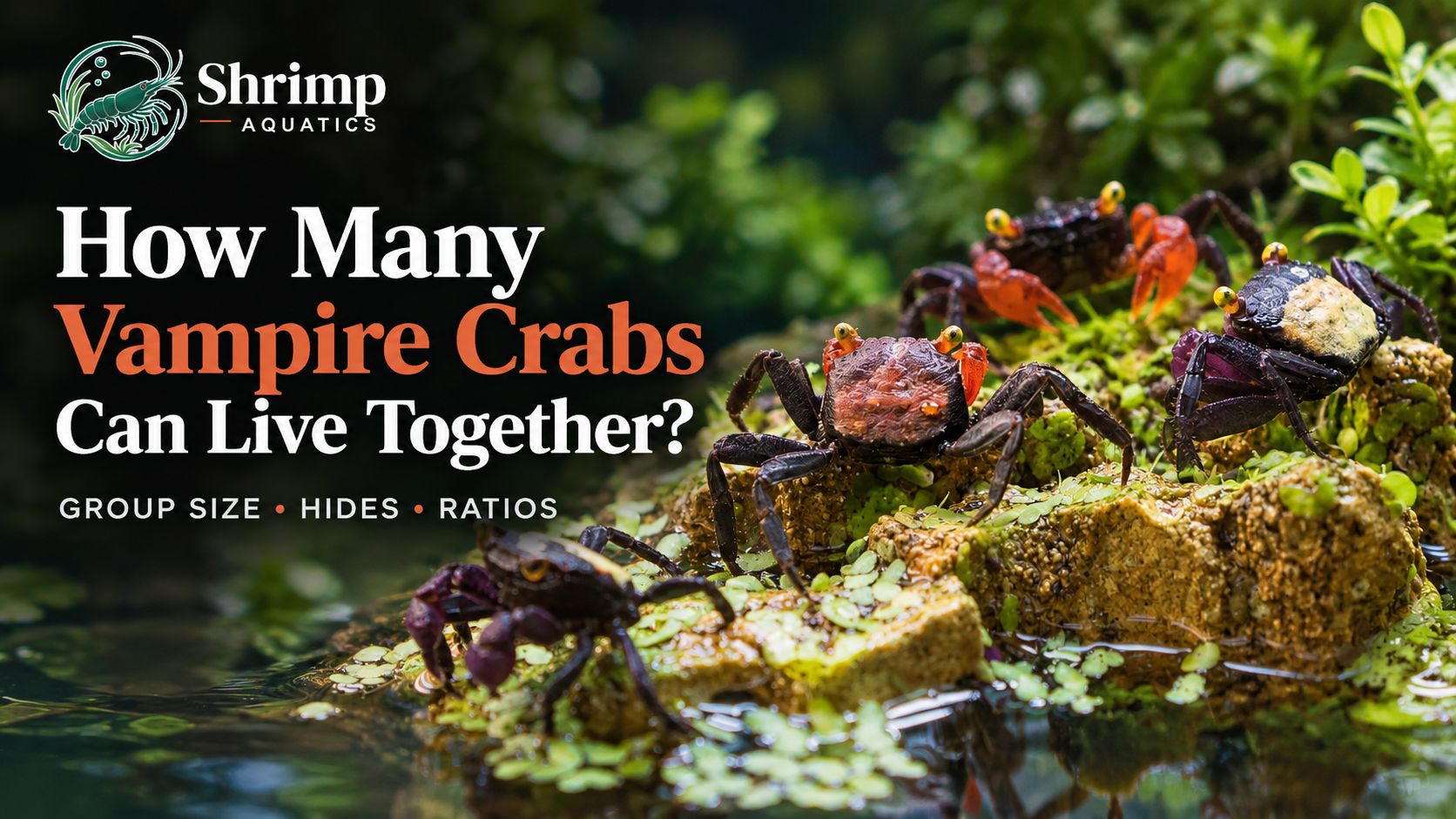
Your paludarium is built, the moss is damp, and the last thing left to settle is how many crabs go in. Vampire crabs live together in groups, and the number that fits your tank comes from its land area and hides, not its gallons. Give every crab a hide of its own with spares left over, start with a small group that has more females than males, and keep the adults apart from crablets, because adults eat the crablets they find.
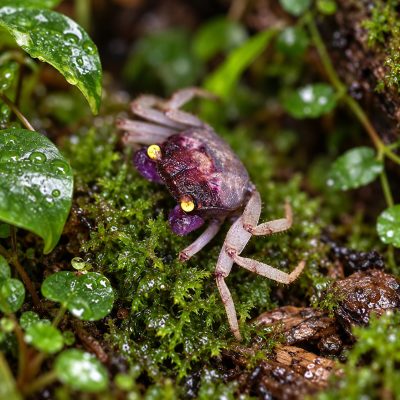
In the wild, at least one species lives packed close together. Geosesarma mirum, from Taiwan, digs burrows under stones at the edge of small streams and sometimes reaches more than 50 crabs per square meter there.1 A stream bank isn’t a tank, though, so take that as a sign they tolerate company, not as a stocking density for yours.
How to size a vampire crab group to your land area and hides
Count the hides on the land section first, then add crabs only while every crab has a hide of its own and some stay empty. Vampire crabs belong to Geosesarma, a genus of semi-terrestrial and land-living crabs,1 so the floor they can walk on and hide under matters more than how much water the tank holds. A tank that’s mostly water holds fewer crabs than its gallons suggest.
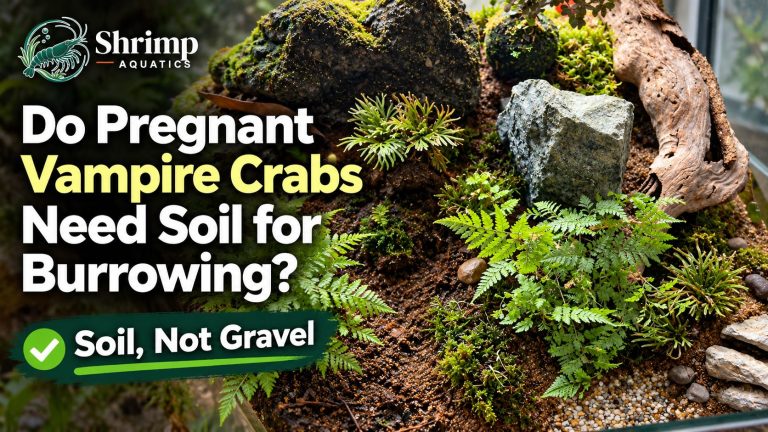
So how many fit in a 10-gallon tank? As many as have a hide of their own on the land you’ve built, with spares left over. That depends on how much of the floor is land, so build the land section and the hides first, then count. Counting crabs before hides is a bit like sending out party invitations before you’ve counted the chairs.
The check is simple: every crab can be out of sight at the same moment, and there are still empty hides. If you often see one crab pushing another out from under cover, add hides before you add crabs. Start small, watch the group for a few weeks, and let it grow only while the hides stay ahead.
One keeper with a communal group reports that around 9 to 10 adults fit in a 60 x 30 x 30 cm tank, about 14 gallons. That’s one well-furnished tank, so use it for a sense of scale and then count your own hides.
How many male and female vampire crabs should you start with?
Start with more females than males. It’s a safe default for a new group, and it leaves you room to adjust the mix once you’ve watched the crabs together for a while.
That watching matters. One keeper’s group had a male that kept attacking the females. One female lost a claw and a leg in a fight with a male, and later another female lost a leg to the same male. If one crab keeps going after the others like that, the room you left in the mix is what lets you change it. If a male keeps at it, separate the aggressive male vampire crab into a tank of his own.
To plan the mix, learn to tell vampire crab males from females by the flap underneath before you count heads. If the crabs you already have keep chasing one another out of cover, more hides and more land usually come before more crabs.
Can a vampire crab live alone?
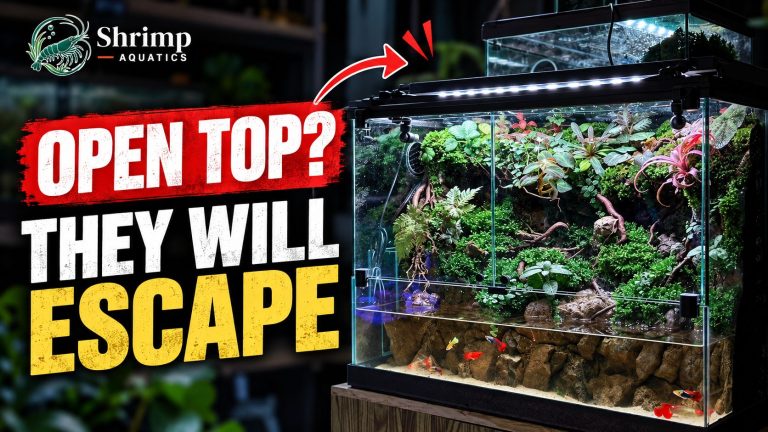
If you keep one vampire crab, give it the same vampire crab tank setup a group gets: a land section with hides, a water section it can climb into and fully enter, and a lid that closes tight. Does it do better or worse on its own? Nobody knows, because no study or keeper record has compared a lone vampire crab with crabs kept communally.
What a single crab can’t show you is how vampire crabs behave with each other. If you want to watch that, or you’d like the chance of crablets one day, start a small group with both sexes instead.
Keep adult vampire crabs apart from crablets
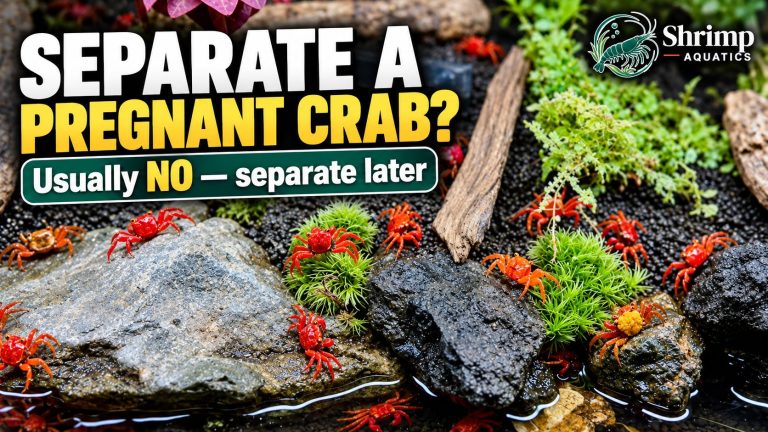
Adult vampire crabs eat crablets they find, so crablets are moved out of the adult tank to grow up. Count only the adults when you plan the group, since the crablets go into a container of their own. Don’t shrink the tank hoping for more young, either, because vampire crabs don’t breed more in a smaller tank.
Found tiny crabs under the moss? They need that container now. Raising them is part of vampire crab breeding, and it’s much easier when the container is ready before the first crablets turn up.
Is a hiding vampire crab molting or stressed by crowding?
Leave it alone: a vampire crab that has gone into the water and stays out of sight may be molting. Vampire crabs usually molt in the water, so a crab that’s missing from the land for a while isn’t by itself a sign the tank is too full.
Crowding shows up in the hides, not in one quiet crab. Go back to the count from the sizing section: if every crab can still be out of sight at once with hides to spare, the group fits. Don’t lift the hides to find a missing crab, and don’t pull it out of the water.
Check the enclosure first when vampire crabs die one after another
When crabs die one after another, check the enclosure before you blame crowding. Start with the lid. Then check humidity, which has to stay high all the time, and temperature, which belongs at about 78°F (26°C) within 72-85°F (22-29°C). Last, make sure every crab can reach the water and climb out again. Put the lid, humidity, temperature and water access right, the basics of vampire crab care, before you take any crabs out of the group. If a crab is still, foaming at the mouth or missing legs, go through why vampire crabs are dying sign by sign.
Should you mix vampire crab colors, lines or species in one tank?
Keep each line in its own tank, especially if you want to breed a line you can name. Trade names don’t tell you much in this genus: in a survey of 574 online land crab listings, 210 were for Geosesarma, and many of those gave no species name, so they could have been any species in the genus.2
Two crabs sold under different color names may be different species, and nothing on the label settles it. A tank per line keeps that question out of your group, and you’ll always know which crab came from which line.
Adding shrimp or fish to a vampire crab group
Neocaridina shrimp are the first choice for the water section, and small, peaceful fish and small snails can share it too. Count only the crabs when you size the group, then check the ranked list of vampire crab tank mates for each option and the temperatures that fit.
Buying vampire crabs for the group you’ve planned
Count your hides first, then order enough crabs to fill them with spares left over. You choose male or female for each crab on the product page for our tank-bred vampire crabs, so you can start the group with more females than males. Everything in our catalog is bred or propagated in our own tanks rather than collected from the wild.
Our vampire crab lines, such as the Tomato Vampire Crab (Geosesarma sp. “Tomato”) and the White-handed Vampire Crab, a Geosesarma species, are each sold as their own line, so you can keep one line to a tank. A group with both sexes has the chance to breed; it doesn’t promise crablets or a number of young. When the crabs arrive, follow the instructions supplied with your order.
References
2 Sources
- Shy and Ng, Geosesarma mirum, a new species of semi-terrestrial sesarmid crab (Crustacea, Decapoda, Brachyura) from central Taiwan, ZooKeys 858, 2019.
- A systematic survey of brachyuran land crabs in the online tropical aquarium trade, Oryx, Cambridge University Press, 2026.
Ready to get started?
Shop our Vampire Crab collection
8 products available · Live Arrival Guarantee