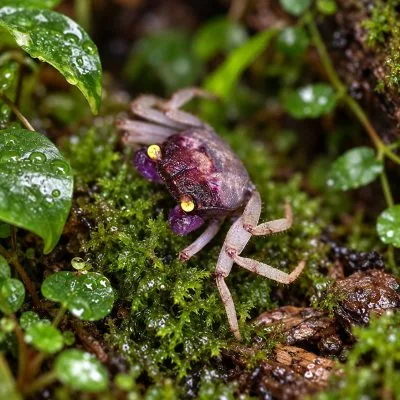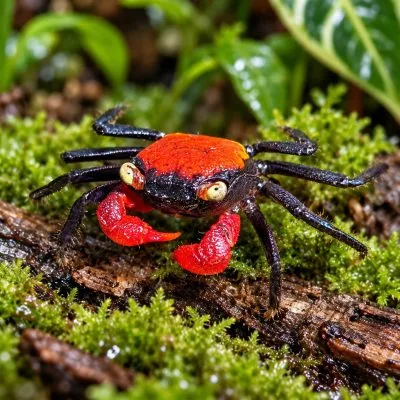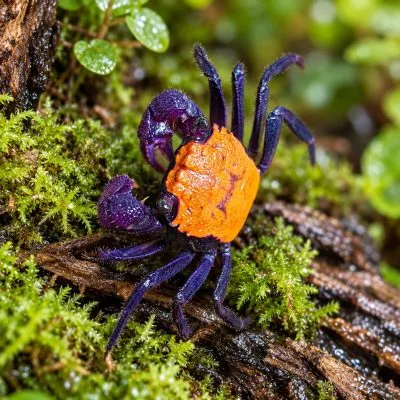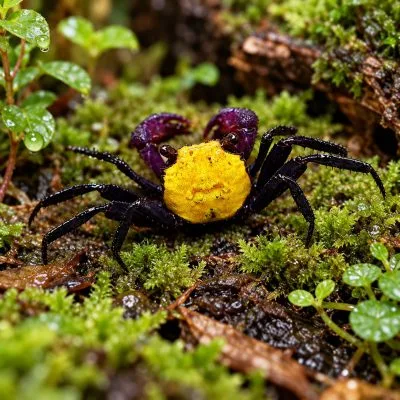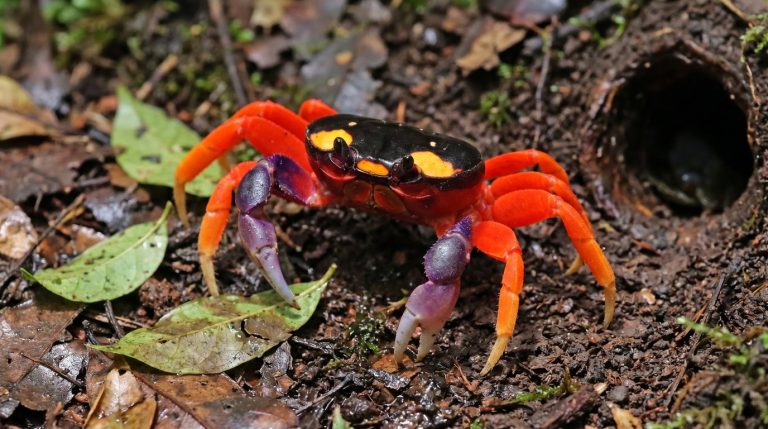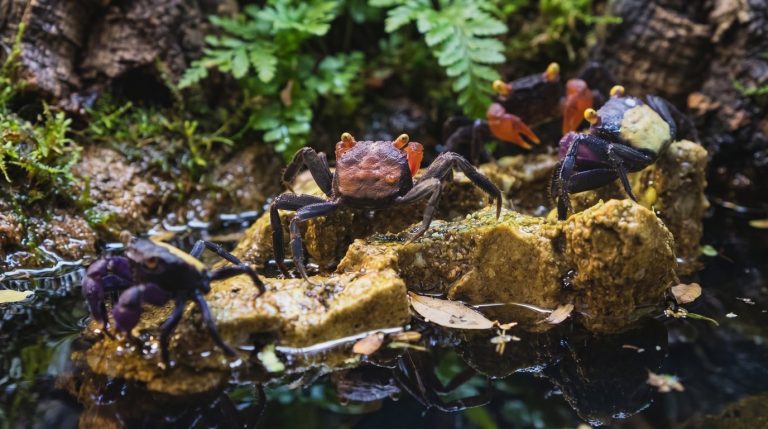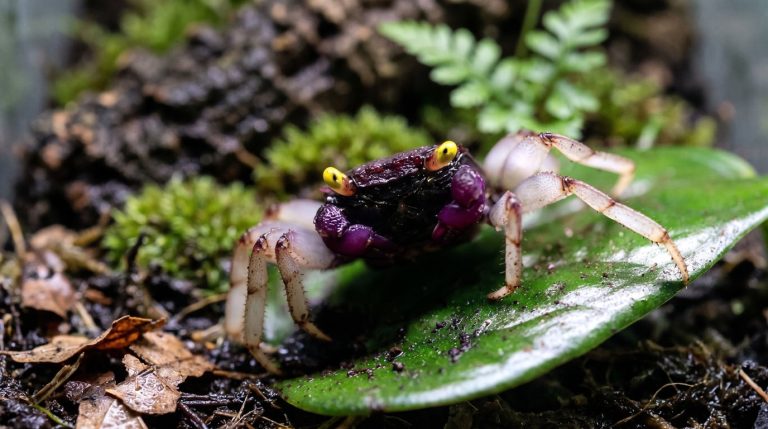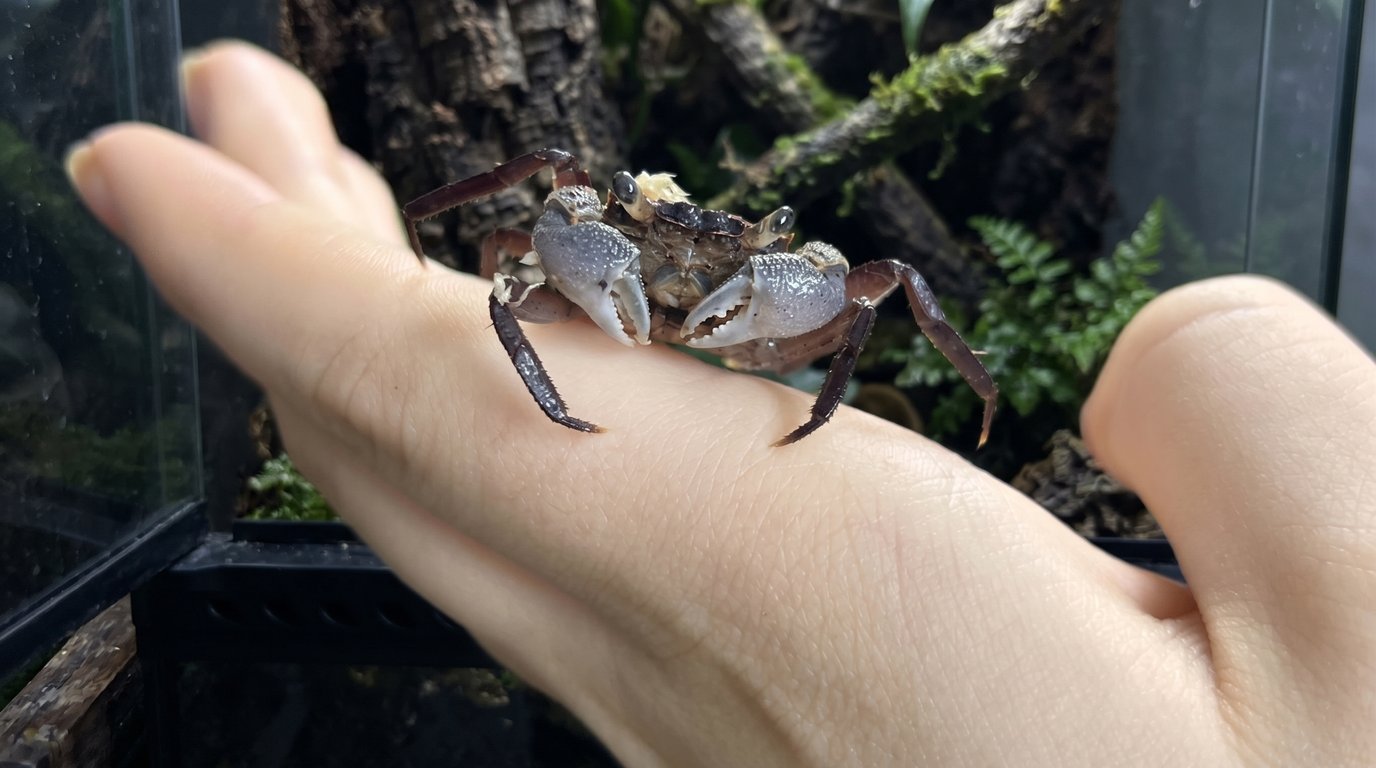
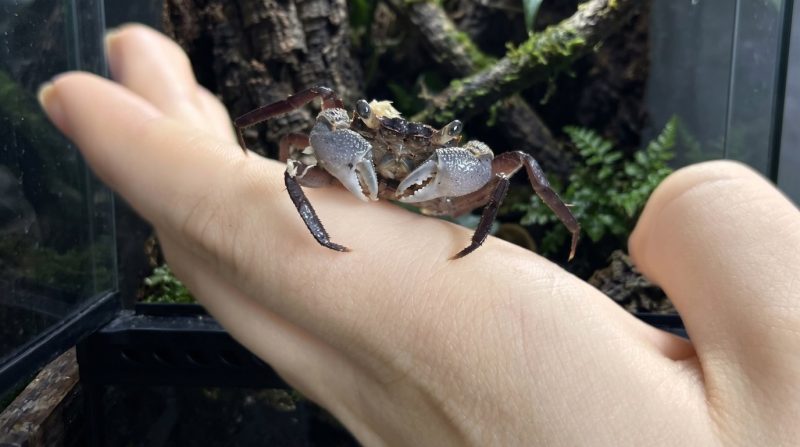
Yes, you can hold a vampire crab, and it’s no danger to you: it has no venom, and its claws are tiny. The risk runs the other way: a vampire crab is small, fast and easy to drop, and a fall or a tight grip can cost it a leg or its life. Pick one up only when you need to move it, keep your hand low over the tank and keep it brief.
Will a vampire crab pinch or bite you?
It can pinch, but it’s no danger to you. A crab grabs with its claws, so a bite from a vampire crab means a pinch, and those claws are tiny. Adults are small: in the two hobby species described in 2015, the shell measured about 11-14.5 mm across, under 0.6 inch.1 The claws on a crab that size are a fraction of that, so the safety side of vampire crab care is about protecting the crab, not you.
A large male can still make itself felt. One keeper says their male shot out of its burrow when they opened the lid and grabbed their hand hard enough to hurt.
There’s no poison to worry about either. The name sounds alarming, but a vampire crab isn’t venomous, and touching one is harmless.
Why holding a vampire crab is risky for the crab
A vampire crab won’t stay put on a hand, and that’s where the risk starts. Young crabs run over the palm, some adults climb on when there’s food, and a startled one runs off into the nearest gap. It can leap, too, and a crab that gets away from you can fall.
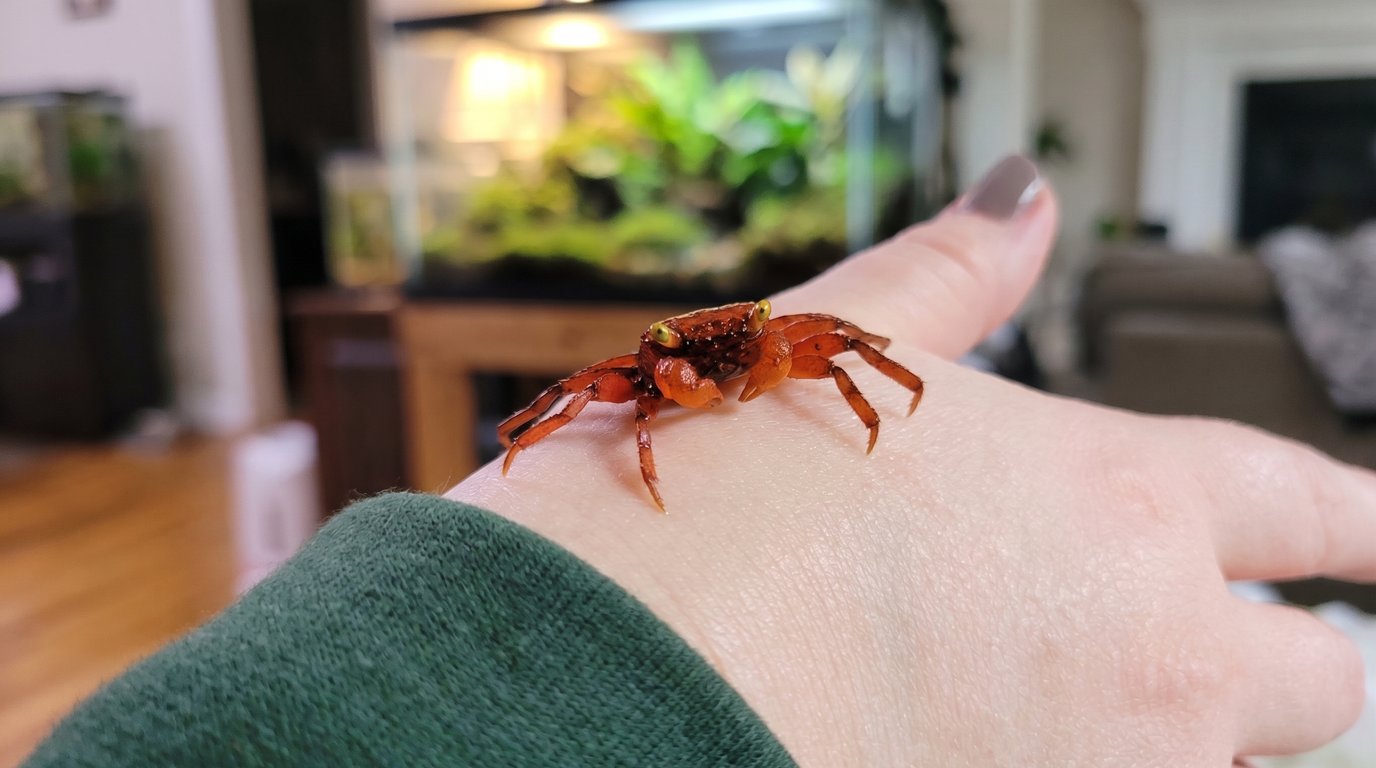
Keepers see their vampire crabs make short, fast leaps when they’re startled, when a hand reaches in for them and when they’re let out of a shipping box. One leap was measured at about 8 cm, a little over 3 inches. A crab that leaps from a hand at chest height has a long way to fall. If it lands on the floor, it can be under the furniture before you see where it went.
A fall can hurt a crab in ways you won’t see at once. No one has dropped vampire crabs to find out, but a fisheries study of snow crabs shows the pattern. Crabs were dropped 2 feet onto a boat deck, kept out of water for 5 minutes, then kept on the sea floor for three to four weeks. By the end, about 1 in 10 had died, against none of the crabs that weren’t dropped. After a 6-foot drop more than a third died, and crabs shed legs at every height tested.2 A snow crab is many times heavier than a vampire crab, so those numbers don’t carry over, but the two kinds of harm do: legs lost on impact, and deaths that come days later.
A squeeze is the other danger. A review of welfare in crabs, lobsters and other decapods warns that careless handling injures them. Cracked shells and lost limbs are among the accidental injuries it lists, and body fluid can leak from a crack and kill the animal. It also says handling stresses these animals, so it should be done with care and kept to a minimum.3 With a shell about half an inch across, a vampire crab has no room to spare between your fingers.
Then there are the legs. Crabs can shed a leg at a fixed breaking point near the body when they’re attacked or injured. The new leg only appears at a later molt and reaches full size over two or three molts.4 Whether vampire crabs regrow legs and claws depends on how often they still molt, so a crab that drops a leg in your fingers carries the gap at least until its next molt.
How to pick up a vampire crab when you need to
Pick one up only when it has to move, for a tank clean-out, a move to a new tank or to check a crab more closely. Keep your hand low over the land section, so a leap or a slip ends on soft, damp ground, and put the crab down within a few seconds.
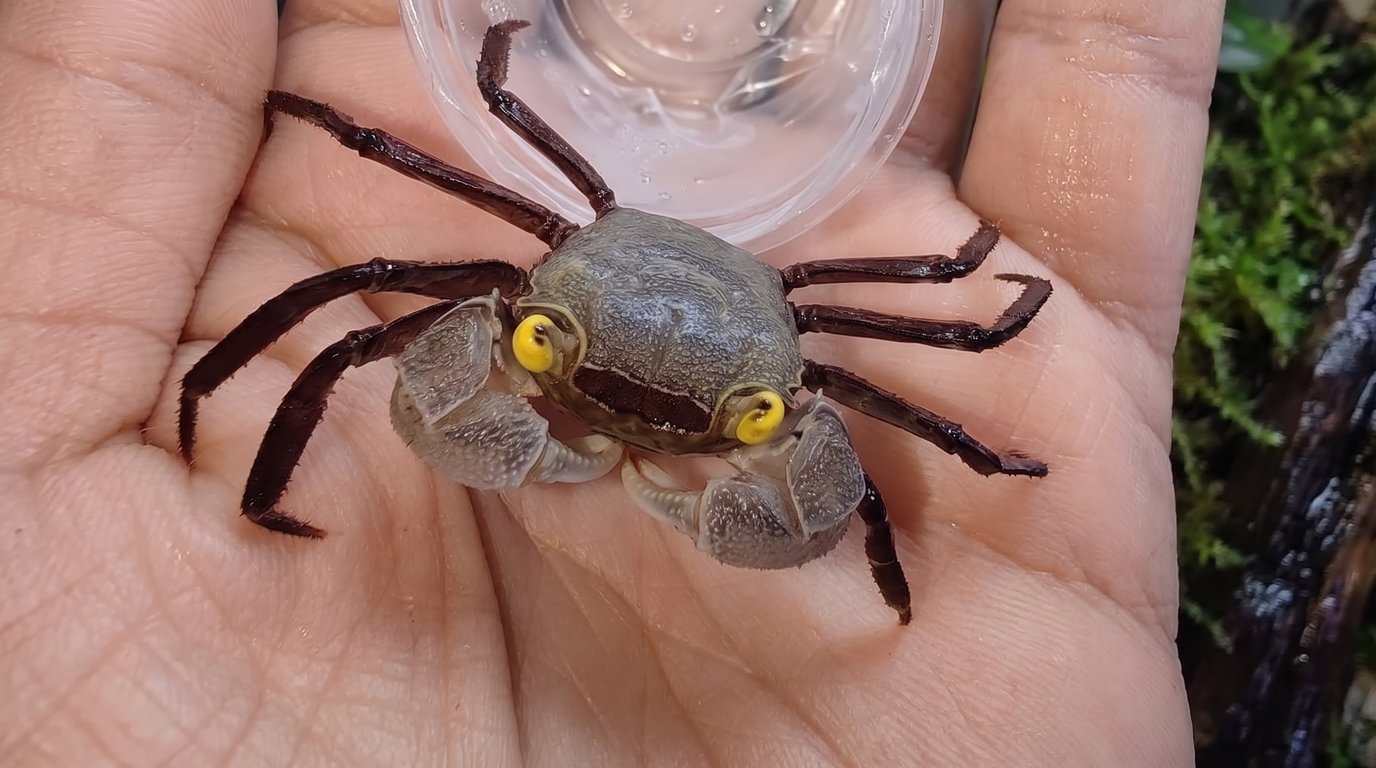
At Shrimp Aquatics, picking up and holding our vampire crabs by hand is routine. When we pack a crab or move it to another tank, we pick it up with our fingers and set it in its box or cup. When we reach in for one, our crabs usually run for a burrow, under the wood or into the water. We’ve never seen one of them jump, and the claws on our vampire crabs are too small to pinch a person’s hand.
If you’re new to it, a cup is the gentler way, because nothing ever closes on the crab:
- Wait until the crab is out on open ground. Don’t dig it out of a burrow or pull it from a hiding place.
- Set a small cup or deli container on its side in front of the crab and nudge the crab in from behind with a second cup or a fingertip.
- Cover the opening with your hand or a lid, and carry the cup level.
- Set the cup down on the land section of the new tank and let the crab walk out on its own. It’s the same way you’d acclimate vampire crabs that arrive in a box.
Using your fingers works too, if you’re gentle. Let the crab walk onto a flat, open palm, or close a loosely cupped hand over it from above, so your hand holds the crab without gripping it. Never grab a crab by a leg or a claw, and never pinch its shell between finger and thumb. Keep your hand over the tank the whole time, and put the crab down on the land, not in the water.
Wash your hands when you’re done, and close the lid as soon as the crab is down, because vampire crabs will escape from an open-top enclosure.
What to do instead of holding your vampire crab
Watch them, ideally in the evening. Vampire crabs are a pet to look at, and most of them stay hidden by day and come out in the evening, at night and in the early morning. Vampire crabs are nocturnal for the most part, though some keepers see a few crabs by day too.
Feed at dusk and sit with the tank for a while. Vampire crabs mostly eat in the evening and at night, so food set out then gives you the best chance of seeing them come out to it. Be patient with new crabs, too: bought crabs often stay hidden for weeks before they settle.
Where your crabs come from matters as well. Crabs born and raised in a keeper’s own tank are much less shy than bought adults, which are often wild-caught. Everything in our catalog is bred or propagated in our own tanks rather than collected from the wild. Pick the line you’d like to watch from our tank-bred vampire crabs, and choose male or female on each product page.
References
4 Sources
- Ng, Schubart and Lukhaup, New species of “vampire crabs” (Geosesarma De Man, 1892) from central Java, Indonesia, and the identity of Sesarma (Geosesarma) nodulifera De Man, 1892 (Zenodo archive copy of the paper), Raffles Bulletin of Zoology 63: 3-13, 2015.
- Grant, Mortality of snow crab discarded in Newfoundland and Labrador’s trap fishery: at-sea experiments on the effect of drop height and air exposure duration, Canadian Technical Report of Fisheries and Aquatic Sciences 2481, Fisheries and Oceans Canada, 2003.
- Browning, Burn, Schnell, Crump and Birch, Animal welfare risks from commercial practices involving cephalopod molluscs and decapod crustaceans, Animal Welfare 34, Cambridge University Press for UFAW, 2025.
- Neto de Carvalho and others, Evidence of cheliped autotomy and regeneration in the Lower Miocene crab Achelous monspeliensis from Portugal, Ecology and Evolution 16(7): e73799, 2026.
Ready to get started?
Shop our Vampire Crab collection
8 products available · Live Arrival Guarantee