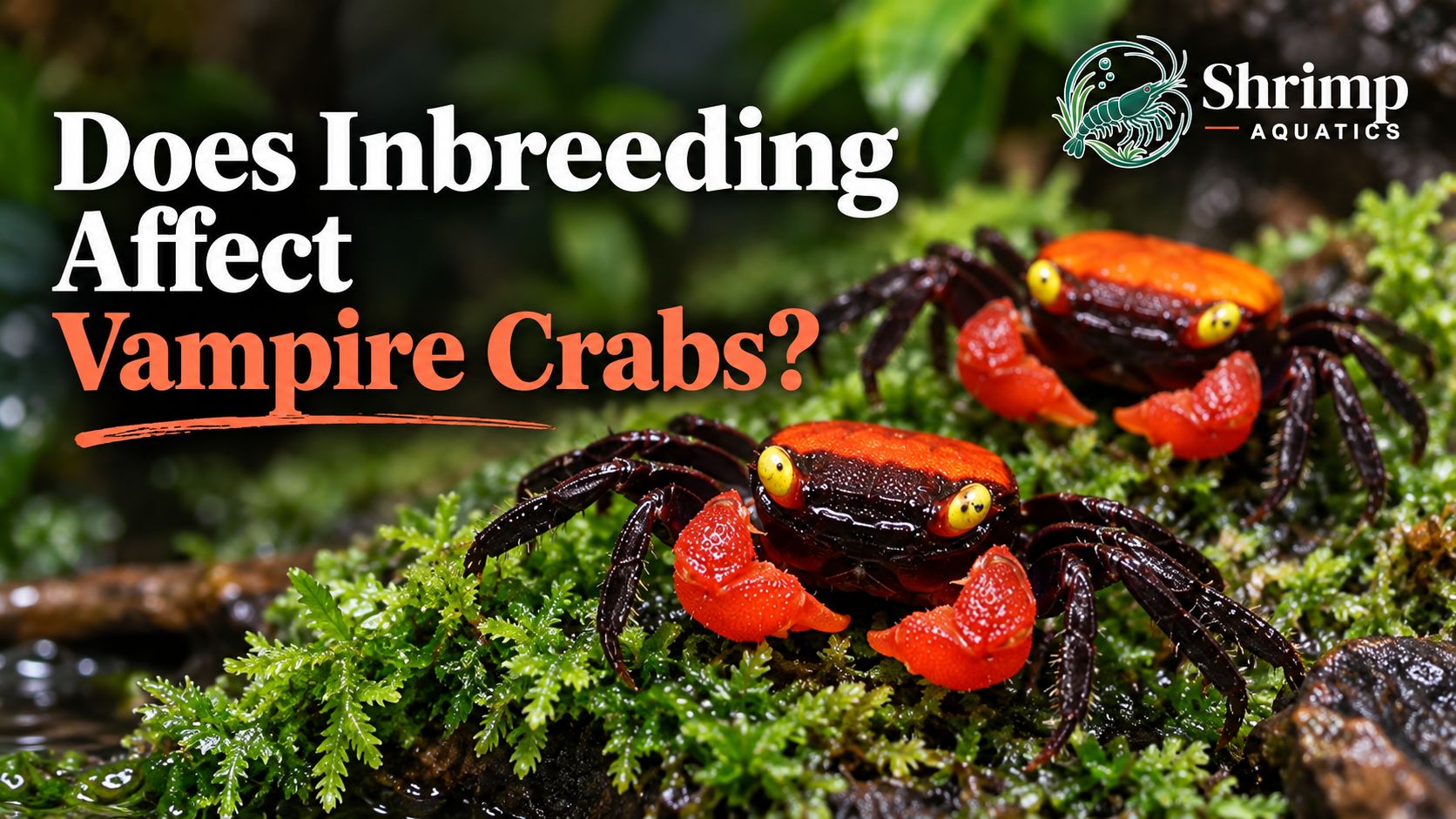
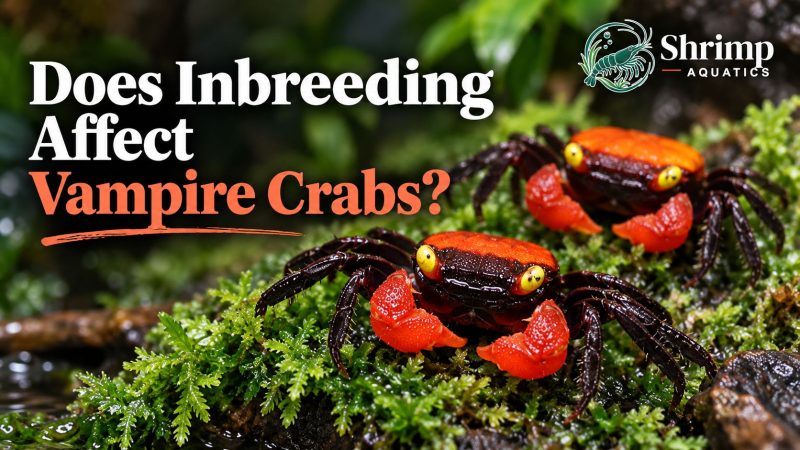
Yes, inbreeding can affect vampire crabs, though it creeps in over generations and doesn’t wreck a colony overnight. No study has measured it in vampire crabs themselves, but in a small freshwater shrimp a single generation of brother-sister mating already meant fewer young hatched.1 If your colony started from a few crabs and has never had an unrelated one added, it’s worth refreshing now and then.
What does inbreeding do to a vampire crab colony?
In a vampire crab colony, inbreeding would most likely cost you young: fewer crablets making it, and weaker growers among the ones that do. Biologists call this inbreeding depression, the lower survival and fertility of young from related parents, and it’s caused mostly by harmful recessive mutations.2
The closest test comes from the cherry shrimp (Neocaridina davidi), a small freshwater crustacean. Females paired with their brothers for one generation carried as many eggs as females paired with unrelated males. Fewer of their young hatched, though, and the inbred young grew more slowly when food ran short.1 When food was plentiful, those young grew normally. We think that’s one reason inbreeding is so easy to miss in a well-fed tank.
How fast does inbreeding build up in a closed vampire crab colony?
It builds with every generation that no unrelated crab joins, and vampire crabs turn over generations quickly. They live about two years at most, a figure taken from experienced keepers’ species profiles, not from crabs aged in a study.3 A colony you’ve kept for a few years has likely outlived the crabs you bought.
One keeper reported a tank started from wild-caught crabs in early 2006 that held its sixth or seventh tank-bred generation by August 2010. The post doesn’t say whether new crabs were added along the way, so it tells you how fast generations stack up, not that a closed colony stays healthy.
The cost rises with each step. A swimming crab raised in aquaculture (Portunus trituberculatus) shows it clearly. At 120 days, young from full-sibling families weighed 7.6 percent less than unrelated controls at the mildest level tested. At the heaviest level they weighed nearly 22 percent less, and the gap widened as the crabs aged.4 We’d expect a closed vampire crab colony started from one pair to drift the same way. It’s slow enough that you won’t see it from one clutch to the next.
Can you tell an inbred vampire crab by looking at it?
No, you can’t, because inbreeding shows up across a whole colony as fewer young and slower growth, not as a mark on one crab. Those are also the signs of a tank that’s too dry, a crowded group or adults catching the crablets. Every one of those is quicker to check and fix.
Adult vampire crabs eat crablets they catch, so a colony that never seems to grow may simply be feeding its young to the adults. Moving the crablets out is a normal step in vampire crab breeding. If your vampire crabs are dying one after another, work through the enclosure checks before you blame their genes. A closed lid, damp air and water a crab can climb fully into are the vampire crab care basics to rule out first.
How to keep inbreeding out of your vampire crab colony
Start any new colony with crabs from more than one batch. After that, add an unrelated crab of the same line now and then, especially if you began with a single pair. Bringing in unrelated animals of the same species is the standard fix for an inbred population. Across 156 such crosses in wild animals and plants judged unlikely to go wrong, it helped in 92.9 percent of cases, and invertebrates gained as much as vertebrates.5
Is any new crab good enough? No. The risk of a bad cross rises when the parents belong to different species or come from different environments.6 With vampire crabs you often can’t tell what you’re buying. The scientists who describe them estimate that dozens of Indonesian species in the trade are still undescribed, and few of the collecting places dealers give can be confirmed.7 Never add a crab of another color or line to freshen a colony. Keep each line in its own tank when you plan which vampire crabs live together.
If you’re buying to refresh a colony, ask the seller where their crabs came from, stick to the same line and pick the sex your group is short of. Everything in our catalog is bred or propagated in our own tanks rather than collected from the wild. Our tank-bred vampire crabs are sold as males or females, so you choose the sex on the product page.
References
7 Sources
- Brothers are better than nothing: first report of incestuous mating and inbreeding depression in a freshwater decapod crustacean (abstract), Tropea C, Marciano A, López Greco LS, Zoology 151: 125990, 2022.
- The genetics of inbreeding depression (abstract), Charlesworth D, Willis JH, Nature Reviews Genetics 10: 783-796, 2009.
- A compilation of longevity data in decapod crustaceans, Vogt G, Nauplius 27: e2019011, 2019.
- Effect of inbreeding on growth and genetic diversity of Portunus trituberculatus based on the full-sibling inbreeding families (abstract), Gao B, Liu P, Li J, Wang Q, Han Z, Aquaculture International 23: 1401-1410, 2015.
- Genetic rescue of small inbred populations: meta-analysis reveals large and consistent benefits of gene flow (abstract record, Macquarie University), Frankham R, Molecular Ecology 24: 2610-2618, 2015.
- Predicting the probability of outbreeding depression (abstract record, Macquarie University), Frankham R et al., Conservation Biology 25: 465-475, 2011.
- Two new species of vampire crabs (Crustacea: Decapoda: Brachyura: Sesarmidae: Geosesarma De Man, 1892) from Java, Indonesia, Ng PKL, Wowor D, Raffles Bulletin of Zoology 72: 469-478, 2024.
Ready to get started?
Shop our Vampire Crab collection
8 products available · Live Arrival Guarantee