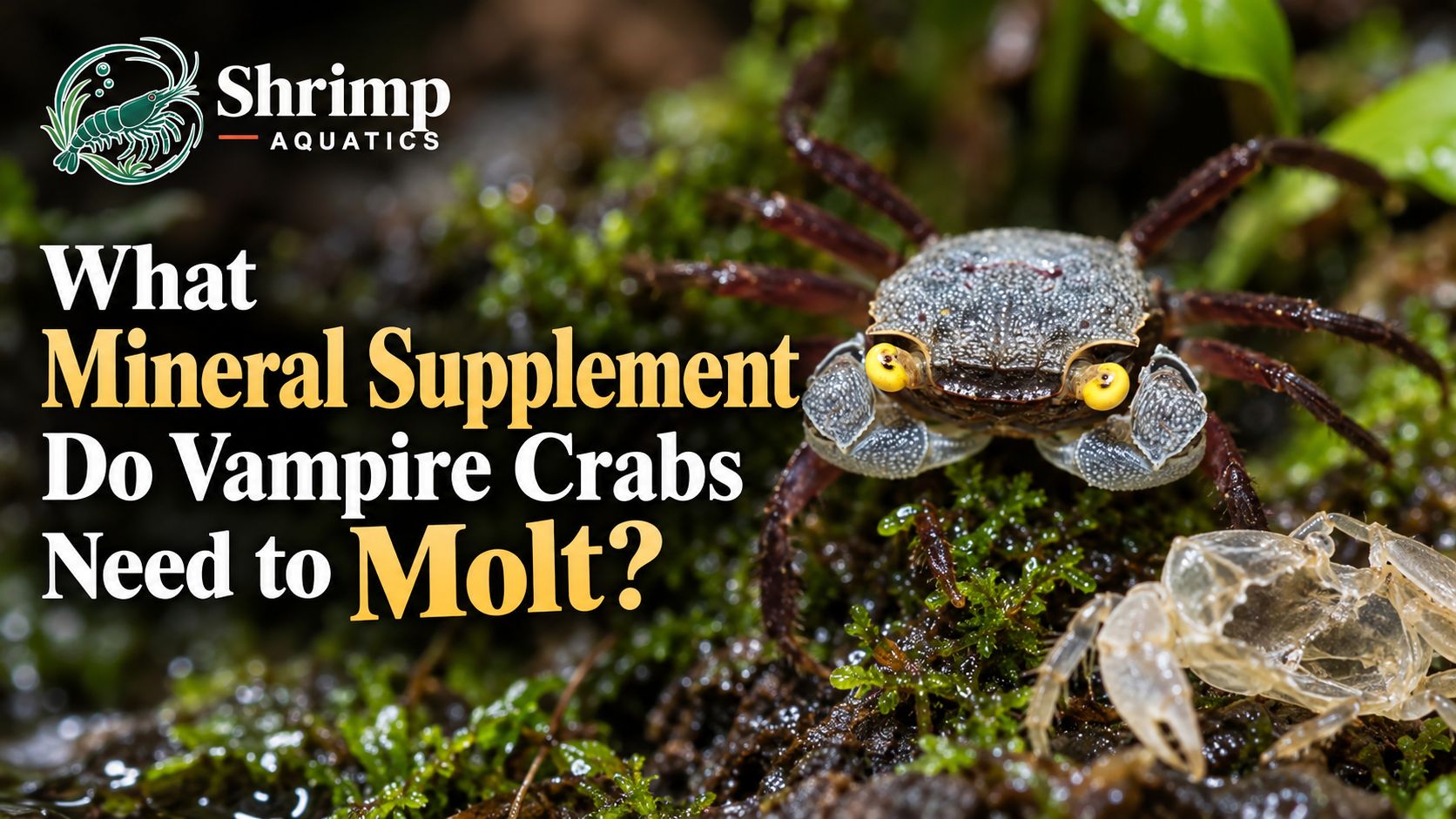

You don’t need a mineral supplement to help vampire crabs (Geosesarma) molt. Leave the shed shell in the tank so the crab can eat it, keep feeding a varied diet, and make sure every crab can reach clean water it can fully enter. If a molt goes wrong, look at humidity, warmth and water access before you look at calcium.
Where does a vampire crab get the minerals for a new shell?
Part of them comes back from its old shell: our crabs eat theirs after a molt, and the shell holds minerals the crab takes back. Across crustaceans, the ones that live in water take most of their calcium up through the gills, while the ones that live on land take it in with their food.1
No study has tested a calcium or mineral supplement in vampire crabs, so the cuttlebone and calcium powder often sold for molting have no measured benefit for them.
Leave the shed shell in the tank
A mineral source already in the tank is the shell your crab just climbed out of. Our crabs eat their old shell after a molt, so we leave it in the tank for them. In land crabs more broadly, a wider group than vampire crabs, eating the shed shell is how the animal takes much of its calcium back after a molt.1
Give it a few days. If the shell is still whole by then, nobody’s eating it, so lift it out before it fouls the water.
Keep feeding the usual varied mix around a molt
Feed the group the same way you would in any other week. At Shrimp Aquatics, we feed our vampire crabs vegetables, fruit and dried insect larvae, among other foods. Keep food and your hands away from a crab that’s down in the water molting, and feed the rest on the land side. Portions and timing from what vampire crabs eat stay the same around a molt.
Should you add cuttlebone or calcium powder to a vampire crab tank?
You can skip both for molting. We know the pull: a crab dies mid-molt, and a tub of calcium feels like doing something. Neither one has a measured benefit for these crabs, though, and in a small, humid tank each comes with a downside. If your vampire crab died suddenly, start with the tank checks, not the calcium.
Calcium powder dusted on food is the one to skip first. Whatever the crabs leave sits on damp moss and goes moldy, and leftovers should come out within a day anyway. Cuttlebone is the milder choice, but it’s an untested extra, not insurance against a failed molt.
If you’re setting up for new vampire crabs, you don’t need to buy anything extra for molting. Everything in our catalog is bred or propagated in our own tanks rather than collected from the wild.
Don’t harden the water section for the crabs
If shrimp share the water section, leave its hardness alone and keep it in the shrimp’s own range. Neocaridina shrimp, the easy first choice, are kept at 6-12 dGH. Bee and Crystal Caridina need 4-6 dGH, and their temperature range meets the crabs’ 72-85°F (22-29°C) only at 72°F (22°C). A remineralizer or mineral block added for the crabs raises hardness for everything in that water, and the crabs’ needs never justify pushing shrimp out of their range.
What to fix before blaming minerals for a failed vampire crab molt
Fix the setup first, because a molting crab depends on things a supplement can’t give it: damp air under a closed lid, steady warmth at about 78°F (26°C) inside 72-85°F (22-29°C), water every crab can get fully into and walk back out of, and nothing in the water that chases a crab while it’s soft. The step-by-step check, and how to tell a shed from a dead crab, are on vampire crab molting.
Work through those for the crabs you still have before the next one molts. They’re the same everyday conditions good vampire crab care asks of your tank.
References
1 Source
- Wheatly, Calcium Homeostasis in Crustacea: The Evolving Role of Branchial, Renal, Digestive and Hypodermal Epithelia (hosted copy on a University of Massachusetts lab page), Journal of Experimental Zoology 283: 620-640, 1999.
Ready to get started?
Shop our Vampire Crab collection
8 products available · Live Arrival Guarantee