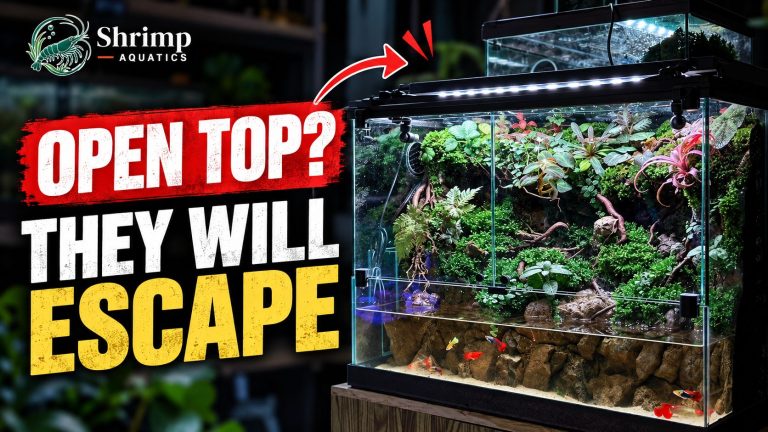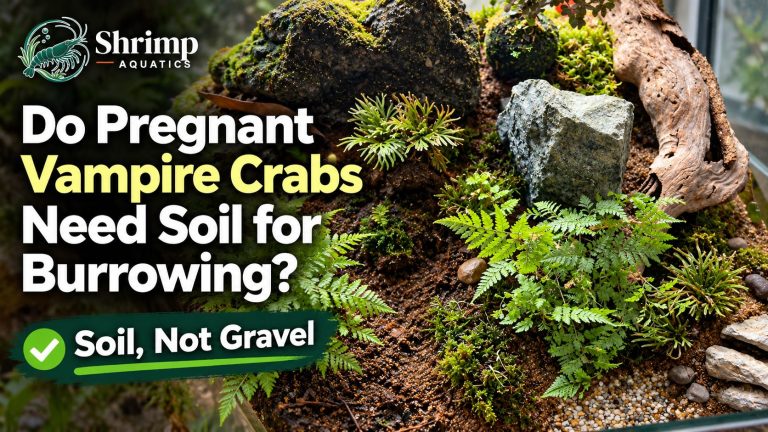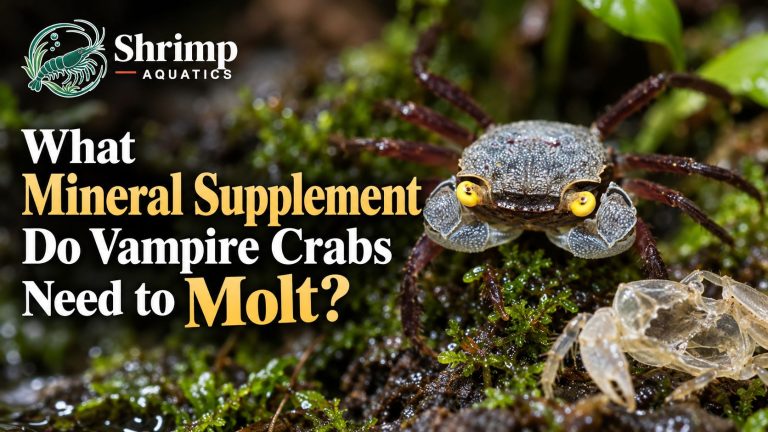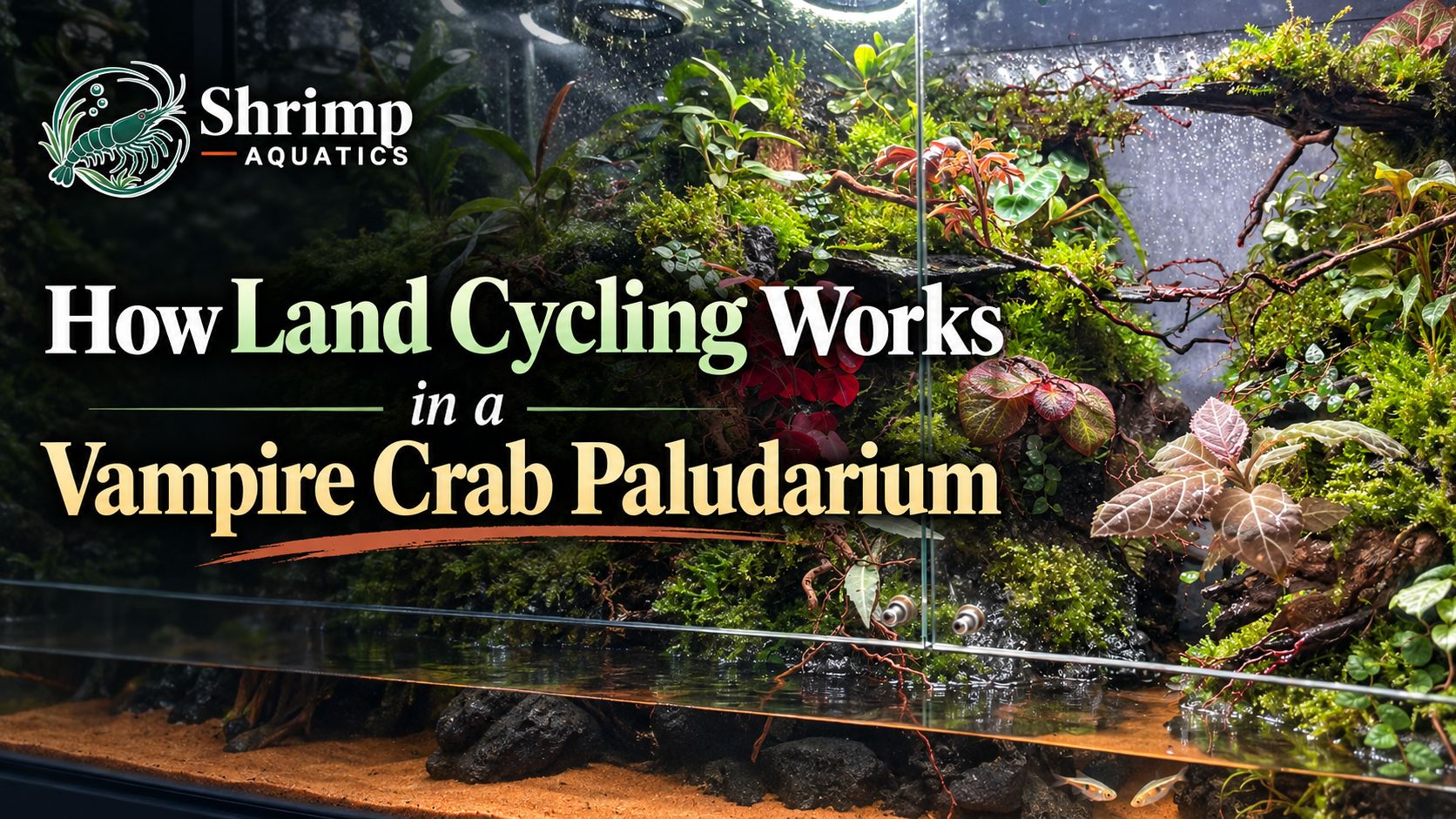

Land cycling in a vampire crab paludarium is really two jobs running on two clocks. The water section has to grow the bacteria that turn waste into nitrate, the same way an aquarium does. The land has to settle until its first wave of mold dies back and the soil life takes over. Plan on several weeks, and don’t add crabs until ammonia and nitrite both test zero and the land has stopped throwing up fresh mold.
You’ll often hear that the land doesn’t need cycling because nothing lives in standing water there. That’s half right. The land doesn’t host a filter colony, but it still has to mature. And the water section, small as it is, carries most of the risk.
How the water section cycles in a vampire crab paludarium
The water section cycles exactly the way an aquarium does, and it has to finish before the crabs go in. Waste, rotting food and decaying organic matter all release ammonia into the water.1 One group of bacteria turns that ammonia into nitrite, and a second group turns the nitrite into nitrate, which is much less toxic.1 Those bacteria live on surfaces: in a pond they colonize the top of the mud and the plants, and in a tank they need a filter or other material to grow on.1 In a paludarium, that’s the filter sponge, the sand or gravel, plant surfaces and any drainage layer the water runs through.
Why does any of this matter when the crabs live on land? Because they don’t stay there. In our paludariums, the crabs spend their time on land and climb down into the water from time to time to feed and to molt. So the water section has to be one a crab can climb into and fully enter. If that water still carries ammonia or nitrite, a molting crab sits in it at its weakest moment: for crustaceans living on land, the molt is an extremely vulnerable stage.2
Something has to feed the bacteria while they build up. In a new paludarium that’s usually decaying leaf litter, plant trimmings and a small pinch of food. On the test kit you’ll see ammonia first, then nitrite, then neither. Run the heater and lights at the settings you’ll keep for the crabs, about 78°F (26°C) within 72-85°F (22-29°C). The bacteria then grow under the conditions they’ll work in.
How long will it take? In fish systems, a new biofilter needs six to eight weeks to build up enough bacteria to keep ammonia and nitrite down.1 Treat that as the scale to expect. The test kit, not the date, tells you when it’s done.
What maturing means for the land side of a crab paludarium
The land section doesn’t cycle the way the water does; it matures. There’s no standing water for a filter colony to clean, so the work is done by the soil, the leaf litter and the small animals that eat whatever rots. What you’re waiting for is a substrate that drains, moss that has taken hold and an end to the first wave of mold.
Expect that mold. It’s common in closed vampire crab paludariums, above all in the first weeks of a new setup. It grows on damp wood, coconut shells, substrate, moss and soft plants wherever water sits and the air is still. Light mold on new wood often clears by itself within days. Mold that keeps coming back usually needs more airflow or less wetness, and mold spreading over living plants is best cut out along with the plants. The aim is to keep a vampire crab tank humid without leaving it wet.
Watch the soggy spots too. Soil that sits wet is where mold settles and moss dies back. Java moss tied to wood or stone that reaches the water’s edge does the opposite, growing on out of the water once it adjusts. If part of the land is still waterlogged days after misting, the drainage under it isn’t working, and that’s far easier to fix now than with crabs dug in. Getting the drainage right is part of the vampire crab tank setup, not a later repair.
Run the tank the way you’ll run it with crabs in, closed lid and regular misting included. The land should mature in the humid air it will live in. The lid, hides and humidity themselves are part of basic vampire crab care, and none of them should change on the day the crabs arrive.
Should springtails and isopods go in before the vampire crabs?
Yes. Add springtails and isopods while the paludarium is still settling, so they’re established before the crabs arrive. Springtails feed on fungi, fungal spores and damp decaying plant matter, returning nutrients to the soil,3 which is exactly the early mold and rot a new land section produces. Isopods, the pillbugs and sowbugs, feed mainly on decaying plant material and are important decomposers.4 That crew is the start of a bioactive enclosure for vampire crabs.
Both need the land to stay damp. Springtails live in large numbers in moist soil,3 so a land section that dries out between mistings thins the crew fast. If the tank is very clean, a scrap of leaf litter is all a new colony needs. In the wild, the vampire crabs described from Java feed at least partly on small insects,5 so don’t be surprised if crew numbers drop once yours are in. A spare culture lets you top them up. Small insects like these are part of what vampire crabs eat, so the crew is food as well as cleaners.
How to tell the paludarium is ready for vampire crabs
Your paludarium is ready when every one of these checks holds for a few days running, whatever the calendar says.
- Ammonia reads zero in the water section.
- Nitrite reads zero.
- Nitrate shows on the test, the sign the second group of bacteria is working.
- No fresh mold has spread for several days, apart from the odd patch on new wood.
- No part of the land stays soggy between mistings.
- Moss is green and growing, not browning.
- Springtails show up when you lift the leaf litter.
- A thermometer at crab level holds 72-85°F (22-29°C) day and night.
We know you want to order the moment it looks finished. Wait for a second clean test a few days after the first one; a cycle that’s still settling can read clean once and slip back.
When the checks hold, that’s the time to order. Our vampire crabs are tank-bred lines. Everything in our catalog is bred or propagated in our own tanks rather than collected from the wild.
What can undo the cycle in a stocked vampire crab paludarium
Rotting food and soil in the water can undo a cycle. Decaying uneaten feed and organic matter add ammonia.1 In a paludarium, that’s leftovers on the land that wash down and soil that slumps through the barrier into the water. Lift uneaten food before it molds, and if soil keeps clouding the water, fix the barrier first.
If ammonia shows up after the crabs are in, the standard first response in fish systems is to cut or stop feeding for a short time and change part of the water.1 Then test until it’s back to zero and look for the cause: a pile of leftovers, a dead animal in the substrate or soil in the water. Some treatments, especially antibiotics, can harm the bacteria in a biofilter, so test more often after using any treatment.1
References
5 Sources
- Francis-Floyd, Watson, Petty and Pouder, Ammonia in Aquatic Systems (FA16), UF/IFAS Extension, University of Florida, revised 2022.
- Marin and Tiunov, Terrestrial crustaceans (Arthropoda, Crustacea): taxonomic diversity, terrestrial adaptations, and ecological functions, ZooKeys 1169, 2023.
- Koehler, Aparicio and Pfiester, Springtails (ENY-228), UF/IFAS Extension, University of Florida.
- Pillbugs and Sowbugs, UC Statewide Integrated Pest Management Program, University of California.
- Ng, Schubart and Lukhaup, New species of “vampire crabs” (Geosesarma De Man, 1892) from central Java, Indonesia, Raffles Bulletin of Zoology 63, 2015.
Ready to get started?
Shop our Vampire Crab collection
8 products available · Live Arrival Guarantee