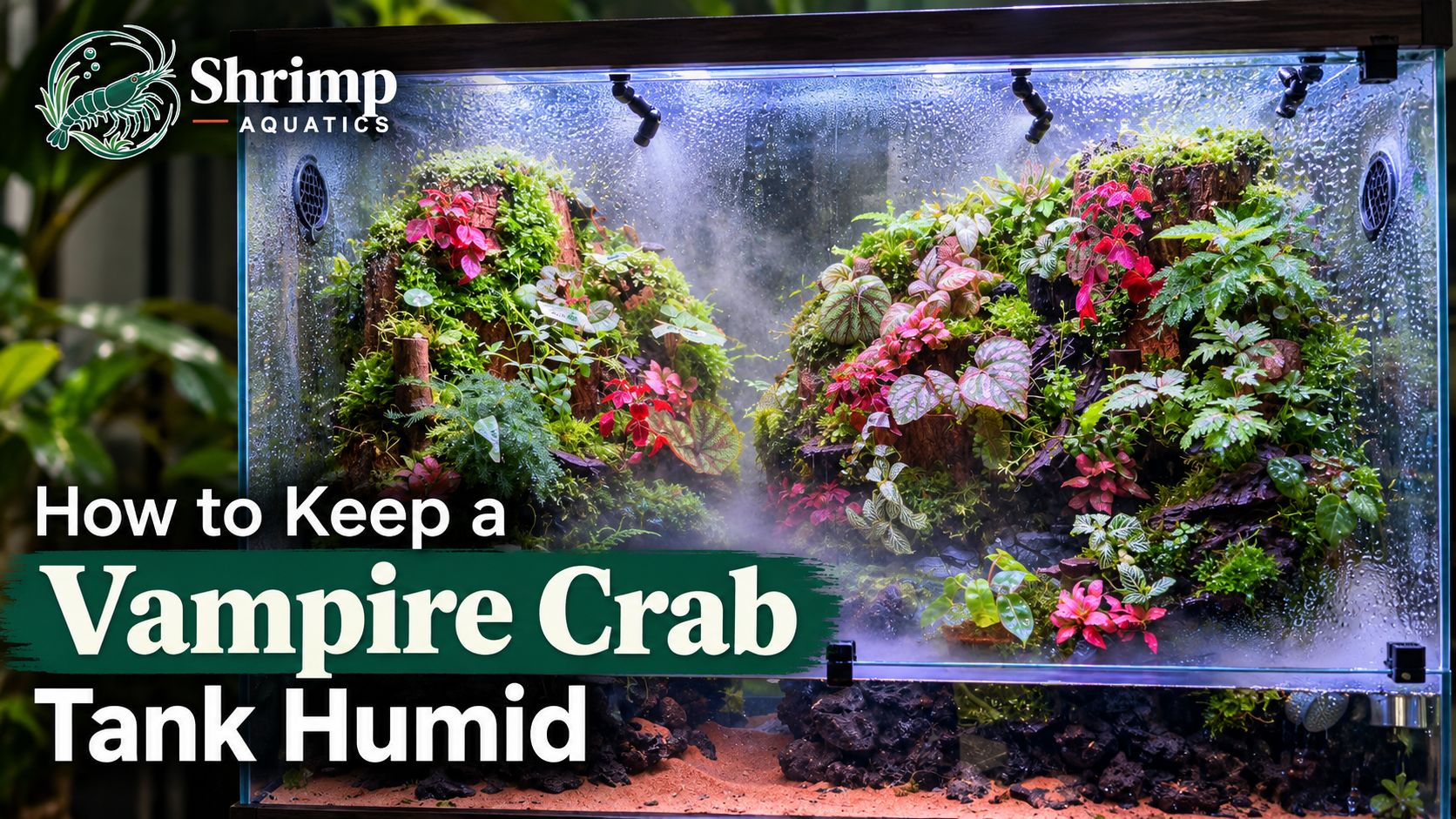
Keep a vampire crab tank humid by closing the lid, keeping the moss and land substrate damp, and misting about once a day, more often while new moss is settling in. You don’t need to hit a set number. What you need is moss that stays green and substrate that stays moist from one misting to the next, with just enough air moving that mold doesn’t take over.
What humidity do vampire crabs actually need?
High and steady: damp enough that the moss and the top of the substrate never dry out between mistings. That’s the target to run your tank by, and you can check it with your fingers and your eyes.
No study has set a humidity range for vampire crabs, so treat any percentage you see as a rough guide. If you own a hygrometer, one keeper reports running their tank at 75 percent or higher. Hang the gauge at crab level, not up by the lid, and watch whether the reading holds steady from day to day, because a steady reading tells you more than the exact number does.
Why dry air is hard on a vampire crab
A vampire crab breathes air with gills, and those gills need water to work. Vampire crabs are sesarmid crabs, a family whose members keep water in their gill chambers and recirculate it so they can breathe out of the water.1
In land crabs generally, most water is lost through the shell and the gills, and a crab that dries out takes in less oxygen because its gill surfaces collapse.2 So the land needs to stay damp, not only the pool.
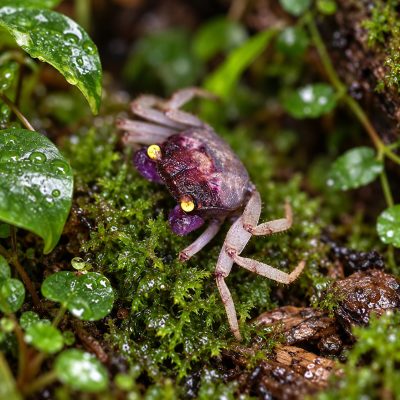
In the wild, adult Geosesarma hagen, one of the two vampire crab species described from central Java, mostly live on moist banks, and the young are often in the water or right beside it.3
Hold moisture in a vampire crab tank before you reach for the mister
Most of the work is done by things that hold water in the tank around the clock: a lid that stays shut, a good layer of moss and a land substrate kept damp. Get those right and misting only tops them up.
Start with the lid. Keep it closed except while you’re working in the tank, and make shutting it the last thing you do every time. A corner left up after misting lets out the damp air you just added. Gaps around cords and tubing leak damp air as well as crabs, so close them as part of your vampire crab tank setup before any crab goes in.
Moss is your reservoir. Java moss grows on out of the water once it has adjusted, and it does best where it stays wet: tied to wood or stone that reaches down into the water, or along the water’s edge, from where it creeps up onto the land. Moss bought or grown under water looks rough for a while as it switches to growing in air, so don’t judge it in its first weeks. Moss also gives the crabs cover, one reason vampire crabs need vegetation on the land.
Keep the land substrate damp, not soggy. Press it with a finger: it should feel like a wrung-out sponge, with no water pooling where you pushed. When you mist, spray the substrate as well as the moss, so the layer your crabs dig into stays moist too.
How often should you mist a vampire crab tank?
About once a day in a closed tank, more often while new moss and plants are settling in and less once they’ve adapted. Some keepers end up misting only every few days once the planting is established. Let the moss set how often you mist a vampire crab paludarium as the planting settles.
Let the moss and the substrate decide, not the calendar. Spray when the moss tips or the top of the substrate start to look dry, and use dechlorinated water, the same water you’d put in the water section. Mist the moss and the land, and aim away from the crabs.
Would you rather not do it by hand? Several keepers hand the job to a mister, a rain system or a fogger on a timer, and still check the moss by eye. Keep looking even with a timer, because a reservoir that runs dry or a nozzle that clogs stops the misting without telling you.
Read the moss to tell when a vampire crab tank is drying out
Moss that turns brown, crisp or pale is the easiest sign that a vampire crab tank is drying out. Check where the browning starts, because that tells you why.
Moss right under a strong light often dries out even with regular misting. Move that moss, raise or dim the light, or mist that patch more. Moss in a dark back corner can struggle for the opposite reason, too little light. Plenty of keepers run a moderate light for their plants or dim it down, and their crabs still come out under it.
If the moss dries between mistings, close more of the lid before you reach for the spray bottle more often. More water treats the symptom; a better seal fixes it.
Watch the crabs as well. One field study of wild vampire crabs in Java describes a crab that’s drying out releasing fluid that shows as foam or bubbles, often at the mouth.4 If you see that, check the moss, the substrate and the water access the same day, and if crabs are also going still or dying, work through why your vampire crabs are dying sign by sign.
Keep a humid vampire crab tank from turning moldy
Give the tank a little moving air and lift leftover food, because mold grows where water sits and the air is still. Can a vampire crab tank be too wet? Yes: when water sits in the substrate and the air never moves, mold follows.
Some mold is normal, above all in the first weeks of a new setup, on damp wood, coconut shells, substrate, moss and soft plants. Light mold on new wood often clears by itself within a few days. If it keeps coming back, the tank needs more airflow. Add a little ventilation that’s still crab-proof, such as a fine mesh strip in the lid sized so your smallest crab can’t get through, and mist a bit less until it settles.
Remove mold you can reach, and replace any substrate that’s gone moldy through. Springtails and isopods help keep it down. Mold that spreads across living plants is the exception: cut those plants out. Keepers haven’t linked mold to crab deaths, but a tank that keeps growing it is telling you it’s too wet and too still.
Have the tank holding moisture before your vampire crabs arrive
Get the tank holding its moisture on its own before you order: the moss stays damp from one misting to the next and the substrate feels moist when you press it. If you’re still chasing dry patches every few hours, wait. Humidity is one part of everyday vampire crab care, alongside temperature, the water section and the lid.
When it’s ready, pick from our tank-bred vampire crabs. Everything in our catalog is bred or propagated in our own tanks rather than collected from the wild. You choose Male or Female for each crab on the product page, and when the box arrives, follow the instructions supplied with your order.
Confirming your own import rules is part of ordering. We cannot tell you that live freshwater invertebrates are legal to import where you live.
References
4 Sources
- Bacci and others, Species-specific gill’s microbiome of eight crab species with different breathing adaptations, Scientific Reports 13: 21033, 2023.
- Lucu and Turner, Ionic regulatory strategies of crabs: the transition from water to land, Frontiers in Physiology 15: 1399194, 2024.
- Ng, Schubart and Lukhaup, New species of “vampire crabs” (Geosesarma De Man, 1892) from central Java, Indonesia, and the identity of Sesarma (Geosesarma) nodulifera De Man, 1892 (Zenodo archive copy of the paper), Raffles Bulletin of Zoology 63: 3-13, 2015.
- Kurniawan, Waluyo, Nofreeana and Aji, Habitat and Food of Vampire Crabs (Geosesarma sp.) in Menoreh Mountain, Yogyakarta, Indonesia, Media Konservasi 30(1): 141-153, 2025.
Ready to get started?
Shop our Vampire Crab collection
8 products available · Live Arrival Guarantee