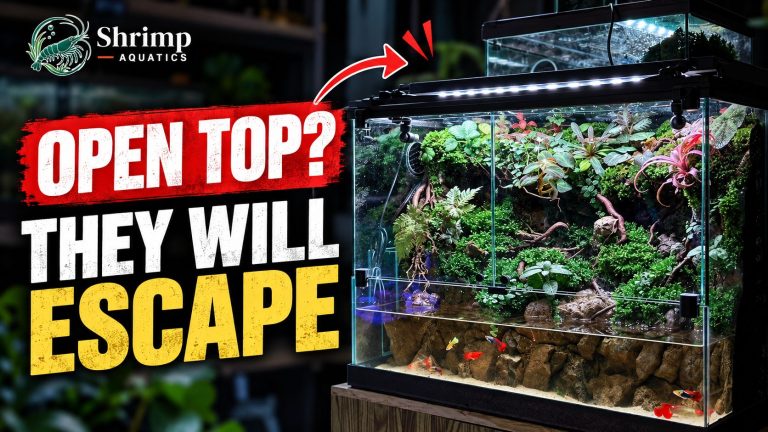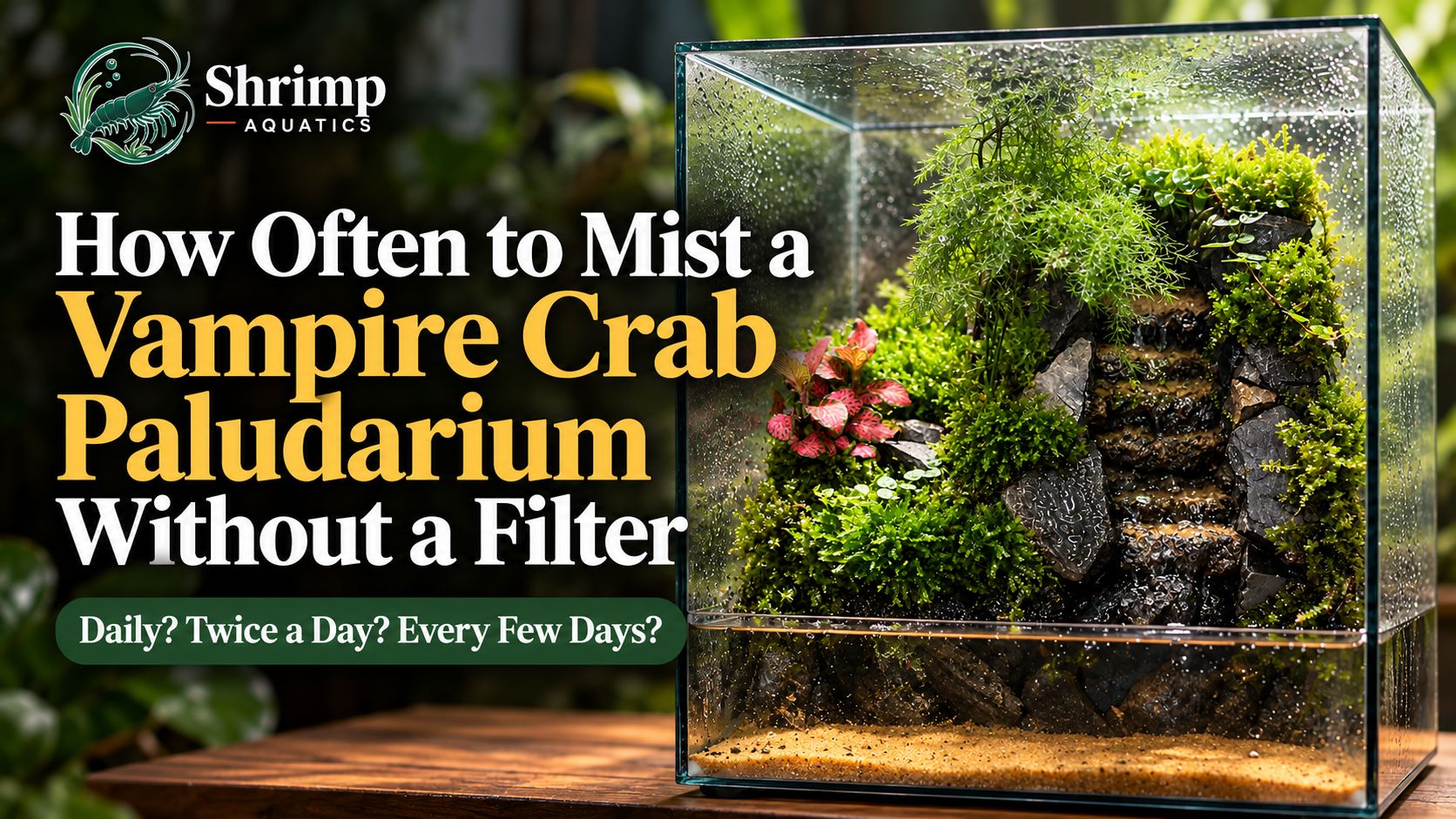
Mist a closed vampire crab paludarium about once a day, more often while new moss and plants settle in and less once they’ve adapted. In practice that runs from twice a day to every few days. Let the moss set the pace: spray when it or the top of the substrate starts to look dry. With no filter, there’s no pump or waterfall wetting the moss for you, so misting carries that job alone. The pool still needs its own topping up and partial water changes.
Without a filter, what does misting do in a vampire crab paludarium?
It keeps the land, the moss and the air damp. In a tank with no filter, it’s the only thing doing that job. Moss does best where it stays wet: at the water’s edge, tied to wood that reaches into the pool, or with water running through it from a pump or waterfall. Where it dries out, it browns and dies back. Take the pump away and every patch of moss above the waterline depends on your spray bottle.
What misting won’t do is look after the pool, because it doesn’t carry waste out of the water. Without a filter, keep the pool small. Top it up as it evaporates and change part of it regularly with dechlorinated water. Small and often is the safe default. Every crab should still be able to climb in, get fully under and climb back out, the same rule as in any vampire crab tank setup.
Read the moss to know when a vampire crab paludarium needs misting
Spray when the moss or the top of the substrate starts to look dry, not on a fixed clock. For a closed tank that usually works out at about once a day. Expect to mist more while new moss and plants are settling in and less once they’ve adapted, sometimes only every few days. Press the moss with a fingertip now and then: it should feel damp, not dripping. The moss and other plants for a vampire crab paludarium set this pace, so expect the routine to shift as they grow in.
Hang a hygrometer at crab level so you see the air the crabs actually live in. Read it at the same time each day for a week or so. Is the reading sliding down between sprays? Then mist more often or close more of the lid. Would you rather not spray by hand? A timer-run mister, rain system or humidifier can take over. Keep glancing at the moss after you switch. Whichever method you pick, the hygrometer shows whether it keeps the vampire crab tank humid.
Why a dry paludarium is hard on vampire crabs
Dry air is the common failure in a vampire crab tank, and it’s easier to prevent than to fix. Vampire crabs belong to a crab family whose semi-terrestrial members breathe air by holding water in their gill chambers and recirculating it.1 In land crabs generally, a crab that dries out takes in less oxygen because its gills collapse.2 Keeping the tank damp is about more than the plants. If crabs keep dying one after another, damp moss and substrate are among the first checks for why vampire crabs are dying.
Mist a vampire crab tank less when mold or soggy moss shows up
Cut back when water starts to sit. Mold is common in a closed vampire crab paludarium, above all in the first weeks of a new setup. It grows on damp wood, coconut shells, substrate, moss and soft plants where water sits and the air is still. Moss that stays waterlogged dies back too, just as moss that dries out does.
When you see either, lift off the mold or the affected substrate and mist a little less. Give the tank a bit more air, for example by opening a vent slightly, while keeping every gap too small for a crab. Springtails and isopods on the land help keep mold down. Light mold on new wood often clears by itself within days; mold that keeps coming back usually needs better airflow. Then go back to reading the moss. The right routine is the one that keeps it damp without leaving puddles on the land.
Choosing tank-bred vampire crabs for a paludarium that stays damp
Order once the paludarium has held damp moss and steady hygrometer readings on your misting routine for a while. Keep the rest of their vampire crab care in step too. That means about 78°F (26°C), within 72-85°F (22-29°C), and water every crab can fully enter. Everything in our catalog is bred or propagated in our own tanks rather than collected from the wild. You choose Male or Female for each crab on the product page when you buy our vampire crabs. We don’t promise breeding or the number of young from any order.
References
2 Sources
- Species-specific gill’s microbiome of eight crab species with different breathing adaptations, Scientific Reports 13: 21033, 2023.
- Lucu and Turner, Ionic regulatory strategies of crabs: the transition from water to land, Frontiers in Physiology 15: 1399194, 2024.
Ready to get started?
Shop our Vampire Crab collection
8 products available · Live Arrival Guarantee