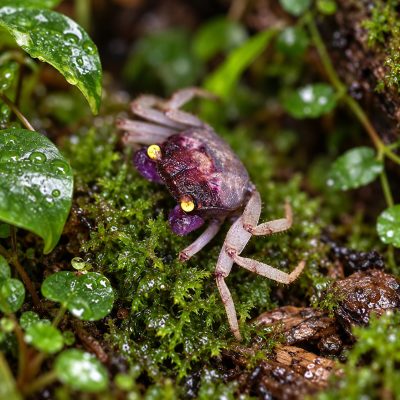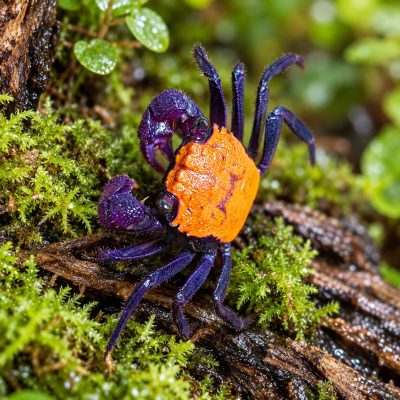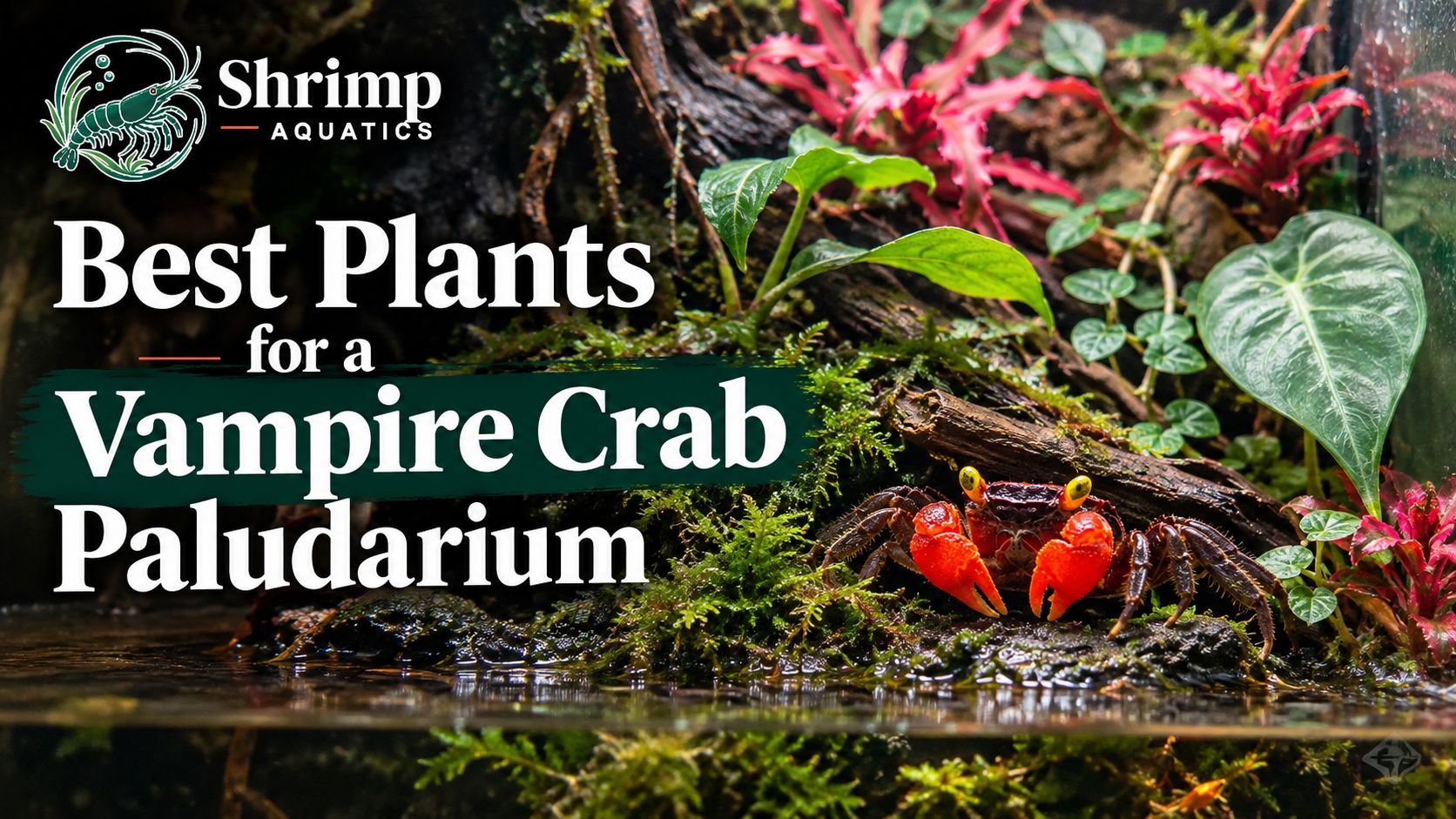
Your vampire crab paludarium has its land, its water and its lid, and right now it looks like a box of wet soil. Start the planting with Java moss, Anubias nana, Java fern and pothos: we grow all four in our vampire crab (Geosesarma) paludariums, and our crabs don’t eat them. For anything else, pick plants that cope with humid air and damp soil, grow in low light and need no fertilizer. Then leave the water section open enough for every crab to climb in and out.
What Java moss, Anubias, Java fern and pothos do in a vampire crab tank
Each of these four plants does a different job in a vampire crab tank: a damp floor, plants that stay put when crabs dig, and cover higher up. Here’s how keepers usually use each one.
Java moss for a damp, covered land surface
Moss is the usual cover for the land in a crab paludarium. Mist it and the mat keeps the surface damp, and it gives a crab somewhere to hide. Java moss is the moss we grow with our crabs. It grows on out of the water once it’s adjusted, and it does best where it stays wet: tied to wood or stone that reaches down into the water, along the water’s edge, or with water running through it. From there it creeps up onto the land. Moss that was grown under water looks rough for a while as it switches over, so don’t judge it too soon.
Patches turning brown? Look at where they sit. Moss dries out right under a strong light, even with misting, rots back where it sits waterlogged, and thins out in dark corners. Move dry patches closer to the water or out from under the light, let soggy ones drain, and give shaded ones more light. While it recovers, mist more often and check that the lid still closes tight. If patches keep drying out anyway, work through what goes into keeping a vampire crab tank humid.
Anubias nana and Java fern, tied on instead of planted
Anubias nana and Java fern are usually tied to wood or rock with cotton thread or fishing line, or wedged into a crack. They don’t go into the soil at all, and the rhizome, the thick creeping stem the leaves grow from, should stay above the substrate, not buried in it. That suits a crab tank, because a crab digging in the substrate can’t uproot a plant that was never in it. You can also move a tied plant later without tearing up the land. One keeper reports Java fern covering the back of the water section, where the crabs mostly climb in and out of the water over it. A plant that doubles as a ladder is a good deal.
Pothos for taller cover on the land
Pothos is a trailing houseplant. Keepers usually let it climb a piece of wood or trail across the land, where its leaves add shade and cover above the moss. It can grow fast, too: one keeper reports that several pothos in a crab tank grew so well they soon needed cutting back. Trim it before it crowds the tank or shades the moss below, and lift yellowing or soft leaves before they rot on the damp land.
Do vampire crabs eat live plants?
Vampire crabs do little or no damage to the land plants in a paludarium, and ours don’t eat the Java moss, Anubias nana, Java fern or pothos we grow with them. Pothos and climbing fig grow on with vampire crabs.
So what does get eaten? Mostly nibbled moss tips and soft, dying or dead leaves, and in one keeper’s tank the leaves of Anubias nana. If the moss tips get grazed short, top the moss up now and then. Trim soft or dying leaves and lift fallen ones before they rot on the damp land, the same way you’d lift leftover food.
Adding a plant that isn’t one of our four? Crabs don’t treat every plant the same: one keeper reports crabs eating baby’s tears from the roots up, along with some ferns. Watch any new plant for its first few weeks and take it out if it’s being torn up.
Don’t count on the plants to feed your crabs, either. A planted tank still needs a proper diet, and what vampire crabs eat is worth sorting out before the crabs arrive.
Where should plants go in a vampire crab paludarium?
Pothos stays on the land of a vampire crab paludarium. Java moss, Anubias nana and Java fern are aquarium plants, so they can go in the water section as well as on the land.
Whatever you put in the water, leave it open enough for every crab to climb in, get fully under and climb back out. Tie plants to the sides, the wood or the rock, and keep a clear path from the land into the water. The slope or steps the crabs use are part of vampire crab tank setup, so plant around them, not on them.
Planning to add shrimp or small snails? Pick your vampire crab tank mates before you plant, because a clump of moss in the water gives them cover too.
How often should you mist a vampire crab paludarium?
Mist a closed vampire crab paludarium about once a day. Mist more often while new plants and moss are settling in, and less once they’ve adapted, when every few days can be enough. The easiest guide is the tank itself: spray when the moss or the top of the substrate starts to look dry.
Rather not do it by hand? A timer-run mister, rain system or humidifier can take over, and it keeps going while you’re away. One keeper left a rain system and a fog machine running on timers for three weeks while they were away. Misting works together with the lid, damp substrate and moss, which is what keeps a crab tank humid. If mold keeps coming back, spray a little less. Whether it’s you or a timer, let the moss decide how often you mist a vampire crab paludarium.
What light do plants in a vampire crab paludarium need?
Plants in a vampire crab paludarium grow under ordinary aquarium or terrarium lights, so you don’t need a special lamp. Fluorescent tubes, LED bars and LED spots all work, usually on a timer, and some crab tanks are lit by daylight from a window alone. Keep the light moderate, or dim it, so the crabs still come out. Then check the corners. Where part of the tank gets too little light, because the light is shorter than the tank or a bulb has burned out, plants and moss there grow poorly. Plants in the water section may need more than the land does. One keeper reports that a single warm-white tube kept the land plants going while most of the water plants died. Before you add a special lamp for the crabs, check whether vampire crabs need UV light at all.
What should you do about mold in a vampire crab paludarium?
Remove mold from a vampire crab paludarium by hand, get more air moving and add springtails or isopods. Mold is common, above all in the first weeks of a new setup. It grows on damp wood, coconut shells, substrate, moss and soft plants, wherever water sits and the air is still. Light mold on new wood often goes away by itself within a few days. If it doesn’t, lift it out or replace that patch of substrate, and lift leftover food before it can start more. Mold that keeps coming back needs better airflow and a little less wetness. Mold that spreads over living plants is a different matter: cut those plants out along with it.
How do you choose other plants for a vampire crab tank?
Choose plants for a vampire crab tank that cope with humid air and damp soil, grow in low light, need no fertilizer and stay small. The tank stays closed and humid all the time, because that’s what vampire crab care asks for, so a plant that wants dry spells or bright light won’t fit. Seen a plant you like in someone else’s crab tank? Run it through these checks first.
- It copes with humid air and damp soil, day after day.
- It grows in low light, so a modest light over the tank is enough.
- It needs no fertilizer or root tabs, so nothing gets dosed into water the crabs climb into.
- It stays small or grows slowly, so you rarely have to open the lid to prune.
- It can be tied to wood or rock, or it’s a moss, so a digging crab can’t uproot it.
Add one new plant at a time and watch both the plant and your crabs for a few weeks before you add the next. No one has tested which houseplants are safe for vampire crabs, so a “pet-safe” label on a pot doesn’t settle it.
Should you use live or fake plants with vampire crabs?
Use live plants with vampire crabs where you can, with live moss over much of the land. A misted moss mat keeps the land surface damp, and the four plants above are the ones we grow with our crabs.
Tempted to go all fake so there’s nothing to keep alive? Fake plants still add cover, and they never need light or trimming. What they can’t do is grow into a damp mat over the land. If you like them, use them as extra hiding places alongside live moss, not in place of it, and rinse them when you clean the tank. Either way, vampire crabs need vegetation or other cover to hide in.
Order vampire crabs once the plants are in
Order your vampire crabs once the plants are in, so you aren’t tying plants and moving moss around crabs later. Tank-bred vampire crabs from Shrimp Aquatics come in several lines, and you choose Male or Female for each crab on the product page. Everything in our catalog is bred or propagated in our own tanks rather than collected from the wild.
Ready to get started?
Shop our Vampire Crab collection
8 products available · Live Arrival Guarantee