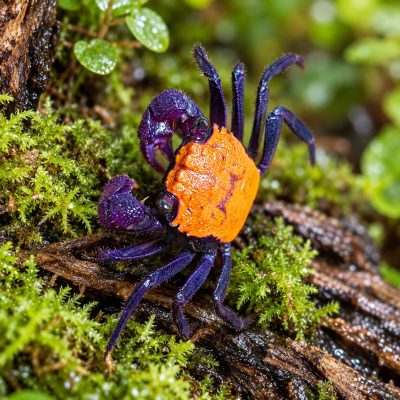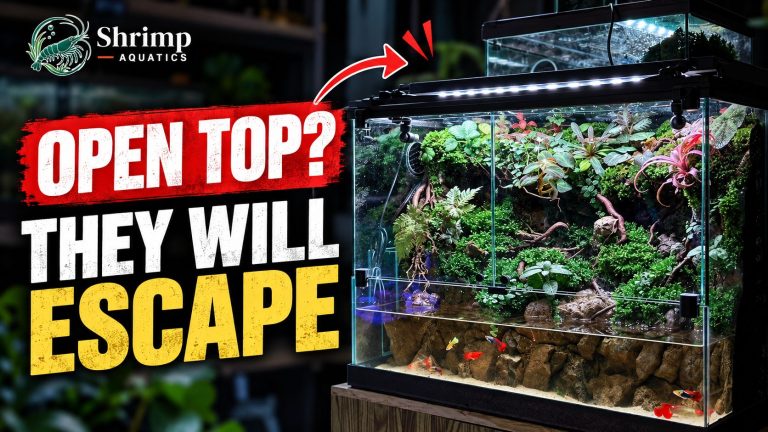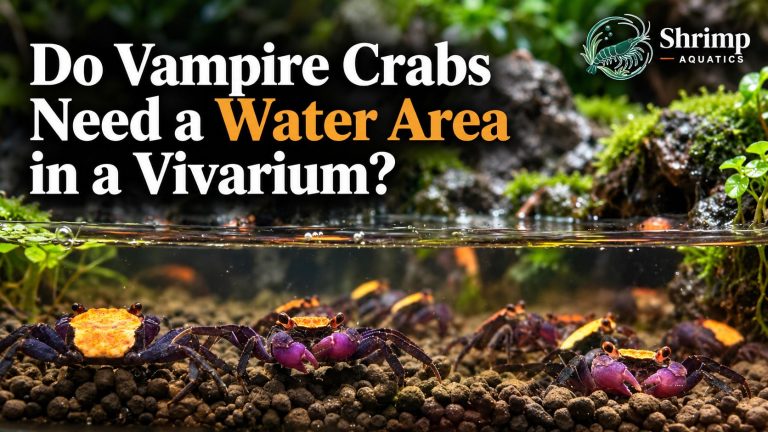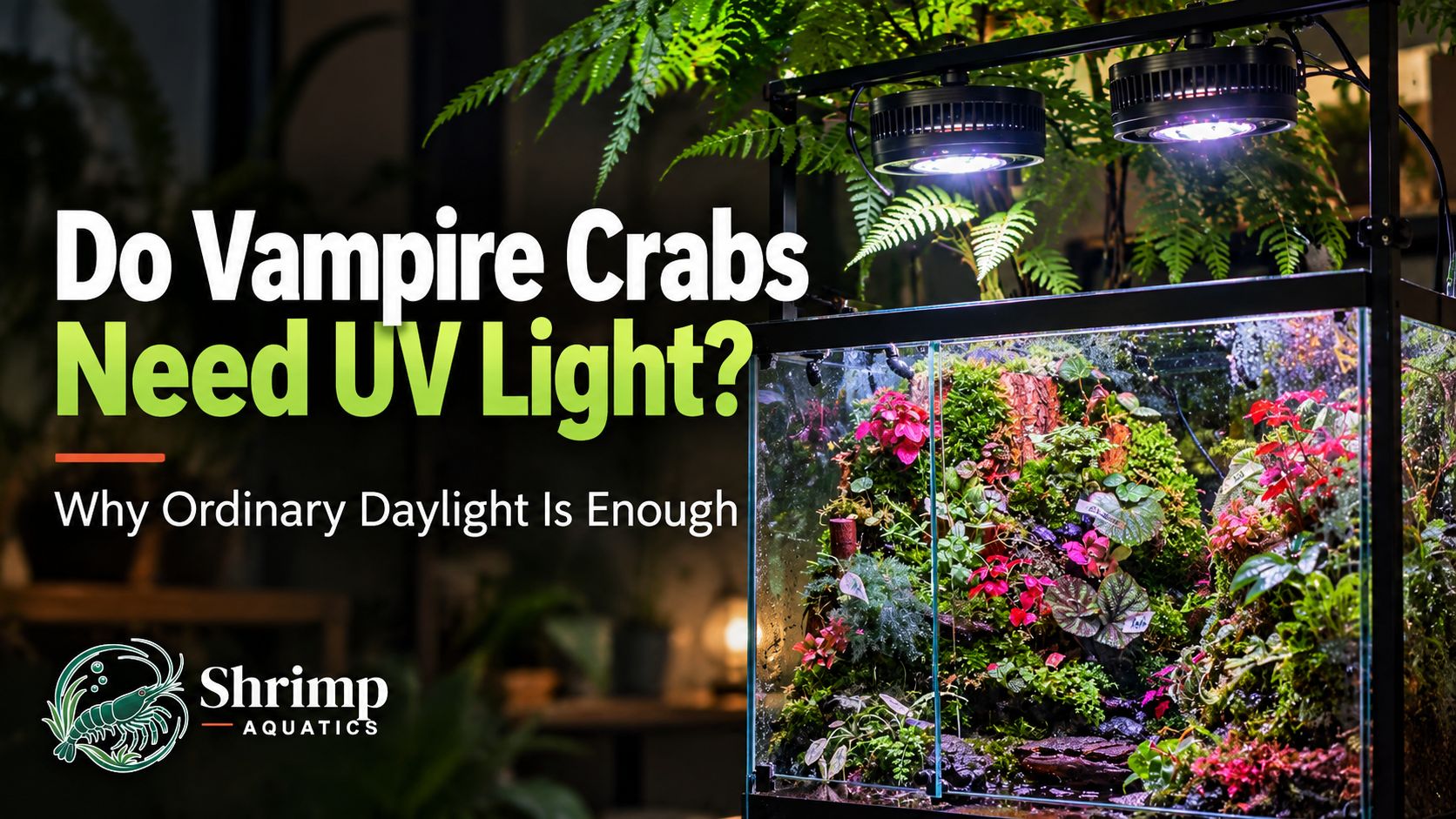
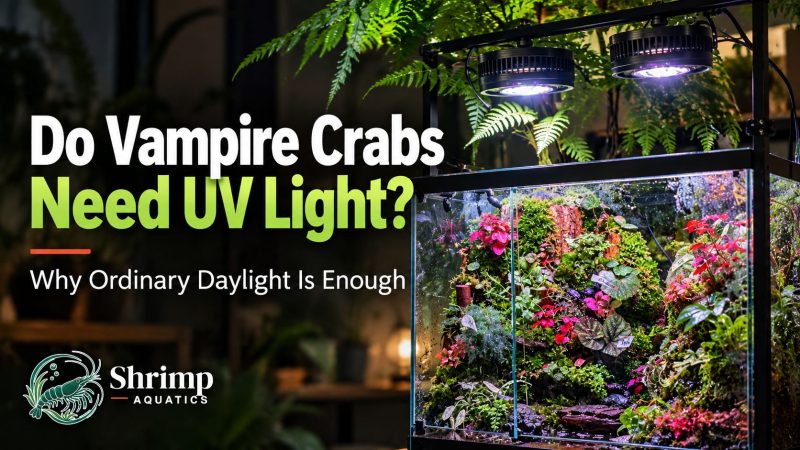
No, vampire crabs don’t need UV or UVB lighting. Ordinary aquarium light, or indirect daylight from a window, is enough when it gives the paludarium a steady day and night and keeps the plants growing. What the crabs do depend on is warmth, damp air and water they can climb into.
Why a UV lamp does little for a crab that hides all day
A vampire crab spends most of the day out of sight, so a UV lamp has very little to work on. Keepers see their crabs mostly in the evening, at night and in the early morning. By day most of them sit in burrows, under bark or among dense plants. Some crabs do show themselves in daylight, which is why “mostly nocturnal” fits better than “only at night.” If you want to see them, look in the evening, when these mostly nocturnal vampire crabs come out.
Is there any sign these crabs need UV the way some reptiles do? Not that we can find. No published study has looked at lighting for vampire crabs, and keepers keep them under ordinary aquarium lights, LED bars or daylight from a window. None of them reports needing a special light for the crabs. The parts of vampire crab care they do depend on are warmth, damp air and water they can climb into.
Some care sheets suggest a UV tube just in case. There’s no need to buy one. If one is already fitted, treat it like any other lamp: watch the thermometer and check that the substrate under it stays damp.
Is window daylight enough for vampire crabs and their plants?
Yes, indirect daylight is enough for the crabs, and it can grow the plants too. Some keepers grow their paludarium plants on daylight from a nearby window with no lamp at all. Others add a small light over the lid to help moss get established.
The catch with a window is heat. Keep the tank out of direct sun. Vampire crabs are kept at about 78°F (26°C), within roughly 72-85°F (22-29°C), so check the thermometer at the warmest time of day, not just in the morning. Damp air matters as much as warmth, and a sunny spot dries the land section quickly.
Your plants are the best test of whether the light is enough. Where part of the tank stays dim, plants and moss grow poorly, so watch the back corners. If moss browns right under a strong lamp, check whether it’s drying out there. Pick the plants for a vampire crab paludarium first, then match the light to them.
Will vampire crabs molt and keep their color without UV light?
Yes. Molting and color both depend on things a UV lamp doesn’t supply: water the crab can get into, and food.
Molting depends on the water section
You’ll find the odd keeper who thinks UV helps a crab molt. What a molting crab really needs is water. In our paludariums, vampire crabs go into the water to molt, so the water section has to be one a crab can climb into and fully enter. Put your effort there, and give them damp hides on land as well.
Shell color comes from food, and light changes how it looks
Crabs can’t make the red and orange pigment astaxanthin themselves. They get it from their food, and in a feeding trial on a marine swimming crab, more astaxanthin in the diet made the shell redder.1 That’s a marine crab fed a pigment supplement, not a vampire crab, so it shows only that diet can change shell color. A white or tinted aquarium light can make the same crab look different, so judge its color under the same light each time.
How to light a vampire crab paludarium without UV
Choose the light for the plants, keep it moderate and put it on a timer. That covers everything the crabs need from it.
- Use an ordinary aquarium or terrarium LED, or a fluorescent tube, suited to the plants you grow.
- Run it on a timer so the tank gets the same day and night every day.
- Keep it moderate. Several keepers dim their lights so the crabs still come out.
- Check that the lamp doesn’t push the tank past 85°F (29°C) or dry out the land section.
- Skip the night light. If you want to watch the crabs after dark, a dim light for a few minutes is plenty.
Once the paludarium holds steady under its light, it’s ready for crabs. Our tank-bred vampire crab lines come from our own paludariums. Everything in our catalog is bred or propagated in our own tanks rather than collected from the wild. You choose Male or Female on each product page, and we don’t promise breeding or the number of young from any order.
References
1 Source
- Dietary Astaxanthin Can Promote the Growth and Motivate Lipid Metabolism by Improving Antioxidant Properties for Swimming Crab, Portunus trituberculatus, Antioxidants 13(5): 522 (MDPI), 2024.
Ready to get started?
Shop our Vampire Crab collection
8 products available · Live Arrival Guarantee